Type 2 Diabetes
AMPK ↑ · GLUT ↑ · glucose ↓
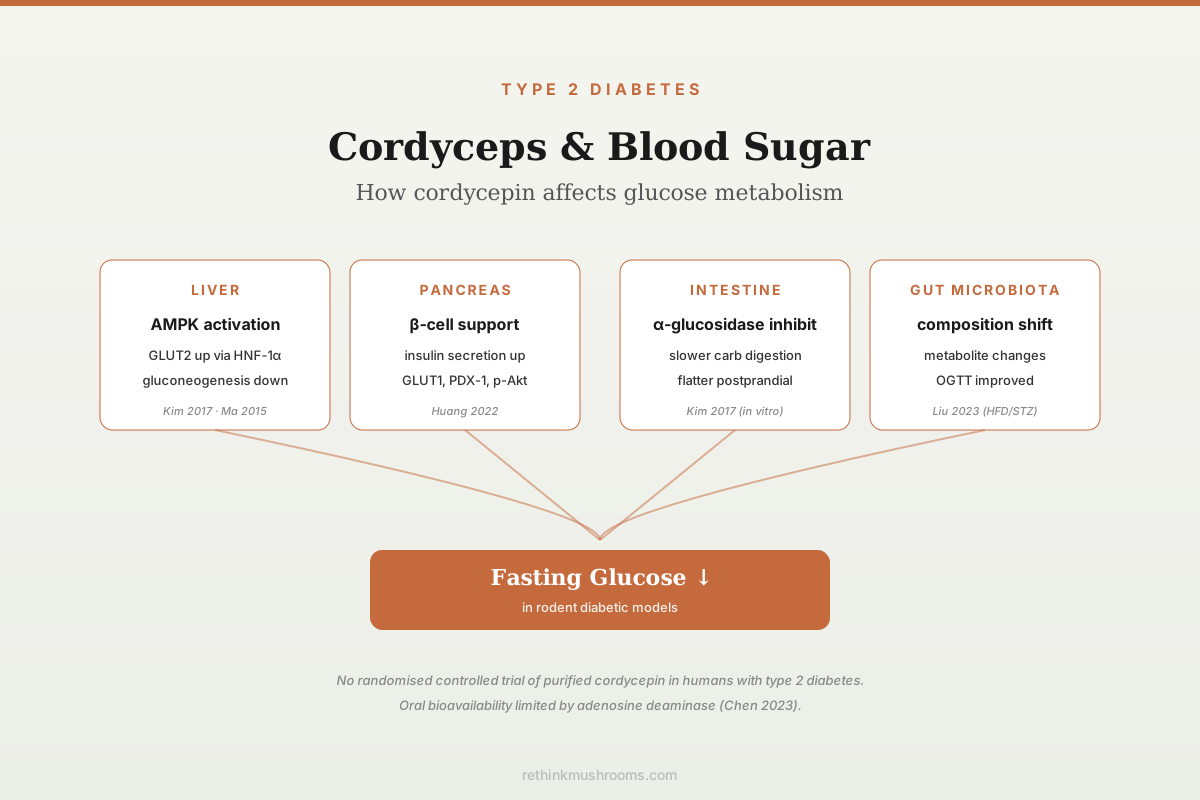
Cordycepin lowers fasting blood glucose in alloxan and high-fat-diet-plus-streptozotocin diabetic mice. The mechanism converges on AMPK activation, GLUT1/GLUT2 upregulation in liver and pancreatic beta cells, and insulin-secretion support.
Ma et al., 2015; Kim et al., 2017; Liu et al., 2023
Animal model: yes
mouse and rat T2DM models
Human RCT: no
no published clinical trial of pure cordycepin
Gut microbiota linked
Liu 2023 identifies microbial mediators
Ma et al., 2015; Kim et al., 2017; Liu et al., 2023
 View as image ↗
Cordycepin, the signature 3'-deoxyadenosine isolated from Cordyceps militaris, has a substantial and internally consistent preclinical literature supporting glucose-lowering activity in diabetic animal models. The mechanistic story centres on AMP-activated protein kinase (AMPK) activation, glucose transporter upregulation, pancreatic beta cell support and, in more recent work, modulation of the gut microbiota. The human clinical literature is substantially thinner: no randomised controlled trial has yet been published testing purified cordycepin for glucose control in type 2 diabetes.[1] This article lays out the specific mechanisms, the specific studies, and the translational gap.
For the broader context see mushrooms for type 2 diabetes: a research-based guide to evidence and species, comparing mushroom species for diabetes management: which has the strongest evidence?, maitake and type 2 diabetes: the SX-fraction clinical trials, and reishi polysaccharides and blood glucose control in diabetic patients.
Key Takeaways
- Ma et al. (2015) showed cordycepin from C. militaris prevented hyperglycemia in alloxan-induced diabetic mice, with liver glucose metabolism normalisation as a central mechanism
- Kim et al. (2017) demonstrated C. militaris water extract increased glucose uptake in HepG2 hepatocytes via AMPK phosphorylation and GLUT2 upregulation driven by HNF-1α
- Sun et al. (2022) reported that cordycepin enhances insulin synthesis and secretion in INS-1 pancreatic beta cells and upregulates GLUT1 and PDX-1 expression via Akt phosphorylation
- Liu et al. (2023) showed C. militaris extract and cordycepin ameliorate T2DM in high-fat-diet/streptozotocin mice, partially through gut microbiota modulation and metabolite profile changes
- Huang et al. (2022, testicular damage paper) separately demonstrated cordycepin protects against diabetes-induced oxidative damage through the Sirt1/Foxo3a pathway
- Zhang et al. (2014) identified cordycepin-driven AMPK activation as an anti-inflammatory mechanism in macrophages, and AMPK is the same master regulator central to hepatic glucose metabolism
- No published randomised controlled trial has evaluated purified cordycepin for glucose control in humans with type 2 diabetes
Why AMPK Is The Central Node
AMP-activated protein kinase (AMPK) is the cellular energy sensor. When cellular AMP:ATP rises (indicating low energy status), AMPK is phosphorylated and active; active AMPK shifts cellular metabolism toward ATP generation and away from ATP-consuming biosynthesis. In liver, active AMPK suppresses gluconeogenesis and lipogenesis and increases fatty acid oxidation. In skeletal muscle, active AMPK increases glucose uptake via GLUT4 translocation. In pancreatic beta cells, AMPK signaling modulates insulin secretion in a context-dependent manner. Metformin, the first-line drug for type 2 diabetes, is understood to work substantially through AMPK activation.
A compound that activates AMPK has, by this mechanism alone, a biologically plausible route to lower blood glucose. Cordycepin is an adenosine analogue, and adenosine/AMP analogues engaging AMPK is a well-characterised pharmacological category. Zhang and colleagues (2014) showed cordycepin activates AMPK in macrophages,[2] and Kim and colleagues (2017) showed the same activation in hepatocytes.[3]
The Animal Evidence: Ma 2015 And Liu 2023
Ma and colleagues (2015) used the alloxan-induced diabetic mouse model, a standard model of beta cell destruction. Mice received cordycepin from C. militaris by oral gavage for several weeks. Fasting blood glucose fell in the cordycepin-treated mice relative to untreated diabetic controls, with improvements in liver glucose metabolism parameters including glycogen content and glucose-6-phosphatase activity.[1] The alloxan model emphasises beta cell dysfunction and is a stricter test than pure insulin-resistance models, because the animals have actively damaged islets and depend on residual beta cell function and on peripheral tissue responses.
Liu and colleagues (2023) used the more translationally relevant high-fat-diet plus streptozotocin (HFD/STZ) model of type 2 diabetes, which captures both insulin resistance and beta cell stress. C. militaris extract and purified cordycepin produced reductions in fasting blood glucose, improvements in oral glucose tolerance test performance, and partial normalisation of lipid metabolism parameters.[4] Notably, the investigators performed 16S rRNA sequencing of faecal microbiota and untargeted metabolomics and found treatment-associated changes in microbial composition and in circulating metabolites, pointing to the gut microbiome as a mediator of the glucose-lowering effect. The microbiota finding connects cordycepin to a broader literature on metformin and other anti-diabetic agents whose efficacy is partly microbiome-mediated.
The Mechanistic Evidence In Cells: Kim 2017 And Sun 2022
Kim and colleagues (2017) studied C. militaris water extract in HepG2 human hepatoma cells, a standard cellular model for hepatic glucose metabolism.[3] The extract stimulated glucose uptake by increasing GLUT2 expression through HNF-1α (hepatocyte nuclear factor 1 alpha), a liver-enriched transcription factor that drives GLUT2 transcription. Downstream, the investigators observed AMPK phosphorylation. The paper also documented alpha-glucosidase inhibitory activity, suggesting a second mechanism at the intestinal level: slower dietary carbohydrate digestion producing a flatter postprandial glucose curve. Alpha-glucosidase inhibition is the same mechanism as the clinical drug acarbose.
Sun and colleagues (2022) tested cordycepin in INS-1 rat insulinoma cells, a model for pancreatic beta cell function.[5] Cordycepin enhanced insulin synthesis and secretion under both normal and oxidative-stress conditions, upregulated mRNA for insulin and GLUT1, and promoted expression of PDX-1 (the master pancreatic transcription factor), GLUT1 and phosphorylated Akt. The beta cell mechanism is important because it addresses the supply side of glucose control. A compound that both supports beta cell function (Sun 2022) and increases peripheral and hepatic glucose uptake (Kim 2017) has a mechanistically complete anti-diabetic profile in vitro.
Huang and colleagues (2022, testicular paper) separately reported that cordycepin protects testicular tissue against diabetes-induced oxidative damage through the Sirt1/Foxo3a pathway, a finding that is tangential to glucose control directly but relevant to the broader diabetic-complications literature.[6]
The Integrated Picture
Across the animal and cellular evidence, cordycepin's effect on glucose metabolism has multiple components:
| Mechanism | Tissue | Key study |
|---|---|---|
| AMPK activation | Liver (HepG2), macrophages | Kim 2017, Zhang 2014 |
| GLUT2 upregulation via HNF-1α | Liver | Kim 2017 |
| GLUT1 upregulation | Pancreatic beta cells | Sun 2022 |
| Insulin synthesis and secretion support | Pancreatic beta cells | Sun 2022 |
| Alpha-glucosidase inhibition | Intestine (in vitro) | Kim 2017 |
| Gluconeogenesis and glycogen normalisation | Liver | Ma 2015 |
| Gut microbiota modulation | Colon | Liu 2023 |
| Oxidative stress protection | Beta cell, testis | Sun 2022, Huang 2022 |
The picture is of a molecule acting at multiple nodes of the glucose-control system rather than at a single target. This is typical of natural products and is part of why the mechanistic literature is so rich while the translational question, whether cordycepin actually lowers HbA1c in humans, remains open.
Mechanism Convergence
Five Nodes, One Outcome — and a Missing Top
Cordycepin does not act on a single target. Across the preclinical literature it engages five distinct tissues, each pushing glucose the same direction. That redundancy is why the mechanism reads as robust — and why the absence of a human trial, not any weakness in the biology, is the real limit of the claim.
Cellular energy sensor
cellAMPK activation — the same master switch metformin engages
Zhang 2014 · Kim 2017
Liver
cell + animalGLUT2 upregulated via HNF-1α; gluconeogenesis suppressed, glycogen and glucose-6-phosphatase normalised
Kim 2017 · Ma 2015
Pancreatic beta cell
cellInsulin synthesis and secretion supported; PDX-1, GLUT1 and phosphorylated Akt increased in INS-1 cells
Sun 2022
Intestine
cellAlpha-glucosidase inhibition slows carbohydrate digestion — the same target as the drug acarbose
Kim 2017
Gut microbiota
animalComposition and circulating-metabolite profile shifted; a mediator of the effect that does not require intact systemic cordycepin
Liu 2023
↓ Fasting blood glucose
Demonstrated in alloxan (Ma 2015) and high-fat-diet/streptozotocin (Liu 2023) rodent models — animal evidence only.
Human with type 2 diabetes
gapNo randomised, placebo-controlled trial has tested purified cordycepin on glucose control in people — and rapid deamination by adenosine deaminase limits oral systemic exposure (Chen 2023).
Sources: Ma 2015 [1]; Zhang 2014 [2]; Kim 2017 [3]; Liu 2023 [4]; Sun 2022 [5]; Chen 2023 [10]. Node placement reflects tissue of action, not effect size; every efficacy finding shown is preclinical (cell line or rodent).
The Human Evidence
The human clinical literature on Cordyceps and glucose control exists but is dominated by extract-level studies, not purified cordycepin. Small clinical trials of Cordyceps sinensis or Cordyceps militaris extracts have shown modest glucose-lowering effects in diabetic and prediabetic cohorts, but the extract products contain cordycepin alongside polysaccharides, adenosine, ergosterol, mannitol, amino acids and many other bioactive components. No trial has isolated cordycepin alone and tested it against placebo in a diabetic population.
Phull and colleagues (2022) reviewed the Cordyceps militaris pharmacological literature and confirmed this gap, noting that the anti-diabetic evidence is "rich at the molecular and preclinical level and sparse at the randomised human trial level."[7] Sharma and colleagues (2022) reached a similar conclusion in their cordycepin pharmacology review.[8] Ashraf and colleagues (2020) surveyed the health and wellbeing literature and did not identify any registered or completed Phase 2 or Phase 3 trial specifically testing cordycepin for glycaemic control.[9]
Chen and colleagues (2023) reviewed the bioavailability and formulation literature and reported that cordycepin is rapidly deaminated by adenosine deaminase to 3'-deoxyinosine, which substantially limits oral systemic exposure in humans at standard supplement doses.[10] The pharmacokinetic constraint is the most important practical obstacle to translating the preclinical glucose-metabolism findings into a meaningful clinical effect from a daily oral supplement.
The Microbiota Angle And Why It Matters
The Liu 2023 finding that gut microbiota modulation mediates part of the cordycepin-and-extract anti-diabetic effect is worth emphasising, because it has a major implication for translation. If the therapeutic effect is partly downstream of microbiota-derived metabolites rather than systemic cordycepin exposure, then the rapid deamination problem becomes less critical: cordycepin in the gut lumen could still alter microbial composition and microbial metabolic output even without crossing into systemic circulation intact.[4]
This is the most plausible bridge between the strong preclinical mechanism and the modest clinical signal reported from Cordyceps extract products in the scattered human literature. It also suggests that whole-extract products, which carry polysaccharides and other microbiota-relevant substrates alongside cordycepin, may be more clinically active than purified cordycepin at matched cordycepin-content doses.
Limitations Of The Evidence
The glucose-metabolism evidence base has clear limits.
All published efficacy data are in rodents (alloxan, HFD/STZ, and related models) and in cell lines (HepG2, INS-1). No randomised controlled trial has tested purified cordycepin in humans with type 2 diabetes or prediabetes.
Cordycepin is rapidly deaminated to 3'-deoxyinosine in vivo, limiting systemic exposure from oral administration. The doses used in mouse studies, typically 20 to 50 mg/kg/day, translate through body-surface-area scaling into doses that exceed the cordycepin content of standard Cordyceps militaris supplements.
The HFD/STZ mouse model captures some features of human T2DM but not others. Long-term complications, glycaemic variability, cardiovascular endpoints and patient-relevant outcomes cannot be evaluated in these models.
The molecular target responsible for cordycepin's AMPK activation is not definitively established. It may operate through adenosine-receptor engagement, direct AMP mimicry, or via 3'-dATP formation. The mechanism-level ambiguity complicates any structure-activity programme aimed at optimising the molecule.
Cross-trial dose-response is inconsistent. Different rodent studies have used widely different dosing regimens, formulations and durations, and a clean dose-response curve has not been established even within the animal literature.
Finally, most Cordyceps clinical trials in humans use whole-extract products, and attributing any observed glucose-lowering effect specifically to cordycepin rather than to co-occurring polysaccharides or other constituents is not possible from the current trials.
What The Evidence Actually Establishes
- Cordycepin lowers fasting blood glucose in multiple rodent diabetic models, including alloxan (Ma 2015) and HFD/STZ (Liu 2023)
- The mechanism includes AMPK activation in liver (Kim 2017), GLUT1 and GLUT2 upregulation (Kim 2017, Sun 2022), insulin-secretion support in pancreatic beta cells (Sun 2022), alpha-glucosidase inhibition in vitro (Kim 2017), and gut microbiota modulation in vivo (Liu 2023)
- Cordycepin protects against diabetes-induced oxidative damage in multiple tissues via Sirt1/Foxo3a and related antioxidant pathways (Huang 2022)
- No randomised controlled trial has tested purified cordycepin for glycaemic control in humans; the clinical evidence base consists of small extract-level studies with confounded attribution
- Oral bioavailability of cordycepin is limited by adenosine deaminase activity, and microbiota-mediated mechanisms may be the most realistic translational route for oral supplement products
The Bottom Line
Cordycepin lowers blood glucose in mouse and rat diabetic models through AMPK activation, GLUT transporter upregulation, pancreatic beta cell support, alpha-glucosidase inhibition and gut microbiota modulation. The mechanism is internally consistent across studies from Ma 2015, Kim 2017, Sun 2022 and Liu 2023. The translational gap is substantial: no randomised controlled trial has tested purified cordycepin in humans with type 2 diabetes, and rapid adenosine deaminase metabolism limits oral systemic exposure.
Frequently Asked Questions
Sources & References
- 1RTHM-00396·Ma, Li et al. (2015). “Cordycepin from Cordyceps militaris prevents hyperglycemia in alloxan-induced diabetic mice..” Nutrition research (New York.Study breakdown →PubMed →↩
- 2RTHM-00361·Zhang, Jian-Li et al. (2014). “Cordycepin inhibits lipopolysaccharide (LPS)-induced tumor necrosis factor (TNF)-α production via activating amp-activated protein kinase (AMPK) signaling..” International journal of molecular sciences.Study breakdown →PubMed →↩
- 3RTHM-00477·Kim, Dae Jung et al. (2017). “Increased glucose metabolism and alpha-glucosidase inhibition in Cordyceps militaris water extract-treated HepG2 cells..” Nutrition research and practice.Study breakdown →PubMed →↩
- 4RTHM-00841·Liu, Xinyuan et al. (2023). “Cordyceps militaris extracts and cordycepin ameliorate type 2 diabetes mellitus by modulating the gut microbiota and metabolites..” Frontiers in pharmacology.Study breakdown →PubMed →↩
- 5RTHM-02265·Sun, Huizhen et al. (2022). “Improving effect of cordycepin on insulin synthesis and secretion in normal and oxidative-damaged INS-1 cells..” European journal of pharmacology.Study breakdown →PubMed →↩
- 6RTHM-00767·Huang, Tao et al. (2022). “Cordycepin, a major bioactive component of Cordyceps militaris, ameliorates diabetes-induced testicular damage through the Sirt1/Foxo3a pathway..” Andrologia.Study breakdown →PubMed →↩
- 7RTHM-00790·Phull, Abdul-Rehman et al. (2022). “Cordyceps militaris as a Bio Functional Food Source: Pharmacological Potential, Anti-Inflammatory Actions and Related Molecular Mechanisms..” Microorganisms.Study breakdown →PubMed →↩
- 8RTHM-00795·Sharma, Shivani et al. (2022). “Cordycepin as a Metabolite with Pharmacological Potential: A Review..” International journal of medicinal mushrooms.Study breakdown →PubMed →↩
- 9RTHM-00605·Ashraf, Syed Amir et al. (2020). “Cordycepin for Health and Wellbeing: A Potent Bioactive Metabolite of an Entomopathogenic Cordyceps Medicinal Fungus and Its Nutraceutical and Therapeutic Potential..” Molecules (Basel.Study breakdown →PubMed →↩
- 10RTHM-00817·Chen, Min et al. (2023). “Cordycepin: A review of strategies to improve the bioavailability and efficacy..” Phytotherapy research : PTR.Study breakdown →PubMed →↩