Mushrooms & Diabetes / Blood Sugar
3 mechanisms
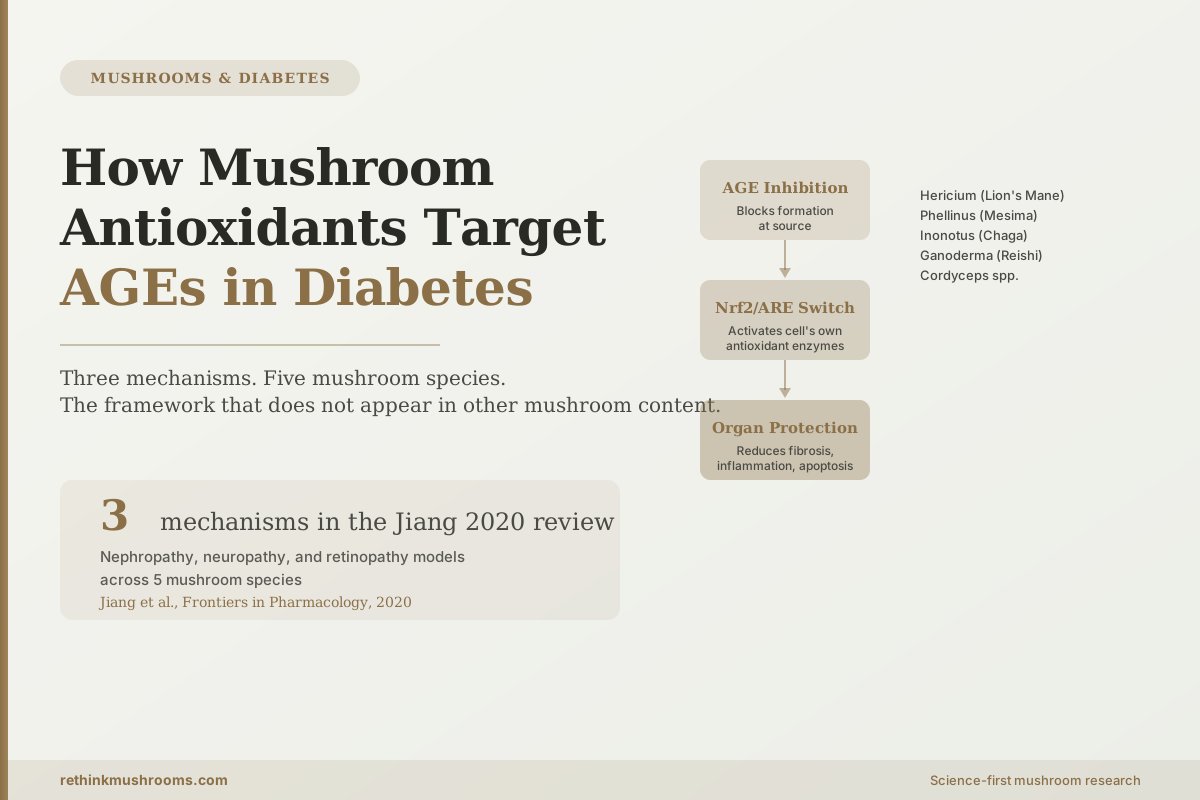
A 2020 Frontiers in Pharmacology review identified three ways mushroom polysaccharides interrupt diabetic complications: AGE inhibition, reactive oxygen species reduction, and direct organ protection in kidney, nerve, and retinal tissue.
Jiang et al., Frontiers in Pharmacology, 2020
5 species
Hericium, Phellinus, Inonotus, Ganoderma, Cordyceps, all tested in diabetic complication models
Nrf2/ARE
the antioxidant gene-expression switch that mushroom polysaccharides activate in multiple species
Collagen
Tremella polysaccharides reduce glycation-induced collagen crosslinking, the mechanism behind slow diabetic wound healing
Jiang et al., Frontiers in Pharmacology, 2020
 View as image ↗
Most diabetes content focuses on controlling blood sugar. That is appropriate for preventing the disease from progressing. But the 422 million people worldwide who already have established diabetes face a different challenge: the damage that accumulated glucose has already caused, and the ongoing damage it continues to cause to organs that cannot immediately feel it.
Advanced glycation end products, known as AGEs, are at the center of that damage. They accumulate over years of elevated blood sugar, cross-link proteins, trigger chronic inflammation, and drive the complications that ultimately kill or disable most people with long-standing diabetes: kidney failure, nerve damage, blindness, and impaired wound healing.
Mushroom polysaccharides have been studied specifically in this context, not just for their blood-sugar-lowering effects but for their ability to interrupt the AGE cascade. A 2020 Frontiers in Pharmacology review by Jiang and colleagues identified three distinct mechanisms by which polysaccharides from five mushroom species address diabetic complications.[1] This framework, which does not appear in any mainstream mushroom health content, is where the interesting science is.
For the broader picture of mushrooms and blood sugar management, the mushrooms and type 2 diabetes research guide covers primary glucose control. This article focuses specifically on what happens after glucose control is inadequate and AGEs begin to accumulate.
Key Takeaways
- Advanced glycation end products (AGEs) form when excess glucose reacts with proteins and fats in the body, accumulating in tissues over years and causing the structural and inflammatory damage behind diabetic kidney disease, neuropathy, retinopathy, and slow wound healing
- Jiang et al. (2020) identified three mechanisms by which mushroom polysaccharides from Hericium, Phellinus, Inonotus, Ganoderma, and Cordyceps interrupt diabetic complications: AGE inhibition, antioxidant pathway activation, and direct organ protection
- The Nrf2/ARE antioxidant defense pathway is a key target: mushroom polysaccharides activate this cellular switch, increasing production of the body's own antioxidant enzymes including superoxide dismutase and catalase
- Chaga (Inonotus obliquus) polysaccharides reduced serum creatinine, BUN, and kidney fibrosis markers in diabetic mice, with low-molecular-weight fractions showing greater protective activity than high-molecular-weight fractions
- Lion's Mane (Hericium erinaceus) polysaccharides reduced blood glucose and kidney inflammation in a diabetic nephritis model, extending the species' protection beyond its well-known neuroprotective effects
- Tremella fuciformis polysaccharides promote collagen synthesis and reduce oxidative damage in skin, addressing the collagen crosslinking mechanism through which AGEs impair wound healing in diabetics
What AGEs Are and Why They Matter More Than Blood Sugar After Years of Diabetes
Advanced glycation end products form through a series of chemical reactions that happen automatically when glucose is present in excess. The process begins with a simple interaction: a glucose molecule attaches to a protein or fat molecule in a process called glycation. Over time and through further reactions, this initial attachment undergoes rearrangements and oxidations that produce stable, irreversible compounds: the AGEs.
The word "end" in the name is important. Unlike the initial glycation reactions, AGE formation is largely irreversible. Once an AGE forms in a tissue, it stays there until the tissue is replaced. In long-lived tissues like collagen fibers, basement membranes, and myelin sheaths, AGE accumulation over years produces structural changes that cannot be undone by improving blood sugar control.
AGEs cause harm through two primary mechanisms.
The first is physical crosslinking. AGE molecules form chemical bridges between adjacent protein molecules, particularly in structural proteins like collagen and the proteins that make up kidney basement membranes. This crosslinking makes tissue stiffer, less elastic, and less permeable in appropriate ways. In the kidney, crosslinked basement membranes become leaky. In blood vessels, crosslinked arterial walls lose elasticity and become prone to hypertension damage. In peripheral nerves, crosslinked myelin sheaths impair nerve conduction.
The second mechanism is receptor-mediated inflammation. Cells throughout the body carry a protein on their surface called the RAGE receptor, which stands for receptor for advanced glycation end products. When AGEs bind to RAGE receptors, they trigger a cascade of inflammatory signaling that produces chronic, low-grade inflammation. This RAGE-mediated inflammation is a key driver of the tissue damage in all major diabetic complications.
Both mechanisms accumulate over years. A person diagnosed with type 2 diabetes at 50 who has had mildly elevated blood sugar for a decade before diagnosis has been accumulating AGEs throughout that decade. Reducing blood sugar going forward stops new AGE formation but does not reverse the existing accumulation.
The Three Mechanisms: How Mushroom Polysaccharides Address the AGE Cascade
Jiang and colleagues conducted a systematic review published in Frontiers in Pharmacology in 2020, focusing specifically on mushroom polysaccharides as adjuvant therapies for diabetic complications.[1]
The species they reviewed were Hericium erinaceus (Lion's Mane), Phellinus linteus (Mesima), Inonotus obliquus (Chaga), Ganoderma lucidum (Reishi), and Cordyceps species. Each had documented effects across one or more of the three major diabetic complication categories: nephropathy (kidney damage), neuropathy (nerve damage), and retinopathy (eye damage).
The review identified three distinct mechanisms operating across these species and complications.
Mechanism 1: AGE inhibition. Some mushroom polysaccharides interfere with the biochemical reactions that produce AGEs in the first place. By chelating the metal ions that catalyze certain glycation reactions, or by scavenging the intermediate reactive compounds, polysaccharides can reduce the rate at which AGEs form. This is a prevention mechanism rather than a repair mechanism.
Mechanism 2: Antioxidant pathway activation. Oxidative stress amplifies AGE formation and AGE damage. Mushroom polysaccharides activate the Nrf2/ARE pathway (described in detail in the next section), which increases the cell's production of its own antioxidant enzymes. Reduced oxidative stress slows both AGE formation and the RAGE receptor inflammatory cascade.[1]
Mechanism 3: Direct organ protection. Even when AGEs have already formed and are triggering RAGE-mediated inflammation, mushroom polysaccharides can reduce the inflammatory response, reduce fibrosis (the scarring that replaces functional tissue), and protect surviving cells from apoptosis. This is a damage-limitation mechanism rather than a prevention mechanism.
The significance of this three-part framework: these mechanisms can all be active simultaneously, and they address different time points in the complication pathway. A patient with established diabetic nephropathy benefits from mechanism 3 even if they can no longer benefit much from mechanism 1.
Switching On the Cell's Antioxidant Factory: The Nrf2/ARE Pathway
The Nrf2/ARE pathway is the cell's most powerful built-in antioxidant defense system. Understanding how it works explains why mushroom polysaccharides produce their antioxidant effects differently from simply consuming antioxidants directly.
Under normal conditions, a protein called Keap1 holds the transcription factor Nrf2 in the cell's cytoplasm, preventing it from entering the nucleus. Keap1 acts as a sensor for oxidative stress. When reactive oxygen species (the harmful byproducts of cell metabolism that accumulate in diabetes) reach elevated levels, they modify Keap1, releasing Nrf2.
Nrf2 then moves into the nucleus and binds to the antioxidant response element (ARE), a section of the genome that controls the production of multiple antioxidant enzymes: superoxide dismutase, catalase, glutathione peroxidase, and others. The result is a coordinated upregulation of the cell's own antioxidant capacity.
Mushroom polysaccharides from the five species reviewed by Jiang 2020 all activated this pathway in diabetic complication models, either by modifying Keap1 directly or by amplifying the oxidative stress signal that frees Nrf2.[1]
This matters for the diabetic complication context specifically because oxidative stress is what connects elevated blood sugar to AGE formation and RAGE receptor activation. Glucose metabolism in hyperglycemia generates excess reactive oxygen species. These reactive oxygen species accelerate the glycation reactions that form AGEs and enhance the RAGE receptor signaling that produces inflammation. By activating Nrf2/ARE and reducing the oxidative stress burden, mushroom polysaccharides interrupt this chain at a point that affects multiple downstream complications simultaneously.
Chaga and Kidney Protection: What the Inonotus Data Shows
The kidney is the organ most extensively studied in the context of mushroom polysaccharides and diabetic complications, partly because diabetic kidney disease (also called diabetic nephropathy) is the leading cause of end-stage renal disease worldwide.
Researchers publishing in the International Journal of Medical Mushrooms in 2016 tested the renal effects of Inonotus obliquus (Chaga) polysaccharides in a streptozotocin-induced diabetic mouse model.[2] Streptozotocin is a compound used to induce diabetes in laboratory animals; it selectively destroys insulin-producing cells, producing a reliable model of type 1-like hyperglycemia that generates AGE accumulation and renal damage over time.
The Chaga polysaccharide reduced two standard markers of kidney damage: serum creatinine (which rises when the kidney cannot filter waste) and blood urea nitrogen (BUN), another waste product that accumulates when filtration fails. It also reduced kidney fibrosis markers, indicating that the structural scarring process in diabetic nephropathy was attenuated.
A detail that stands out in this study: the low-molecular-weight fraction of the polysaccharide was more effective than the high-molecular-weight fraction.[2] This is consistent with findings in other polysaccharide research where smaller chains penetrate tissue and reach cellular targets more effectively than larger chains that remain in the bloodstream.
This molecular-weight finding has practical implications for anyone interested in Chaga preparations: not all extracts are equivalent, and the effectiveness may depend partly on the size distribution of polysaccharide chains in the final product.
For a more detailed look at the full Cordyceps and Chaga evidence for diabetic kidney disease, including the specific molecular targets like the AMPK/mTOR and miRNA-33a-5p/SIRT6 pathways, see the article on Cordyceps and diabetic kidney disease.
Lion's Mane Beyond Neuroprotection: Kidney Effects in Diabetic Nephritis
Lion's Mane (Hericium erinaceus) is primarily studied for cognitive and neurological effects, and within the diabetic complication context it is most often discussed for its potential benefit in diabetic neuropathy through nerve growth factor (NGF) stimulation.
A 2017 study published in the International Journal of Biological Macromolecules examined a different angle: what Lion's Mane polysaccharides do in a diabetic nephritis model.[3]
The results showed dual activity. H. erinaceus polysaccharides reduced blood glucose in the diabetic animals, providing some metabolic benefit. They also attenuated kidney inflammation, specifically reducing the inflammatory cell infiltration and cytokine production that characterize nephritis. Both effects were observed within the same experimental preparation, suggesting the polysaccharide fraction of Lion's Mane has kidney-relevant activity separate from its hericenone/erinacine compounds that stimulate NGF.
This finding matters for a specific reason: it suggests Lion's Mane polysaccharides may have value across multiple diabetic complications simultaneously. A single mushroom compound class affecting both glucose metabolism and inflammatory organ protection represents a broader effect than either mechanism alone.
The Jiang 2020 review specifically included Hericium as one of the five key species for diabetic complication adjuvant therapy, and this nephritis study provides experimental support for that inclusion that goes beyond the more commonly cited neuroprotection data.[1]
For the neuropathy-specific Lion's Mane data, including the peripheral nerve regeneration research most relevant to diabetic peripheral neuropathy, see the Lion's Mane for diabetic neuropathy article. The broader reishi polysaccharide evidence for blood glucose control in diabetic patients, including AGE-related cardiac tissue protection, is covered in the reishi polysaccharides and blood glucose article.
Tremella and the Skin: AGEs, Collagen, and Why Diabetics Heal Slowly
One consequence of AGE accumulation that receives less research attention than nephropathy or neuropathy is its effect on the skin. This is clinically important because slow wound healing in diabetics is one of the leading causes of amputation.
The mechanism runs through collagen. Collagen is the structural protein that gives skin tensile strength and enables the organized tissue formation that characterizes proper wound healing. In diabetic skin, elevated AGE levels crosslink collagen fibers, making them stiffer and less capable of the organized remodeling that wound healing requires. The basement membrane of blood vessels in the skin also becomes crosslinked and thickened, reducing the delivery of oxygen and nutrients to healing tissue.
Tremella fuciformis, the white jelly fungus, has been studied for skin-related properties in a dermatological context. A systematic review by Mineroff and Jagdeo published in the Archives of Dermatological Research in 2023 summarized the evidence on Tremella's cutaneous benefits.[4]
Tremella polysaccharides promote collagen synthesis, enhance skin barrier function, and reduce oxidative damage in skin tissue. The collagen synthesis promotion is mechanistically relevant to diabetic wound healing: if Tremella polysaccharides support the type of ordered collagen deposition that AGE crosslinking disrupts, they address the wound healing problem at a structural level.
The oxidative damage reduction in skin is consistent with the Nrf2/ARE activation mechanism identified in the broader polysaccharide literature. Skin cells under oxidative stress from hyperglycemia are less able to synthesize collagen and more prone to the inflammatory disruptions that impair wound closure.
Tremella is not a traditional anti-diabetic mushroom and no study has directly tested it in a diabetic wound healing model. But the mechanisms it engages are directly relevant to the pathology of diabetic skin complications, and it offers a different compound profile than the five species in the Jiang review. For the Sparassis crispa data specifically tested in a diabetic wound model, see the diabetic wound healing and medicinal mushrooms article.
What the Evidence Can and Cannot Say
The research on mushroom polysaccharides and diabetic complications via AGE mechanisms is preclinical. Every study in this area uses animal models or cell cultures. No randomized controlled trials have tested mushroom polysaccharides specifically for AGE reduction in human diabetic patients.
This is a more honest picture than most mushroom content provides, but it does not make the evidence meaningless. Animal models of diabetic nephropathy are well-validated and mechanistically predictive for several pharmaceutical drugs that later succeeded in human trials. The specific finding that Chaga polysaccharides reduce serum creatinine and BUN in diabetic mice is not arbitrary; these are the same markers that clinical trials monitor in human patients.
What the preclinical evidence does is establish biological plausibility and identify candidate mechanisms. Three independent mechanisms (AGE inhibition, Nrf2/ARE activation, organ protection) operating across five mushroom species in multiple tissue targets represents a consistent and mechanistically coherent picture. This is stronger than a single finding from a single species.
What it does not do: establish the dose, form, duration, or patient population in which the benefits would translate to humans. It does not establish whether dietary consumption of mushrooms produces the tissue concentrations of polysaccharides needed to engage these mechanisms.
The honest assessment: the AGE inhibition framework provides a compelling biological rationale for studying mushrooms as adjuvant therapies for diabetic complications. The animal data is consistent and mechanistically sophisticated. The human data gap is real and significant.
For readers interested in the human evidence that does exist for mushrooms and diabetes, the maitake SX-fraction clinical trials represent the most rigorous human-level evidence in the diabetes and mushrooms literature. And for the overview of all complications research, see mushrooms and diabetic complications.
The Bottom Line
Jiang et al. (2020) identified three mechanisms by which polysaccharides from five mushroom species (Hericium, Phellinus, Inonotus, Ganoderma, Cordyceps) address diabetic complications: AGE inhibition, antioxidant Nrf2/ARE pathway activation, and direct organ protection. Supporting preclinical studies show Chaga polysaccharides reducing renal damage markers in diabetic mice, Lion's Mane polysaccharides attenuating diabetic nephritis inflammation, and Tremella polysaccharides promoting collagen synthesis and reducing oxidative skin damage through mechanisms relevant to diabetic wound healing. All evidence is preclinical; no human RCTs have tested mushroom polysaccharides specifically for AGE reduction in diabetic patients.
Frequently Asked Questions
Sources & References
- 1. Source details for this reference are not yet available.
- 2. Source details for this reference are not yet available.
- 3. Source details for this reference are not yet available.
- 4. Source details for this reference are not yet available.