Mushrooms and Diabetic Complications
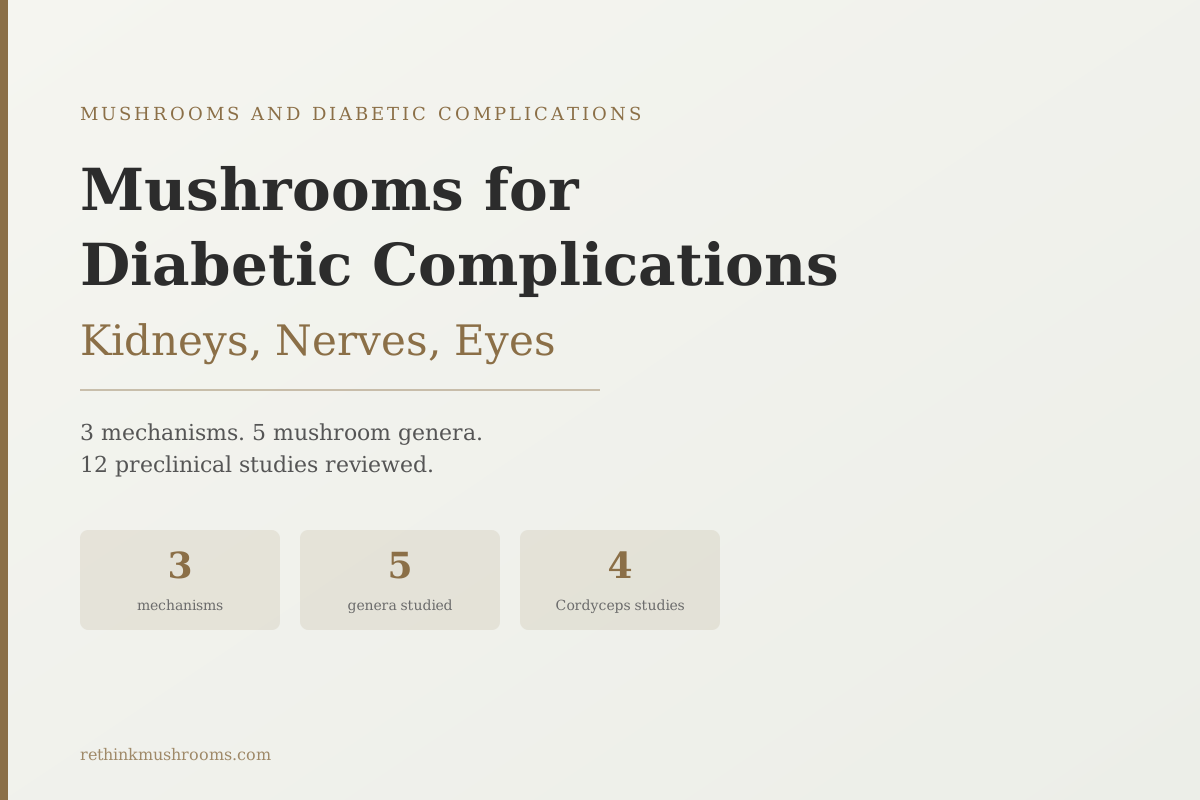
3 mechanisms
A 2020 systematic review in Frontiers in Pharmacology identified three pathways through which mushroom polysaccharides reduce organ damage in diabetes: AGE inhibition, oxidative stress reduction, and direct organ protection.
Jiang et al., Frontiers in Pharmacology, 2020
5 genera
Hericium, Cordyceps, Inonotus, Phellinus, and Ganoderma all show complication-targeting evidence
4 studies
independent Cordyceps experiments all reaching the same renal-protective result in diabetic animal models
Preclinical
all complication-targeted evidence comes from animal and cell models; no dedicated human RCTs exist yet
Jiang et al., Frontiers in Pharmacology, 2020
 View as image ↗
A 2020 systematic review in Frontiers in Pharmacology asked a specific question about mushrooms for diabetic complications: not whether mushrooms lower blood sugar, but whether their polysaccharides can protect the organs that high blood sugar is actively destroying.[1]
Jiang and colleagues reviewed evidence across five mushroom genera — Hericium (Lion's Mane), Cordyceps, Inonotus obliquus (Chaga), Phellinus, and Ganoderma (Reishi) — and identified three mechanisms that appear consistently across species and organ systems. The three complications they examined were the ones responsible for most of diabetes' serious harm: diabetic kidney disease (nephropathy), nerve damage (neuropathy), and eye damage (retinopathy).
These are downstream consequences of diabetes. They're not caused by a single high-sugar meal; they accumulate over years of elevated blood glucose, and they're largely separate from whether someone's blood sugar is controlled in the short term. For how mushrooms affect glucose and insulin directly, see our research guide to mushrooms and type 2 diabetes. What follows covers the evidence for the downstream organ damage.
Key Takeaways
- Jiang et al. (2020) in Frontiers in Pharmacology identified three mechanisms through which mushroom polysaccharides reduce diabetic complications: inhibiting AGE formation (proteins bonding chemically with excess glucose), reducing oxidative stress in organ cells, and directly protecting kidney and nerve tissue
- Four independent research groups tested Cordyceps species for diabetic kidney protection in animal models and consistently found reduced kidney damage markers (creatinine, BUN) and less glomerular destruction
- Cordycepin, the primary bioactive compound in Cordyceps, protects kidney cells through two separate mechanisms: suppressing a molecular brake that normally blocks a protective protein called SIRT6, and activating autophagy (the cell's self-cleaning process)
- Chaga (Inonotus obliquus) polysaccharides reduced kidney fibrosis and waste-clearance marker levels in diabetic mice, with the low-molecular-weight fraction showing greater effect than the high-molecular-weight fraction
- Lion's Mane (Hericium erinaceus) is the primary candidate for diabetic neuropathy: its compounds stimulate production of NGF (nerve growth factor), the protein the body uses to maintain and regrow nerve fiber coatings, and Wong et al. (2012) specifically documented accelerated peripheral nerve regeneration in crush-injury models
- No human clinical trials have tested any mushroom extract specifically for diabetic nephropathy, neuropathy, or retinopathy; all findings are from animal and cell models
Three Ways Mushroom Polysaccharides Target Diabetic Organ Damage
Medicinal mushrooms for diabetic complications work through three mechanisms: inhibiting the formation of tissue-damaging AGEs, reducing oxidative stress in organ cells, and directly protecting kidney, nerve, and retinal tissue. The species with the strongest complication-focused evidence are Lion's Mane (for neuropathy), Cordyceps (for nephropathy), and Inonotus obliquus (for nephropathy and retinal vasculature).[1]
Each mechanism operates differently:
AGE inhibition. Advanced glycation end products (AGEs) are what form when proteins and fats in the body bond chemically with excess glucose. Over years, AGEs accumulate in blood vessel walls, joints, and kidneys, cross-linking structural proteins and making tissue stiff, leaky, and prone to failure. Mushroom polysaccharides appear to slow this process, reducing how fast AGEs accumulate rather than reversing existing damage. The dedicated article on mushroom antioxidants and AGEs in diabetes covers this mechanism in detail.
Oxidative stress reduction. High blood sugar floods cells with reactive oxygen species, unstable molecules that damage DNA, protein structures, and cell membranes. Mushroom polysaccharides activate the Nrf2 pathway, a cellular switch that prompts cells to manufacture their own protective enzymes. This is an endogenous response: the mushroom compound triggers the body's defenses rather than acting as a direct antioxidant itself.
Direct organ protection. Some mushroom compounds act on the specific cell types most vulnerable to diabetic damage. In the kidney, this means protecting the filtering cells (podocytes and tubular cells). In nerve tissue, it means maintaining the protein responsible for myelin synthesis and nerve fiber survival. Each organ system has its own evidence base, covered in the sections below.
Diabetic Nephropathy: Four Cordyceps Studies, One Consistent Signal
Diabetic nephropathy is kidney damage caused by chronically high blood sugar. The damage typically starts at the glomeruli, the kidney's tiny filtering clusters, and spreads to the tubular cells that handle waste reabsorption. Once a critical mass of filtering capacity is lost, the kidneys can no longer maintain fluid balance or clear waste without medical intervention.
What distinguishes the Cordyceps nephropathy evidence is convergence. Four independent research groups tested different Cordyceps preparations in different diabetic kidney models and reached the same conclusion.
Cordyceps militaris. A 2016 study administered Cordyceps militaris to rats with type 2 diabetes and found significantly preserved kidney function compared to untreated diabetic controls.[6] The treated animals had lower creatinine and BUN levels — the two standard laboratory markers for how well kidneys clear waste — and reduced glomerular damage on tissue examination.
Cordyceps sinensis (Bailing capsule). A 2022 study used Bailing capsule, a standardized Cordyceps sinensis extract used clinically in China, in a diabetic kidney disease model.[7] The treated animals showed reduced fat accumulation, inflammation, and fibrosis markers in kidney tissue. This points to a specific mechanism: reducing lipid buildup inside kidney cells, known as lipotoxicity. That's a target distinct from glucose-lowering that most diabetes drugs don't address.
Cordycepin and SIRT6. Cordycepin is the most studied individual compound isolated from Cordyceps. A 2023 study in Biomedicine and Pharmacotherapy identified a specific molecular chain through which cordycepin reduces kidney fibrosis.[8] Cordycepin suppresses a gene-silencing molecule called miRNA-33a-5p, which normally blocks production of SIRT6, a protective protein that reduces kidney inflammation and scar tissue formation. By removing this molecular brake, cordycepin allows SIRT6 to accumulate and perform its protective function.
Cordycepin and autophagy. A 2019 study found a second mechanism for the same compound.[10] Cordycepin activated autophagy, the cell's built-in process for clearing damaged proteins and worn-out organelles, through the AMPK/mTOR energy-sensing pathway. In diabetic rats, this resulted in reduced death of podocytes (the primary filtering cells at the top of the glomerular filter) and less protein leaking into urine. Protein in urine, called proteinuria, is an early clinical sign of kidney damage; reducing it indicates preserved filtering capacity.
Two mechanisms for cordycepin. Both routes lead to the same place: less kidney damage.
Protecting tubular cells. Zhang et al. (2023) in BMC Complementary Medicine examined a part of the kidney that most studies overlook: the tubular cells, which handle waste reabsorption after initial filtration.[9] Cordyceps sinensis extract reduced tubular cell death and promoted cell survival in DKD animals. This suggests Cordyceps protects the kidney at two distinct points in the filtration process, not just the glomerular filter where most nephropathy research focuses.
Chaga (Inonotus obliquus). A 2016 study tested the low-molecular-weight fraction of Chaga polysaccharides in diabetic mice.[11] Kidney fibrosis markers, creatinine, and BUN all decreased compared to diabetic controls. The finding that the low-molecular-weight fraction outperformed the high-molecular-weight fraction has practical implications: it suggests that how Chaga extracts are processed, specifically whether smaller polysaccharide chains are preserved, may determine how much kidney-protective activity the extract contains.
All five of these studies used animal models. No clinical trial has tested a Cordyceps or Chaga extract specifically for diabetic nephropathy in human patients. For a dedicated review of the Cordyceps kidney evidence, see Cordyceps and diabetic kidney disease. For how cordycepin's glucose-lowering and kidney-protective effects interact in the same bioactive compound, see Cordyceps and blood sugar. The traditional Chinese medicine context for Cordyceps use in kidney conditions predating this research is covered in Cordyceps sinensis and kidney transplant research.
Diabetic Neuropathy: How Lion's Mane Targets Damaged Nerves
Diabetic peripheral neuropathy is nerve damage caused by long-term high blood sugar. The process is well characterized: excess glucose generates oxidative stress inside nerve cells, which damages the myelin sheath (the protective coating around nerve fibers), disrupts electrical conduction, and eventually produces the burning, tingling, numbness, and pain that characterize the condition. Damage typically starts in the longest nerves first, which is why the feet and hands are affected before the core.
Among all medicinal mushrooms studied for neurological conditions, Lion's Mane (Hericium erinaceus) has the most specific and consistent evidence for peripheral nerve regeneration.
Wong et al. (2012) reviewed animal experiments using a peripheral nerve crush-injury model, where a nerve is mechanically compressed in a way that mimics the progressive degeneration of diabetic neuropathy.[2] Lion's Mane administration accelerated nerve fiber regrowth, restored sensory reflexes, and upregulated NGF (nerve growth factor) in treated animals. Critically, this review was specifically about peripheral nerve injury, not cognitive or central nervous system neuroprotection. That distinction matters for diabetic applications, where the peripheral nerves are the primary clinical target.
The mechanism was characterized by Mori et al. (2013).[3] Lion's Mane contains two classes of neuroactive compounds: hericenones (concentrated in the fruiting body) and erinacines (in the mycelium). Both stimulate production of NGF through different cellular pathways. NGF, or nerve growth factor, is the protein responsible for the growth, maintenance, and survival of nerve fibers and their myelin coating. Erinacines cross the blood-brain barrier and upregulate the NGF gene in brain cells; hericenones act at a different receptor pathway in peripheral tissue. Both routes lead to more available NGF.
Phan et al. (2015) reviewed culinary-medicinal mushrooms for neurological conditions and identified Lion's Mane as the strongest candidate, partly because hericenones stimulate NGF through a non-immunological pathway.[4] Most bioactive compounds that protect nerve tissue do so by reducing inflammation. The hericenone route is distinct: it works even in the absence of an inflammatory state, which makes it potentially relevant to the low-inflammation nerve degeneration pattern of diabetic neuropathy.
The most recent comprehensive review, Contato and Conte-Junior (2025) in Nutrients, confirmed that erinacine A is the primary neuroprotection-relevant compound in Lion's Mane, and identified three overlapping protective mechanisms: NGF induction, anti-inflammatory activity, and antioxidant protection of nerve tissue.[5]
The human trial gap. No published randomized controlled trial has tested Lion's Mane specifically for diabetic peripheral neuropathy. The evidence consists of peripheral nerve injury models in animals, mechanistic in vitro work, and cognitive neuroprotection studies with indirect relevance to peripheral applications. The mechanism is coherent, and the animal evidence is consistent. But the distance between animal model and human RCT is real, and should be stated plainly rather than glossed over.
For more depth on the neuropathy evidence and the NGF mechanism, see Lion's Mane for diabetic neuropathy. For the pharmacology of hericenones vs. erinacines and why the fruiting body vs. mycelium distinction matters for NGF stimulation, see Lion's Mane bioactive compounds.
Lion's Mane Polysaccharides Also Protect the Kidneys
Lion's Mane is typically categorized as the neurological mushroom, but a 2017 study in International Journal of Biological Macromolecules found something that complicates that tidy label: H. erinaceus polysaccharides reduced blood glucose and attenuated kidney inflammation in a diabetic nephritis animal model.[12]
The active compounds here are the polysaccharides, the long-chain carbohydrate structures, rather than the hericenones and erinacines responsible for NGF stimulation. Different molecular fractions of the same mushroom appear to act on different biological targets: the terpenoid fraction for nerve support, the polysaccharide fraction for kidney and glucose effects.
This doesn't make Lion's Mane superior to Cordyceps for kidney protection. What it illustrates is that the evidence for any mushroom species is rarely confined to a single organ system. The diabetic complications literature has largely sorted species by their primary application — Cordyceps for kidneys, Lion's Mane for nerves — and the full range of each species' bioactivity probably extends beyond that categorization.
Diabetic Retinopathy: Where the Evidence Is Thin
Diabetic retinopathy is damage to the small blood vessels in the retina caused by chronically high blood sugar. The vessels become leaky, develop abnormal growths, or bleed in ways that can cause vision loss or blindness. It is the leading cause of new blindness among working-age adults in developed countries.
The biological processes driving retinopathy overlap substantially with those in nephropathy: AGE accumulation in blood vessel walls, oxidative damage to the endothelial cells lining those vessels, and chronic low-grade inflammation. This overlap is why Jiang et al. include retinopathy as a target complication alongside nephropathy and neuropathy. Polysaccharides that inhibit AGE formation and reduce oxidative stress in kidney blood vessels should, by the same logic, apply to retinal blood vessels as well.[1]
But the direct evidence is sparse. No study in this database tested a specific mushroom extract in a diabetic retinopathy model. The review's retinopathy section relies largely on the same AGE-inhibition and antioxidant mechanisms documented more thoroughly for kidney outcomes — it's mechanistic extrapolation, not retina-specific trial data.
The honest position: the biology is plausible, but the direct evidence doesn't exist yet. Mechanistic overlap is a reasonable basis for hypothesis. It's not a substitute for retinopathy-specific trials.
The Evidence Landscape: Nephropathy Leads, Retinopathy Lags
Pulling all three complications together:
Nephropathy (kidney disease): The strongest section by a clear margin. Four independent Cordyceps studies with converging results, two distinct cordycepin mechanisms (SIRT6 pathway and autophagy activation), one Chaga study identifying a structurally specific polysaccharide effect, and a fifth study extending the kidney protection data to tubular cells specifically. The signal is consistent across species, compounds, and model systems — even if all of it is preclinical.
Neuropathy (nerve damage): Strong mechanistic evidence. The NGF pathway through which Lion's Mane acts on peripheral nerves is well characterized, and the peripheral nerve crush-injury model is the most mechanistically relevant animal model for diabetic peripheral neuropathy. The human trial gap is the primary limitation.
Retinopathy (eye damage): Mechanistic reasoning supported by adjacent nephropathy evidence, but no direct retinopathy studies. The weakest section by a significant margin.
The Jiang 2020 framework implies a clear next step for the field: if polysaccharides from five mushroom genera consistently protect kidney blood vessels through antioxidant and AGE-inhibition mechanisms, and retinal blood vessels develop damage through the same mechanisms, then retinopathy-specific trials are the obvious gap to fill. That step hasn't been taken yet.
For the fourth major diabetic complication, impaired wound healing, see diabetic wound healing and medicinal mushrooms, which covers the evidence on Sparassis crispa and the beta-glucan mechanism for accelerating wound closure in diabetic animal models. Wound healing shares the oxidative stress and AGE mechanisms discussed above but requires its own treatment, because the cellular target (macrophage and fibroblast recruitment at the wound site) is distinct from the organ-level protection covered here.
The Bottom Line
The clearest signal in the mushrooms-and-diabetic-complications literature is the renal data on Cordyceps: four independent animal studies converging on kidney protection through multiple molecular mechanisms, including SIRT6 upregulation, autophagy activation, lipotoxicity reduction, and tubular cell protection. Lion's Mane shows consistent mechanistic evidence for peripheral nerve applications via NGF stimulation, though no human trial has tested it specifically for diabetic neuropathy. Retinopathy is the weakest area — mechanistically plausible, empirically thin. All findings are preclinical, with no dedicated human RCTs for any of these complications.
Frequently Asked Questions
Sources & References
- 1. Source details for this reference are not yet available.
- 2. Source details for this reference are not yet available.
- 3. Source details for this reference are not yet available.
- 4. Source details for this reference are not yet available.
- 5. Source details for this reference are not yet available.
- 6. Source details for this reference are not yet available.
- 7. Source details for this reference are not yet available.
- 8. Source details for this reference are not yet available.
- 9. Source details for this reference are not yet available.
- 10. Source details for this reference are not yet available.
- 11. Source details for this reference are not yet available.
- 12. Source details for this reference are not yet available.