Mushrooms and Diabetic Complications
NGF upregulation in peripheral nerve
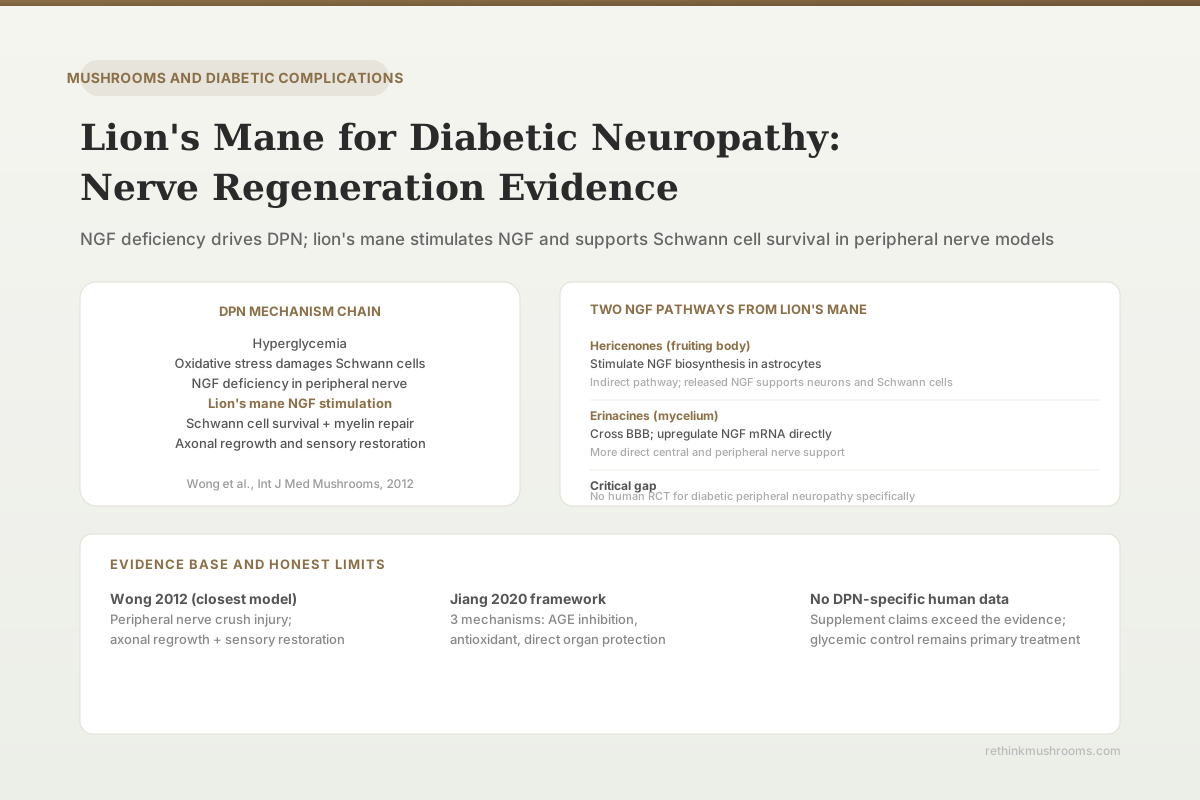
Lion's mane hericenones stimulate NGF biosynthesis; in peripheral nerve injury models, NGF-driven axonal regrowth and sensory restoration provide the mechanistic case for diabetic neuropathy applications.
Wong et al., Int J Med Mushrooms, 2012
No human DPN trial
no RCT has tested lion's mane specifically for diabetic peripheral neuropathy
Peripheral nerve model
axonal regrowth and sensory reflex restoration in crush injury animals (Wong 2012)
NGF induction
hericenones and erinacines from lion's mane induce nerve growth factor synthesis in nerve cells (Lai 2013)
Wong et al., Int J Med Mushrooms, 2012
 View as image ↗
About half of people with long-term diabetes develop peripheral neuropathy, the gradual damage to the nerves in the hands, feet, and legs that causes pain, numbness, tingling, and in severe cases, complete loss of sensation. It is one of the most common and debilitating complications of the disease, and conventional treatments manage symptoms but do not address the underlying nerve damage.
Lion's mane for diabetic neuropathy is an area where the mechanistic case is clear and direct, but where the clinical evidence has not yet caught up. The mushroom stimulates nerve growth factor (NGF), a protein essential for the survival of the myelin-producing cells that diabetic neuropathy damages. Animal studies of peripheral nerve injury, the closest available model to diabetic neuropathy, show axonal regrowth and functional recovery. No human trial has tested lion's mane specifically for diabetic peripheral neuropathy.
For the broader context of mushrooms and diabetic complications, see Mushrooms for Type 2 Diabetes: A Research-Based Guide.
Key Takeaways
- Diabetic peripheral neuropathy (DPN) results from chronic hyperglycemia damaging Schwann cells (the myelin-producing cells of peripheral nerves) via oxidative stress and impaired NGF signaling
- Lion's mane compounds stimulate nerve growth factor (NGF): Hericium erinaceus extract raised NGF gene expression in astrocytes and in the mouse hippocampus through the JNK signaling pathway (Mori et al., 2008), and both hericenones (fruiting body) and erinacines (mycelium) can induce NGF synthesis in nerve cells (Lai et al., 2013)
- In peripheral nerve crush injury models, lion's mane promoted axonal regrowth, improved myelination, and restored sensory reflexes via NGF upregulation (Wong et al., 2012); lion's mane extract also promoted myelination directly in nerve-cell cultures (Kolotushkina et al., 2003)
- A 2020 Frontiers review identifies mushroom polysaccharides as working through three mechanisms against diabetic complications: advanced glycation end product (AGE) inhibition, antioxidant pathway activation, and direct organ protection (Jiang et al., 2020)
- Beyond the nerves, lion's mane's polysaccharide fraction shares the antioxidant and AGE-inhibition activities linked to protection across diabetic target organs, indicating multi-organ complication activity rather than neuroprotection alone
- No published human RCT has tested lion's mane specifically for diabetic peripheral neuropathy; supplement brand claims about DPN reversal exceed the current evidence base
What Diabetic Peripheral Neuropathy Is and Why It Is Hard to Treat
Diabetic peripheral neuropathy develops when chronic exposure to high blood glucose damages the peripheral nervous system, the network of nerves extending beyond the brain and spinal cord into the limbs and organs. The damage pathway involves several interconnected mechanisms.
Excess glucose undergoes a chemical reaction called glycation, where it binds to proteins non-enzymatically. These glycated proteins accumulate into structures called advanced glycation end products (AGEs), which deposit in tissues including the walls of the blood vessels supplying peripheral nerves. Over years, this impairs blood flow to the nerves.
At the same time, excess glucose drives production of reactive oxygen species, molecules that damage cells. The myelin-producing cells of the peripheral nervous system, called Schwann cells, are particularly vulnerable to this oxidative damage. When Schwann cells are damaged or die, the myelin coating they maintain on nerve fibers breaks down. Without myelin, the electrical signal that nerves carry slows and eventually fails.
The result is the characteristic symptoms of DPN: numbness and tingling in the feet and hands, burning pain that is often worse at night, loss of balance and proprioception (the sense of where the body is in space), and in severe cases, the complete loss of protective sensation that leads to unhealed diabetic foot wounds.
NGF (nerve growth factor) plays a critical role in this disease process. NGF is required for the survival and maintenance of Schwann cells and the sensory neurons they serve. In diabetic neuropathy, NGF levels in peripheral nerves are reduced, contributing to Schwann cell loss and axonal degeneration. Restoring NGF signaling has been a target for DPN research for decades.
This is the mechanism through which lion's mane becomes relevant: it is among the most potent natural stimulators of NGF known, and peripheral nerve NGF deficiency is a core feature of diabetic neuropathy pathology.
The Mechanistic Connection: How Lion's Mane Stimulates NGF
Mori and colleagues, in a 2008 study, documented how Hericium erinaceus stimulates NGF in detail.[2] They found that lion's mane extract increased NGF gene expression in human astrocytes and, in mice fed the mushroom, raised NGF levels in the hippocampus, acting through a cell-signaling cascade known as the JNK pathway. Notably, the isolated hericenones they tested did not by themselves reproduce the full effect, indicating that the active NGF-stimulating constituents reside in the whole extract. Two compound classes are thought to drive these NGF-related effects through different routes.
Hericenones, found in the fruiting body of lion's mane, and erinacines, found in the mycelium, can both induce NGF synthesis in nerve cells.[3] Hericenones act largely on brain support cells called astrocytes: when astrocytes produce more NGF, the protein is released into surrounding tissue where it supports neuronal survival. This is an indirect mechanism, in which the mushroom's compounds act on support cells that then produce the growth factor benefiting neurons and Schwann cells.
Erinacines act differently. These diterpenoid compounds are small enough to cross the blood-brain barrier, the protective membrane that limits which molecules can enter the central nervous system, and comprehensive reviews of lion's mane's neurotrophic activity identify them as the primary drivers of its central NGF effects.[5] Once inside, erinacines upregulate NGF mRNA expression, the molecular instruction sequence for producing NGF protein, directly in central nervous tissue rather than depending on peripheral astrocyte activity.
The relevance to peripheral neuropathy is that NGF effects are not limited to the central nervous system. NGF receptors are present on peripheral sensory neurons and Schwann cells, and NGF supports their survival and function in the peripheral nervous system as well. A compound that increases NGF production systemically could theoretically support peripheral nerve health alongside its better-documented central effects.
Phan and colleagues' 2015 comprehensive review of culinary and medicinal mushrooms for neurological conditions identified lion's mane and its hericenones as unique among mushrooms for stimulating NGF through a non-immunological pathway, distinct from the immune-mediated activity of most mushroom polysaccharides.[7] This distinction matters for understanding why lion's mane has more specific neurological potential than mushrooms primarily studied for immune effects.
For more detail on hericenone-driven NGF synthesis, see Hericenones and NGF Synthesis: How Lion's Mane Stimulates Nerve Growth.
Mechanism Map
Where Lion’s Mane Meets the Diabetic Nerve-Damage Cascade
Diabetic neuropathy follows one specific chain, not random decay. Hyperglycemia injures Schwann cells, which depletes NGF, which drives demyelination and axonal loss. Lion’s mane’s two best-documented activities land on two nodes of that exact chain — NGF stimulation and myelination — which is why the interest is mechanistically specific. Every arrow below rests on cell or animal evidence only.
The cascade nodes are the established pathology of diabetic neuropathy; the two green intervention arrows are the points where documented lion’s mane activities align with that pathology — NGF stimulation [1][2][3] and myelination promotion [4]. Alignment of mechanism is not evidence of clinical benefit: no step in this figure has been demonstrated in human diabetic nerves.
Mechanism synthesis; nodes and arrows from refs [1][2][3][4]
The Peripheral Nerve Evidence: The Most Relevant Preclinical Model
Wong and colleagues' 2012 review specifically examined lion's mane in peripheral nerve injury models, making it the most mechanistically relevant evidence for diabetic neuropathy applications.[1]
The research they reviewed used crush injury models, where a peripheral nerve is physically compressed to simulate nerve damage. This is not a diabetes model, but it is mechanistically analogous in one critical way: both crush injury and diabetic neuropathy result in damage to peripheral axons and myelin, and both require NGF-driven regeneration for recovery.
In the peripheral nerve crush models, lion's mane extract produced several measurable effects. First, it accelerated axonal regrowth, the physical extension of the nerve fiber back toward its target tissue after injury. Second, it improved myelination, meaning the Schwann cells reestablished the myelin coating around regenerating fibers more completely; lion's mane extract has been shown to promote the myelination process directly in nerve-cell cultures.[4] Third, it restored sensory reflexes, the functional tests showing that the regenerated nerve fibers were actually transmitting signals.
These effects were attributed to NGF upregulation by lion's mane's bioactive compounds, operating through the same mechanism described in the Mori 2008 work.
Contato and Conte-Junior's 2025 narrative review, the most recent comprehensive review of lion's mane neuroprotective properties, confirmed that erinacine A is the primary active compound for neurodegeneration-relevant mechanisms and that anti-inflammatory pathways complement the neurotrophic activity.[8] In diabetic neuropathy, where neuroinflammation exacerbates myelin damage, this anti-inflammatory dimension adds a second potentially beneficial mechanism alongside the NGF stimulation.
The Three-Mechanism Anti-Diabetic Complication Framework
Jiang and colleagues' 2020 review in Frontiers in Pharmacology provides the most comprehensive framework for understanding how mushroom polysaccharides reduce diabetic complications.[6] The review identified three distinct mechanisms across multiple mushroom species: AGE inhibition, antioxidant pathway activation, and direct organ protection.
AGE inhibition is relevant to diabetic neuropathy because AGEs accumulate in peripheral nerve tissue and blood vessels, driving both the vascular impairment and the direct protein modification damage that underlies neuropathy. Mushroom polysaccharides with AGE-inhibiting properties could theoretically slow this accumulation.
Antioxidant pathway activation addresses the reactive oxygen species burden that damages Schwann cells. Several mushroom polysaccharide fractions activate the Nrf2 pathway, the master regulator of the cellular antioxidant response. Activating Nrf2 in tissue exposed to chronic hyperglycemia increases production of protective enzymes that neutralize oxidative damage.
Direct organ protection, in the context of the peripheral nervous system, relates to the specific survival-promoting effects on neurons and Schwann cells through growth factor signaling. This is where lion's mane's NGF stimulation fits most directly.
The Jiang 2020 review covers multiple species including lion's mane, cordyceps, and chaga for these mechanisms. Lion's mane's particular strength is the direct neurotrophic (NGF stimulation) component, while its polysaccharide fraction contributes to the antioxidant and AGE inhibition effects.
Lion's Mane Beyond Neuropathy: Broader Diabetic Anti-Complication Effects
Lion's mane's activity in diabetes may extend beyond the nervous system. Its polysaccharide fraction shares the antioxidant and AGE-inhibition activities that the Jiang 2020 review links to protection across multiple diabetic target organs, including the kidneys.[6] This positions lion's mane as part of the broader class of medicinal mushrooms studied for diabetic complications rather than a single-pathway agent.
For diabetic patients, the complications of diabetes affect multiple organ systems simultaneously: kidneys (nephropathy), eyes (retinopathy), nerves (neuropathy), and wound healing capacity. A compound that addresses multiple diabetic complications through shared mechanisms (oxidative stress reduction, AGE inhibition) is more valuable as an adjunct than one addressing only a single complication pathway.
Lion's mane appears to have this multi-organ character, with evidence across neuroprotective and anti-inflammatory mechanisms relevant to the diabetic complication landscape.
For the renal protection evidence specifically, see Cordyceps and Diabetic Kidney Disease: Renal Protective Research, which covers the most studied mushroom for diabetic nephropathy.
The Evidence Gap: Why No Human DPN Trial Exists Yet
Evidence Ladder
How Far Up the Ladder the Evidence Actually Reaches
Reading the studies as a hierarchy shows the ceiling. Cell studies and reviews establish the mechanism; adjacent animal models show nerve regrowth after a different kind of injury. The top rung — a human trial in diabetic neuropathy patients — is empty. The mechanism is well-supported; the clinical claim has no rung to stand on.
Rungs 1 and 2 are solid and consistent across independent groups [1][2][3][4][5]; rung 3 is real but tests a different kind of nerve injury; rung 4 — the only rung that would support a clinical claim — is empty. This is why the honest framing is “mechanistically relevant,” not “treats diabetic neuropathy.”
Evidence-hierarchy synthesis; rungs from refs [1][2][3][4][5]
The honest statement about lion's mane and diabetic neuropathy is that the preclinical mechanistic case is strong, and the human clinical evidence specifically for DPN does not exist.
Several factors explain this gap. First, peripheral neuropathy is difficult to study in clinical trials: measuring nerve function requires electrophysiological testing (nerve conduction velocity, sensory thresholds) that is more demanding than standard cognitive or blood marker assessments. Second, DPN progresses slowly, meaning clinical trials require longer durations to detect effects. Third, lion's mane research has focused heavily on the central nervous system (cognitive function, neurodegeneration) rather than peripheral nervous system applications.
The existing human trials for lion's mane are in cognitive function (MCI, early Alzheimer's), mood and anxiety, and general wellness. None of these populations have diabetic neuropathy as the primary outcome. The mechanistic pathway from NGF stimulation to peripheral nerve repair is plausible and supported by animal data, but plausibility is not clinical evidence.
Supplement content claiming that lion's mane can "reverse" or "cure" diabetic neuropathy goes far beyond what the evidence establishes. What the evidence establishes is a mechanism by which lion's mane could theoretically support peripheral nerve health in the context of diabetes, combined with animal data showing that this mechanism produces functional nerve recovery after peripheral nerve injury. A dedicated human DPN trial has not been done.
What the Research Cannot Tell You
Dose for DPN applications is unknown. Human cognitive trials have used 1g to 3g per day of fruiting body powder or extract. Whether these doses produce sufficient NGF stimulation in peripheral nerve tissue to benefit DPN is unknown.
Product form matters but has not been tested for this application. Erinacines from mycelium extract and hericenones from fruiting body extract produce NGF stimulation by different routes. No study has compared these forms for peripheral nerve outcomes.
DPN is a progressive condition with variable severity. Early, mild neuropathy (reversible myelin damage, intact axons) is mechanistically different from advanced neuropathy (axonal loss, irreversible changes). Lion's mane's NGF-driven repair mechanisms are most plausible for early-stage neuropathy with intact nerve architecture.
Blood glucose control is the primary intervention. No supplement can substitute for glycemic control in preventing or managing DPN. The most evidence-based approach to DPN is aggressive blood glucose management to slow the hyperglycemia that drives nerve damage in the first place. This article is educational and is not medical advice; anyone managing diabetic neuropathy should work with their physician before adding any supplement.
The Bottom Line
Lion's mane has a mechanistically direct case for diabetic peripheral neuropathy applications: it stimulates NGF (nerve growth factor), which is the growth protein essential for Schwann cell survival and peripheral nerve maintenance, and which is deficient in diabetic neuropathy. Animal studies of peripheral nerve injury show axonal regrowth and functional recovery via NGF upregulation. Mushroom polysaccharides in lion's mane also work through AGE inhibition and antioxidant mechanisms relevant to the broader diabetic complication picture. No human clinical trial has tested lion's mane specifically for diabetic peripheral neuropathy. The mechanistic rationale is sound; the clinical evidence does not yet exist.
Frequently Asked Questions
Sources & References
- 1RTHM-00500·Wong, Kah-Hui et al. (2012). “Neuroregenerative potential of lion's mane mushroom, Hericium erinaceus (Bull.: Fr.) Pers. (higher Basidiomycetes), in the treatment of peripheral nerve injury (review)..” International journal of medicinal mushrooms.Study breakdown →PubMed →↩
- 2RTHM-00268·Mori, Koichiro et al. (2008). “Nerve growth factor-inducing activity of Hericium erinaceus in 1321N1 human astrocytoma cells..” Biological & pharmaceutical bulletin.Study breakdown →PubMed →↩
- 3RTHM-00295·Lai, Puei-Lene et al. (2013). “Neurotrophic properties of the Lion's mane medicinal mushroom, Hericium erinaceus (Higher Basidiomycetes) from Malaysia..” International journal of medicinal mushrooms.Study breakdown →PubMed →↩
- 4RTHM-00058·Kolotushkina, E V et al. (2003). “The influence of Hericium erinaceus extract on myelination process in vitro..” Fiziolohichnyi zhurnal (Kiev.Study breakdown →PubMed →↩
- 5RTHM-01798·Szućko-Kociuba, Izabela et al. (2023). “Neurotrophic and Neuroprotective Effects of Hericium erinaceus..” International journal of molecular sciences.Study breakdown →PubMed →↩
- 6RTHM-01212·Jiang, Xue et al. (2020). “Adjuvant Therapy With Mushroom Polysaccharides for Diabetic Complications..” Frontiers in pharmacology.Study breakdown →PubMed →↩
- 7RTHM-00397·Phan, Chia-Wei et al. (2015). “Therapeutic potential of culinary-medicinal mushrooms for the management of neurodegenerative diseases: diversity, metabolite, and mechanism..” Critical reviews in biotechnology.Study breakdown →PubMed →↩
- 8RTHM-00921·Contato, Alex Graça et al. (2025). “Lion's Mane Mushroom (Hericium erinaceus): A Neuroprotective Fungus with Antioxidant, Anti-Inflammatory, and Antimicrobial Potential-A Narrative Review..” Nutrients.Study breakdown →PubMed →↩