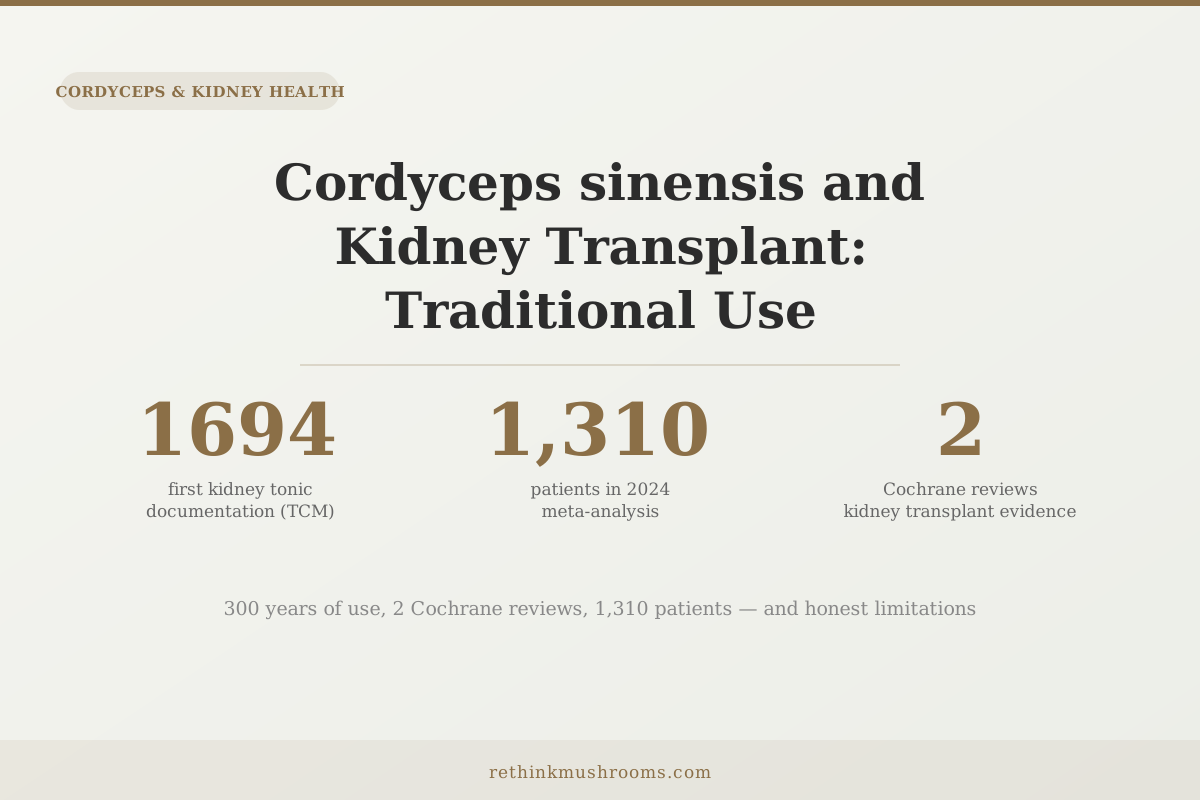
Cordyceps & Kidney Health
1,310 patients in the largest Cordyceps kidney meta-analysis
A 2024 meta-analysis of 15 studies and 1,310 patients found Cordyceps sinensis preparations significantly reduced blood creatinine, shortened oliguria periods, and increased urine osmolality as adjuvant treatment for renal dysfunction.
Wu et al., Frontiers in Medicine, 2024
447
kidney transplant patients in the Cochrane review (Hong et al., 2015)
1694
year Cordyceps appeared in Ben Cao Bei Yao as a kidney tonic
Lower AEs
vs. azathioprine: less hyperuricemia, hyperlipidemia, and liver injury
Wu et al., Frontiers in Medicine, 2024
 View as image ↗
Ophiocordyceps sinensis has been documented in Chinese medicine since at least 1694, when the Ben Cao Bei Yao listed it as a tonic for the kidneys and lungs. What makes that historical record interesting to modern readers isn't the date — it's that today, in Chinese hospitals, C. sinensis preparations are routinely used as adjuvant immunosuppressants in kidney transplant patients, and two Cochrane reviews have evaluated the clinical evidence for this specific use. The convergence of 300-year-old traditional application and contemporary clinical practice around the same organ is unusual enough to be worth examining closely.
For a broad overview of Cordyceps research, see what is Cordyceps: the science behind the energy mushroom.
Key Takeaways
- Cordyceps sinensis is documented as a kidney and lung tonic in the 1694 Chinese pharmacopeia Ben Cao Bei Yao — and is today used in Chinese hospitals as an adjuvant immunosuppressant after kidney transplant
- A Cochrane review of 5 studies and 447 kidney transplant patients found Cordyceps improved graft function and may reduce acute rejection compared to azathioprine — though all included studies were assessed as having unclear risks of bias due to limited reporting of study methods (Hong et al., Cochrane, 2015)
- A 2024 meta-analysis of 15 studies and 1,310 patients confirmed significant reductions in blood creatinine, shorter oliguria periods, and increased urine osmolality from Cordyceps sinensis as adjuvant treatment for renal dysfunction (Wu et al., Frontiers in Medicine, 2024)
- In a 202-patient randomized study, C. sinensis alongside cyclosporine A allowed significantly lower CsA doses at 2–6 months while halving hepatotoxicity (12.90% vs 24.77%) and nephrotoxicity (19.35% vs 33.94%) — though patient survival, graft survival and serum creatinine did not differ (Li et al., Transplantation Proceedings, 2009)
- Two mechanisms have been characterized at the molecular level: inhibition of cytokine-activated human mesangial cell proliferation (Lin et al., 1999) and suppression of Th22 cell chemotaxis (Xiao et al., 2018) — both specific to kidney pathology, but both established in cell culture and mice rather than in patients
- The creatinine benefit is not universal: in maintenance hemodialysis patients, pooled analysis found no significant improvement in serum creatinine, and the reviewers concluded the evidence was insufficient to recommend Cordyceps at all (Bee et al., 2019)
- The Cochrane authors note that the included evidence has methodological limitations: Hong (2015) rated all 5 transplant trials as unclear risk of bias, and Zhang (2014) rated 4 of 22 CKD trials as high risk and the rest as unclear — context that consumer articles often omit
TCM's Kidney Tonic: 300 Years Before the First Clinical Trial
In traditional Chinese medicine, C. sinensis occupies a specific category: it tonifies both the kidney and lung jing (essence), making it appropriate for conditions involving weakness or depletion in those systems. The 1694 Ben Cao Bei Yao entry is one of the earliest detailed pharmacopoeias to characterize it, and subsequent classical texts built on that categorization. By the 19th century, C. sinensis was widely understood in Chinese medicine as a kidney tonic in a specific sense: restorative for people depleted by age, illness, or convalescence.
The interesting feature of this traditional use is its organ specificity. Many medicinal mushrooms in TCM are categorized as general tonics or immune supports. Cordyceps was specifically paired with kidney and lung applications from the beginning. Whether this reflects empirical observation of effects, an application of the doctrine of signatures (the mushroom's larval substrate resembling a worm or caterpillar, associated symbolically with kidney qi in TCM theory), or both, is debated. What is less debatable is that when Chinese clinical researchers began investigating which traditional medicines might complement modern immunosuppressive therapy after kidney transplant, Cordyceps was a natural candidate.
How Cordyceps Entered Modern Chinese Transplant Medicine
The clinical adoption story runs primarily through a specific product: Bailing capsule. Bailing is a standardized cultured preparation of Hirsutella sinensis — the anamorph (asexual form) of O. sinensis, grown by fermentation rather than harvested from the wild.[12] In China it holds regulatory approval as a pharmaceutical for kidney disease, respiratory disease and immune disease — not the unregulated-supplement status Cordyceps products carry in most Western markets.[10] The specific preparation used in its registration trials is designated Cs-C-Q80.[11]
That regulatory status is worth pausing on, because it sets up an oddity in the evidence base. Bailing has been through a modern, placebo-controlled registration trial — just not for the indication it is best known for.
Evidence Quality Inversion
Bailing Capsule’s Best Trial Is Not in Kidney Disease
The same approved product carries both indications. Only one of them has been tested against a placebo, with blinding, prospective registration and reported harms — and it is not the one the product is famous for.
Chronic bronchitis
[11]- Design
- Randomised, double-blind, placebo-controlled, parallel-group
- Comparator
- Placebo
- Scale
- 240 randomised across 8 hospitals; 238 analysed (159 vs 79)
- Duration
- 48 weeks at 2.0 g three times daily
- Prospective registration
- ChiCTR1900025707
- Headline result
- Acute exacerbations 0.43 ± 0.82 vs 1.56 ± 1.34; wheezing severity P = 0.003
- Harms reported
- Yes — 29.6% vs 30.4%, no significant difference
Kidney transplant
[2]- Design
- Randomised and quasi-randomised trials, no blinding described
- Comparator
- Azathioprine or low-dose ciclosporin — never placebo
- Scale
- 5 studies / 447 recipients pooled by Cochrane
- Duration
- Three months to one year
- Prospective registration
- Not reported for included trials
- Headline result
- Graft function improved; graft and patient survival unchanged
- Harms reported
- Inconsistently; no study reported quality of life
Why this matters
A placebo-controlled result in bronchitis does not transfer to transplant medicine — different population, different endpoint, different risk. What it does prove is that a rigorous Bailing trial is possible: the manufacturer and Chinese trial infrastructure have already run one. The absence of an equivalent kidney trial after three decades of routine hospital use is therefore a choice, not a constraint.
Source: Shu 2024; Hong 2015; Zhang 2022 (see references)
Li and colleagues published a randomized clinical study in 2009 in 202 renal transplant patients (93 treatment vs 109 control), documenting how C. sinensis was used clinically alongside cyclosporine A (CsA), the primary immunosuppressant.[5] The rationale was pragmatic: CsA is nephrotoxic (it can damage the kidney it is trying to protect) and causes a range of metabolic side effects. C. sinensis was used as an adjuvant to allow lower CsA doses while maintaining immunosuppressive efficacy. The reported outcomes: CsA dosages in the treated group were significantly lower than control between 2-6 months post-transplant; serum uric acid and 24-hour urinary total protein were significantly lower in the treatment group; and the incidences of hepatotoxicity (12.90% vs 24.77%) and nephrotoxicity (19.35% vs 33.94%) were significantly lower in the treated group. Patient and graft survival, serum creatinine, and BUN did not differ significantly between groups.
Two further results are worth naming because they point in opposite directions. Chronic allograft nephropathy — the slow, progressive scarring that eventually costs most transplant recipients their graft — occurred in 7.53% of treated patients versus 18.35% of controls (P = .024), which is the single most clinically meaningful number in the study. But patient survival, graft survival, serum creatinine and blood urea nitrogen showed no significant difference at all. The authors' own conclusion is appropriately narrow: C. sinensis "may allow decreased dosages and concentrations of CsA causing fewer side effects without an increased risk of acute rejection."
The trial used randomization by lottery and was not blinded; methodologically it lies between an open cohort and a fully blinded RCT, which is consistent with the Cochrane rating of unclear risk of bias for most Chinese trials in this space.
Li et al. (2009) · Transplantation Proceedings
- Population
- 202 renal transplant recipients in China (93 treatment, 109 control), randomized by lottery, unblinded
- Intervention
- Cordyceps sinensis 1.0 g three times daily, added to a standard cyclosporine A-based immunosuppressive regimen
- Comparator
- The same immunosuppressive regimen without Cordyceps
- Finding
- CsA dosages were significantly lower in the treated group at 2–6 months post-transplant. Hepatotoxicity occurred in 12.90% vs 24.77% and nephrotoxicity in 19.35% vs 33.94%. Chronic allograft nephropathy occurred in 7.53% vs 18.35% (P = .024). Serum uric acid and 24-hour urinary total protein were also lower. Patient survival, graft survival, serum creatinine and BUN did not differ significantly.
mixed A real drug-sparing and toxicity-sparing signal, but no effect on the hard outcomes — survival, graft survival, or filtration measured by creatinine. Unblinded and single-country, so it supports the practice rather than proving it.
Li et al., Transplantation Proceedings, 2009 [5]
For the drug interaction implications of Cordyceps immunomodulation in transplant patients, see cordyceps side effects: what the safety research shows.
The Molecular Explanation for a 300-Year-Old Traditional Use
Three strands of laboratory work provide modern molecular context for why Cordyceps might have kidney-specific effects.
Lin and colleagues, working in 1999, took a bioassay-guided approach.[6] Mesangial cells are structural cells within the kidney's filtering units (glomeruli). When overactivated by immune complexes or injury — which happens in IgA nephropathy, the most common form of glomerular kidney disease globally — mesangial cell proliferation drives progressive kidney damage. The team built a model in which cultured human mesangial cells were activated with interleukin-1 plus interleukin-6, then screened six chromatographic fractions of C. sinensis fruiting bodies against it. One fraction, F-2, significantly inhibited that activation. Fed at 1% of the diet to mice with an experimentally induced IgA nephropathy, F-2 significantly reduced hematuria and proteinuria with histopathologic improvement. Further purification of F-2 yielded the compound the paper is usually cited for: H1-A.
Xiao and colleagues extended this in 2018 — not in patients, but in an induced IgA nephropathy model in six-week-old female BALB/c mice randomized into normal-control, disease and C. sinensis-treated (5 mg/kg/day) groups.[7] After one month of treatment, the frequency of Th22 cells fell, mesangial cell proliferation decreased, and expression of the chemokine receptor CCR10 along with its ligand CCL27 and the cytokine IL-22 was significantly reduced. Th22 cells produce IL-22, which drives mesangial cell activation and inflammation in IgA nephropathy; the CCL27–CCR10 axis is what recruits them to tissue. The authors' conclusion is stated as a possibility rather than a finding — C. sinensis "may modulate the chemotaxis of Th22 cells to suppress inflammatory responses."
Together, these mechanisms suggest that C. sinensis has molecular activity relevant to the most common forms of kidney inflammation and injury — not just general anti-inflammatory effects, but effects directed at cell types and pathways central to kidney disease. A third strand of preclinical work points the same way: a nucleoside/nucleobase-rich C. sinensis extract limited epithelial–mesenchymal transition and extracellular matrix deposition in diabetic mice and in human kidney tubular cells, acting through p38 and ERK signaling.[13] This is the mechanistic foundation that gives the traditional use some biological plausibility beyond historical coincidence — while remaining, in every case, evidence from cells and rodents.
What Two Cochrane Reviews Found — and What They Were Honest About
Cochrane reviews are systematic evaluations of clinical evidence conducted using rigorous, pre-specified methods. Two separate Cochrane reviews examined Cordyceps sinensis in kidney patients.
Zhang and colleagues published the CKD review in 2014, covering 22 studies and 1,746 participants taking C. sinensis as adjuvant therapy in chronic kidney disease and not on dialysis.[3] Compared to conventional treatment alone, Cordyceps preparations decreased serum creatinine by a mean of 60.76 µmol/L (95% CI −85.82 to −35.71; 14 studies, 987 participants), increased creatinine clearance by 9.22 mL/min (95% CI 3.10 to 15.34; 6 studies, 362 participants), and reduced 24-hour proteinuria by 0.15 g (95% CI −0.24 to −0.05; 4 studies, 211 participants). These are meaningful clinical markers — creatinine is a waste product that the kidneys filter; elevated blood creatinine indicates impaired filtering function.
Hong and colleagues published the kidney transplant review in 2015, covering 5 studies (six reports) and 447 transplant recipients.[2] Four trials (n=265) compared Cordyceps with azathioprine and one trial (n=182) compared Cordyceps plus low-dose CsA versus standard-dose CsA. Compared to azathioprine, Cordyceps showed no significant difference in graft or patient survival, but improved graft function and may reduce acute rejection episodes; anaemia, leucopenia, and liver function improved, and incidence of infection may also be reduced.
The second comparison is the one that usually gets dropped in summaries, and it is less flattering. Against standard-dose cyclosporine, adding Cordyceps to a reduced CsA dose produced no statistically significant difference in patient survival, graft loss, acute rejection or allograft function. There was limited low-quality evidence suggesting benefits in pulmonary infection, serum albumin, serum uric acid, and both CNI nephrotoxicity and hepatotoxicity — but on the outcomes that define transplant success, that single 182-patient trial was null.
Both reviews included methodological caveats. Hong (2015) assessed all 5 included studies as having unclear risks of bias due to limited reporting of study methods. Zhang (2014) assessed 4 of the 22 CKD trials as high risk of bias and the remaining 18 as unclear. The Cochrane authors were explicit that these limitations, together with short follow-up (three months to one year in Hong) and the small number of studies, mean the results should be interpreted with caution.
The 2024 Meta-Analysis: The Largest Dataset to Date
Wu and colleagues published the most recent and largest synthesis in 2024, pooling 15 studies covering 1,310 patients with renal dysfunction across different clinical contexts.[1]
The specific outcomes showing significant improvement with C. sinensis adjuvant:
Blood creatinine — significantly reduced, consistent across pooled studies. Creatinine reduction signals improved glomerular filtration function.
Oliguria period — shortened. Oliguria (abnormally low urine output) is a marker of acute kidney injury severity; shorter oliguria periods indicate faster recovery of tubular function.
Urine osmolality — increased. Urine osmolality reflects the kidney's ability to concentrate urine; higher osmolality indicates improved tubular function.
The 2024 review concluded that C. sinensis "can be considered a dependable clinical treatment" for renal dysfunction, improving the function of both glomeruli and tubules. The language is stronger than the Cochrane hedging — and one methodological detail is worth flagging for anyone reading the paper itself. Wu et al. reported their pooled estimates as sensitivity (0.89), specificity (0.69), diagnostic odds ratio (18.0) and a summary ROC curve with an area under the curve of 0.88. Those are diagnostic-accuracy statistics, normally used to describe how well a test identifies a condition, rather than the risk ratios and mean differences used to describe how much a treatment changes an outcome. The review was prospectively registered (PROSPERO CRD42024559042) and its direction of effect agrees with the two Cochrane reviews, but that unusual framing is a reason to weigh it alongside Zhang and Hong rather than above them.
Ong and colleagues' earlier meta-analysis pooled nine transplant studies, four of which compared Cordyceps-based therapy against azathioprine-based therapy, and found an advantage that the kidney function numbers alone don't capture: fewer metabolic side effects.[4] Against azathioprine, acute rejection rates, graft survival and patient survival were comparable, but the Cordyceps group showed better kidney function and lower incidences of hyperuricemia (elevated uric acid), hyperlipidemia (elevated blood fats), hyperglycemia, and liver injury. If efficacy is comparable on the outcomes that matter and the toxicity profile is better, that is a genuine advantage for patients — with the caveat Ong states directly: these nine studies were at moderate risk of bias from poor reporting of methods, and adverse events were "either not monitored or poorly documented in most trials."
Beyond Transplant: The Hemodialysis and Renal Fibrosis Data
The kidney evidence extends beyond transplant to the broader spectrum of kidney disease management.
Bee and colleagues' 2019 meta-analysis pooled 12 studies and 655 maintenance hemodialysis patients — and it is the most important corrective in this entire literature, because it is where the pattern breaks.[8] Low-to-moderate quality evidence showed that Cordyceps plus conventional treatment improved C-reactive protein (SMD −0.61), high-sensitivity CRP (−3.44 mg/L), serum albumin (+3.07 g/L), malondialdehyde (−1.95 nmol/L) and haemoglobin (+9.56 g/L). Those are markers of inflammation, nutrition, oxidative stress and anaemia. Serum creatinine did not significantly improve, and neither did LDL cholesterol.
The reviewers' own bottom line is unambiguous and rarely quoted: given the small number of trials, their unclear methodological quality and high heterogeneity, "the evidence obtained in this review is insufficient to recommend the use of cordyceps as adjunctive treatment in hemodialysis patients."
Outcome by Clinical Context
“Cordyceps Lowers Creatinine” — Except Where It Doesn’t
Five pooled analyses cover five different kidney populations. Four of them are routinely summarised as one claim. The creatinine column shows why that summary breaks: in maintenance hemodialysis the effect is absent, and the reviewers who found that declined to recommend the treatment at all.
Kidney transplant
[2]All 5 studies rated unclear risk of bias
Serum creatinine
Arm-dependentGraft function improved vs azathioprine; no benefit at all in the low-dose-CsA arm
What else moved
Anaemia, leucopenia and liver function improved; acute rejection may fall; infection may fall. No difference in graft or patient survival.
Favourable, but not on the outcomes that matter most
Kidney transplant
[4]Moderate risk of bias (poor reporting of methods)
Serum creatinine
ReducedBetter kidney function than azathioprine-based therapy
What else moved
Lower hyperuricemia, hyperlipidemia, hyperglycemia and liver injury. Acute rejection, graft and patient survival comparable.
Same efficacy, better metabolic tolerability
CKD, not on dialysis
[3]4 studies high risk, 18 unclear
Serum creatinine
ReducedSerum creatinine −60.76 µmol/L (95% CI −85.82 to −35.71)
What else moved
Creatinine clearance +9.22 mL/min (95% CI 3.10 to 15.34); 24 h proteinuria −0.15 g/24 h (95% CI −0.24 to −0.05).
Largest and most consistent creatinine signal
Renal dysfunction / AKI
[1]Assessed with the Cochrane risk-of-bias tool; predominantly Chinese trials
Serum creatinine
ReducedBlood creatinine significantly reduced
What else moved
Oliguria period shortened and urine osmolality increased — glomerular and tubular function both. SROC AUC 0.88 (95% CI 0.85–0.90).
Authors call it "a dependable clinical treatment"
Maintenance hemodialysis
[8]Low-to-moderate quality evidence; unclear methodological quality; high heterogeneity
Serum creatinine
No changeNo significant improvement in serum creatinine (or LDL-C)
What else moved
CRP, hs-CRP, serum albumin, malondialdehyde and haemoglobin all improved — inflammation, nutrition and anaemia, not filtration.
Authors: evidence insufficient to recommend use
The pattern
The creatinine benefit tracks how much kidney is left to protect. In CKD and acute renal dysfunction, where residual filtration still exists, pooled creatinine falls. In maintenance hemodialysis, where a machine has replaced filtration, it does not — and what improves instead is inflammation, nutrition and anaemia. That is a biologically coherent pattern, not a contradiction, but it means the blanket claim is wrong and the population matters more than the dose.
Source: Wu 2024; Hong 2015; Zhang 2014; Ong 2017; Bee 2019 (see references)
Tan and colleagues' 2022 review covered the evidence for Cordyceps and related products in renal fibrosis — the scarring process that drives progression of almost all kidney diseases toward end-stage failure.[9] The mechanisms it catalogues are inflammation, oxidative stress, apoptosis, regulation of autophagy, reduction of extracellular matrix deposition, and fibroblast activation. Its assessment of the clinical literature is the same one every rigorous source in this article reaches: available studies support Cordyceps as an adjuvant to conventional drugs in chronic kidney disease, but "the existing clinical studies are limited by low quality and significant heterogeneity," and adequately designed randomized trials are still needed.
The picture that emerges from the full body of literature is more textured than the consumer version. Cordyceps sinensis has been investigated across the kidney disease spectrum from IgA nephropathy to transplant to CKD to hemodialysis. In CKD and mixed renal dysfunction, the creatinine signal is consistent and the pooled effect sizes are non-trivial. In transplant, the benefit is real but sits on tolerability and drug-sparing rather than on graft or patient survival, both of which were unchanged in every comparison. In hemodialysis, the filtration benefit disappears entirely and the reviewers declined to recommend it. Across all of it, the evidence is China-only, largely unblinded, rated unclear-to-high risk of bias, and short-term. The consistency that does exist is worth noting; so is the fact that it is not uniform.
- Cell & mechanistic studiescompleted
Bioassay-guided fractionation to H1-A against IL-1/IL-6-activated human mesangial cells (Lin 1999); EMT and ECM suppression via p38/ERK in human tubular cells (Dong 2019)
- Animal modelscompleted
Induced IgA nephropathy in mice with reduced Th22 chemotaxis (Xiao 2018); diabetic-nephropathy rats treated with Bailing capsule (Zhang 2022); F-2 fraction reduced hematuria and proteinuria in mice (Lin 1999)
- Small human trialscompleted
Unblinded randomized and quasi-randomized Chinese trials, typically 60–200 patients, active comparators rather than placebo (e.g. Li 2009, n = 202)
- Large, blinded, placebo-controlled RCT in kidney diseasemissing
None. The one double-blind placebo-controlled Bailing trial (Shu 2024, n = 240) is in chronic bronchitis, not kidney disease
- Meta-analysiscurrent
Five pooled analyses (Zhang 2014; Hong 2015; Ong 2017; Bee 2019; Wu 2024) — consistent in CKD, null for creatinine in hemodialysis, all constrained by the quality of the underlying trials
This literature has an unusual shape: it reaches meta-analysis without ever passing through a large blinded placebo-controlled trial in kidney disease. Pooling many small unblinded trials produces narrow confidence intervals but cannot remove the bias they share. That is why Zhang, Hong, Ong, Tan and Wu all reach favourable directional conclusions while still calling for better trials — and why Bee, looking at hemodialysis, declined to recommend the treatment at all.
Synthesis of references [1]–[13] cited in this article
Transplant Safety
CriticalNever add Cordyceps to a transplant regimen on your own
Concern
Every favourable result in this article comes from supervised settings where clinicians deliberately adjusted immunosuppressant dosing alongside Cordyceps. In Li's 202-patient study, whole-blood trough cyclosporine concentrations were significantly lower in the Cordyceps group at 3–6 months — a change in drug exposure, not just drug dose. A transplant recipient who adds Cordyceps to a fixed regimen without monitoring is altering the exposure of the drug that keeps their graft alive, in an uncontrolled direction.
What the research says
There is also a mechanistic tension worth naming: the transplant literature uses Cordyceps as an adjuvant immunosuppressant, while a separate preclinical literature characterises Cordyceps species as immunostimulatory. Both cannot be assumed to apply to a given product, species and dose, and no trial has resolved which prevails in a transplant recipient.
Particularly relevant for: Kidney transplant recipients, and anyone taking calcineurin inhibitors such as cyclosporine or tacrolimus
What to do
Do not start, stop or change any Cordyceps product without your transplant team. If you already take one, tell them — it belongs on your medication list, and trough-level monitoring is the only way to know what it is doing.
Li et al., 2009 [5]; Hong et al., Cochrane, 2015 [2]
This article describes what the research shows. It is not medical advice, and nothing here should be used to self-manage kidney disease or post-transplant care.
For the full evidence on how Cordyceps affects creatinine levels specifically, see cordyceps and creatinine levels: what the studies show. For the kidney protection research more broadly, see cordyceps and kidney health: research on renal protection. For the immunosuppression research in transplant patients specifically, see cordyceps and kidney transplant: immunosuppression research in renal patients.
The Bottom Line
Cordyceps sinensis has been used in Chinese medicine as a kidney tonic since at least 1694, and is today used as an adjuvant immunosuppressant in Chinese hospitals after kidney transplant, primarily in the form of Bailing capsule — a cultured Hirsutella sinensis preparation approved in China as a pharmaceutical. Two Cochrane reviews and a 2024 meta-analysis of 1,310 patients show improved kidney function markers as an adjuvant to conventional treatment: serum creatinine fell by a mean 60.76 µmol/L in CKD (Zhang 2014), and creatinine, oliguria duration and urine osmolality all improved in mixed renal dysfunction (Wu 2024). The effect is not uniform, and that is the part consumer coverage omits — in maintenance hemodialysis, pooled analysis found no significant creatinine improvement and the reviewers judged the evidence insufficient to recommend Cordyceps at all (Bee 2019). In transplant specifically, graft and patient survival were unchanged in every comparison; the benefit sits on drug-sparing and tolerability. Molecular mechanisms — mesangial cell proliferation inhibition (Lin 1999) and Th22 chemotaxis suppression (Xiao 2018) — are established in cell culture and mice, not in patients. The honest limitation: all clinical evidence is from Chinese trials, rated unclear risk of bias (Hong 2015, all 5 studies) or mostly unclear (Zhang 2014, 18 of 22 unclear and 4 high), with no double-blind placebo-controlled trial in kidney disease anywhere in the literature. Cordyceps is not established practice outside Chinese clinical settings, and unsupervised use by transplant patients presents genuine drug-exposure risks.
Frequently Asked Questions
Sources & References
- 1RTHM-02021·Wu, Fenfang et al. (2024). “Efficacy of traditional Chinese medicine Cordyceps sinensis as an adjunctive treatment in patients with renal dysfunction: a systematic-review and meta-analysis..” Frontiers in medicine.Study breakdown →PubMed →↩
- 2RTHM-00375·Hong, Tao et al. (2015). “Cordyceps sinensis (a traditional Chinese medicine) for kidney transplant recipients..” The Cochrane database of systematic reviews.Study breakdown →PubMed →↩
- 3RTHM-00360·Zhang, Hong Wei et al. (2014). “Cordyceps sinensis (a traditional Chinese medicine) for treating chronic kidney disease..” The Cochrane database of systematic reviews.Study breakdown →PubMed →↩
- 4RTHM-00486·Ong, Bee Yean et al. (2017). “Efficacy of Cordyceps sinensis as an adjunctive treatment in kidney transplant patients: A systematic-review and meta-analysis..” Complementary therapies in medicine.Study breakdown →PubMed →↩
- 5RTHM-00161·Li, Y et al. (2009). “Clinical application of Cordyceps sinensis on immunosuppressive therapy in renal transplantation..” Transplantation proceedings.Study breakdown →PubMed →↩
- 6RTHM-00029·Lin, C Y et al. (1999). “Inhibition of activated human mesangial cell proliferation by the natural product of Cordyceps sinensis (H1-A): an implication for treatment of IgA mesangial nephropathy..” The Journal of laboratory and clinical medicine.Study breakdown →PubMed →↩
- 7RTHM-00536·Xiao, Chenggen et al. (2018). “Cordyceps sinensis may inhibit Th22 cell chemotaxis to improve kidney function in lgA nephropathy..” American journal of translational research.Study breakdown →PubMed →↩
- 8RTHM-01033·Bee Yean, Ong et al. (2019). “Efficacy of Cordyceps sinensis as an adjunctive treatment in hemodialysis patients: a systematic review and Meta-analysis..” Journal of traditional Chinese medicine = Chung i tsa chih ying wen pan.Study breakdown →PubMed →↩
- 9RTHM-00798·Tan, Wei et al. (2022). “Potential Therapeutic Strategies for Renal Fibrosis: Cordyceps and Related Products..” Frontiers in pharmacology.Study breakdown →PubMed →↩
- 10RTHM-00807·Zhang, Qian et al. (2022). “Bailing capsule (Cordyceps sinensis) ameliorates renal triglyceride accumulation through the PPARα pathway in diabetic rats..” Frontiers in pharmacology.Study breakdown →PubMed →↩
- 11RTHM-00910·Shu, Xinyang et al. (2024). “Efficacy and safety of Cordyceps sinensis (Hirsutella sinensis, Cs-C-Q80) in chronic bronchitis..” Frontiers in pharmacology.Study breakdown →PubMed →↩
- 12RTHM-00542·Lo, Hui-Chen et al. (2013). “A Systematic Review of the Mysterious Caterpillar Fungus Ophiocordyceps sinensis in Dong-ChongXiaCao ( Dōng Chóng Xià Cǎo) and Related Bioactive Ingredients..” Journal of traditional and complementary medicine.Study breakdown →PubMed →↩
- 13RTHM-00552·Dong, Zhonghua et al. (2019). “A Nucleoside/Nucleobase-Rich Extract from Cordyceps Sinensis Inhibits the Epithelial-Mesenchymal Transition and Protects against Renal Fibrosis in Diabetic Nephropathy..” Molecules (Basel.Study breakdown →PubMed →↩