Cordyceps (C. militaris & C. sinensis)
528 athletes
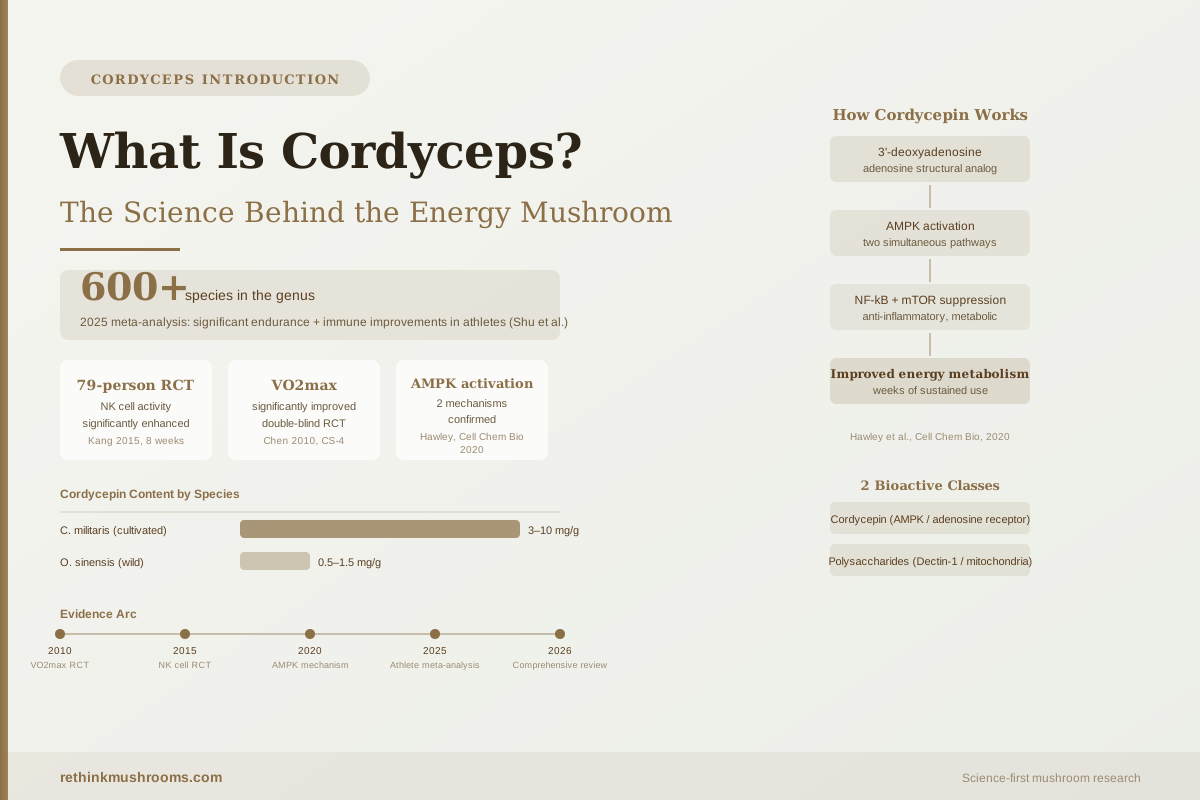
A 2025 systematic review and meta-analysis pooled 14 randomized trials covering 528 athletes and found that Cordyceps sinensis supplementation significantly improved endurance performance, ventilatory threshold, and VO2peak.
Shu et al., Frontiers in Nutrition, 2025
79-person RCT
enhanced NK cell activity over 4 weeks of C. militaris at 1.5g/day (Kang 2015)
Pro-drug
cordycepin is converted by cells into cordycepin monophosphate, the molecule that activates AMPK (Hawley 2020)
No VO2max change
in the most-cited CS-4 exercise trial — thresholds moved, the ceiling did not (Chen 2010)
Shu et al., Frontiers in Nutrition, 2025
 View as image ↗
The fungus that inspired the zombie apocalypse narrative in "The Last of Us" turns out to be one of the more actively researched subjects in sports physiology. Cordyceps is a genus of parasitic fungi with hundreds of described species. Most parasitize insects; two of them have become the focus of an increasingly serious body of human research. A 2025 systematic review and meta-analysis of fungal supplementation in adult athletes pooled 14 randomized controlled trials covering 528 athletes and found that Cordyceps sinensis significantly improved endurance performance, ventilatory threshold, and VO2peak.[1]
What is cordyceps, and how does it actually work? The honest answer requires distinguishing between two species with different compound profiles and different clinical evidence bases, and understanding a molecular mechanism that wasn't correctly explained until a 2020 paper in Cell Chemical Biology — a mechanism that turns out to be different from the one most consumer articles describe.
Key Takeaways
- Cordyceps is a genus of parasitic fungi with hundreds of described species; the two most-researched are Cordyceps militaris (commercially cultivated) and Ophiocordyceps sinensis (wild, roughly $20,000-$40,000 per kilogram on the Tibetan plateau)
- The primary bioactive is cordycepin (3'-deoxyadenosine), but cordycepin is a pro-drug: cells convert it into cordycepin monophosphate, and that molecule is what activates AMPK (Hawley et al., Cell Chemical Biology, 2020)
- A 2025 meta-analysis of 14 trials in 528 athletes found Cordyceps sinensis significantly improved endurance performance, ventilatory threshold, and VO2peak (Shu et al., Frontiers in Nutrition, 2025)
- A 79-person randomized controlled trial found C. militaris at 1.5g/day for 4 weeks significantly enhanced NK cell activity and lymphocyte proliferation in healthy Korean men, with no significant adverse reactions (Kang et al., 2015)
- The most-cited cordyceps exercise trial found improved metabolic and ventilatory thresholds but explicitly no change in VO2max — a distinction routinely collapsed in supplement marketing (Chen et al., 2010)
- C. militaris is the species in nearly every commercial supplement because it can be cultivated and standardized; most wild O. sinensis clinical evidence sits in kidney and traditional-medicine applications rather than athletic performance
What Cordyceps Is: A Genus of Insect-Parasitizing Fungi
Cordyceps is a genus of parasitic fungi in the family Cordycipitaceae. Most species parasitize insects and other arthropods, eventually killing the host and emerging from its body to release spores. The two species with the most research behind them are Cordyceps militaris, which can be commercially cultivated and is the source of most supplements on the market, and Ophiocordyceps sinensis, the wild Tibetan caterpillar fungus that has been used in traditional medicine for centuries and is among the most expensive biological products in the world.[3]
Both species produce cordycepin and polysaccharides among their primary bioactive compounds. They work through different mechanisms — cordycepin through the adenosine and AMPK axis, polysaccharides through immune pattern-recognition pathways — and they're present in different concentrations across species and preparations.[5]
The name "cordyceps" has become shorthand in the supplement market for a broad category of fungi with overlapping but distinct properties. Understanding which species is in a product, and what evidence applies to that specific species, is the starting point for making sense of any claim about it.
How Cordyceps Grows: The Lifecycle Behind the Name
The wild species that dominates traditional medicine accounts for most of the name recognition. Ophiocordyceps sinensis is called yartsa gunbu in Tibetan and DongChongXiaCao in Chinese, both meaning roughly "winter worm, summer grass" — a name that describes the organism's two visible states.[3] It spends most of its life inside the body of a ghost moth larva (Thitarodes spp.) on the high-altitude grasslands of the Tibetan plateau and the surrounding Himalayan range.
The cycle works like this: spores infect the caterpillar in autumn, germinate inside its body over winter, and gradually colonize its tissues. By spring, the larva is mummified. The fungal stroma — the fruiting body — erupts from the caterpillar's head and emerges above the soil. Harvesters find the small orange stalks by scanning the mountainside before the stroma disperses its spores. The harvest window is narrow and the terrain is extreme, which is part of why wild O. sinensis has been valued at roughly $20,000 to $40,000 per kilogram, earning it the nickname "soft gold" in China.[3]
Traditional Tibetan and Chinese medicine used this fungus as a tonic for lung weakness, kidney deficiency, and fatigue. A systematic review of the wild caterpillar fungus catalogued more than 30 reported bioactivities and more than 20 bioactive ingredients across wild material, mycelia, and culture supernatants — a breadth that reflects both genuine chemical complexity and the loose standards of much of the older literature.[3]
Cordyceps militaris has a parallel lifecycle in nature, parasitizing moth pupae rather than caterpillars. The critical practical difference is that it can be grown on grain substrates in controlled environments, which is why it is the commercially dominant species: it is straightforward to cultivate for mass production, whereas O. sinensis remains expensive and difficult to collect.[2] Cultivation conditions also shape the compound profile. Metabolomic profiling of C. militaris fruiting bodies across developmental stages found that cordycepin is significantly enriched during the aging phase of fruiting body development rather than during peak growth, meaning harvest timing itself changes what ends up in the final material.[11]
This combination — cultivability plus controllable compound content — is why C. militaris is the species in virtually every commercial cordyceps supplement sold today.
A note on naming: the wild species is correctly called Ophiocordyceps sinensis, with Cordyceps sinensis retained as a synonym. Its asexual (anamorph) form was long known separately as Hirsutella sinensis. Under the International Code of Nomenclature for algae, fungi, and plants, the "one fungus, one name" rule took effect on January 1, 2013, ending the practice of maintaining separate names for the sexual and asexual forms of the same organism.[3] Supplement labels still predominantly use the old name. When you see "Cordyceps sinensis" in an ingredient list, it typically refers to O. sinensis material, or to CS-4, a mycelium fermentation product.
Militaris vs. Sinensis: Two Species With Different Evidence Bases
Most articles about cordyceps treat all forms as equivalent. The clinical evidence does not support that.
Ophiocordyceps sinensis has a centuries-long traditional use history and has been studied most extensively for kidney applications in Chinese medicine. Systematic reviews examining O. sinensis preparations for chronic kidney disease and kidney transplant recipients have found some signals of benefit for kidney function markers, but have rated the overall evidence quality as low due to methodological limitations in the underlying trials. The clinical evidence base for wild O. sinensis is concentrated in kidney and transplant medicine, not in the athletic or energy applications most people associate with the name.
Cordyceps militaris has a different and more modern evidence profile. Because it can be commercially grown and standardized, it has been the subject of better-controlled trials. A 2026 review of C. militaris in Phytotherapy Research synthesized in vitro, in vivo, and clinical trial data across immunomodulatory, antitumor, antioxidant, anti-diabetic, anti-obesity, and neuroprotective activities, noting that the immunomodulatory effects are the most studied of these — a research portfolio that extends well beyond the kidney indications where sinensis evidence is concentrated.[2]
CS-4 is a third category: a mycelium fermentation product developed in China from cultivated C. sinensis. It has direct human trial data, including the Chen 2010 exercise trial discussed below, but as a mycelium product rather than a fruiting body, its compound profile differs from cultivated fruiting bodies.
For a detailed three-way comparison and a framework for evaluating supplement labels, see The Wild vs. Cultivated Cordyceps Debate: Does Origin Affect Efficacy?. For the cultural, ecological, and pricing story behind wild O. sinensis, see The Wild Cordyceps Controversy: Why It Costs $20,000 Per Kilogram.
The Compound That Explains the Effects: Cordycepin and Its Roles
A 2015 review by Liu and colleagues mapped the chemical profile of Cordyceps sinensis, covering the major bioactive categories: cordycepin (3'-deoxyadenosine), polysaccharides, ergosterol, D-mannitol, and free adenosine.[5] Each is associated with pharmacological activity, but cordycepin and polysaccharides are the two that researchers have studied most extensively.
Cordycepin is the molecule that defines the genus pharmacologically. Its structure is nearly identical to adenosine, the naturally occurring molecule that cells use in energy transfer and signaling. The one difference: cordycepin is missing a hydroxyl group at the 3' position of the ribose sugar, which is why it's called 3'-deoxyadenosine. That structural similarity to adenosine is what gives cordycepin its pharmacological reach — and, as the next section explains, it is also what lets the cell's own machinery act on it.
Pharmacokinetic work in rats measured cordycepin and adenosine in blood and liver and found that both declined rapidly, within roughly 30 minutes of administration, with short elimination half-lives and high rates of clearance. Blocking adenosine deaminase with the inhibitor EHNA suppressed the biotransformation of both — direct evidence that cordycepin is processed through an adenosine-like metabolic route.[8] This is useful mechanistic confirmation, but it also flags a real translational problem: a compound cleared that quickly has limited systemic exposure, which is one reason cell-level findings don't automatically scale to whole-organism effects.
Polysaccharides operate through a separate pathway. Rather than engaging the adenosine machinery, they act on immune pattern-recognition pathways that trigger innate immune cell responses. A study of polysaccharides extracted from cultivated C. militaris fruiting bodies found that they inhibited mitochondrial swelling and injury induced by Fe²⁺-L-cysteine in vitro, scavenged superoxide anions, and — in mice given D-galactose to induce an accelerated aging model — significantly increased liver catalase, superoxide dismutase, and glutathione peroxidase activity.[9] These are cell and animal findings, not human ones, and they are attributable to the polysaccharide fraction rather than to cordycepin.
A 2023 review in Molecules grouped Cordyceps with lion's mane, reishi, chaga, shiitake, and turkey tail as medicinal mushrooms being developed into functional foods, characterised by β-glucans, triterpenes, phenolic compounds, and sterols. Its conclusion is worth quoting for calibration: the detailed mechanisms by which these mushrooms act on the human body still require long-term clinical studies to confirm their nutraceutical effects, their safety of use, and their dosage.[12] That caveat applies to the compound distinctions above: cordycepin and polysaccharides are different molecules acting through different routes, but a label reading "cordyceps extract" tells you which mushroom was used and very little else.
For compound-level detail including how extraction method affects bioavailability, see Cordyceps Bioactive Compounds: Cordycepin, Adenosine, and Polysaccharides.
The 2020 AMPK Discovery: Cordycepin Is a Pro-Drug
Most consumer content about cordyceps says it "increases ATP" or "boosts energy metabolism." A more sophisticated version of the claim, common in supplement copy, is that cordycepin activates AMPK by directly mimicking AMP. That version is closer, but it is still not what the definitive paper found.
AMPK, or AMP-activated protein kinase, is the enzyme cells use as an energy sensor. When a cell is running low on energy, AMP levels rise relative to ATP. AMPK detects this shift and turns on, telling cells to take up more glucose, burn more fat, build more mitochondria, and switch off energy-consuming processes. It's the molecular switch exercise researchers have studied for decades and the primary target of metformin.
A 2020 paper by Hawley and colleagues in Cell Chemical Biology established how cordycepin actually activates AMPK, and the answer reframes the compound entirely: cordycepin is a pro-drug.[4]
Mechanism · Hawley 2020
Cordycepin Is a Pro-Drug — the Cell Builds the Active Molecule
Cordycepin does not switch AMPK on by itself. Your cells convert it into a different molecule, and that molecule is what the enzyme actually responds to.
Cordycepin reaches the cell
Cordycepin (3′-deoxyadenosine) crosses the membrane through adenosine transporters — the same route the cell uses for adenosine itself.
Cellular metabolism phosphorylates it
Inside the cell it is converted into cordycepin mono-, di-, and triphosphate. At high concentrations these can almost replace the cell’s own adenine nucleotides.
Cordycepin monophosphate is the active species
AMPK activation tracks the content of cordycepin monophosphate specifically — not cordycepin, and not the other adenine nucleotides.
It acts as an AMP analog at the γ-subunit
In cell-free assays cordycepin monophosphate reproduces all three effects of AMP on AMPK. In cells, a γ-subunit mutation that blocks AMP activation also blocks this one — the same site, the same switch.
What the same paper ruled out
The correlation with AMPK activation held for cordycepin monophosphate and not for cordycepin or the other adenine nucleotides. That negative result is what makes the pro-drug conclusion load-bearing rather than a restatement of “cordycepin activates AMPK.”
Source: Hawley et al. (2020), Cell Chemical Biology — “Mechanism of Activation of AMPK by Cordycepin” [ref 4]. Cell and cell-free experiments; not measured in humans.
The sequence runs like this. Cordycepin enters cells through adenosine transporters. Once inside, cellular metabolism converts it into cordycepin mono-, di-, and triphosphates — and at high cordycepin concentrations, these can almost entirely replace the cell's own adenine nucleotides. AMPK activation then correlates with the content of cordycepin monophosphate specifically, and not with cordycepin itself or the other nucleotides. In cell-free assays, cordycepin monophosphate reproduces all three effects that AMP has on AMPK. And in intact cells, activation is blocked by a mutation in AMPK's γ-subunit that prevents activation by AMP — the same binding site, the same switch.[4]
The researchers also found that genetically knocking out AMPK made cells more sensitive to cordycepin's cytotoxic effects, indicating that AMPK activation is partly protective against the compound rather than being the whole of its activity.[4]
This matters practically for two reasons. First, it means the active molecule is one your cells manufacture, so the conversion step is a real variable — anything affecting cordycepin uptake or phosphorylation affects the result. Second, it explains why effects emerge over weeks rather than hours: AMPK-mediated metabolic adaptation is a gradual reprogramming process, not acute stimulation. Cordyceps is not a stimulant, and the pharmacology does not predict that it would feel like one.
Hawley et al. (2020) · Cell Chemical Biology
- Population
- Cultured cells and cell-free enzyme assays — not humans
- Intervention
- Cordycepin exposure, with genetic AMPK knockout and γ-subunit mutants
- Finding
- Cordycepin is converted by cells into cordycepin monophosphate, which mimics all three effects of AMP on AMPK. Activation correlated with cordycepin monophosphate content specifically, and was blocked by a γ-subunit mutation that prevents AMP activation.
positive A clean mechanistic result, but entirely preclinical — no human measurement of AMPK activation from supplementation exists.
Hawley et al. (2020), Cell Chemical Biology [ref 4]
Common Claim
Myth vs. evidence
The claim
“Cordyceps gives you an energy boost — it raises your VO2max and increases ATP.”
Supplement marketing that compresses 'AMPK activation' and 'improves exercise performance' into 'energy booster,' then borrows VO2max as the headline number.
What research shows
OverstatedCordyceps is not a stimulant and has no acute energy effect. The most-cited human exercise trial found improvements in metabolic and ventilatory thresholds but explicitly no change in VO2max in either group. A 2025 meta-analysis did find improved VO2peak across pooled trials in athletes.
The mechanism is AMPK-mediated metabolic adaptation over weeks, not central nervous system stimulation. Threshold improvements and VO2max improvements are different claims, and single trials should not be quoted as if they showed both.
Chen et al. (2010) [ref 10]; Shu et al. (2025) [ref 1]; Hawley et al. (2020) [ref 4]
The full pharmacological cascade is covered in depth in The Pharmacology of Cordyceps: How It Works in the Body. For a focused look at cordycepin's multi-target mechanisms, see Cordycepin (3'-Deoxyadenosine): The Multi-Target Compound Behind Cordyceps' Effects.
What Human Trials Show: Athletic Performance Data
The best current synthesis of human evidence is the 2025 meta-analysis by Shu and colleagues in Frontiers in Nutrition. The authors searched PubMed, Scopus, Web of Science, and CNKI, included 14 randomized controlled trials covering 528 athletes, and pooled 8 of those studies (n = 288) for quantitative synthesis. Cordyceps sinensis supplementation significantly improved endurance performance (p = 0.05), ventilatory threshold (p = 0.03), and VO2peak (p = 0.04), with low heterogeneity across trials.[1]
One detail matters a great deal for reading this paper correctly, and it is routinely lost in secondary coverage.
Attribution · Shu 2025
Two Mushrooms, Two Different Result Sets
14 randomized trials, 528 athletes, with 8 studies (n = 288) pooled for quantitative synthesis. Cordyceps carried the aerobic outcomes. The blood and recovery outcomes came from a different mushroom entirely.
Cordyceps sinensis
Aerobic capacity
- Endurance performancep = 0.05
- Ventilatory thresholdp = 0.03
- VO₂peakp = 0.04
Reported with low heterogeneity across the pooled trials.
Ganoderma lucidum
Recovery & blood markers
- Blood urea nitrogen ↓p < 0.00001
- Blood lactate ↓p < 0.00001
- Hematocrit ↑p < 0.00001
- Superoxide dismutase ↑p = 0.01
Frequently misattributed to cordyceps when this meta-analysis is cited.
Both mushrooms produced real results. Only one of them produced the aerobic ones — and reading the hematological findings as a cordyceps effect overstates what this meta-analysis actually established.
Source: Shu et al. (2025), Frontiers in Nutrition — systematic review and meta-analysis of fungal supplementation in adult athletes [ref 1].
The same meta-analysis reported substantial improvements in blood urea nitrogen, blood lactate, hematocrit, and superoxide dismutase activity — but those results came from Ganoderma lucidum (reishi), not from Cordyceps.[1] Articles that cite this paper as showing cordyceps improves "endurance, immune function, and hematological profiles" are attributing one mushroom's results to another. Cordyceps carried the aerobic outcomes; reishi carried the blood and recovery outcomes.
At the individual trial level, the most frequently cited athletic performance data comes from Chen and colleagues (2010) — and it is even more frequently misreported.
Trial Readout · Chen 2010
The Thresholds Moved. The Ceiling Did Not.
20 healthy adults aged 50–75, Cs-4 333 mg three times daily for 12 weeks, double-blind and placebo-controlled. Two endurance markers improved; maximal oxygen uptake did not budge in either group.
Metabolic threshold
+10.5%The intensity above which lactate starts accumulating — 0.83 → 0.93 L/min (p < 0.02)
Ventilatory threshold
+8.5%The intensity above which breathing ramps up sharply — 1.25 → 1.36 L/min
VO₂max
No changeThe ceiling on how much oxygen the body can use — No change in either group
Thresholds and VO₂max are not the same claim. A threshold shift means you can hold a given pace with less metabolic strain; a VO₂max shift means the ceiling itself moved. This trial found the first and explicitly not the second — and its own authors describe it as a pilot study.
Source: Chen et al. (2010), Journal of Alternative and Complementary Medicine — double-blind, placebo-controlled trial in healthy older subjects, n = 20 [ref 10].
In this double-blind, placebo-controlled trial, 20 healthy older adults aged 50 to 75 took either CS-4 at 333 mg three times daily or placebo for 12 weeks, with maximal incremental exercise testing on a cycle ergometer at baseline and completion. The metabolic threshold — the intensity above which lactate begins accumulating — increased by 10.5%, from 0.83 to 0.93 L/min (p < 0.02). The ventilatory threshold increased by 8.5%, from 1.25 to 1.36 L/min. Neither measure changed significantly in the placebo group. But VO2max did not change in either group, and the authors describe the work as a pilot study.[10]
That distinction is not pedantic. A threshold shift means you can sustain a given workload with less metabolic strain — a real and meaningful endurance benefit. A VO2max shift would mean the ceiling on oxygen utilization itself moved. This trial found the first and specifically not the second, so any article citing Chen 2010 as VO2max evidence is citing it for a result it reports as null.
Chen et al. (2010) · Journal of Alternative and Complementary Medicine
- Population
- 20 healthy adults aged 50-75
- Intervention
- CS-4 (Cordyceps sinensis) 333 mg three times daily for 12 weeks
- Comparator
- Matched placebo, double-blind
- Finding
- Metabolic threshold rose 10.5% (0.83 to 0.93 L/min, p < 0.02) and ventilatory threshold rose 8.5% (1.25 to 1.36 L/min). No changes in VO2max in either group.
mixed Positive on submaximal endurance markers, null on maximal oxygen uptake. Described by its authors as a pilot study; n = 20, older and untrained population.
Chen et al. (2010), J Altern Complement Med [ref 10]
Two further limitations of the Chen trial are worth stating. It used an older adult population rather than trained athletes, and baseline fitness is a known moderator of supplementation response. And CS-4 is a mycelium fermentation product, so it does not represent the compound profile of the cultivated C. militaris fruiting body products that dominate the current market. Both points narrow generalizability without invalidating the result.
- Cell studiescompleted
AMPK activation mechanism established in cultured cells and cell-free assays (Hawley 2020)
- Animal studiescompleted
Pharmacokinetics and antioxidant/mitochondrial effects characterized in rats and mice (Tsai 2010; Li 2010)
- Small human trialscompleted
Double-blind RCTs with 20-79 participants on exercise thresholds and immune markers (Chen 2010; Kang 2015)
- Meta-analysis of small trialscurrent
14 RCTs, 528 athletes, 8 studies pooled: endurance, ventilatory threshold, and VO2peak improved (Shu 2025)
- Large standalone RCTmissing
No adequately powered trial in trained athletes using standardized C. militaris fruiting body extract
The evidence has climbed to a meta-analysis of consistently positive but individually small trials. What it has skipped is the large, well-powered standalone RCT that would normally precede that step.
Hawley et al. (2020) [ref 4]; Tsai et al. (2010) [ref 8]; Li et al. (2010) [ref 9]; Chen et al. (2010) [ref 10]; Kang et al. (2015) [ref 6]; Shu et al. (2025) [ref 1]
For athlete-focused research including exercise type, dose timing, and population-specific findings, see Cordyceps for Runners and Endurance Athletes: Research Review.
The Immunity RCT: 79 Men, 4 Weeks, and Enhanced NK Cell Activity
The cleanest human RCT for immune effects is Kang and colleagues (2015), published in the Journal of Medicinal Food. Seventy-nine healthy Korean men were randomized to either ethanol-treated C. militaris in capsules at 1.5 g/day (n = 39) or identical placebo capsules (n = 40) for four weeks, with measurements at weeks 0, 2, and 4.[6]
Compared with the placebo group, the C. militaris group showed significantly greater increases from baseline in NK cell activity (p = .0010), lymphocyte proliferation index (p ≤ .0001), interleukin-2 (p = .0096), and interferon-γ (p = .0126). The authors reported no statistically significant adverse reactions.[6]
That caveat is the important one. The Kang trial measured immune markers in healthy men, not clinical outcomes, and not in immunocompromised patients. What it establishes is that 1.5 g/day of C. militaris measurably shifts immune activity markers in healthy adults over four weeks. Whether that translates into fewer infections, or into benefit for people with immune challenges, is not something this study was designed to answer.
Kang et al. (2015) · Journal of Medicinal Food
- Population
- 79 healthy Korean men (39 treatment, 40 placebo)
- Intervention
- Ethanol-treated Cordyceps militaris capsules, 1.5 g/day for 4 weeks
- Comparator
- Identical placebo capsules (microcrystalline cellulose and lactose)
- Finding
- Significantly greater increases vs placebo in NK cell activity (p = .0010), lymphocyte proliferation index (p ≤ .0001), IL-2 (p = .0096), and IFN-γ (p = .0126). No significant adverse reactions.
positive Surrogate immune markers in healthy adults over a short duration — not clinical outcomes such as infection rates.
Kang et al. (2015), Journal of Medicinal Food [ref 6]
Guggenheim and colleagues (2014) reviewed immune modulation across five major medicinal mushrooms — including Cordyceps sinensis — in the context of integrative oncology, examining how they modify cytokines within specific cancer models, their direct effects on cancer, and how they interact with chemotherapeutic agents and the myelosuppression that treatment causes. Their assessment was measured: an abundance of in vitro evidence exists for the anticancer immunological mechanisms, while human research remains preliminary.[7] A broader 2020 review of the genus catalogued cytokine production, phagocytosis stimulation, and nitric oxide effects alongside antioxidant, anti-cancer, anti-fatigue, and kidney-protective activities — while noting explicitly that these findings come from preclinical studies.[13]
For the combination of Cordyceps with lion's mane, see Lion's Mane + Cordyceps for Focus and Energy: Research Review.
Where the Evidence Thins: Limitations Worth Stating Clearly
The cordyceps evidence base points consistently in several directions: improved submaximal endurance markers, enhanced immune markers, and AMPK-mediated metabolic effects. Several limitations matter for understanding what it actually establishes.
Trial sizes are small. The Kang 2015 immunity RCT enrolled 79 people; the Chen 2010 exercise trial enrolled 20 and is described by its own authors as a pilot. These are well-designed studies with clean endpoints, but small samples produce wide confidence intervals. The Shu 2025 meta-analysis improves statistical power by pooling, yet only 8 studies with 288 participants total met its criteria for quantitative synthesis — a small evidence base by the standards of established ergogenic aids.
Species and preparation heterogeneity makes cross-study comparison difficult. Different trials use wild O. sinensis, CS-4 mycelium, or cultivated C. militaris fruiting body. These preparations differ in compound profile and standardization. Pooling across them assumes a degree of equivalence the chemistry does not clearly support, and an effect seen with CS-4 may not carry over to a standardized C. militaris extract.
Mechanistic evidence is preclinical. The AMPK pro-drug mechanism was established in cultured cells and cell-free assays.[4] The antioxidant and mitochondrial findings come from in vitro work and mouse models.[9] The pharmacokinetic characterization is from rats, and it showed rapid clearance and short half-lives.[8] Human trials measure physiological endpoints — thresholds, NK cell activity — without confirming that AMPK activation is the operative mechanism in people. The mechanistic picture is plausible and internally consistent, but the link from cell-level mechanism to human outcome rests on inference.
Research Gap
What would it take?
What would it take to establish cordyceps as a proven ergogenic aid?
An adequately powered RCT in trained athletes
Existing trials range from 20 to 79 participants; the largest pooled analysis covers 288 people across 8 studies
Standardized C. militaris fruiting body extract with verified cordycepin content
Trials to date have used CS-4 mycelium or non-standardized preparations, making results hard to compare
Confirmation that AMPK activation occurs in humans at supplement doses
The pro-drug mechanism is established only in cells; rat pharmacokinetics show rapid clearance
Consistent positive direction across independent trials
Shu 2025 found significant aerobic improvements with low heterogeneity across pooled trials
Short-term safety characterization
Kang 2015 reported no significant adverse reactions over 4 weeks at 1.5 g/day
Shu et al. (2025) [ref 1]; Hawley et al. (2020) [ref 4]; Kang et al. (2015) [ref 6]; Chen et al. (2010) [ref 10]
Safety Context
ModerateWhat the trials did and did not test for safety
Concern
Cordyceps is widely marketed for immune support, blood sugar, and kidney health — all areas where people may be taking prescription medication. The controlled safety data covers healthy adults over short durations only.
What the research says
The largest controlled safety readout is Kang 2015: 79 healthy men, 1.5 g/day for 4 weeks, no statistically significant adverse reactions. Long-term daily use beyond several months has not been characterized in controlled trials, and specific populations — pregnant or breastfeeding people, immunosuppressed individuals, and people taking anticoagulants, immunosuppressants, or diabetes medication — have not been studied.
Particularly relevant for: Anyone taking prescription medication, managing a chronic condition, or considering long-term daily use
What to do
This article is research education, not medical advice. Talk to a physician or pharmacist before starting cordyceps if you take medication or have a diagnosed condition.
Kang et al. (2015), Journal of Medicinal Food [ref 6]
These limitations don't undermine the case for cordyceps research; they contextualize it. The evidence supports continued investigation and has reached a consistency across independent research groups that distinguishes it from most supplement categories. But the full clinical picture is still being assembled.
Explore the Full Research in This Cluster
This article provides an overview of cordyceps biology, compound profile, and top-level evidence. Each of the following goes deeper on a specific aspect:
- The Pharmacology of Cordyceps: How It Works in the Body — the adenosine and AMPK axes in full, including downstream signaling
- Cordyceps Bioactive Compounds: Cordycepin, Adenosine, and Polysaccharides — compound profiles by species and preparation, extraction methods, and what standardization means on a label
- The Wild vs. Cultivated Cordyceps Debate: Does Origin Affect Efficacy? — three-way comparison of wild O. sinensis, CS-4 mycelium, and cultivated C. militaris fruiting body
- The Wild Cordyceps Controversy: Why It Costs $20,000 Per Kilogram — the ecological, economic, and evidence story behind the world's most expensive fungal product
- Cordyceps for Runners and Endurance Athletes: Research Review — athlete-specific trials, dose data, and performance metrics in detail
The Bottom Line
Cordyceps is a genus of parasitic fungi whose two most-researched species have different compound profiles and different clinical evidence bases. Cordyceps militaris, cultivated and standardizable, carries most of the current immune and performance research. Ophiocordyceps sinensis, wild and valued at roughly $20,000-$40,000 per kilogram, has a longer traditional use history but clinical evidence concentrated in kidney applications. The primary active compound, cordycepin, turns out to be a pro-drug: cells convert it into cordycepin monophosphate, and that molecule activates AMPK at the same site AMP does. Human evidence supports improved submaximal endurance markers and NK cell activity, though the most-cited exercise trial found no VO2max change and trial sizes remain small.
Frequently Asked Questions
Sources & References
- 1RTHM-00951·Shu, Meng-Yuan et al. (2025). “Effects of fungal supplementation on endurance, immune function, and hematological profiles in adult athletes: a systematic review and meta-analysis..” Frontiers in nutrition.Study breakdown →PubMed →↩
- 2RTHM-02247·Yang, Eun-Ju et al. (2026). “An Immunomodulatory Mushroom, Cordyceps militaris, and Its Constituents: A Review of In Vitro/In Vivo Studies and Clinical Trials..” Phytotherapy research : PTR.Study breakdown →PubMed →↩
- 3RTHM-00542·Lo, Hui-Chen et al. (2013). “A Systematic Review of the Mysterious Caterpillar Fungus Ophiocordyceps sinensis in Dong-ChongXiaCao ( Dōng Chóng Xià Cǎo) and Related Bioactive Ingredients..” Journal of traditional and complementary medicine.Study breakdown →PubMed →↩
- 4RTHM-00618·Hawley, Simon A et al. (2020). “Mechanism of Activation of AMPK by Cordycepin..” Cell chemical biology.Study breakdown →PubMed →↩
- 5RTHM-00723·Liu, Yi et al. (2015). “The Chemical Constituents and Pharmacological Actions of Cordyceps sinensis..” Evidence-based complementary and alternative medicine : eCAM.Study breakdown →PubMed →↩
- 6RTHM-00378·Kang, Ho Joon et al. (2015). “Cordyceps militaris Enhances Cell-Mediated Immunity in Healthy Korean Men..” Journal of medicinal food.Study breakdown →PubMed →↩
- 7RTHM-00323·Guggenheim, Alena G et al. (2014). “Immune Modulation From Five Major Mushrooms: Application to Integrative Oncology..” Integrative medicine (Encinitas.Study breakdown →PubMed →↩
- 8RTHM-00199·Tsai, Yung-Jen et al. (2010). “Pharmacokinetics of adenosine and cordycepin, a bioactive constituent of Cordyceps sinensis in rat..” Journal of agricultural and food chemistry.Study breakdown →PubMed →↩
- 9RTHM-00191·Li, Xing-Tai et al. (2010). “Protective effects on mitochondria and anti-aging activity of polysaccharides from cultivated fruiting bodies of Cordyceps militaris..” The American journal of Chinese medicine.Study breakdown →PubMed →↩
- 10RTHM-00176·Chen, Steve et al. (2010). “Effect of Cs-4 (Cordyceps sinensis) on exercise performance in healthy older subjects: a double-blind, placebo-controlled trial..” Journal of alternative and complementary medicine (New York.Study breakdown →PubMed →↩
- 11RTHM-00582·Oh, Junsang et al. (2019). “Metabolomic profiling reveals enrichment of cordycepin in senescence process of Cordyceps militaris fruit bodies..” Journal of microbiology (Seoul.Study breakdown →PubMed →↩
- 12RTHM-00843·Łysakowska, Paulina et al. (2023). “Medicinal Mushrooms: Their Bioactive Components, Nutritional Value and Application in Functional Food Production-A Review..” Molecules (Basel.Study breakdown →PubMed →↩
- 13RTHM-01184·Das, Gitishree et al. (2020). “Cordyceps spp.: A Review on Its Immune-Stimulatory and Other Biological Potentials..” Frontiers in pharmacology.Study breakdown →PubMed →↩