Cordyceps Fundamentals
20+ bioactive compounds isolated
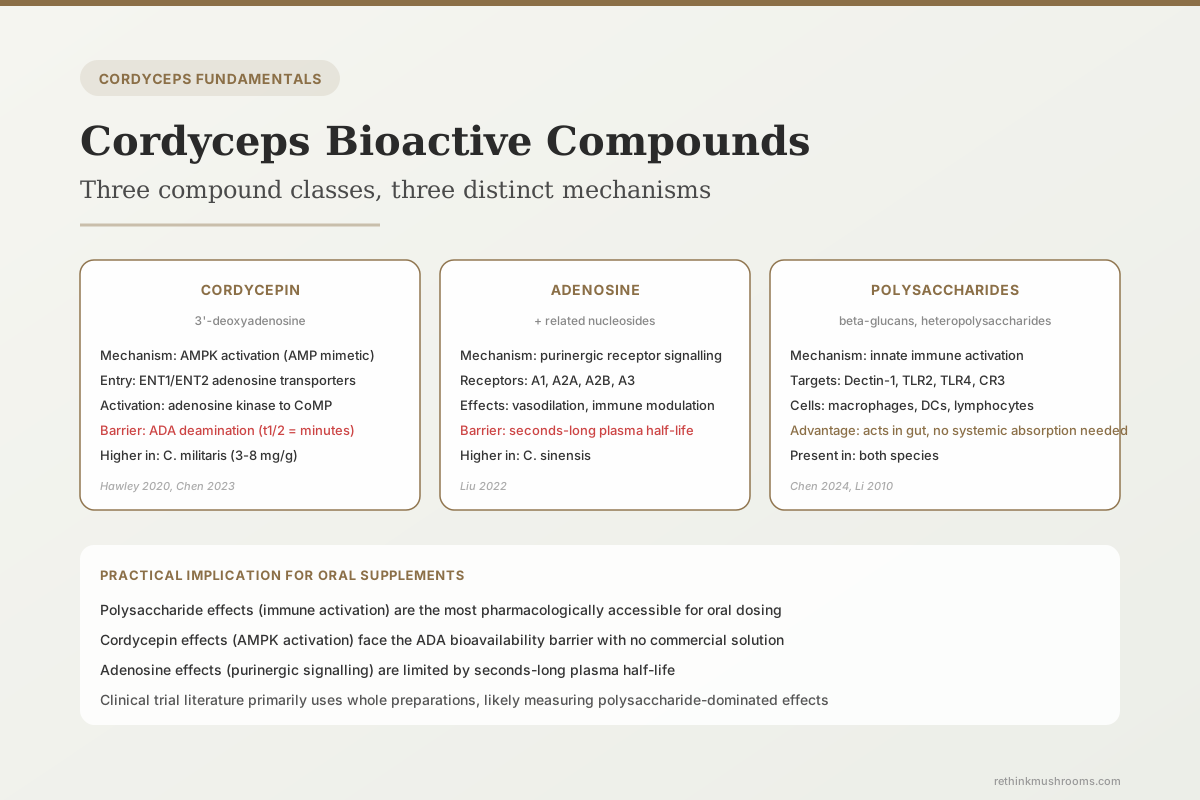
Over 20 bioactive compounds have been isolated from Cordyceps species, but the pharmacological evidence concentrates on three classes: cordycepin (3'-deoxyadenosine), adenosine and related nucleosides, and immunomodulatory polysaccharides. Each class has distinct mechanisms, distinct bioavailability profiles, and distinct evidence bases.
Liu et al., Molecules, 2022
Cordycepin
3'-deoxyadenosine: AMPK activator, ADA substrate, the most-studied cordyceps molecule
Polysaccharides
beta-glucans that activate macrophages, dendritic cells, and lymphocytes
ADA deamination
the primary barrier to cordycepin oral bioavailability (Chen 2023)
Liu et al., Molecules, 2022
 View as image ↗
Cordyceps supplements are marketed with broad health claims, but the pharmacology behind those claims reduces to a surprisingly small number of compound classes. Over 20 bioactive compounds have been isolated from Cordyceps sinensis and Cordyceps militaris, including nucleosides, polysaccharides, sterols, peptides, and fatty acids.[1] The compounds with the strongest evidence base and the clearest pharmacological mechanisms fall into three groups: cordycepin (3'-deoxyadenosine), which activates AMPK and modulates purinergic signalling; adenosine and related nucleosides, which act through adenosine receptors; and polysaccharides, which activate innate immune cells. Understanding what each class does, how it is absorbed, and where the evidence is strong versus speculative is the foundation for evaluating any cordyceps product claim. For how cordyceps works in the body more broadly, see the pharmacology of cordyceps. For the species comparison that determines bioactive profiles, see cordyceps militaris vs. sinensis: which is better.
Key Takeaways
- Liu et al. (2022) catalogued over 20 bioactive compounds isolated from Chinese cordyceps, identifying cordycepin, adenosine, and polysaccharides as the three compound classes with confirmed antitumor, immunomodulatory, and anti-inflammatory functions (Molecules)
- Hawley et al. (2020) demonstrated that cordycepin enters cells via ENT1/ENT2 adenosine transporters, is phosphorylated by adenosine kinase to cordycepin monophosphate, and activates AMPK as an AMP mimetic, establishing the central mechanism behind cordyceps energy and metabolic effects (Cell Chemical Biology)
- Chen et al. (2023) reviewed cordycepin pharmacokinetics and identified rapid in vivo deamination by adenosine deaminase as the primary bioavailability barrier, with a half-life of minutes without ADA inhibition, and catalogued strategies including nanoparticle delivery, prodrugs, and ADA inhibitor co-administration (Phytotherapy Research)
- Chen et al. (2024) reviewed cordyceps polysaccharides from 2004 to 2024 and confirmed immunomodulatory effects on macrophages, lymphocytes, and dendritic cells, with in vivo effects including immune suppression reversal, enhanced immune organ indices, and tumor immune evasion reduction (Molecules)
- Li et al. (2010) demonstrated that Cordyceps militaris polysaccharides preserved mitochondrial membrane potential, reduced ROS, and showed dose-dependent anti-aging activity in a D-galactose mouse model (American Journal of Chinese Medicine)
- Phull et al. (2022) reviewed Cordyceps militaris as a bio-functional food and catalogued anti-inflammatory NF-kB suppression, antioxidant activity, and immunomodulation as reproducible pharmacological effects across disease models (Microorganisms)
Cordycepin: The Most-Studied Molecule
Cordycepin (3'-deoxyadenosine) is a naturally occurring nucleoside analog that differs from adenosine by a single structural modification: the absence of a hydroxyl group at the 3' position of the ribose sugar. This seemingly minor chemical difference has profound pharmacological consequences. Adenosine is the body's ubiquitous signalling molecule for energy status, sleep regulation, and immune modulation. Cordycepin mimics adenosine closely enough to interact with the same transporters and enzymes but differently enough to produce distinct downstream effects.
Cordycepin is the single most researched bioactive in the entire cordyceps literature. It has demonstrated anti-inflammatory, anticancer, antiviral, antioxidant, and metabolic effects in cell culture and animal models across hundreds of publications. The concentration of cordycepin is substantially higher in Cordyceps militaris (typically 3-8 mg/g in cultivated fruiting bodies) compared with Cordyceps sinensis (typically less than 1 mg/g), which is one reason C. militaris dominates the modern supplement market despite C. sinensis having the deeper traditional medicine history.
The AMPK Mechanism
Hawley et al. (2020), published in Cell Chemical Biology, provided the definitive characterization of how cordycepin activates AMPK.[2] Cordycepin enters cells through equilibrative nucleoside transporters ENT1 and ENT2, the same transporters used by adenosine. Inside the cell, adenosine kinase phosphorylates cordycepin to cordycepin monophosphate (CoMP). CoMP is structurally similar enough to AMP to bind the gamma subunit of AMPK and allosterically activate the kinase, mimicking a low-energy state.
AMPK activation triggers a cascade of metabolic effects: stimulation of PGC-1alpha (driving mitochondrial biogenesis), phosphorylation of acetyl-CoA carboxylase (promoting fatty acid oxidation), activation of ULK1 (stimulating mitophagy), and inhibition of mTOR (reducing anabolic synthesis). This single mechanism connects cordycepin to the energy, fatigue, exercise, and mitochondrial claims made for cordyceps supplements. For the detailed mitochondrial picture, see cordyceps and mitochondrial function.
The AMPK mechanism also explains why blocking adenosine transporters (with NBMPR or dipyridamole) or knocking out adenosine kinase abolishes cordycepin's activity: the intracellular conversion to CoMP is required for AMPK activation. Free cordycepin in the bloodstream or extracellular space does not directly activate AMPK.
The Bioavailability Problem
Chen et al. (2023), published in Phytotherapy Research, reviewed the central pharmacokinetic challenge for cordycepin.[3] Adenosine deaminase (ADA), the enzyme that normally converts adenosine to inosine, also converts cordycepin to inactive 3'-deoxyinosine. This deamination is rapid: cordycepin has a plasma half-life measured in minutes without ADA inhibition. The practical consequence is that oral cordycepin or oral cordyceps supplements deliver a small and poorly characterized fraction of the ingested cordycepin to intracellular compartments where it can be phosphorylated and activate AMPK.
Chen et al. catalogued the strategies being developed to overcome this barrier: co-administration with ADA inhibitors (pentostatin being the most studied), nanoparticle delivery systems that protect cordycepin from deamination in the gastrointestinal tract and bloodstream, prodrug approaches that resist ADA cleavage, and structural analogs that retain the pharmacological activity of cordycepin but resist deamination. None of these strategies has been deployed in a commercially available cordyceps supplement. The supplements currently on the market deliver cordycepin without ADA protection, meaning their cordycepin-specific effects are limited by the same bioavailability problem identified in the research literature.
This does not mean oral cordyceps supplements are inactive. It means that the specific cordycepin-AMPK pathway may not be the primary mechanism by which oral supplements exert their effects. The polysaccharide and whole-extract effects, which operate through different absorption pathways, may be more pharmacologically relevant at achievable oral doses.
Adenosine and Related Nucleosides
Adenosine itself is present in both C. sinensis and C. militaris, alongside N6-(2-hydroxyethyl)adenosine and several other nucleoside analogs. Adenosine acts through four G-protein coupled receptor subtypes: A1 (inhibitory, widespread), A2A (stimulatory, brain and immune cells), A2B (inflammatory regulation), and A3 (anti-inflammatory, emerging anticancer interest). The adenosine receptor signalling system regulates vasodilation, neurotransmission, cardiac rhythm, sleep-wake cycling, and immune cell trafficking.
The distinction between cordycepin and adenosine is pharmacologically critical. Cordycepin mimics AMP intracellularly (AMPK activation), while adenosine acts extracellularly through cell-surface receptors. These are different mechanisms hitting different targets. A cordyceps preparation that delivers adenosine to the bloodstream is engaging the purinergic signalling system (vasodilation, immune modulation, anti-inflammatory effects), while one that delivers cordycepin to the intracellular compartment is engaging the AMPK energy-sensing system. Both are relevant pharmacological pathways, but they are not the same pathway.
Liu et al. (2022) noted that adenosine content in Chinese cordyceps varies substantially by source, processing method, and extraction conditions.[1] Unlike cordycepin, adenosine is not subject to rapid ADA-mediated deactivation (adenosine is ADA's natural substrate, but it is constantly being produced and recycled). The clinical relevance of oral adenosine from cordyceps supplements is limited by the fact that adenosine has an extremely short plasma half-life (seconds) and is rapidly taken up by red blood cells and endothelial cells. Whether oral cordyceps delivers pharmacologically meaningful adenosine concentrations to target tissues is an open question.
Polysaccharides: The Immune Arm
Cordyceps polysaccharides are high-molecular-weight carbohydrate polymers, including beta-glucans and heteropolysaccharides, that constitute a substantial fraction of both C. sinensis and C. militaris biomass. Unlike cordycepin and adenosine, polysaccharides are too large to be absorbed intact through the intestinal epithelium. Their primary pharmacological target is the gut-associated lymphoid tissue (GALT) and intestinal immune cells, where they interact with pattern recognition receptors (Dectin-1, TLR2, TLR4, complement receptor 3) on macrophages, dendritic cells, and intestinal epithelial cells.
Chen et al. (2024), published in Molecules, reviewed two decades of cordyceps polysaccharide immunology research (2004-2024).[4] The review confirmed that cordyceps polysaccharides activate macrophages (increasing phagocytic activity, NO production, and cytokine secretion including TNF-alpha, IL-1beta, and IL-6), promote dendritic cell maturation (enhancing antigen presentation), and stimulate lymphocyte proliferation and natural killer cell activity. In animal models, polysaccharide administration reversed drug- and radiation-induced immunosuppression, enhanced immune organ indices (spleen and thymus weight), and reduced tumor immune evasion.
Li et al. (2010) added the mitochondrial dimension, showing that C. militaris polysaccharides protected mitochondrial membrane potential, reduced intracellular ROS, and upregulated antioxidant enzymes (SOD, catalase, GPx) in senescent cells.[5] In a D-galactose aging mouse model, the anti-aging effects were dose-dependent. This is a separate pathway from immune activation: the same polysaccharide fraction both activates innate immunity and protects cellular energy infrastructure.
The polysaccharide evidence base is arguably the most robust component of cordyceps pharmacology for oral supplementation, because the gut immune interaction does not require systemic absorption of the active molecule. The polysaccharides act at the site of ingestion (the gut immune system), bypassing the bioavailability problem that limits cordycepin pharmacology.
Other Bioactive Classes
Beyond the three major groups, cordyceps species contain several additional bioactive compound classes with preliminary evidence:
Ergosterol is the primary sterol in fungal membranes and serves as a provitamin D2 precursor. UV-irradiated cordyceps can contain ergocalciferol (vitamin D2).
D-mannitol (cordycepic acid) is a sugar alcohol present in relatively high concentrations, with reported antioxidant and hepatoprotective properties. Its pharmacological significance relative to other dietary sources of mannitol is unclear.
Cordyceps-specific peptides have shown antimicrobial activity in vitro, though the characterization of individual peptides is less advanced than for nucleosides or polysaccharides.
Carotenoids in C. militaris (which give it its orange color) include cordyxanthin, with antioxidant properties that are not unique to cordyceps.
Phull et al. (2022) integrated these secondary bioactives into the broader C. militaris pharmacological profile, noting that anti-inflammatory NF-kB suppression and antioxidant effects are reproducible across multiple bioactive fractions, suggesting that the whole-extract effects are not reducible to any single compound.[6] For the specific role of these compounds in inflammation, see cordyceps and inflammation: anti-inflammatory mechanisms.
Species Matters: C. militaris vs. C. sinensis Profiles
The bioactive profile differs substantially between the two commercial species:
Cordyceps militaris has higher cordycepin content (typically 3-8 mg/g), moderate adenosine, characteristic carotenoids, and well-characterized polysaccharides. It is cultivable on grain substrates, which makes it the dominant species in modern supplements.
Cordyceps sinensis (Ophiocordyceps sinensis) has lower cordycepin (often less than 1 mg/g), higher adenosine and N6-(2-hydroxyethyl)adenosine content, a distinct polysaccharide profile, and the fermented mycelial preparations (Bailing capsule, JinShuiBao, Cs-4) that constitute most of the Chinese clinical trial literature.
The practical implication is that a C. militaris supplement and a C. sinensis supplement are pharmacologically different products, even if both are labeled "cordyceps." The clinical trial evidence for COPD exacerbation reduction (Bailing capsule) does not transfer to a C. militaris fruiting body product, and the cordycepin content data from C. militaris does not predict the bioactive profile of a C. sinensis preparation. For the complete species analysis, see wild vs. cultivated cordyceps: does origin affect efficacy and what is cordyceps: the science behind the energy mushroom.
What This Means for Supplement Evaluation
Understanding the three bioactive classes provides a framework for evaluating supplement claims. A product claiming energy or metabolic benefits is implicitly claiming cordycepin-AMPK pathway activation, which requires intracellular cordycepin delivery that is limited by ADA deamination. A product claiming immune support is implicitly claiming polysaccharide-mediated immune cell activation, which is better supported for oral delivery because it acts through gut immune interactions. A product claiming anti-inflammatory or antioxidant effects could be operating through any or all of the bioactive classes, since NF-kB suppression and oxidative stress reduction have been demonstrated for cordycepin, polysaccharides, and whole extracts.
The bioavailability literature suggests that polysaccharide-mediated effects may be the most pharmacologically accessible pathway for oral cordyceps supplementation, while cordycepin-specific effects (AMPK activation, direct nucleoside analog pharmacology) face the ADA barrier that current commercial supplements do not address. The clinical trial literature, which primarily uses whole preparations rather than isolated compounds, may be measuring polysaccharide-dominated effects in practice, even when the mechanistic discussion focuses on cordycepin.
The Bottom Line
Cordyceps pharmacology concentrates on three bioactive compound classes: cordycepin (3'-deoxyadenosine), which activates AMPK through intracellular phosphorylation but faces rapid deamination by adenosine deaminase limiting oral bioavailability; adenosine and related nucleosides, which engage purinergic receptors with extremely short plasma half-lives; and polysaccharides, which activate macrophages, dendritic cells, and lymphocytes through gut immune interactions without requiring systemic absorption. Over 20 bioactive compounds have been isolated, but the evidence base for antitumor, immunomodulatory, and anti-inflammatory effects is built primarily on these three classes. Species matters: Cordyceps militaris has higher cordycepin, while C. sinensis has different nucleoside ratios and the clinical trial pedigree.
Frequently Asked Questions
Sources & References
- 1RTHM-01574·Liu, Yan et al. (2022). “Chinese Cordyceps: Bioactive Components, Antitumor Effects and Underlying Mechanism-A Review..” Molecules (Basel.Study breakdown →PubMed →↩
- 2RTHM-00618·Hawley, Simon A et al. (2020). “Mechanism of Activation of AMPK by Cordycepin..” Cell chemical biology.Study breakdown →PubMed →↩
- 3RTHM-00817·Chen, Min et al. (2023). “Cordycepin: A review of strategies to improve the bioavailability and efficacy..” Phytotherapy research : PTR.Study breakdown →PubMed →↩
- 4RTHM-01868·Chen, Liping et al. (2024). “Cordyceps Polysaccharides: A Review of Their Immunomodulatory Effects..” Molecules (Basel.Study breakdown →PubMed →↩
- 5RTHM-00191·Li, Xing-Tai et al. (2010). “Protective effects on mitochondria and anti-aging activity of polysaccharides from cultivated fruiting bodies of Cordyceps militaris..” The American journal of Chinese medicine.Study breakdown →PubMed →↩
- 6RTHM-00790·Phull, Abdul-Rehman et al. (2022). “Cordyceps militaris as a Bio Functional Food Source: Pharmacological Potential, Anti-Inflammatory Actions and Related Molecular Mechanisms..” Microorganisms.Study breakdown →PubMed →↩