Cordyceps & Cellular Energy
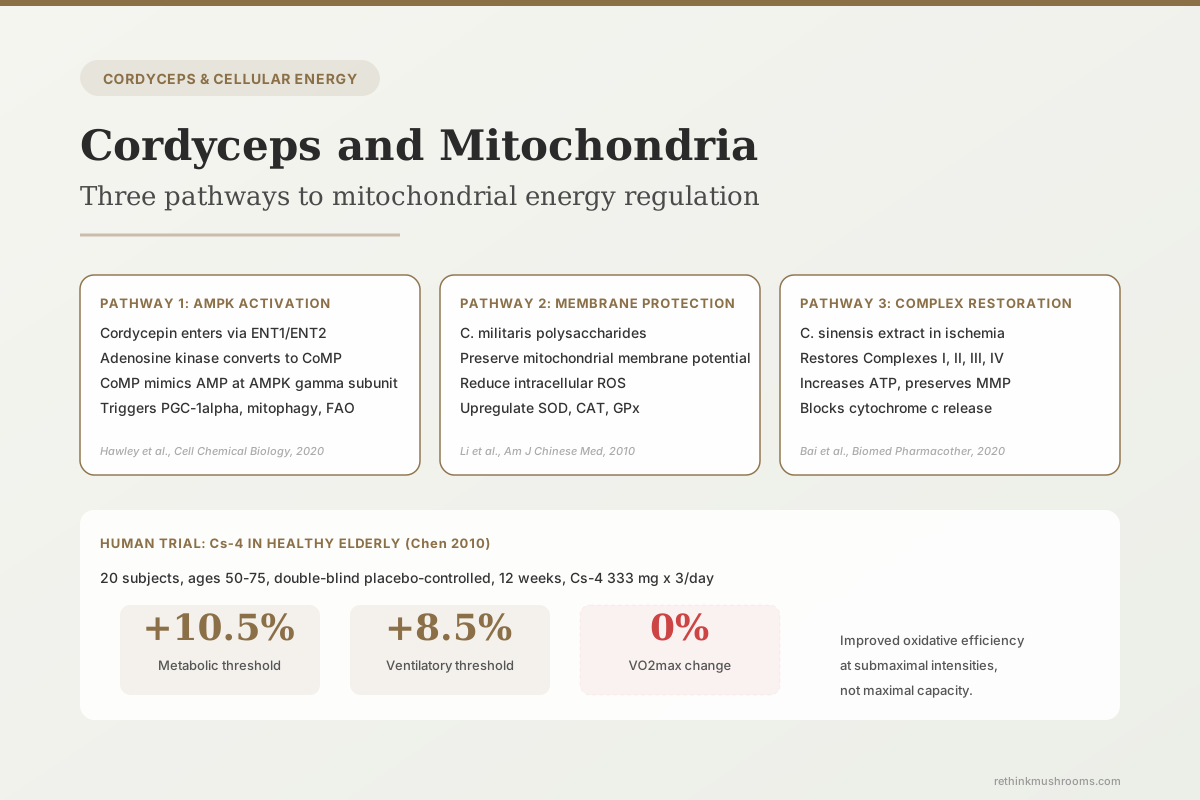
AMPK activated by cordycepin as AMP mimetic
Hawley et al. (2020, Cell Chemical Biology) identified the mechanism by which cordycepin activates AMP-activated protein kinase: cordycepin enters cells via adenosine transporters, is phosphorylated to cordycepin monophosphate by adenosine kinase, and acts as an AMP analog to allosterically activate AMPK.
Hawley et al., Cell Chemical Biology, 2020
Complexes I-IV
cordyceps restored mitochondrial complex activity in ischemia model (Bai 2020)
MMP restored
mitochondrial membrane potential preserved by C. militaris polysaccharides (Li 2010)
10.5% threshold gain
metabolic threshold increase in elderly after 12 weeks of Cs-4 (Chen 2010)
Hawley et al., Cell Chemical Biology, 2020
 View as image ↗
Mitochondria generate the ATP that powers nearly every cellular process, and their decline is central to aging, fatigue, and metabolic disease. Cordyceps has been marketed as an energy-boosting supplement for decades, but the mechanistic question is more specific: does cordyceps or its bioactive compounds actually affect mitochondrial function at the molecular level? The answer from the current research is yes, through at least two distinct pathways. Cordycepin (3'-deoxyadenosine) activates AMPK, the master energy-sensing kinase, by acting as an AMP analog after intracellular phosphorylation. Cordyceps polysaccharides protect mitochondrial membrane potential and reduce oxidative damage to mitochondrial membranes. And whole Cordyceps sinensis extracts restore the activity of mitochondrial respiratory chain complexes I through IV in ischemia models. Whether these preclinical effects translate fully to oral supplementation in humans is the open question. For the related ATP production pathway and creatine phosphate dual-energy data, see the sibling articles.
Key Takeaways
- Hawley et al. (2020) demonstrated that cordycepin enters cells via ENT1/ENT2 adenosine transporters, is converted to cordycepin monophosphate by adenosine kinase, and allosterically activates AMPK as an AMP mimetic, establishing the molecular mechanism behind cordyceps energy signalling (Cell Chemical Biology)
- Li et al. (2010) showed that Cordyceps militaris polysaccharides preserved mitochondrial membrane potential, reduced intracellular reactive oxygen species, and protected mitochondrial membrane integrity in senescent cells, with dose-dependent anti-aging effects in a D-galactose mouse model (American Journal of Chinese Medicine)
- Bai et al. (2020) reported that Cordyceps sinensis extract restored the activity of mitochondrial complexes I through IV, improved mitochondrial membrane potential, increased ATP levels, and inhibited cytochrome c release and the mitochondrial apoptotic pathway in a cerebral ischemia model (Biomedicine and Pharmacotherapy)
- Chen et al. (2010) tested Cs-4 (a Cordyceps sinensis fermentation product) in a double-blind placebo-controlled trial of 20 healthy elderly subjects (ages 50-75) for 12 weeks and reported a 10.5% increase in metabolic threshold and 8.5% increase in ventilatory threshold, though VO2max did not change (Journal of Alternative and Complementary Medicine)
- Phull et al. (2022) reviewed Cordyceps militaris as a bio-functional food source and catalogued its pharmacological effects including anti-inflammatory NF-kB suppression, antioxidant activity, and immunomodulation, all of which converge on mitochondrial protection pathways (Microorganisms)
Why Mitochondria Are the Target
Mitochondria produce ATP through oxidative phosphorylation across a five-complex electron transport chain embedded in the inner mitochondrial membrane. Complex I (NADH dehydrogenase) and Complex II (succinate dehydrogenase) accept electrons from NADH and FADH2 respectively. Complexes III and IV pass those electrons to molecular oxygen. Complex V (ATP synthase) uses the resulting proton gradient to drive ATP synthesis. The efficiency of this chain determines how much usable energy a cell produces from each unit of substrate.
When mitochondria decline in function, through aging, oxidative stress, ischemia, or metabolic disease, cells produce less ATP, generate more reactive oxygen species (ROS) as byproduct, and accumulate damaged mitochondria that trigger apoptotic pathways. The mitochondrial membrane potential (MMP) is a proxy for respiratory chain health: when MMP drops, oxidative phosphorylation is compromised and cytochrome c can leak into the cytoplasm, initiating caspase-mediated cell death.
Any compound that demonstrably preserves MMP, restores respiratory chain complex activity, activates mitochondrial biogenesis through AMPK or PGC-1alpha, or reduces mitochondrial ROS is intervening at the right targets. The cordyceps literature claims effects on all four of these, through different bioactives and different mechanisms.
AMPK Activation by Cordycepin: The Core Mechanism
Hawley et al. (2020), published in Cell Chemical Biology, provided the definitive mechanistic study of how cordycepin activates AMPK.[1] AMPK (AMP-activated protein kinase) is the cell's master energy sensor. When the AMP-to-ATP ratio rises, indicating energy deficit, AMP binds AMPK and triggers a conformational change that activates the kinase. Active AMPK then switches on catabolic pathways (fatty acid oxidation, glucose uptake, autophagy) and switches off anabolic pathways (lipid synthesis, protein synthesis, cell growth) to restore energy balance.
Cordycepin (3'-deoxyadenosine) enters cells through the same adenosine transporters (ENT1 and ENT2) that handle adenosine. Once inside, adenosine kinase phosphorylates cordycepin to cordycepin monophosphate (CoMP). CoMP is structurally close enough to AMP to bind the same allosteric sites on the AMPK gamma subunit, triggering AMPK activation. The Hawley study showed that blocking adenosine transporters (with NBMPR or dipyridamole) or knocking out adenosine kinase abolished cordycepin's ability to activate AMPK, confirming that intracellular conversion to CoMP is required.
This is the molecular link between a mushroom-derived nucleoside and mitochondrial energy regulation. AMPK activation triggers PGC-1alpha, the master regulator of mitochondrial biogenesis. It also phosphorylates acetyl-CoA carboxylase to promote fatty acid oxidation, and it activates ULK1 to promote mitophagy, the selective removal of damaged mitochondria. Through AMPK, cordycepin is connected to every major axis of mitochondrial quality control.
The practical caveat is the same one that applies to all cordycepin pharmacology: adenosine deaminase rapidly converts cordycepin to inactive 3'-deoxyinosine in vivo, limiting oral bioavailability. The AMPK activation demonstrated by Hawley et al. required direct cordycepin exposure to cells in culture, where deamination is not a factor. Whether oral cordyceps supplementation achieves sufficient intracellular cordycepin to meaningfully activate AMPK in human tissue is not directly measured.
Polysaccharide Protection of Mitochondrial Membranes
Li et al. (2010), published in The American Journal of Chinese Medicine, addressed a different bioactive fraction: the polysaccharides from cultivated Cordyceps militaris fruiting bodies.[2] The study examined mitochondrial protection using two models: in vitro treatment of senescent cells and in vivo treatment of D-galactose-induced aging in mice.
In vitro, C. militaris polysaccharides preserved mitochondrial membrane potential (MMP) in cells exposed to oxidative stress, reduced intracellular reactive oxygen species (ROS) accumulation, and protected mitochondrial membrane lipid integrity. In the D-galactose mouse aging model, polysaccharide treatment showed dose-dependent anti-aging effects including improvements in antioxidant enzyme activity (superoxide dismutase, catalase, glutathione peroxidase) and reductions in malondialdehyde, the standard marker of lipid peroxidation.
The mechanism here is not AMPK-dependent. Polysaccharides are too large to enter cells through nucleoside transporters and are not converted to phosphorylated metabolites. Their protective effects on mitochondria appear to work through direct radical scavenging and through upregulation of endogenous antioxidant enzyme systems. This means cordyceps has at least two independent pathways to mitochondrial protection: the cordycepin-AMPK axis and the polysaccharide-antioxidant axis. A whole cordyceps preparation delivers both.
Respiratory Chain Restoration in Ischemia
Bai et al. (2020), published in Biomedicine and Pharmacotherapy, provided the most comprehensive direct measurement of cordyceps effects on mitochondrial respiratory chain function.[3] Using a murine middle cerebral artery occlusion (MCAO) model of cerebral ischemia, the study tested a Cordyceps sinensis extract and measured its effects on mitochondrial complex activity, MMP, ATP production, cytochrome c localization, and the mitochondrial apoptotic pathway.
Cordyceps sinensis extract restored the activity of mitochondrial complexes I, II, III, and IV toward normal levels in ischemic brain tissue. MMP was preserved. ATP levels increased. The release of cytochrome c from mitochondria to cytoplasm was inhibited, which blocked the downstream caspase-9 and caspase-3 activation that drives apoptotic cell death. Neurobehavioral scores and oxygen free radical levels both improved.
This is a direct, functional demonstration that a Cordyceps sinensis preparation can restore oxidative phosphorylation capacity at the level of individual mitochondrial complexes. The context matters: ischemia-reperfusion injury causes massive mitochondrial damage through oxygen radical burst upon reperfusion, so the effect is protective and restorative rather than enhancing baseline function. Whether the same magnitude of effect occurs in non-damaged mitochondria (for example, in an aging or fatigued but otherwise healthy person) is a different question that this study does not answer. For the broader anti-inflammatory mechanisms that converge on mitochondrial protection, see cordyceps and inflammation.
Three Pathways, One Endpoint
How Cordyceps Reaches the Mitochondria
Different cordyceps bioactives act on mitochondria through mechanistically separate routes — one signalling (AMPK), one antioxidant, one structural. None depends on the others, and a whole preparation can deliver all three. The shared destination is healthier, better-protected mitochondria.
Cordycepin
[1]3′-deoxyadenosine
Mechanistic (cell-free + intact cells)Mechanism
Enters via adenosine transporters → phosphorylated to cordycepin monophosphate → activates AMPK as an AMP mimetic
Mitochondrial endpoint
Mitochondrial biogenesis + mitophagy (via AMPK → PGC-1α / ULK1)
Polysaccharides
[2]C. militaris fruiting body
In vitro + D-galactose mouse modelMechanism
Direct radical scavenging + upregulation of SOD, catalase, glutathione peroxidase (not AMPK-dependent)
Mitochondrial endpoint
Preserved membrane potential, lower ROS and lipid peroxidation
Whole C. sinensis extract
[3]full extract matrix
Murine MCAO ischemia modelMechanism
Restores electron transport chain complex I–IV activity; blocks cytochrome c release and caspase cascade
Mitochondrial endpoint
Recovered oxidative phosphorylation + higher ATP (ischemia model)
Caveat: the AMPK route is shown mechanistically in cultured cells, where deamination does not limit cordycepin; the membrane and respiratory-chain effects come from animal and disease models, not healthy humans. Whether oral cordyceps reaches intracellular levels high enough to engage all three arms at once in people has not been measured.
Source: Hawley 2020; Li 2010; Bai 2020 (see references)
The Human Exercise Evidence
Chen et al. (2010), published in the Journal of Alternative and Complementary Medicine, tested Cs-4 (a standardized Cordyceps sinensis fermentation product) in a double-blind, placebo-controlled trial of 20 healthy elderly subjects aged 50 to 75.[4] Participants took Cs-4 at 333 mg three times daily (approximately 1 g/day total) or placebo for 12 weeks, with exercise testing before and after.
After 12 weeks of Cs-4, the metabolic threshold (the exercise intensity at which anaerobic metabolism begins supplementing aerobic metabolism) increased by 10.5%. The ventilatory threshold (the point at which ventilation increases disproportionately to oxygen consumption) increased by 8.5%. Both measures reflect improved efficiency of mitochondrial oxidative metabolism at submaximal exercise intensities. VO2max, the ceiling measure of maximal aerobic capacity, did not change in either group.
The interpretation is nuanced. The threshold improvements suggest that Cs-4 improved the efficiency of existing mitochondrial oxidative phosphorylation, allowing aerobic metabolism to sustain higher workloads before the transition to anaerobic glycolysis. The unchanged VO2max suggests it did not increase the absolute ceiling of oxygen processing capacity. This pattern is consistent with a compound that improves mitochondrial efficiency (through better respiratory chain function or reduced uncoupling) rather than one that increases total mitochondrial mass. For more on the exercise performance clinical trial data, see the dedicated article.
Converging Mechanisms: NF-kB and Oxidative Stress
Phull et al. (2022) provided the integrative framework across Cordyceps militaris bioactivities.[5] The review catalogued NF-kB suppression, TNF-alpha reduction, antioxidant effects, and immunomodulation as reproducible findings across inflammatory and metabolic disease models. All of these converge on mitochondrial health: NF-kB-driven inflammation increases mitochondrial ROS production, TNF-alpha directly damages mitochondrial membranes, and oxidative stress degrades the respiratory chain complexes whose activity Bai et al. (2020) measured.
The implication is that cordyceps mitochondrial effects may be partly indirect. By reducing systemic inflammation and oxidative stress, cordyceps reduces the ongoing damage to mitochondria that cells must repair. Combined with the direct AMPK activation by cordycepin (which stimulates mitophagy and biogenesis) and the polysaccharide protection of mitochondrial membranes (which preserves existing mitochondrial function), the result is a three-pronged mechanism: protect existing mitochondria, remove damaged ones, and generate new ones. Whether all three arms operate simultaneously at physiological cordyceps doses in humans is unknown.
Cordyceps militaris vs. Cordyceps sinensis for Mitochondria
The mitochondrial research spans both species but uses different bioactive fractions. The AMPK mechanism (Hawley 2020) was characterized using isolated cordycepin, which is present at higher concentrations in Cordyceps militaris. The mitochondrial membrane protection (Li 2010) used C. militaris polysaccharides specifically. The respiratory chain restoration (Bai 2020) used a whole C. sinensis extract. The clinical exercise trial (Chen 2010) used Cs-4, a C. sinensis fermentation product.
This means extrapolating from one species to another is not straightforward. A C. militaris supplement delivers more cordycepin (and therefore potentially more AMPK activation) but different polysaccharides. A C. sinensis preparation delivers lower cordycepin but the specific extract matrix that Bai et al. showed restoring respiratory chain function. Consumer supplements vary widely in composition, and the mitochondrial evidence base does not support treating "cordyceps" as a single pharmacological entity. For the detailed species comparison, see cordyceps militaris vs. sinensis: which is better.
What the Evidence Does and Does Not Support
The evidence supports specific claims. Cordycepin activates AMPK through a characterized intracellular mechanism (phosphorylation to CoMP by adenosine kinase). C. militaris polysaccharides protect mitochondrial membrane potential and reduce oxidative damage. Whole C. sinensis extract restores respiratory chain complex I-IV activity in ischemia models. Cs-4 supplementation at 1 g/day for 12 weeks improves metabolic and ventilatory thresholds in healthy elderly subjects.
The evidence does not support broader claims. There is no direct measurement of mitochondrial biogenesis (new mitochondria formation) in response to oral cordyceps in humans. There is no measurement of intracellular cordycepin concentrations after oral supplementation to confirm AMPK activation occurs in practice. There is no dose-response characterization for mitochondrial endpoints at different cordyceps preparation doses. And the clinical exercise improvement was modest (10.5% threshold shift, no VO2max change), consistent with a functional benefit that falls short of the transformative energy claims common in supplement marketing.
For the fatigue-specific evidence, see cordyceps for fatigue: clinical evidence on energy levels. For the adenosine signalling context, see how cordycepin enhances adenosine signaling.
This article summarizes published research on cordyceps and mitochondrial biology and is not medical advice. Cordyceps preparations vary widely in composition, much of the mechanistic evidence is preclinical, and the single human trial used a specific fermentation product (Cs-4) at a defined dose. Anyone considering cordyceps supplementation for an energy, metabolic, or health concern should consult a qualified healthcare professional, particularly if they take medications or have an underlying condition.
The Bottom Line
Cordyceps affects mitochondrial function through at least three pathways: cordycepin activates AMPK as an AMP mimetic (demonstrated mechanistically by Hawley 2020), C. militaris polysaccharides protect mitochondrial membranes and reduce oxidative damage (Li 2010), and whole C. sinensis extract restores respiratory chain complex I-IV activity in ischemia models (Bai 2020). The one placebo-controlled human trial (Chen 2010) showed a 10.5% improvement in metabolic threshold in healthy elderly after 12 weeks of Cs-4 supplementation, consistent with improved mitochondrial efficiency rather than increased mitochondrial mass. Whether oral supplementation achieves sufficient intracellular cordycepin to activate AMPK in human tissue remains an open question.
Frequently Asked Questions
Sources & References
- 1RTHM-00618·Hawley, Simon A et al. (2020). “Mechanism of Activation of AMPK by Cordycepin..” Cell chemical biology.Study breakdown →PubMed →↩
- 2RTHM-00191·Li, Xing-Tai et al. (2010). “Protective effects on mitochondria and anti-aging activity of polysaccharides from cultivated fruiting bodies of Cordyceps militaris..” The American journal of Chinese medicine.Study breakdown →PubMed →↩
- 3RTHM-00606·Bai, Xue et al. (2020). “The protective effect of cordyceps sinensis extract on cerebral ischemic injury via modulating the mitochondrial respiratory chain and inhibiting the mitochondrial apoptotic pathway..” Biomedicine & pharmacotherapy = Biomedecine & pharmacotherapie.Study breakdown →PubMed →↩
- 4RTHM-00176·Chen, Steve et al. (2010). “Effect of Cs-4 (Cordyceps sinensis) on exercise performance in healthy older subjects: a double-blind, placebo-controlled trial..” Journal of alternative and complementary medicine (New York.Study breakdown →PubMed →↩
- 5RTHM-00790·Phull, Abdul-Rehman et al. (2022). “Cordyceps militaris as a Bio Functional Food Source: Pharmacological Potential, Anti-Inflammatory Actions and Related Molecular Mechanisms..” Microorganisms.Study breakdown →PubMed →↩