Cordyceps for Athletic Performance
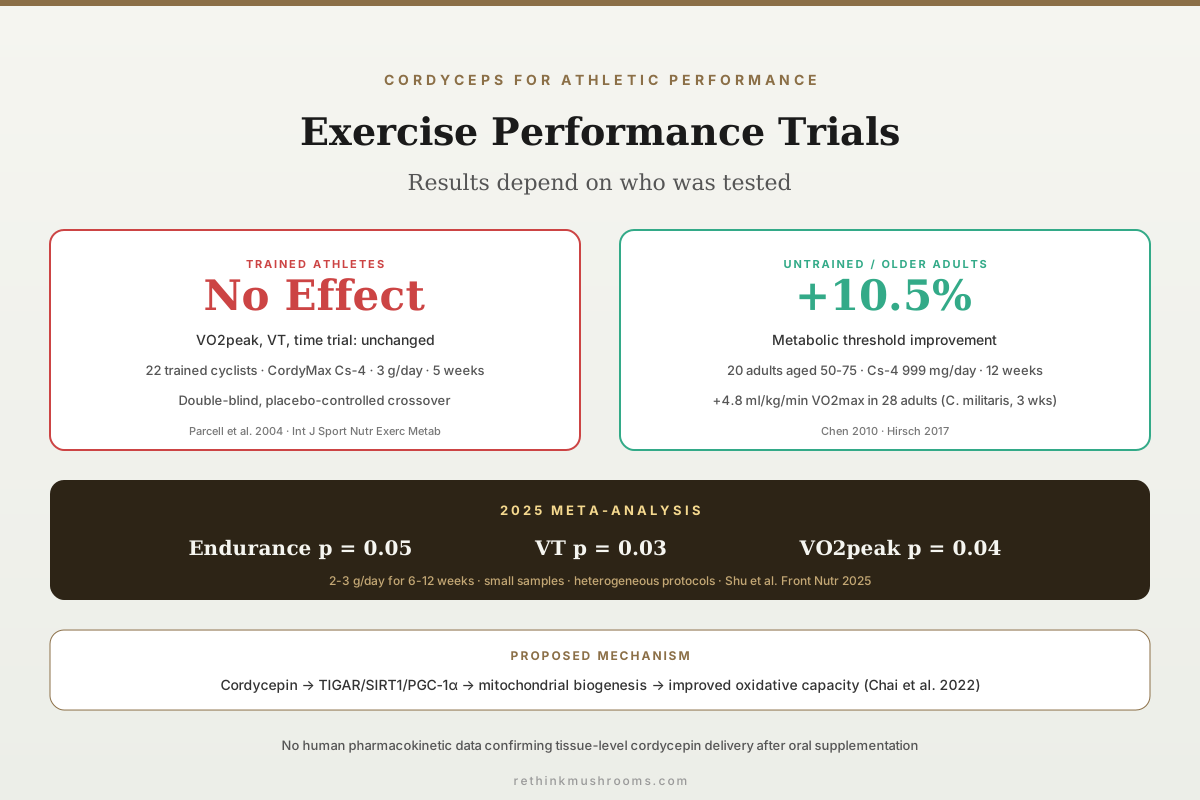
10.5% Metabolic Threshold ↑
Healthy adults aged 50-75 taking Cs-4 (Cordyceps sinensis) at 999 mg/day for 12 weeks improved their metabolic threshold by 10.5% and ventilatory threshold by 8.5% versus placebo, while trained cyclists taking 3 g/day for 5 weeks showed zero improvement in VO2peak or time-trial performance.
Chen et al., J Alternative & Complementary Medicine, 2010
+4.8 ml/kg/min
VO2max increase in healthy adults after 3 weeks of Cordyceps militaris mushroom blend (Hirsch et al., 2017)
No effect
CordyMax Cs-4 at 3 g/day for 5 weeks produced no VO2peak, VT, or time-trial changes in trained cyclists (Parcell et al., 2004)
p = 0.04
Meta-analysis of C. sinensis trials found significant VO2peak improvement pooled across studies (Shu et al., 2025)
Chen et al., J Alternative & Complementary Medicine, 2010
 View as image ↗
The cordyceps exercise performance literature tells two different stories depending on who was studied and what species was used. In trained endurance athletes, the earliest and most methodologically rigorous trial found no benefit whatsoever.[1] In untrained or older adults, two trials showed statistically significant improvements in metabolic threshold and VO2max.[2][3] A 2025 systematic review and meta-analysis pooling the available data found a small but significant effect on endurance performance and VO2peak, while flagging substantial methodological limitations across the field.[4] For the cellular energy mechanisms behind these effects, see cordyceps and ATP: how it boosts cellular energy; for dosing timing considerations, see best time to take cordyceps: morning, pre-workout, or evening?.
Key Takeaways
- Parcell et al. (2004) in the International Journal of Sport Nutrition and Exercise Metabolism found CordyMax Cs-4 at 3 g/day for 5 weeks produced no improvement in VO2peak, ventilatory threshold, or time-trial performance in 22 trained male cyclists, the only trial in a well-trained population
- Chen et al. (2010) in the Journal of Alternative and Complementary Medicine showed Cs-4 at 999 mg/day for 12 weeks increased metabolic threshold by 10.5% and ventilatory threshold by 8.5% in 20 healthy adults aged 50-75, with no change in VO2max itself
- Hirsch et al. (2017) in the Journal of Dietary Supplements reported a Cordyceps militaris mushroom blend increased VO2max by 4.8 ml/kg/min after 3 weeks of supplementation in 28 healthy adults, with ventilatory threshold also increasing by 0.7 L/min
- Shu et al. (2025) in Frontiers in Nutrition conducted a systematic review and meta-analysis finding C. sinensis supplementation (2-3 g/day for 6-12 weeks) significantly improved endurance performance (p = 0.05), ventilatory threshold (p = 0.03), and VO2peak (p = 0.04)
- Song et al. (2015) in Evidence-Based Complementary and Alternative Medicine demonstrated C. militaris fruit body extract delayed fatigue onset in mice across rotating rod, forced swimming, and forced running tests within 2 weeks of administration
- Chai et al. (2022) in Biochemical and Biophysical Research Communications identified the cordycepin anti-fatigue mechanism as TIGAR/SIRT1/PGC-1α pathway activation, linking the bioactive compound to mitochondrial biogenesis and energy metabolism
The Negative Trial That Set the Baseline
Parcell et al. (2004) conducted the only exercise trial in well-trained athletes, and the results were unambiguous: no effect. Twenty-two male cyclists with established endurance training histories took CordyMax Cs-4 at 3 g/day or placebo for 5 weeks. Training intensity was documented throughout to control for fitness changes. VO2peak, ventilatory threshold, and a work-based time trial were measured before and after supplementation.[1]
No significant differences emerged between groups on any measure. The study used a double-blind, placebo-controlled, crossover design with adequate statistical power for the primary outcome. The supplement was a standardised Cs-4 fermentation product (not wild-harvested Cordyceps sinensis), and the 5-week duration matched or exceeded most subsequent trials.
This negative result is critical context for interpreting the positive trials. Trained athletes already operate near their aerobic ceiling, leaving minimal room for ergogenic improvement from any supplement. The positive studies used untrained or older populations where baseline fitness is lower and the potential for improvement is larger. Whether cordyceps produces a genuine physiological effect that is only detectable in untrained individuals, or whether it produces a small effect that trained athletes cannot express, is the central unresolved question.
The Positive Trials: What Changed
Cs-4 in Older Adults (Chen et al., 2010)
Twenty healthy adults aged 50-75 took Cs-4 at 999 mg/day (333 mg capsule three times daily) or placebo for 12 weeks in a double-blind design. The primary outcome was maximal incremental exercise testing on a cycle ergometer with breath-by-breath gas analysis.[2]
After 12 weeks, the Cs-4 group showed a 10.5% increase in metabolic threshold (the exercise intensity where lactate begins accumulating faster than it is cleared) and an 8.5% increase in ventilatory threshold (the intensity where ventilation increases disproportionately to oxygen consumption). VO2max itself did not change in either group.
The distinction between threshold improvement and VO2max improvement matters. VO2max represents the absolute ceiling of oxygen consumption. The metabolic and ventilatory thresholds represent the sustainable exercise intensity below the ceiling. Improving thresholds without changing VO2max means a person can exercise at a higher fraction of their maximal capacity before fatigue onset, which is functionally relevant for real-world endurance activity. The 12-week duration is longer than most other cordyceps trials, and the threshold changes were absent at earlier time points, suggesting a cumulative rather than acute effect.
Cordyceps militaris in Healthy Adults (Hirsch et al., 2017)
Twenty-eight individuals (mean age 22.7 years) took a mushroom blend containing Cordyceps militaris or placebo for 3 weeks. VO2max, time to exhaustion, and ventilatory threshold were measured on a cycle ergometer at baseline, week 1, and week 3.[3]
After 1 week (acute supplementation), no significant differences were observed. After 3 weeks (chronic supplementation), VO2max significantly improved in the cordyceps group by 4.8 ml/kg/min, and ventilatory threshold increased by 0.7 L/min. Time to exhaustion showed a non-significant trend toward improvement.
This study is important for two reasons. First, it used Cordyceps militaris rather than the Cs-4 fermentation product used in most earlier trials. C. militaris can be cultivated to produce standardised levels of cordycepin and adenosine, which the Cs-4 product does not guarantee. Second, the VO2max improvement (unlike Chen et al.) suggests a genuine increase in maximal aerobic capacity rather than just threshold shifts, though the 3-week duration leaves open whether this reflects a true physiological adaptation or a familiarisation/training effect. For how these cellular energy mechanisms work, see cordyceps and creatine phosphate: dual pathways to cellular energy.
The 2025 Meta-Analysis: Pooled Evidence
Shu et al. (2025) conducted a systematic review and meta-analysis searching PubMed, Scopus, Web of Science, and CNKI for randomised controlled trials of fungal supplementation in adult athletes. For Cordyceps sinensis specifically, the pooled analysis found statistically significant improvements in endurance performance (p = 0.05), ventilatory threshold (p = 0.03), and VO2peak (p = 0.04), with the effective dosing range of 2-3 g/day for 6-12 weeks.[4]
The meta-analysis also identified substantial limitations across the included studies: small sample sizes, heterogeneous exercise protocols, inconsistent participant populations (mixing trained and untrained), insufficient randomisation reporting, lack of trial pre-registration, and the absence of standardised preparations with quantified bioactive constituents. These limitations reduce confidence in the pooled effect size.
The heterogeneity between studies is the key issue. Pooling a negative trial in trained cyclists with positive trials in older or untrained adults produces a mathematically significant average, but that average may not represent what happens in any specific population. The meta-analytic finding of significance should be interpreted as "there is a signal worth investigating further" rather than "cordyceps improves exercise performance."
Preclinical Mechanisms: Why It Might Work
Two animal studies provide mechanistic context for the human trial results.
Song et al. (2015) administered C. militaris fruit body extract to mice for 2 weeks, then tested fatigue resistance across three exercise modalities: rotating rod (motor coordination under fatigue), forced swimming (endurance), and forced running (high-intensity endurance). The extract significantly delayed fatigue onset in all three tests. Blood lactate levels were reduced, suggesting improved lactate clearance or reduced anaerobic metabolism at equivalent workloads. Liver and muscle glycogen content increased, indicating enhanced energy substrate storage.[5]
Chai et al. (2022) isolated the mechanism to cordycepin specifically. In a mouse fatigue model, cordycepin activated the TIGAR/SIRT1/PGC-1α signalling pathway. PGC-1α is the master regulator of mitochondrial biogenesis, the process by which cells increase their mitochondrial density and oxidative capacity. SIRT1 is a NAD-dependent deacetylase that activates PGC-1α and promotes fatty acid oxidation. TIGAR (TP53-induced glycolysis and apoptosis regulator) redirects glucose metabolism toward the pentose phosphate pathway, increasing NADPH availability for antioxidant defence.[6]
This pathway is the same one activated by endurance training itself. If cordycepin genuinely upregulates PGC-1α-mediated mitochondrial biogenesis, it would explain why effects are more detectable in untrained individuals (who have low baseline mitochondrial density and large potential for improvement) than in trained athletes (who have already maximally stimulated this pathway through training). Choi et al. (2020) provided supporting evidence by showing C. militaris extract increased grip strength and improved blood biochemical markers related to cellular energy production in a mouse model.[7]
Altitude Training: A Specific Use Case
Chen et al. (2014) tested a combined Rhodiola crenulata and Cordyceps sinensis supplement during short-term high-altitude training. The supplement improved aerobic exercise performance after the altitude training period compared to placebo.[8] However, because this study used a multi-ingredient supplement, the contribution of cordyceps versus rhodiola cannot be separated. This is a common limitation in the exercise-supplement literature where combination products are tested as single entities.
Why the Results Diverge
The clearest way to see the pattern is to line the three human trials up by baseline training status: the response gradient collapses to zero exactly where baseline fitness is highest.
Response by Training Status
Who Responds Tracks Baseline Fitness — Not Dose or Species
The three human trials split cleanly by how much room the participants had to improve. The measured benefit shrinks as baseline fitness rises, and disappears entirely in trained cyclists — even though their dose (3 g/day) was the highest of the three.
Untrained older adults (50-75)
Lowest baselineChen 2010 · Cs-4 999 mg/day · 12 wks — +10.5% metabolic threshold (p < 0.02)
Recreationally active young adults
Mid baselineHirsch 2017 · C. militaris 4 g/day · 3 wks — +4.8 ml/kg/min VO₂max (p = 0.042)
Endurance-trained cyclists
Trained ceilingParcell 2004 · Cs-4 3 g/day · 5 wks — No change in VO₂ or threshold
The same pattern seen with creatine, beta-alanine, and nitrate: larger effects in less-trained people, negligible effects once the mitochondrial and enzymatic adaptations cordyceps appears to enhance are already maximized by training.
Sources: Chen et al. (2010) [ref 1]; Hirsch et al. (2017) [ref 2]; Parcell et al. (2004) [ref 3].
The conflicting results map cleanly onto three variables:
Population fitness level. The only trial in trained athletes (Parcell et al., 2004) was negative. All positive trials used untrained, recreationally active, or older populations. The ceiling effect in trained individuals is the most parsimonious explanation for this pattern.
Species and preparation. The negative trial used Cs-4 (a fermented mycelium product of C. sinensis). The strongest positive VO2max result (Hirsch et al., 2017) used C. militaris. These are different species with different bioactive profiles. C. militaris contains quantifiable cordycepin; Cs-4 products may contain little to no cordycepin depending on fermentation conditions. If the active compound is cordycepin, Cs-4 products may be subtherapeutic even at adequate total gram doses.
Duration. The negative trial lasted 5 weeks. Chen et al.'s positive threshold results appeared only after 12 weeks. Hirsch et al.'s positive VO2max result appeared at 3 weeks but not at 1 week. The time course suggests either a cumulative physiological adaptation (consistent with mitochondrial biogenesis) or insufficient washout/familiarisation in shorter studies.
Limitations of the Current Evidence
No trial has exceeded 28 subjects in the treatment arm. Statistical power to detect small but real ergogenic effects (the kind most plausible for a dietary supplement) requires substantially larger samples. Effect sizes in the positive trials are moderate but confidence intervals are wide.
No study has directly measured cordycepin or adenosine levels in blood or muscle tissue after supplementation. The assumption that orally consumed cordyceps delivers bioactive compounds to exercising muscle at effective concentrations has not been verified. Cordycepin has a short plasma half-life due to rapid deamination by adenosine deaminase.
The 2025 meta-analysis mixes studies using different species, preparations, doses, populations, and exercise protocols. The pooled statistical significance should not be over-interpreted given this heterogeneity.
Publication bias is a concern: small trials showing null results are less likely to be published, which would inflate the apparent effect in meta-analyses. Several included studies were from Chinese-language journals with variable peer review standards.
The Bottom Line
Clinical trials on cordyceps and exercise performance show a clear population-dependent pattern: no benefit in trained athletes, modest improvements in metabolic threshold and VO2max in untrained and older adults. A 2025 meta-analysis found significant pooled effects on endurance and VO2peak, but all included trials had small samples and methodological limitations. The mechanistic case (cordycepin activating PGC-1α-mediated mitochondrial biogenesis) is consistent with the population-specific results, but human pharmacokinetic data confirming tissue-level exposure are missing.
Frequently Asked Questions
Sources & References
- 1RTHM-00075·Parcell, Allen C et al. (2004). “Cordyceps Sinensis (CordyMax Cs-4) supplementation does not improve endurance exercise performance..” International journal of sport nutrition and exercise metabolism.Study breakdown →PubMed →↩
- 2RTHM-00176·Chen, Steve et al. (2010). “Effect of Cs-4 (Cordyceps sinensis) on exercise performance in healthy older subjects: a double-blind, placebo-controlled trial..” Journal of alternative and complementary medicine (New York.Study breakdown →PubMed →↩
- 3RTHM-00473·Hirsch, Katie R et al. (2017). “Cordyceps militaris Improves Tolerance to High-Intensity Exercise After Acute and Chronic Supplementation..” Journal of dietary supplements.Study breakdown →PubMed →↩
- 4RTHM-00951·Shu, Meng-Yuan et al. (2025). “Effects of fungal supplementation on endurance, immune function, and hematological profiles in adult athletes: a systematic review and meta-analysis..” Frontiers in nutrition.Study breakdown →PubMed →↩
- 5RTHM-00401·Song, Jingjing et al. (2015). “Studies on the Antifatigue Activities of Cordyceps militaris Fruit Body Extract in Mouse Model..” Evidence-based complementary and alternative medicine : eCAM.Study breakdown →PubMed →↩
- 6RTHM-00749·Chai, Xiaoming et al. (2022). “Cordycepin exhibits anti-fatigue effect via activating TIGAR/SIRT1/PGC-1α signaling pathway..” Biochemical and biophysical research communications.Study breakdown →PubMed →↩
- 7RTHM-00613·Choi, Eunhyun et al. (2020). “Beneficial Effect of Cordyceps militaris on Exercise Performance via Promoting Cellular Energy Production..” Mycobiology.Study breakdown →PubMed →↩
- 8RTHM-00313·Chen, Chung-Yu et al. (2014). “Rhodiola crenulata- and Cordyceps sinensis-based supplement boosts aerobic exercise performance after short-term high altitude training..” High altitude medicine & biology.Study breakdown →PubMed →↩