Cordyceps Usage
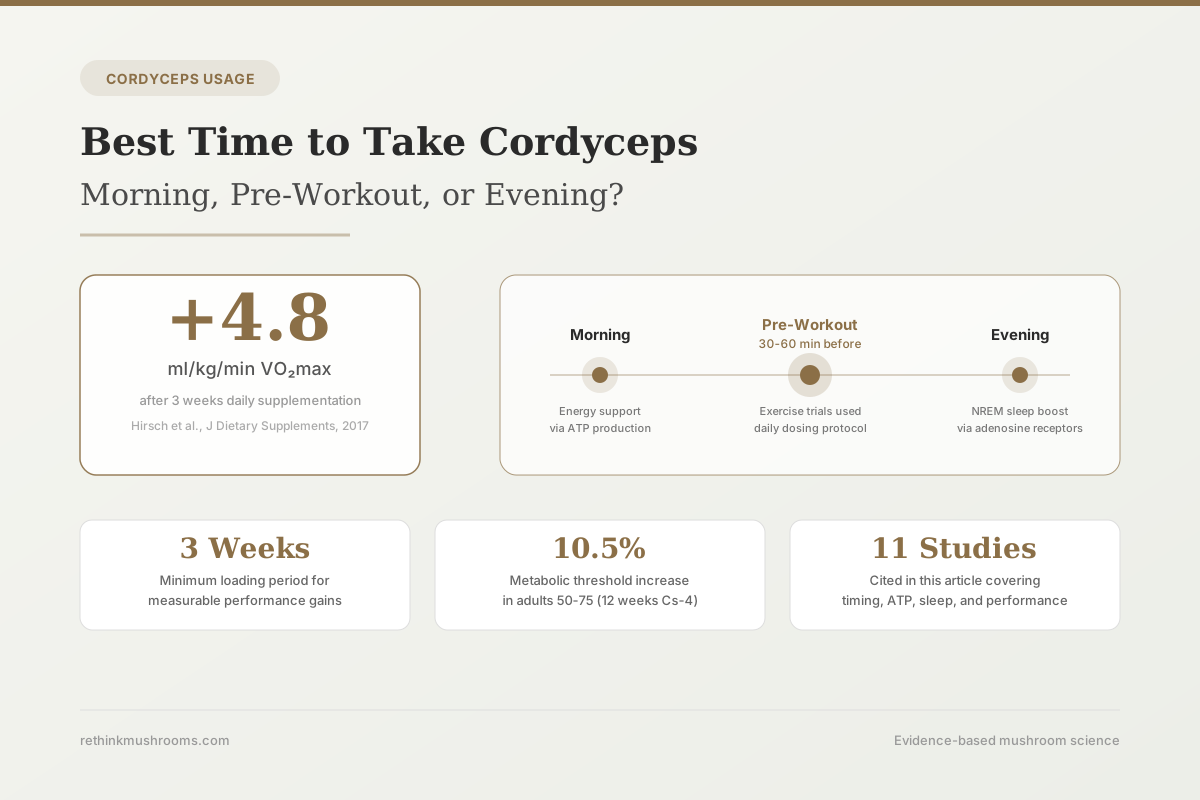
+4.8 ml/kg/min VO₂max
In a 28-person randomized controlled trial, 3 weeks of daily Cordyceps militaris supplementation increased VO₂max by 4.8 ml/kg/min, but only 1 week of supplementation showed no significant change.
Hirsch et al., Journal of Dietary Supplements, 2017
3 Weeks
minimum loading period for performance gains
30-60 Min
pre-workout window used in exercise trials
NREM Sleep
cordycepin increased deep sleep in rats
Hirsch et al., Journal of Dietary Supplements, 2017
 View as image ↗
A question that comes up constantly in mushroom supplement forums: should you take cordyceps in the morning, before a workout, or at night? The answer depends on what you are trying to achieve, and the clinical evidence points in directions that might surprise you. Cordyceps contains cordycepin, a compound structurally almost identical to adenosine, the molecule your brain uses to regulate both energy metabolism and sleep. That dual role means timing matters more than most supplement brands acknowledge.
The research on cordyceps dosing is still limited, but the clinical trials that do exist reveal a consistent pattern: chronic daily supplementation over weeks matters far more than the exact hour you take your dose.
Key Takeaways
- Three weeks of daily Cordyceps militaris supplementation (4 g/day) increased VO₂max by 4.8 ml/kg/min and time to exhaustion by 69.8 seconds; one week showed no VO₂max change (Hirsch et al., J Dietary Supplements, 2017)
- Twelve weeks of Cs-4 supplementation (999 mg/day) increased metabolic threshold by 10.5% and ventilatory threshold by 8.5% in adults aged 50-75, but did not change VO₂max (Chen et al., J Alternative and Complementary Medicine, 2010)
- Cordycepin increased non-rapid eye movement (NREM) sleep and theta wave power density in rats by upregulating adenosine A1, A2A, and A2B receptors in the hypothalamus (Hu et al., eCAM, 2013)
- Cordycepin undergoes rapid deamination by adenosine deaminase (ADA) in vivo, resulting in a short half-life that may influence optimal dosing schedules (Chen et al., Phytotherapy Research, 2023)
- Cordyceps militaris extract increased intracellular ATP production and enhanced swimming endurance in mice by activating AMPK and AKT/mTOR pathways (Choi et al., Mycobiology, 2020)
- Five weeks of CordyMax Cs-4 (3 g/day) produced no change in VO₂peak, ventilatory threshold, or time trial performance in trained male cyclists (Parcell et al., Int J Sport Nutrition, 2004)
Why Timing Seems to Matter: Cordycepin and Adenosine
The case for caring about when you take cordyceps rests on one compound: cordycepin (3'-deoxyadenosine). Cordycepin is a naturally occurring adenosine analogue isolated from Cordyceps militaris and C. sinensis.[1] Its molecular structure differs from adenosine by a single oxygen atom at the 3' position of the ribose sugar.
Adenosine plays two seemingly contradictory roles in human physiology. During waking hours, adenosine triphosphate (ATP) drives cellular energy. As you expend energy throughout the day, adenosine accumulates in the brain and binds to A1 and A2A receptors, building "sleep pressure" that eventually makes you drowsy. This is the same system that caffeine blocks.
Cordycepin interacts with this system on both sides. In a 2020 study by Choi and colleagues, Cordyceps militaris ethanol extract increased intracellular ATP production in L6 skeletal muscle cells and enhanced endurance capacity in mice by activating AMPK and AKT/mTOR signaling pathways.[2] On the sleep side, Hu and colleagues demonstrated in 2013 that oral cordycepin administration reduced sleep-wake cycles and increased non-rapid eye movement (NREM) sleep in rats. The protein levels of adenosine receptor subtypes A1, A2A, and A2B were all elevated after cordycepin administration, with the strongest increases in the hypothalamus.[3]
This dual action creates a theoretical basis for timing: cordycepin's ATP-boosting effects may support daytime energy and exercise, while its adenosine receptor activity may support sleep architecture at night. The practical question is whether the dose and route used in human supplements produce enough cordycepin to drive either effect measurably.
The Bioavailability Problem
Before optimizing timing, it is worth understanding a fundamental challenge. Cordycepin has poor bioavailability. Chen and colleagues published a comprehensive review in Phytotherapy Research in 2023 documenting that cordycepin undergoes rapid deamination by adenosine deaminase (ADA) in vivo, shortening its half-life and reducing the amount that reaches target tissues.[4]
This means that a single dose of cordyceps does not produce a sustained, hours-long pharmacological effect the way, say, a time-release medication would. The bioactive compounds peak and decline relatively quickly. That pharmacokinetic reality has two implications for timing: (1) taking cordyceps closer to your target activity window makes pharmacological sense, and (2) consistent daily dosing matters more than single-dose timing because the benefits appear to accumulate through repeated exposure rather than acute pharmacological action.
Morning Timing: The Energy Case
Most supplement brands recommend taking cordyceps in the morning, and the logic is straightforward: cordyceps supports cellular energy production, so take it when you need energy most. The preclinical data provides some support for this.
Song and colleagues (2015) demonstrated that two weeks of Cordyceps militaris fruit body extract administration in mice significantly increased endurance in forced swimming tests. The extract increased hepatic and muscle glycogen stores while reducing blood lactic acid and lactic dehydrogenase levels, suggesting improved energy substrate utilization.[5]
Chai and colleagues (2022) identified a specific molecular pathway: cordycepin exhibits anti-fatigue effects by activating the TIGAR/SIRT1/PGC-1α signaling pathway. In their mouse model, cordycepin increased hepatic glycogen, muscle glycogen, ATP, superoxide dismutase, and glutathione while reducing markers of fatigue and oxidative stress.[6]
These are animal studies. They establish biological plausibility for cordyceps supporting energy metabolism, but they do not prove that taking cordyceps at 7 AM produces a measurably different energy curve than taking it at 2 PM. No human clinical trial has directly compared morning versus afternoon dosing.
What the human exercise trials (discussed below) do show is that the performance benefits require weeks of daily loading, not acute dosing. This argues against treating cordyceps as a morning energy supplement in the way you might use caffeine for an immediate boost.
Pre-Workout Timing: What the Exercise Trials Show
The strongest evidence for timing comes from exercise performance trials, and the results are more nuanced than most supplement marketing suggests.
The Positive Trials
Hirsch and colleagues (2017) conducted a randomized, double-blind, placebo-controlled trial with 28 healthy adults. Subjects consumed 4 g/day of a mushroom blend containing Cordyceps militaris or placebo.[7] After one week, there was no significant change in VO₂max, ventilatory threshold, or time to exhaustion. After three weeks, VO₂max increased by 4.8 ml/kg/min in the cordyceps group (no change in placebo), and time to exhaustion improved by 69.8 seconds. Ventilatory threshold also improved by 0.7 L/min after three weeks.
The critical detail: one week was not enough. Three weeks of consistent daily dosing was required before measurable performance changes appeared. This suggests that the performance benefit is cumulative, not acute.
Chen and colleagues (2010) ran a double-blind, placebo-controlled trial with 20 healthy adults aged 50-75 who took Cs-4 (Cordyceps sinensis) at 999 mg/day (333 mg three times daily) for 12 weeks.[8] Metabolic threshold increased by 10.5% (from 0.83 to 0.93 L/min) and ventilatory threshold increased by 8.5% (from 1.25 to 1.36 L/min). VO₂max did not change. The threshold improvements mean participants could sustain higher intensity exercise before lactate accumulated, a meaningful performance marker.
Chen and colleagues (2014) tested a Rhodiola crenulata and Cordyceps sinensis blend in athletes during short-term high altitude training. The combination improved aerobic exercise performance at altitude, though the effect cannot be attributed to cordyceps alone due to the multi-ingredient design.[9]
The Negative Trial
Parcell and colleagues (2004) gave 22 endurance-trained male cyclists 3 g/day of CordyMax Cs-4 for five weeks. VO₂peak, ventilatory threshold, and time trial performance did not change in either group.[10]
This is an important study because the participants were already well-trained. Their baseline VO₂peak averaged 59.5 ml/kg/min, which is substantially higher than the untrained or moderately active subjects in the positive trials. The evidence suggests cordyceps may improve exercise capacity in people with room to improve, but offers diminishing returns for athletes already near their ceiling. The form used (Cs-4 fermented mycelium vs. C. militaris fruiting body) may also matter, though direct comparisons are lacking.
What This Means for Pre-Workout Timing
If you are using cordyceps for exercise performance, the evidence suggests:
- Take it daily for at least three weeks before expecting measurable results
- On training days, taking your dose 30-60 minutes before exercise aligns with the absorption window
- The benefit is from chronic loading, not acute pre-workout supplementation
- If you are already a highly trained athlete, the effect may be minimal
The 30-60 minute pre-workout window is extrapolated from supplement absorption kinetics, not directly tested in cordyceps timing trials. None of the published exercise studies specifically compared pre-workout versus post-workout dosing.
Evening Timing: The Sleep Question
The sleep case for cordyceps is the most pharmacologically interesting and the least studied in humans.
Hu and colleagues (2013) demonstrated that cordycepin reduced sleep-wake cycles and increased NREM sleep in rats.[3] The mechanism was direct: cordycepin upregulated adenosine receptors (A1, A2A, and A2B) in the hypothalamus, the brain region that orchestrates sleep-wake transitions. Theta wave power density during NREM sleep increased, which is associated with deeper, more restorative sleep.
This is a single animal study. The dose was administered orally, which matches supplement use, but rat sleep physiology differs from human sleep in important ways. No randomized controlled trial has tested cordyceps or cordycepin for sleep outcomes in humans.
The theoretical concern that cordyceps before bed will keep you awake is based on its reputation as an energy supplement, not on pharmacological evidence. Cordycepin's adenosine receptor agonism would, if anything, promote sleepiness. However, the ATP-boosting effects could theoretically counteract this. The net effect in humans at supplement doses is unknown.
If you are taking cordyceps primarily for sleep, the honest answer is that the evidence is insufficient to guide timing. The rat data suggests evening dosing could support NREM sleep, but this has not been validated in humans.
The Loading Period: More Important Than Time of Day
Across every positive exercise trial, one pattern is consistent: the benefits required weeks of daily supplementation to appear. Hirsch (2017) found no benefit at one week but significant improvement at three weeks.[7] Chen (2010) supplemented for 12 weeks.[8] Parcell (2004) supplemented for five weeks, though in trained athletes who may have been at their physiological ceiling.[10]
Ontawong and colleagues (2024) ran a randomized controlled trial examining a Cordyceps militaris beverage in healthy adults over multiple weeks. The immune markers (NK cell activity) showed changes at the 8-week mark in female participants, reinforcing the pattern that cordyceps compounds accumulate effects over chronic use rather than producing acute responses.[11]
The practical takeaway: picking a consistent daily time that fits your routine and sticking with it for at least three weeks matters more than agonizing over morning versus evening. The clinical data supports daily consistency above all else.
What Actually Moves the Needle
The Loading Period Outranks the Time of Day
Every positive trial found the benefit accrues over weeks of daily use. The hour you take your dose is the weaker lever — and the evidence behind each within-day window is thinner than the marketing suggests.
The dominant variable: days on, not time of day
Week 1
No measurable change
Week 3
+4.8 ml/kg/min VO₂max appears
Week 12
+10.5% metabolic threshold sustained
The weaker lever: within-day windows, graded honestly
Morning · energy
Animal onlyEndurance and glycogen effects shown in mice (Song 2015; Chai 2022). No human trial compared morning vs afternoon dosing.
Pre-workout · performance
InferredThe 30–60 min window is extrapolated from absorption kinetics, not tested directly. The measured benefit came from weeks of daily loading, not the pre-session dose.
Evening · sleep
Rat studyCordycepin raised NREM sleep via hypothalamic adenosine receptors in rats (Hu 2013). Not validated in humans; pharmacology does not contradict evening use.
Sources: Hirsch et al. (2017) [ref 7]; Chen et al. (2010) [ref 8]; Song et al. (2015) [ref 5]; Chai et al. (2022) [ref 6]; Hu et al. (2013) [ref 3].
Dose Splitting: Once Daily vs Multiple Times
Chen et al. (2010) used a three-times-daily protocol: 333 mg of Cs-4 at breakfast, lunch, and dinner.[8] Hirsch et al. (2017) used a single daily dose of 4 g.[7] Both trials showed positive results (with different outcome measures), so neither protocol has been proven superior.
Given cordycepin's rapid deamination by adenosine deaminase,[4] splitting the dose across the day could theoretically maintain more consistent blood levels. This has not been directly tested. For simplicity, a single daily dose taken at a consistent time each day aligns with the largest positive exercise trial (Hirsch 2017).
For more detail on amounts, the cordyceps dosage guide covers the ranges used across clinical trials.
What the Evidence Does Not Support
Several popular claims about cordyceps timing lack evidence:
"Take cordyceps on an empty stomach for better absorption." No clinical trial has compared fasted versus fed cordyceps supplementation. The bioavailability review by Chen et al. (2023) does not mention food timing as a significant variable.[4]
"Cycle on and off for best results." No trial has tested cycling protocols. The positive trials used continuous daily supplementation for 3-12 weeks.
"Cordyceps replaces your morning coffee." Cordycepin has a completely different mechanism from caffeine. Caffeine blocks adenosine receptors; cordycepin activates them. These are opposite pharmacological actions. If anything, cordycepin could theoretically blunt caffeine's effects, though this interaction has not been studied.
"Avoid cordyceps at night because it will keep you awake." The only sleep study on cordycepin showed it promoted NREM sleep in rats.[3] The "energy boost" reputation comes from ATP production in muscle cells, not from CNS stimulation like caffeine.
If you are new to cordyceps, the beginner's guide covers what to expect in the first few weeks.
Timing by Goal: A Summary
For exercise performance: Take daily for at least 3 weeks. On training days, 30-60 minutes before exercise is a reasonable window based on absorption kinetics. Daily consistency over weeks matters far more than single-session timing. For people who are concerned about cordyceps interactions with medications, check compatibility before adding it to a pre-workout stack.
For general energy: Morning or early afternoon, taken consistently. The evidence for acute energy effects is from animal studies, not human trials.
For sleep support: The only relevant data (increased NREM sleep in rats) used evening dosing, but no human trial has confirmed this. If you respond well to cordyceps at night, the pharmacology does not contradict evening use.
For immune support: Timing within the day is unlikely to matter. Ontawong et al. (2024) found immune marker changes after 8 weeks of daily use, not from specific timing.[11]
For broader context on how cordyceps functions as an adaptogenic mushroom, the stress response research explains the HPA axis connection.
This article is educational and is not medical advice. Cordyceps can interact with medications, including blood thinners and immunosuppressants, and is not appropriate for everyone. Consult a qualified healthcare provider before starting cordyceps or adding it to a supplement or pre-workout stack, particularly if you are pregnant, taking prescription drugs, or managing a health condition.
The Bottom Line
Cordyceps timing is less important than consistency. The clinical trial evidence consistently shows that benefits emerge after 3-12 weeks of daily supplementation, not from acute single doses. Cordycepin's dual nature as both an ATP promoter and an adenosine receptor activator means the compound does not fit neatly into a "morning energy" or "nighttime sleep" category. The strongest recommendation the data supports is daily use at a consistent time for at least three weeks, with pre-workout dosing (30-60 minutes before exercise) as a reasonable approach for those targeting performance.
Frequently Asked Questions
Sources & References
- 1RTHM-00790·Phull, Abdul-Rehman et al. (2022). “Cordyceps militaris as a Bio Functional Food Source: Pharmacological Potential, Anti-Inflammatory Actions and Related Molecular Mechanisms..” Microorganisms.Study breakdown →PubMed →↩
- 2RTHM-00613·Choi, Eunhyun et al. (2020). “Beneficial Effect of Cordyceps militaris on Exercise Performance via Promoting Cellular Energy Production..” Mycobiology.Study breakdown →PubMed →↩
- 3RTHM-00288·Hu, Zhenzhen et al. (2013). “Cordycepin Increases Nonrapid Eye Movement Sleep via Adenosine Receptors in Rats..” Evidence-based complementary and alternative medicine : eCAM.Study breakdown →PubMed →↩
- 4RTHM-00817·Chen, Min et al. (2023). “Cordycepin: A review of strategies to improve the bioavailability and efficacy..” Phytotherapy research : PTR.Study breakdown →PubMed →↩
- 5RTHM-00401·Song, Jingjing et al. (2015). “Studies on the Antifatigue Activities of Cordyceps militaris Fruit Body Extract in Mouse Model..” Evidence-based complementary and alternative medicine : eCAM.Study breakdown →PubMed →↩
- 6RTHM-00749·Chai, Xiaoming et al. (2022). “Cordycepin exhibits anti-fatigue effect via activating TIGAR/SIRT1/PGC-1α signaling pathway..” Biochemical and biophysical research communications.Study breakdown →PubMed →↩
- 7RTHM-00473·Hirsch, Katie R et al. (2017). “Cordyceps militaris Improves Tolerance to High-Intensity Exercise After Acute and Chronic Supplementation..” Journal of dietary supplements.Study breakdown →PubMed →↩
- 8RTHM-00176·Chen, Steve et al. (2010). “Effect of Cs-4 (Cordyceps sinensis) on exercise performance in healthy older subjects: a double-blind, placebo-controlled trial..” Journal of alternative and complementary medicine (New York.Study breakdown →PubMed →↩
- 9RTHM-00313·Chen, Chung-Yu et al. (2014). “Rhodiola crenulata- and Cordyceps sinensis-based supplement boosts aerobic exercise performance after short-term high altitude training..” High altitude medicine & biology.Study breakdown →PubMed →↩
- 10RTHM-00075·Parcell, Allen C et al. (2004). “Cordyceps Sinensis (CordyMax Cs-4) supplementation does not improve endurance exercise performance..” International journal of sport nutrition and exercise metabolism.Study breakdown →PubMed →↩
- 11RTHM-00899·Ontawong, Atcharaporn et al. (2024). “A randomized controlled clinical trial examining the effects of Cordyceps militaris beverage on the immune response in healthy adults..” Scientific reports.Study breakdown →PubMed →↩