Cordyceps Practical Use
1-3g/day
Human clinical trials have used 1-3 grams of cordyceps daily for 8-12 weeks. Every published trial at these doses reported no significant adverse effects.
Multiple RCTs, 2008-2024
8-12 Weeks
typical trial duration
No Adverse Events
at clinical trial doses
2 Species
C. sinensis and C. militaris tested
Multiple RCTs, 2008-2024
 View as image ↗
Every piece of cordyceps dosing advice on the internet ultimately comes from the same small set of clinical trials. Rather than repeating supplement marketing claims, this article goes straight to those trials and reports exactly what doses were tested, in whom, for how long, and what happened. The honest picture: human trials have used 1-3 grams daily of various cordyceps preparations for 8-12 weeks, and all reported good safety profiles. The effects that emerged in those timeframes were modest, measurable changes in immune markers and exercise capacity, not dramatic energy surges or overnight transformations. For a deeper dive into optimal dosing beyond the beginner stage, the cordyceps dosage guide covers the full dose-response evidence.
Key Takeaways
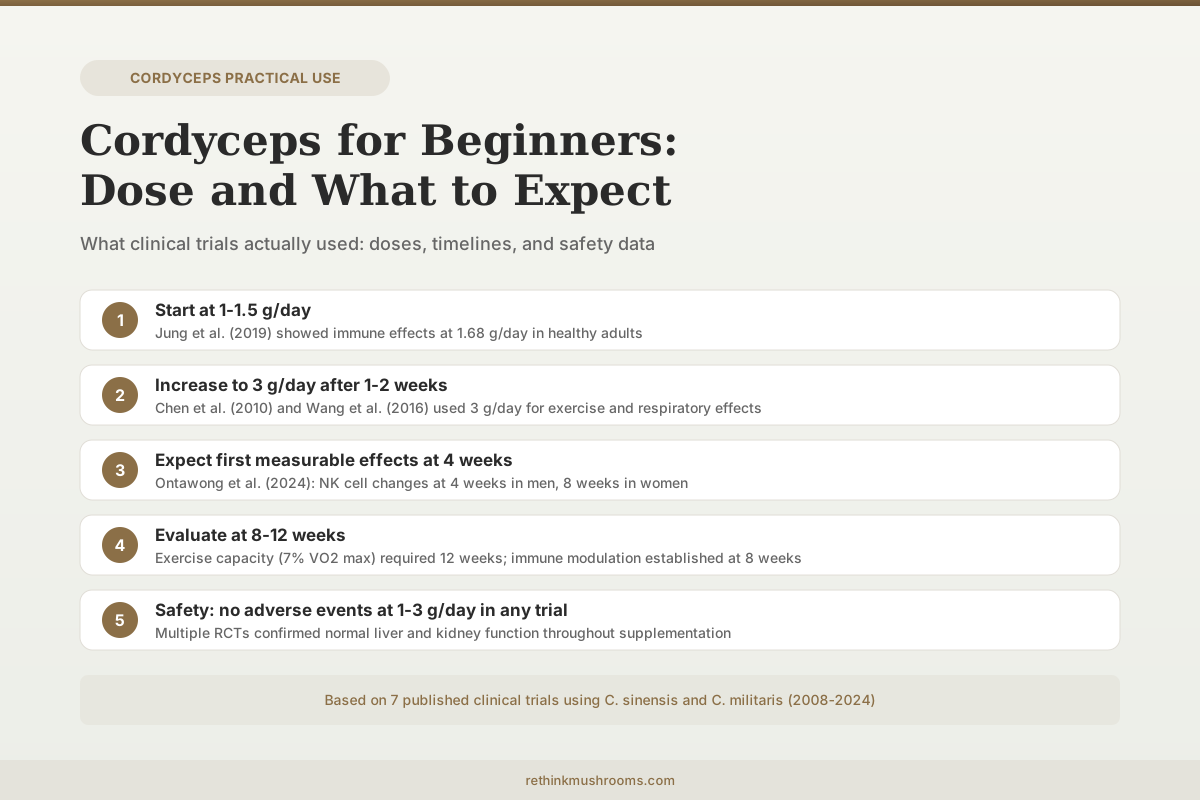
- Clinical trials used doses of 1-3 g/day: Jung et al. (2019) used 1.68 g/day, Wang et al. (2016) used 3 g/day, and Chen et al. (2010) used 3 g/day of Cs-4
- NK cell changes appeared at 4 weeks in men and 8 weeks in women in the Ontawong et al. (2024) RCT
- Exercise performance improvements (7% VO2 max increase) required 12 weeks in the Chen et al. (2010) trial of older adults
- No significant adverse events were reported in any published human trial at doses up to 3 g/day for up to 12 months
- The two cordyceps species used in human trials (C. sinensis mycelium and C. militaris fruiting body/fermented) have different bioactive profiles
- Reported mild effects in some trials included dry mouth, mild GI discomfort, and changes in stool consistency
What the Clinical Trials Actually Used
No regulatory authority has established an official recommended dose for cordyceps. What exists is a set of clinical trials that tested specific products at specific doses, and the following is what those trials used.
1.68 g/day: C. sinensis Mycelium Extract (CBG-CS-2)
Jung et al. (2019) gave 39 healthy adults 1.68 g/day of a Cordyceps sinensis mycelium culture extract (Paecilomyces hepiali, CBG-CS-2) for 8 weeks. NK cell cytotoxic activity increased by 38.8% versus placebo. No adverse events were reported. Liver function (AST, ALT) and kidney function (creatinine, BUN) remained normal throughout.[1]
3 g/day: C. sinensis (Cs-4) for Exercise
Chen et al. (2010) administered 3 g/day of Cs-4 (C. sinensis fermented mycelium) to 10 healthy older adults (aged 50-75) for 12 weeks. Metabolic threshold improved by 10.5% and VO2 max by approximately 7%. No adverse effects were documented.[2]
3 g/day: C. sinensis for Asthma
Wang et al. (2016) gave 60 patients with moderate-to-severe asthma 1 g of C. sinensis (Corbin capsule) three times daily (3 g/day total) for 3 months. Health-related quality of life improved. This is one of the longer human trials and one of the few in a clinical population rather than healthy volunteers.[3]
3 g/day: C. sinensis for Renal Transplant
Li et al. (2009) administered 1 g of C. sinensis three times daily as an adjunct to immunosuppressive therapy in 93 renal transplant patients. After 3 months, the cordyceps group showed improved renal function and fewer complications. This trial used the highest patient risk population and showed no safety concerns specific to cordyceps.[4]
Fermented C. militaris Beverage
Ontawong et al. (2024) used a fermented C. militaris beverage containing 2.85 mg of cordycepin for 8 weeks in healthy adults. The daily cordycepin dose was far lower than what whole-extract products provide, yet NK cell changes were measurable.[5]
C. militaris in Healthy Men
Kang et al. (2015) supplemented healthy Korean men with C. militaris and measured increases in NK cell activity, lymphocyte proliferation, IL-2, and IFN-γ. The study confirmed cell-mediated immune enhancement from the C. militaris species specifically.[6]
How Long Before You Notice Anything
The timeline question is the one beginners most want answered, and the clinical trials give a concrete answer: weeks, not days.
4 weeks: Ontawong et al. (2024) detected NK cell activity changes in men at the 4-week mark. This is the earliest measurable immune effect in any published trial.
8 weeks: Both the Jung et al. (2019) and Ontawong et al. (2024) trials measured outcomes at 8 weeks. NK cell enhancement, cytokine changes, and immune modulation were established by this point. Women in the Ontawong trial showed NK cell changes at 8 weeks rather than 4.
12 weeks: Chen et al. (2010) required 12 weeks to show the exercise performance improvements (7% VO2 max increase). This suggests that metabolic and mitochondrial adaptations take longer than immune changes.
3 weeks: Hirsch et al. (2017) found improved exercise tolerance after 3 weeks of a C. militaris-containing mushroom blend, but found no effect after a single acute dose. This confirms that cordyceps effects are cumulative and require consistent daily use.[7]
The practical takeaway: plan for at least 4-8 weeks of daily use before evaluating whether cordyceps is producing an effect. Single-dose or occasional use has no evidence behind it.
For the research on when to take it during the day, see Best Time to Take Cordyceps: Morning, Pre-Workout, or Evening?.
C. sinensis vs. C. militaris: Which Species for Beginners
The two species available commercially have different bioactive profiles and different evidence bases.
Cordyceps sinensis (often sold as Cs-4 or mycelium-on-grain products): This is the species traditional Chinese medicine used. The Chen et al. (2010), Wang et al. (2016), and Jung et al. (2019) trials all used C. sinensis mycelium preparations. Wild C. sinensis is extremely expensive ($20,000+ per kilogram); commercial products use lab-cultured mycelium, typically grown on grain substrates.
Cordyceps militaris (available as fruiting body or fermented extract): This species is easier to cultivate and is the primary source of cordycepin. The Ontawong et al. (2024) and Kang et al. (2015) trials used C. militaris. Fruiting body products generally contain higher measurable cordycepin than mycelium-on-grain products.
Both species have shown immune-modulating effects in human trials. The choice depends on the specific outcome: C. militaris fruiting body products offer higher cordycepin content, while C. sinensis mycelium products (like Cs-4) have the longest safety record in clinical trials.
Safety Profile: What the Evidence Shows
Across all published human trials, cordyceps at 1-3 g/day showed no significant adverse events. The specific safety data from trials includes:
- Jung et al. (2019): Liver function (AST, ALT) and kidney function (creatinine, BUN) monitored throughout 8 weeks, all values remained within normal ranges
- Chen et al. (2010): No adverse effects reported over 12 weeks at 3 g/day
- Li et al. (2009): No cordyceps-specific complications in immunosuppressed transplant patients over 3 months
The LiverTox database (maintained by the National Institutes of Health) notes that cordyceps extracts are "well tolerated with only minimal or mild adverse events" that can include dry mouth, mild gastrointestinal discomfort, and rare skin reactions.
Potential interactions: Cordyceps has theoretical interactions with anticoagulant drugs (due to anti-platelet activity observed in vitro) and immunosuppressants (due to immune-modulating effects). The Li et al. (2009) transplant study suggests that cordyceps can be used alongside immunosuppressants under medical supervision, but the drug interaction evidence should be reviewed for specific medications.
For the full safety data, see Cordyceps Side Effects: What the Safety Research Shows.
What Beginners Should Realistically Expect
Based on the clinical trial evidence, realistic expectations for a beginner taking 1-3 g/day of cordyceps are:
Weeks 1-2: No measurable effects in any published study at this timeframe. Subjective reports from users (not clinical data) sometimes describe mild energy changes, but this may be placebo effect. Hirsch et al. (2017) showed no acute effects from a single dose.
Weeks 3-4: Possible early immune changes. Ontawong et al. (2024) detected NK cell changes in men at 4 weeks. Hirsch et al. (2017) showed improved exercise tolerance at 3 weeks.
Weeks 8-12: The timeframe where measurable effects are established across immune function (Jung et al., 2019), cytokine levels (Ontawong et al., 2024), and exercise capacity (Chen et al., 2010).
What you will NOT experience: Dramatic energy surges, immediate athletic performance changes, or noticeable libido shifts. The research on cordyceps and exercise performance shows modest improvements (7-10% in metabolic thresholds) in older or untrained individuals, with no measurable effect in already-fit young athletes. The cordyceps and libido research has no human trial data on sexual function outcomes.
Supplement Quality Considerations
Not all cordyceps products contain what they claim. Relevant quality factors:
- Fruiting body vs. mycelium-on-grain: Fruiting body products generally have higher measurable beta-glucan and cordycepin content. Mycelium-on-grain products contain residual grain starch that dilutes the fungal bioactives. Both have been used in clinical trials.
- Cordycepin content: Varies widely between products. The Ontawong et al. (2024) trial used a preparation standardized to contain 2.85 mg cordycepin. Many commercial products do not disclose cordycepin content.
- Third-party testing: Look for products with certificate of analysis (COA) from independent labs verifying beta-glucan content and absence of contaminants.
For details on mushroom supplement manufacturing standards, that article covers what separates quality products from unreliable ones.
The Bottom Line
Human clinical trials have used 1-3 g/day of cordyceps for 8-12 weeks with no significant adverse events. Measurable immune changes appear at 4-8 weeks, and exercise capacity improvements at 12 weeks. Both C. sinensis mycelium and C. militaris fruiting body preparations have shown effects in human trials. Realistic expectations for beginners: plan for 4-8 weeks of daily use, expect modest and gradual changes in immune markers and exercise tolerance, and do not expect the dramatic effects that supplement marketing implies.
Frequently Asked Questions
Sources & References
- 1RTHM-00563·Jung, Su-Jin et al. (2019). “Immunomodulatory effects of a mycelium extract of Cordyceps (Paecilomyces hepiali; CBG-CS-2): a randomized and double-blind clinical trial..” BMC complementary and alternative medicine.Study breakdown →PubMed →↩
- 2RTHM-00176·Chen, Steve et al. (2010). “Effect of Cs-4 (Cordyceps sinensis) on exercise performance in healthy older subjects: a double-blind, placebo-controlled trial..” Journal of alternative and complementary medicine (New York.Study breakdown →PubMed →↩
- 3RTHM-00456·Wang, Ningqun et al. (2016). “Herbal Medicine Cordyceps sinensis Improves Health-Related Quality of Life in Moderate-to-Severe Asthma..” Evidence-based complementary and alternative medicine : eCAM.Study breakdown →PubMed →↩
- 4RTHM-00161·Li, Y et al. (2009). “Clinical application of Cordyceps sinensis on immunosuppressive therapy in renal transplantation..” Transplantation proceedings.Study breakdown →PubMed →↩
- 5RTHM-00899·Ontawong, Atcharaporn et al. (2024). “A randomized controlled clinical trial examining the effects of Cordyceps militaris beverage on the immune response in healthy adults..” Scientific reports.Study breakdown →PubMed →↩
- 6RTHM-00378·Kang, Ho Joon et al. (2015). “Cordyceps militaris Enhances Cell-Mediated Immunity in Healthy Korean Men..” Journal of medicinal food.Study breakdown →PubMed →↩
- 7RTHM-00473·Hirsch, Katie R et al. (2017). “Cordyceps militaris Improves Tolerance to High-Intensity Exercise After Acute and Chronic Supplementation..” Journal of dietary supplements.Study breakdown →PubMed →↩