Cordyceps Sexual Health
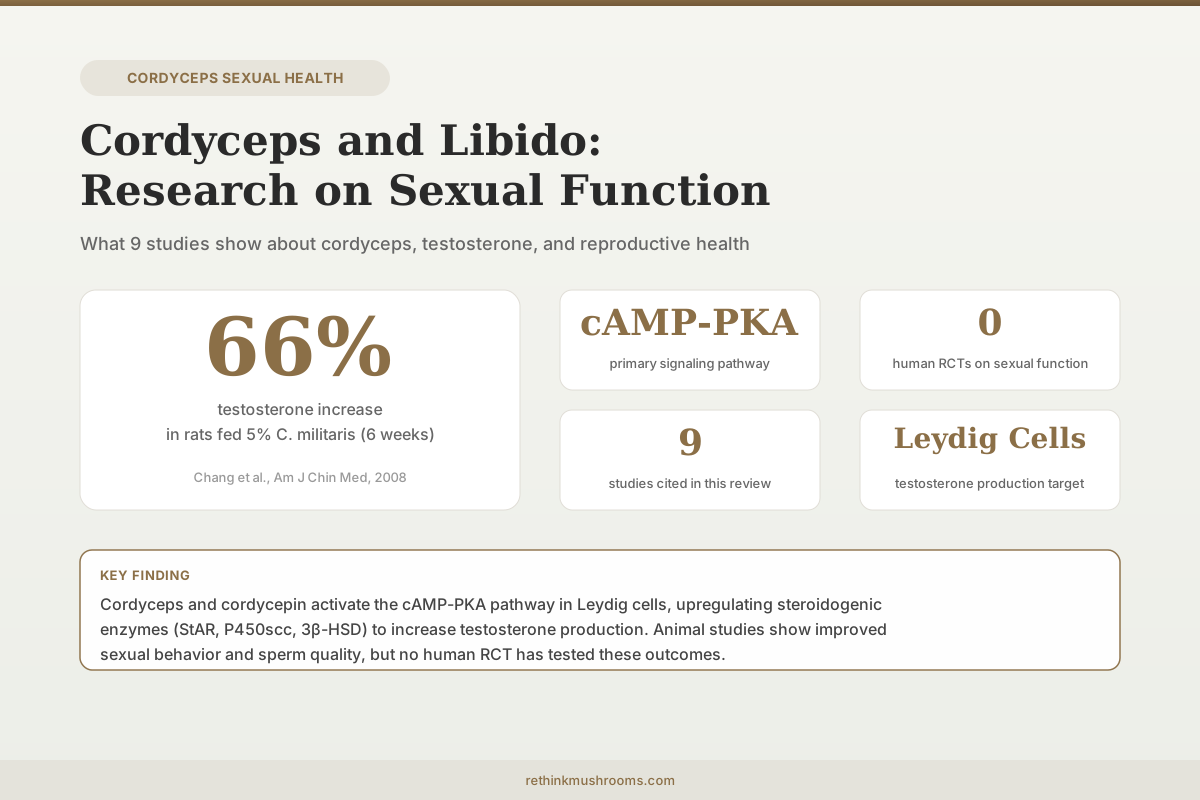
66% T increase
Rats supplemented with 5% Cordyceps militaris mycelium for 6 weeks showed a 66% increase in serum testosterone compared to controls, with simultaneous improvements in sperm motility.
Chang et al., Am J Chin Med, 2008
Leydig Cells
primary testosterone target
cAMP-PKA
signaling pathway activated
0 Human RCTs
on sexual function directly
Chang et al., Am J Chin Med, 2008
 View as image ↗
Cordyceps species have been used in traditional Chinese medicine for centuries as a tonic for sexual dysfunction, but the scientific evidence behind this reputation is almost entirely preclinical. Animal studies consistently show that both Cordyceps sinensis and Cordyceps militaris stimulate testosterone production in Leydig cells, improve sperm parameters, and enhance sexual behavior in rodent models. The mechanisms are well-mapped: activation of the cAMP-PKA signaling pathway drives steroidogenic enzyme expression, increasing testosterone synthesis. What the research has not yet produced is a single randomized controlled trial measuring sexual function outcomes in humans. That gap between centuries of traditional use, strong animal data, and absent human trials defines the current state of cordyceps libido research. For the specific hormonal data, the dedicated article on cordyceps and testosterone goes deeper into dose-response relationships.
Key Takeaways
- Rats fed 5% Cordyceps militaris mycelium for 6 weeks had 66% higher serum testosterone and improved sperm motility versus controls (Chang et al., 2008)
- Cordyceps sinensis mycelium stimulated testosterone production in mouse Leydig cells in vivo through the cAMP-PKA signaling pathway (Huang et al., 2004)
- Diabetic rats given C. militaris extract (1.0 g/kg/day) for 3 weeks showed restored ejaculation frequency and increased intracavernous pressure, indicating improved erectile function (Pohsa et al., 2020)
- C. sinensis upregulated steroidogenic enzymes (StAR, P450scc, 3β-HSD) and increased 17β-estradiol production in human granulosa-lutein cells (Huang et al., 2004)
- C. militaris fruit body extract maintained serum testosterone and DHT levels while simultaneously inhibiting testosterone-stimulated prostate growth in castrated rats (Kusama et al., 2020)
- No published randomized controlled trial has tested cordyceps for sexual function, libido, or erectile dysfunction in humans
The Traditional Claim and Its Scientific Basis
Cordyceps has been called "Himalayan Viagra" in popular media, a label rooted in centuries of use in Tibetan and Chinese traditional medicine for treating hyposexuality and kidney yang deficiency. The Jiraungkoorskul (2016) review traced this tradition through historical pharmacopoeias, noting that Ophiocordyceps sinensis (the wild-harvested Tibetan species) was documented as a treatment for sexual dysfunction, fatigue, and weakness in the Ben Cao Cong Xin (1757).[1]
The scientific question is whether this traditional use reflects genuine pharmacological activity on reproductive hormones, or whether it stems from the fungus's general adaptogenic and energy-enhancing properties. The evidence from the last two decades points toward direct hormonal effects, though exclusively in cell and animal models.
How Cordyceps Stimulates Testosterone Production
The most mechanistically detailed work comes from a series of studies on mouse Leydig cells, the testicular cells responsible for testosterone synthesis.
Huang et al. (2004) demonstrated that Cordyceps sinensis mycelium and its fractions stimulated testosterone production in vivo in male mice. The mechanism involved activation of the cAMP-protein kinase A (PKA) pathway, which upregulated key steroidogenic enzymes: steroidogenic acute regulatory protein (StAR), cytochrome P450 side-chain cleavage (P450scc), and 3β-hydroxysteroid dehydrogenase (3β-HSD). These enzymes control the rate-limiting steps of converting cholesterol into testosterone.[2]
Chen et al. (2017) reviewed the accumulated evidence on this pathway and confirmed that both C. sinensis water extracts and purified cordycepin activated the same cAMP-PKA cascade in MA-10 mouse Leydig tumor cells and primary Leydig cells. The review noted that C. sinensis stimulated not only testosterone but also progesterone production, suggesting broad steroidogenic activation rather than testosterone-specific effects.[3]
The same group also showed this mechanism works in female reproductive tissue. Huang et al. (2004) found that C. sinensis mycelium upregulated steroidogenic enzymes and increased 17β-estradiol (E2) production in human granulosa-lutein cells collected from women undergoing IVF. This is one of the few studies using human tissue, and it confirmed that the steroidogenic enzyme activation observed in mouse cells also occurs in human cells.[4]
For the full picture of how these effects connect to female sexual health and fertility research, that article covers the estradiol and ovarian function data.
Sperm Quality and Reproductive Parameters
Chang et al. (2008) conducted one of the most frequently cited studies on cordyceps and male reproduction. Sprague-Dawley rats (90 total, 30 per group) were fed either a regular diet or a diet supplemented with 1% or 5% Cordyceps militaris mycelium for 6 weeks. The 5% supplementation group showed a 66% increase in serum testosterone compared to controls. Sperm motility also improved, and epididymal sperm counts increased in the supplemented groups.[5]
The testosterone increase was dose-dependent: 1% supplementation produced a smaller but measurable increase, while 5% produced the larger effect. The study also measured serum estradiol, which increased in supplemented groups, consistent with the broad steroidogenic activation described in the Leydig cell studies.
For a focused analysis of the sperm parameter data across multiple studies, see Cordyceps and Sperm Quality: What the Studies Show.
Sexual Behavior in Diabetic Animal Models
Diabetes frequently causes sexual dysfunction through vascular damage, neuropathy, and hormonal disruption. Two studies tested cordyceps specifically in diabetic rat models of sexual dysfunction.
Pohsa et al. (2020) cultured C. militaris on white rice and silkworm pupae medium, then fed the extract to streptozotocin-induced diabetic rats at 0.1, 0.5, or 1.0 g/kg body weight daily for 3 weeks. The highest dose group showed restored ejaculation frequency, increased mount and intromission frequency, and improved intracavernous pressure-to-mean arterial pressure (ICP/MAP) ratio, a direct measure of erectile function. Serum testosterone increased in the treatment groups, and testicular histology showed reduced diabetes-related damage.[6]
Nguyen et al. (2021) replicated similar findings in STZ-induced diabetic Wistar rats. C. militaris treatment improved epididymal sperm parameters and serum testosterone levels, which in turn improved copulatory behavior. The study attributed these effects to both direct hormonal stimulation and the antioxidant properties of cordycepin, which may protect testicular tissue from diabetes-induced oxidative damage.[7]
Both studies used oral administration, which is relevant to how humans would actually consume cordyceps. The doses (0.1-1.0 g/kg in rats) would translate to very rough human equivalent doses of approximately 1-10 g/day, though interspecies dose scaling is imprecise.
Testosterone Maintenance Without Prostate Growth
One of the more nuanced findings came from Kusama et al. (2020), who tested C. militaris fruit body extract in castrated rats receiving testosterone propionate (TP) to simulate androgen replacement. The extract maintained serum testosterone and dihydrotestosterone (DHT) levels, but it simultaneously inhibited TP-induced prostate growth. In prostate cancer cell lines (LNCaP and PC3), the extract decreased cell viability in a dose-dependent manner.[8]
This dual action is pharmacologically interesting. Testosterone decline in aging males (late-onset hypogonadism) and prostate enlargement (benign prostatic hyperplasia) often occur together, and conventional testosterone replacement can worsen prostate symptoms. A compound that supports testosterone levels while restraining prostate growth would address both problems, though this has only been demonstrated in rodents.
The Steroidogenesis Pathway: What Cordyceps Actually Does
Wang et al. (1998) were among the first to demonstrate that a water-soluble extract of C. sinensis directly stimulated steroid production in primary rat adrenal cell cultures. The extract increased plasma corticosterone levels in a dose-dependent manner. This established that cordyceps acts directly on steroidogenic tissue rather than through the hypothalamic-pituitary axis, an important mechanistic distinction.[9]
The combined evidence from Wang (1998), Huang (2004), and Chen (2017) maps a clear pathway: cordyceps and cordycepin activate adenylyl cyclase, increasing intracellular cAMP, which activates PKA, which phosphorylates and upregulates StAR protein (the rate-limiting step in cholesterol transport into mitochondria), P450scc (which converts cholesterol to pregnenolone), and downstream enzymes that produce testosterone. This is the same pathway that luteinizing hormone (LH) uses to stimulate testosterone production, suggesting cordyceps may mimic or amplify the natural hormonal signal.
This connects to how cordyceps boosts cellular energy through ATP production, since the cAMP pathway overlaps with energy metabolism signaling.
The Human Evidence Gap
The absence of human clinical trials on cordyceps and sexual function is the defining limitation of this research area. The Jiraungkoorskul (2016) review noted that despite "thousands of years" of traditional use and consistent animal data, no controlled human study had measured sexual function outcomes.[1] As of 2026, that gap persists.
The closest human data comes from adjacent research. Huang et al. (2004) showed C. sinensis stimulated steroidogenic enzymes in human granulosa-lutein cells, confirming the biochemical pathway is active in human tissue.[4] Clinical trials on cordyceps and exercise performance have demonstrated physiological effects in humans, including improved oxygen utilization. But sexual function, testosterone levels, and libido have not been measured as primary or secondary endpoints in any published RCT.
Several factors explain this gap. Sexual function trials are expensive, require large sample sizes for adequate power, and face regulatory complexity. The traditional use basis makes funding from pharmaceutical companies unlikely, and the supplement industry has little incentive to fund rigorous trials when marketing claims can be made from traditional use alone.
What the Evidence Actually Supports
The preclinical case for cordyceps affecting reproductive hormones is consistent and mechanistically detailed. Cordyceps extracts and cordycepin activate the cAMP-PKA pathway in Leydig cells, upregulating steroidogenic enzymes and increasing testosterone production. In intact animals, this translates to measurable increases in serum testosterone, improved sperm parameters, and enhanced sexual behavior, including in disease models where sexual function is impaired.
The human evidence is limited to one study showing steroidogenic enzyme activation in human ovarian cells. No clinical trial has tested whether oral cordyceps supplementation increases testosterone, improves libido, or enhances sexual function in men or women. The animal doses that produced effects (1-5% of diet, or 0.1-1.0 g/kg body weight) are substantially higher than typical supplement doses, raising additional questions about whether commercially available products contain sufficient bioactive compounds to replicate the animal findings.
The Bottom Line
Cordyceps stimulates testosterone production through cAMP-PKA pathway activation in Leydig cells, with consistent evidence across cell culture and animal studies showing increased serum testosterone, improved sperm quality, and enhanced sexual behavior. The fruit body extract may also inhibit prostate growth while maintaining testosterone levels. However, no randomized controlled trial has tested cordyceps for sexual function, libido, or testosterone levels in humans, leaving a significant gap between the mechanistic evidence and clinical application.
Frequently Asked Questions
Sources & References
- 1RTHM-00428·Jiraungkoorskul, Kanitta et al. (2016). “Review of Naturopathy of Medical Mushroom, Ophiocordyceps Sinensis, in Sexual Dysfunction..” Pharmacognosy reviews.Study breakdown →PubMed →↩
- 2RTHM-00070·Huang, Yuan-Li et al. (2004). “In vivo stimulatory effect of Cordyceps sinensis mycelium and its fractions on reproductive functions in male mouse..” Life sciences.Study breakdown →PubMed →↩
- 3RTHM-00466·Chen, Yung-Chia et al. (2017). “Functional study of Cordyceps sinensis and cordycepin in male reproduction: A review..” Journal of food and drug analysis.Study breakdown →PubMed →↩
- 4RTHM-00069·Huang, Bu-Miin et al. (2004). “Upregulation of steroidogenic enzymes and ovarian 17beta-estradiol in human granulosa-lutein cells by Cordyceps sinensis mycelium..” Biology of reproduction.Study breakdown →PubMed →↩
- 5RTHM-00127·Chang, Ying et al. (2008). “Effect of Cordyceps militaris supplementation on sperm production, sperm motility and hormones in Sprague-Dawley rats..” The American journal of Chinese medicine.Study breakdown →PubMed →↩
- 6RTHM-00650·Pohsa, Sureena et al. (2020). “Effects of Cultured Cordycep militaris on Sexual Performance and Erectile Function in Streptozotocin-Induced Diabetic Male Rats..” BioMed research international.Study breakdown →PubMed →↩
- 7RTHM-00710·Nguyen, Toan Van et al. (2021). “A study of the aphrodisiac properties of Cordyceps militaris in streptozotocin-induced diabetic male rats..” Veterinary world.Study breakdown →PubMed →↩
- 8RTHM-00629·Kusama, Kazuya et al. (2020). “Cordyceps militaris Fruit Body Extract Decreases Testosterone Catabolism and Testosterone-Stimulated Prostate Hypertrophy..” Nutrients.Study breakdown →PubMed →↩
- 9RTHM-00027·Wang, S M et al. (1998). “Effects of a water-soluble extract of Cordyceps sinensis on steroidogenesis and capsular morphology of lipid droplets in cultured rat adrenocortical cells..” Journal of cellular biochemistry.Study breakdown →PubMed →↩