Cordyceps & Sexual Health
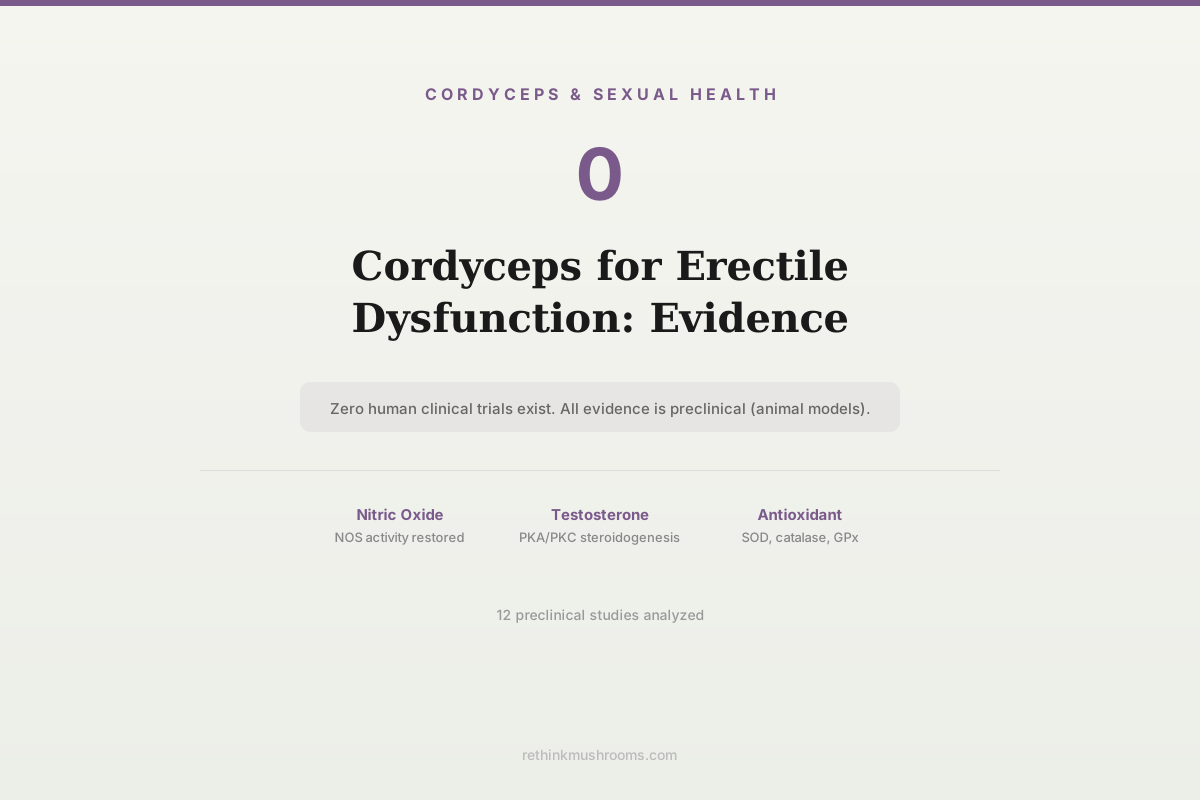
0 human clinical trials on cordyceps and ED
Despite centuries of traditional use for sexual dysfunction, zero controlled human trials have tested cordyceps specifically for erectile dysfunction. All direct evidence comes from animal models, primarily diabetic rats. The mechanisms are well-characterized in preclinical work, but the clinical gap remains total.
Pohsa et al., BioMed Research International, 2020; Jiraungkoorskul & Jiraungkoorskul, Pharmacognosy Reviews, 2016
3 mechanisms
nitric oxide, testosterone, antioxidant defense
Cordycepin
adenosine analogue that mediates vasodilation
All preclinical
no human erectile dysfunction data published
Pohsa et al., BioMed Research International, 2020; Jiraungkoorskul & Jiraungkoorskul, Pharmacognosy Reviews, 2016
 View as image ↗
Cordyceps species have been used in traditional Chinese and Tibetan medicine for sexual dysfunction for centuries. Ophiocordyceps sinensis (formerly Cordyceps sinensis) was prescribed specifically for impotence and infertility in classical Chinese pharmacopeia, and that traditional reputation now drives a significant portion of modern cordyceps supplement marketing.[1] The preclinical research has identified three distinct pathways through which cordyceps compounds affect erectile physiology: nitric oxide synthesis in penile tissue, testosterone production via Leydig cell steroidogenesis, and antioxidant protection of reproductive tissue. None of these pathways has been tested in a controlled human erectile dysfunction trial. This article examines each mechanism separately and evaluates the quality of evidence behind it. For broader coverage of how cordyceps affects sexual desire, see cordyceps and libido: research on sexual function. For the testosterone evidence specifically, see cordyceps and testosterone: does it increase male hormones?.
Key Takeaways
- Pohsa et al. (2020) found that Cordyceps militaris at 0.1-1.0 g/kg reversed diabetes-induced erectile dysfunction in rats, restoring intracavernosal pressure response to cavernous nerve stimulation and increasing penile nitric oxide synthase activity (BioMed Research International)
- Nguyen et al. (2021) confirmed that C. militaris at 100 mg/kg for 21 days improved copulatory behavior, sperm parameters, and serum testosterone while reducing malondialdehyde levels in diabetic rats (Veterinary World)
- Hsu et al. (2003) demonstrated that C. sinensis and its protein fractions (F2, F3) stimulated testosterone production both in vitro in purified Leydig cells and in vivo in mice, with maximal response at 3 mg/ml for 3 hours (Life Sciences)
- Leu et al. (2011) mapped the molecular pathway: cordycepin activates adenosine receptors, triggering cAMP-PKA signaling that induces StAR protein expression and steroidogenesis in Leydig cells, with receptor antagonists suppressing 20-50% of testosterone output (Bioscience, Biotechnology, and Biochemistry)
- Chen et al. (2005) identified dual PKA and PKC pathway activation by C. sinensis mycelium in Leydig cells, with combined pathway inhibition blocking 61% of stimulated steroid production (International Journal of Biochemistry and Cell Biology)
- Zero published human clinical trials have tested cordyceps for erectile dysfunction as a primary endpoint; all direct evidence is preclinical
How Erections Work and Where Cordyceps May Act
Erectile function depends on a coordinated vascular event. Sexual stimulation triggers release of nitric oxide (NO) from nerve endings and endothelial cells in the corpus cavernosum. NO activates guanylate cyclase, producing cyclic GMP, which relaxes smooth muscle in the penile arteries and sinusoidal spaces. Blood flows in, the tissue expands against the tunica albuginea, venous outflow is compressed, and rigidity results. The entire process requires adequate NO production, functional smooth muscle, sufficient testosterone to maintain the signaling apparatus, and healthy tissue without excessive oxidative damage.
Erectile dysfunction arises when any part of this chain fails. The most common causes are vascular (reduced NO production or endothelial dysfunction), hormonal (low testosterone), neurogenic (nerve damage), or a combination. Diabetes is a particularly effective destroyer of erectile function because it damages all three simultaneously: hyperglycemia reduces NO bioavailability, increases oxidative stress in penile tissue, and impairs testosterone production. This is why diabetic rat models dominate cordyceps erectile dysfunction research. For how cordyceps affects vascular function more broadly, see cordyceps and vascular health: endothelial function and nitric oxide.
Mechanism · Three Pathways
How Cordyceps Compounds Reach Erectile Physiology
Preclinical work identifies three separate routes by which cordyceps compounds affect the erectile chain. Each is characterized in cells or rodents — none has been tested in a human erectile-dysfunction trial.
Nitric oxide
Restores penile nitric oxide synthase (NOS) activity lost to hyperglycemia
The vasodilator signal that relaxes penile smooth muscle and lets blood in
Diabetic rats (Pohsa 2020)
Testosterone
Adenosine-receptor activation → cAMP-PKA / PKC → StAR protein → steroidogenesis
Maintains the hormonal signaling apparatus erections depend on
Mouse Leydig cells (Leu 2011; Chen 2005)
Antioxidant defense
Raises SOD, catalase, glutathione; lowers malondialdehyde (lipid peroxidation)
Protects the nitric oxide signal from superoxide scavenging in penile tissue
Diabetic rats (Pohsa 2020; Nguyen 2021)
Erectile physiology
blood flow in, rigidity out — the endpoint all three pathways feed
The translation gap
0 human erectile-dysfunction trials
No randomized controlled trial has given men a standardized cordyceps preparation and measured erectile function with a validated instrument (Jiraungkoorskul & Jiraungkoorskul, 2016).
Source: Pohsa et al. (2020); Nguyen et al. (2021); Leu et al. (2011); Chen et al. (2005); Jiraungkoorskul & Jiraungkoorskul (2016)
Cordyceps militaris in Diabetic Erectile Dysfunction Models
The most direct evidence for cordyceps and erectile function comes from two studies using streptozotocin-induced diabetic rats, the standard pharmacological model for diabetes-related ED.
The Pohsa Study (2020)
Pohsa et al. cultured C. militaris on medium containing white rice and silkworm pupae, then administered it orally to diabetic rats at three doses (0.1, 0.5, and 1.0 g/kg body weight per day) for 3 weeks. A positive control group received sildenafil citrate at 5 mg/kg.[2]
Diabetic rats showed the expected pattern: increased mount latency and intromission latency (slower to initiate sexual behavior), reduced intracavernosal pressure (ICP) response to cavernous nerve stimulation (weaker erections), decreased sperm count, lower testosterone, reduced penile nitric oxide synthase (NOS) activity, and lower testicular superoxide dismutase (SOD) activity.
C. militaris treatment reversed these effects across all three doses. The treated rats showed restored mating behavior timing, recovered ICP responses to electrical stimulation, increased penile NOS activity, elevated testicular SOD, higher testosterone, higher sperm count, and reduced testicular malondialdehyde (a marker of lipid peroxidation from oxidative damage). The sildenafil group showed significant improvements in intromission frequency, NOS activity, SOD activity, and ICP response.
The study did not report whether the cordyceps groups achieved full normalization to non-diabetic levels or whether any dose was comparable in magnitude to sildenafil. The 3-week treatment duration limits conclusions about sustained effects.
Pohsa et al. (2020) · BioMed Research International
- Population
- Streptozotocin-induced diabetic rats (standard diabetes-related ED model)
- Intervention
- Oral C. militaris at 0.1, 0.5, and 1.0 g/kg/day for 3 weeks
- Comparator
- Sildenafil citrate 5 mg/kg as a positive control
- Finding
- Across all three doses, C. militaris restored mating-behavior timing and intracavernosal pressure response to cavernous nerve stimulation, raised penile nitric oxide synthase and testicular superoxide dismutase activity, increased testosterone and sperm count, and lowered testicular malondialdehyde.
preliminary This is animal data in a severely dysfunctional diabetic model, where partial recovery is easy to detect. The paper did not report whether any dose matched sildenafil in magnitude or normalized rats to non-diabetic levels. No human erectile-dysfunction trial has replicated it.
Pohsa et al., BioMed Research International, 2020
The Nguyen Study (2021)
Nguyen et al. used a simpler design: healthy control rats, healthy rats given C. militaris (100 mg/kg), untreated diabetic rats, and diabetic rats given C. militaris (100 mg/kg) orally for 21 days.[3]
C. militaris treatment in diabetic rats improved epididymal sperm parameters, elevated serum testosterone, and improved copulatory behavior. The antioxidant profile shifted: malondialdehyde decreased while glutathione and catalase levels increased. Healthy rats receiving C. militaris showed no adverse effects and maintained normal parameters.
Together, these two studies establish that C. militaris can partially reverse diabetes-induced erectile and reproductive dysfunction in rats through multiple simultaneous mechanisms. The consistency across two independent laboratories strengthens the finding. The limitation remains species translation: rat erectile physiology, while anatomically similar, involves different vascular proportions, neural control, and hormonal dynamics than human erectile function. For the sperm quality data specifically, see cordyceps and sperm quality: what the studies show.
The Testosterone Pathway: Leydig Cell Steroidogenesis
The testosterone component of the cordyceps erectile dysfunction story is the most thoroughly characterized at the molecular level. A series of studies from Bu-Miin Huang's laboratory at National Cheng Kung University in Taiwan mapped the pathway across more than a decade of work.
Huang et al. (2001) first demonstrated that C. sinensis directly stimulates testosterone production in normal mouse Leydig cells in a dose-dependent relationship, with significant stimulation at 3 mg/ml and maximal response between 2 to 3 hours.[4] An unexpected finding: C. sinensis suppressed hCG-stimulated testosterone production in a dose-dependent manner, suggesting it acts through a pathway distinct from the normal luteinizing hormone signaling cascade.
Hsu et al. (2003) extended this to in vivo conditions, showing that C. sinensis and its water-soluble protein (F2) and poorly water-soluble polysaccharide-protein (F3) fractions significantly increased plasma testosterone levels in mice.[5] The water-soluble polysaccharide fraction (F1) had no effect. This fractionation is important: it means the active testosterone-stimulating compounds are proteins and protein-polysaccharide complexes, not the pure polysaccharides that dominate many mushroom supplement discussions.
Hsu et al. (2003, FEBS Letters) identified that C. sinensis activated the Gsalpha protein subunit in Leydig cells to initiate steroidogenesis.[6] Chen et al. (2005) then mapped the downstream signaling: C. sinensis activates both PKA and PKC signal transduction pathways simultaneously. PKA inhibitors blocked 37% of stimulated steroidogenesis. PKC pathway inhibitors blocked 35-52%. Combined inhibition blocked 61%, confirming parallel pathway activation.[7] C. sinensis also induced steroidogenic acute regulatory (StAR) protein expression in dose- and time-dependent patterns. StAR is the rate-limiting transporter that moves cholesterol into mitochondria for conversion to pregnenolone, the first step in testosterone synthesis.
Wong et al. (2007) added a complexity: C. sinensis fractions F2 and F3 suppressed hCG-stimulated testosterone production at high concentrations (10 mg/ml for F2, 3-10 mg/ml for F3), indicating that C. sinensis modulates rather than simply amplifies testosterone production.[8] This biphasic effect (stimulating basal production while suppressing gonadotropin-stimulated production) is pharmacologically interesting but complicates predictions about what oral supplementation would do to systemic testosterone in humans.
Huang et al. (2004) confirmed the in vivo relevance: feeding C. sinensis or its F2 and F3 fractions to both immature and mature mice for 3 to 7 days significantly increased plasma testosterone levels.[9] Reproductive organ weights were generally unaffected, suggesting the testosterone increase was within physiological range rather than pharmacological excess.
The Cordycepin Mechanism: Adenosine Receptor Activation
Cordycepin (3'-deoxyadenosine) is the primary bioactive compound in Cordyceps militaris and is present in smaller quantities in C. sinensis preparations. Its structural similarity to adenosine is directly relevant to erectile function.
Leu et al. (2011) characterized how cordycepin stimulates testosterone production at the receptor level.[10] Cordycepin increased plasma testosterone concentration in vivo and stimulated Leydig cell testosterone production in vitro in dose- and time-dependent patterns. The mechanism proceeds through adenosine receptors: cordycepin regulated mRNA expression of A1, A2a, A2b, and A3 adenosine receptors in Leydig cells. Antagonists of A1, A2a, and A3 receptors each suppressed 20-50% of cordycepin-stimulated testosterone production. The cAMP-PKA pathway was required, as both cAMP antagonists and PKA inhibitors significantly decreased cordycepin-induced testosterone. The endpoint was StAR protein induction, which PKA inhibition suppressed.
This adenosine receptor mechanism also has vascular implications. Adenosine is a vasodilator. In penile tissue, adenosine A2b receptors on smooth muscle cells mediate relaxation. Cordycepin's activity at adenosine receptors could theoretically promote vasodilation in erectile tissue through the same receptor family that mediates its steroidogenic effects. The Chen et al. (2017) review noted that cordycepin acts as an adenosine analogue mediating vasodilation that could improve erectile function.[11] This dual action (testosterone stimulation plus direct vasodilation) through the same receptor class is mechanistically elegant, but the vasodilation component has not been tested in penile tissue specifically.
Oxidative Stress: The Third Mechanism
Both the Pohsa (2020) and Nguyen (2021) studies found that C. militaris treatment increased antioxidant enzyme activity (SOD, catalase, glutathione) and reduced malondialdehyde (MDA, a lipid peroxidation marker) in reproductive tissue of diabetic rats.[2][3]
This matters for erectile function because oxidative stress directly degrades NO bioavailability. Superoxide reacts with NO to form peroxynitrite, simultaneously destroying the vasodilator signal and generating a tissue-damaging oxidant. In diabetes, chronic hyperglycemia drives excessive superoxide production through mitochondrial electron transport chain dysfunction, advanced glycation end product formation, and protein kinase C activation. The result is a penile tissue environment where NO is produced but immediately scavenged before it can reach its smooth muscle targets.
By enhancing SOD activity (which converts superoxide to hydrogen peroxide) and catalase/glutathione (which detoxify hydrogen peroxide), cordyceps treatment theoretically preserves more of the NO signal. This is the same rationale behind antioxidant approaches to ED that have been tested in human trials with other compounds, though not with cordyceps specifically.
Chang et al. (2008) provided supporting evidence from non-diabetic rats: C. militaris supplementation at 1% and 5% of diet for 6 weeks significantly increased sperm count, sperm motility, and serum testosterone and estradiol levels in healthy rats, with effects persisting for 2 weeks after discontinuation.[12] The persistence after stopping treatment suggests structural or enzymatic changes rather than simple acute effects. For drug interaction concerns with ED medications, see cordyceps drug interactions: blood thinners, immunosuppressants, and more.
The Clinical Evidence Gap
The Jiraungkoorskul and Jiraungkoorskul (2016) review in Pharmacognosy Reviews surveyed the full literature on Ophiocordyceps sinensis and sexual dysfunction and concluded that O. sinensis can enhance libido and sexual performance and can restore impaired reproductive functions in both sexes, but acknowledged that "the scientific evidence related to the mechanisms and efficacy of these alternative medicines is both scarce and all too often unconvincing."[1]
The gap is specific: no published randomized controlled trial has recruited men with erectile dysfunction, administered a standardized cordyceps preparation, and measured erectile function as a primary endpoint using validated instruments (IIEF-5, EHS, or similar). The animal evidence is internally consistent and mechanistically detailed, but the translation barrier is real. Oral bioavailability of cordycepin is limited by adenosine deaminase metabolism. The doses used in rat studies (0.1-1.0 g/kg for Pohsa, 100 mg/kg for Nguyen) would translate to impractically high human doses by simple allometric scaling. The diabetic rat model may overstate effects because the baseline dysfunction is so severe that partial recovery is easier to detect than enhancement from a healthy baseline.
The Chen et al. (2017) review synthesized the full Leydig cell steroidogenesis literature and noted that while C. sinensis and cordycepin stimulate testosterone through well-defined PKA and PKC pathways, clinical translation requires human pharmacokinetic data and dose-finding studies that do not yet exist.[11]
- Cell-culture studiescompleted
Leydig-cell steroidogenesis mapped to adenosine receptors, cAMP-PKA/PKC signaling, and StAR induction (Hsu et al., 2003; Chen et al., 2005; Leu et al., 2011)
- Animal studiescompleted
Two independent labs reversed diabetes-induced erectile and reproductive dysfunction in rats via NOS, testosterone, and antioxidant pathways (Pohsa et al., 2020; Nguyen et al., 2021)
- Case reportsmissing
No human case reports of cordyceps used specifically for erectile dysfunction
- Small human trialmissing
No trial has recruited men with ED, given a standardized cordyceps preparation, and measured erectile function
- Large RCTmissing
No adequately powered randomized trial exists
- Meta-analysismissing
Impossible without human trials to pool
The evidence stops at the animal and cell-culture rungs. Every direct erectile-function result comes from diabetic rats, and every testosterone-pathway result comes from mouse cells or mice. No human erectile-dysfunction study of any size has been conducted, so the entire clinical ladder above 'animal studies' is empty.
Hsu et al., 2003; Chen et al., 2005; Leu et al., 2011; Pohsa et al., 2020; Nguyen et al., 2021; Jiraungkoorskul & Jiraungkoorskul, 2016
What the Evidence Supports and What It Does Not
The preclinical evidence supports three conclusions: (1) cordyceps compounds can increase nitric oxide synthase activity in penile tissue of diabetic rats, (2) cordyceps compounds stimulate testosterone production in Leydig cells through adenosine receptor-mediated PKA/PKC activation and StAR protein induction, and (3) cordyceps treatment reduces oxidative stress markers in reproductive tissue while enhancing antioxidant enzyme activity.
The evidence does not support: (1) that cordyceps treats erectile dysfunction in humans, (2) that any specific dose of cordyceps supplement improves erectile function, (3) that the mechanisms observed in cell culture and rodent models produce clinically meaningful effects at achievable oral doses in humans, or (4) that cordyceps is comparable in efficacy to phosphodiesterase-5 inhibitors or any approved ED treatment.
The distance between "cordyceps activates PKA signaling in mouse Leydig cells at 10 mg/ml" and "cordyceps supplements help with ED" is the full width of translational medicine. For how cordyceps affects female reproductive health through related pathways, see cordyceps and female sexual health: fertility and hormone research.
Treatment decisions
ModerateErectile dysfunction can signal a treatable underlying condition — do not self-treat it with a supplement
Concern
New or worsening erectile dysfunction is frequently the first visible sign of cardiovascular disease, diabetes, or low testosterone. Replacing a medical evaluation with an unproven supplement can delay diagnosis of a condition that needs treatment. Separately, no clinical study has tested cordyceps alongside prescription ED drugs (sildenafil, tadalafil); because both act on nitric-oxide-related vasodilation, a theoretical additive drop in blood pressure cannot be ruled out.
What the research says
This article is educational and is not medical advice. Cordyceps has no human erectile-dysfunction trial behind it, so it should not be treated as a therapy. Erectile dysfunction warrants a conversation with a clinician who can check cardiovascular and hormonal causes and discuss treatments with actual evidence.
Particularly relevant for: Men experiencing erectile dysfunction, especially anyone taking PDE-5 inhibitors, nitrates, or blood-pressure medication
What to do
See a doctor to evaluate the cause before trying any supplement, and do not combine cordyceps with prescription ED medication without medical guidance.
Jiraungkoorskul & Jiraungkoorskul, Pharmacognosy Reviews, 2016; Pohsa et al., 2020
The Bottom Line
The preclinical evidence for cordyceps and erectile function is mechanistically coherent: nitric oxide synthesis, testosterone production via Leydig cell steroidogenesis, and antioxidant protection of penile tissue all contribute to erectile physiology, and all three are demonstrably affected by cordyceps compounds in animal models. The critical limitation is the complete absence of human clinical trial data. No controlled study has tested cordyceps for erectile dysfunction in men. The traditional use reputation and the supplement marketing claims both outpace the available evidence by a wide margin.
Frequently Asked Questions
Sources & References
- 1RTHM-00428·Jiraungkoorskul, Kanitta et al. (2016). “Review of Naturopathy of Medical Mushroom, Ophiocordyceps Sinensis, in Sexual Dysfunction..” Pharmacognosy reviews.Study breakdown →PubMed →↩
- 2RTHM-00650·Pohsa, Sureena et al. (2020). “Effects of Cultured Cordycep militaris on Sexual Performance and Erectile Function in Streptozotocin-Induced Diabetic Male Rats..” BioMed research international.Study breakdown →PubMed →↩
- 3RTHM-00710·Nguyen, Toan Van et al. (2021). “A study of the aphrodisiac properties of Cordyceps militaris in streptozotocin-induced diabetic male rats..” Veterinary world.Study breakdown →PubMed →↩
- 4RTHM-00037·Huang, B M et al. (2001). “Effects of Cordyceps sinensis on testosterone production in normal mouse Leydig cells..” Life sciences.Study breakdown →PubMed →↩
- 5RTHM-00056·Hsu, Chih Chao et al. (2003). “In vivo and in vitro stimulatory effects of Cordyceps sinensis on testosterone production in mouse Leydig cells..” Life sciences.Study breakdown →PubMed →↩
- 6RTHM-00109·Hsu, Chih-Chao et al. (2003). “Regulatory mechanism of Cordyceps sinensis mycelium on mouse Leydig cell steroidogenesis..” FEBS letters.Study breakdown →PubMed →↩
- 7RTHM-00149·Chen, Yung-Chia et al. (2005). “Cordyceps sinensis mycelium activates PKA and PKC signal pathways to stimulate steroidogenesis in MA-10 mouse Leydig tumor cells..” The international journal of biochemistry & cell biology.Study breakdown →PubMed →↩
- 8RTHM-00235·Wong, K L et al. (2007). “Regulation of steroidogenesis by Cordyceps sinensis mycelium extracted fractions with (hCG) treatment in mouse Leydig cells..” Archives of andrology.Study breakdown →PubMed →↩
- 9RTHM-00070·Huang, Yuan-Li et al. (2004). “In vivo stimulatory effect of Cordyceps sinensis mycelium and its fractions on reproductive functions in male mouse..” Life sciences.Study breakdown →PubMed →↩
- 10RTHM-00414·Leu, Sew-Fen et al. (2011). “The in vivo and in vitro stimulatory effects of cordycepin on mouse leydig cell steroidogenesis..” Bioscience.Study breakdown →PubMed →↩
- 11RTHM-00466·Chen, Yung-Chia et al. (2017). “Functional study of Cordyceps sinensis and cordycepin in male reproduction: A review..” Journal of food and drug analysis.Study breakdown →PubMed →↩
- 12RTHM-00127·Chang, Ying et al. (2008). “Effect of Cordyceps militaris supplementation on sperm production, sperm motility and hormones in Sprague-Dawley rats..” The American journal of Chinese medicine.Study breakdown →PubMed →↩