Cordyceps & Sexual Health
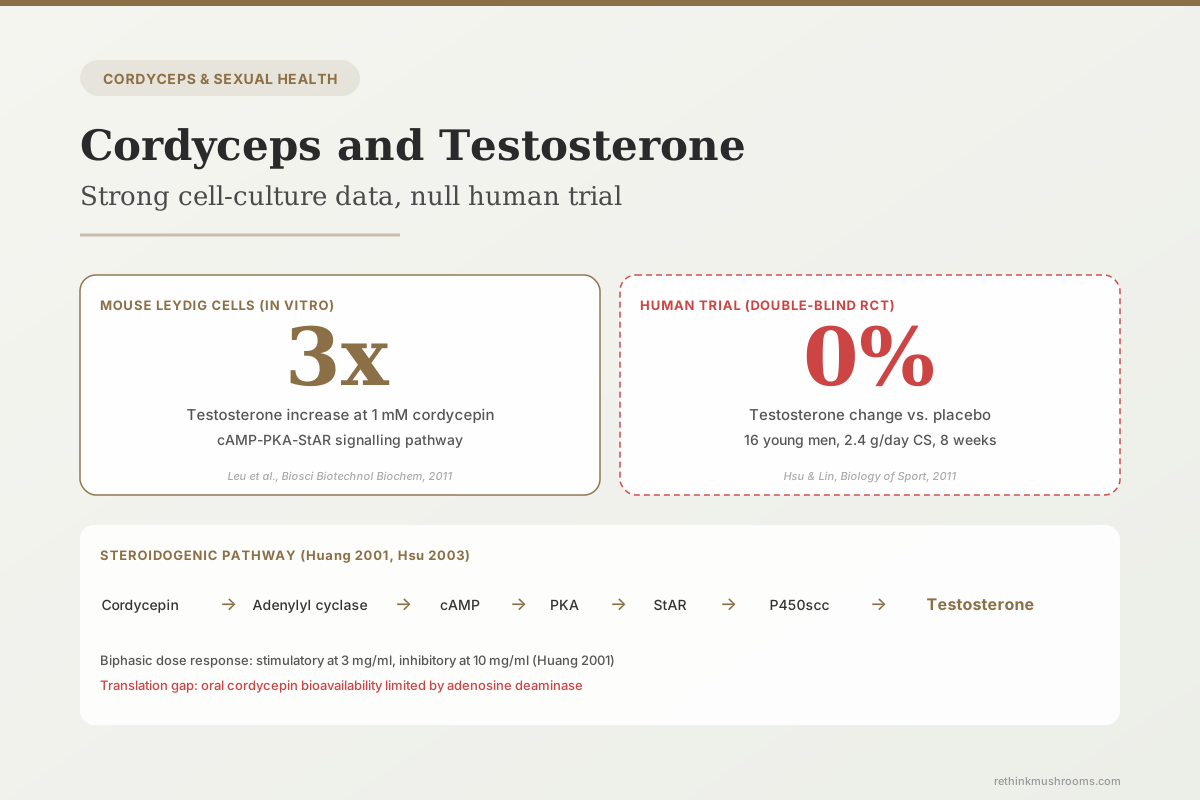
3x testosterone increase in mouse Leydig cells
Cordycepin at 1 mM concentration produced a three-fold increase in testosterone production in normal mouse Leydig cells in vitro, with the effect mediated through the cAMP-PKA-StAR signalling pathway. The one published human trial found no effect on testosterone in young men.
Leu et al., Bioscience Biotechnology and Biochemistry, 2011
cAMP-PKA-StAR
the signal pathway cordycepin activates in primary Leydig cells
No human effect
2.4 g/day CS for 8 weeks did not change testosterone in young men
Guanosine
Cordyceps sobolifera bioactive promoting Leydig proliferation (Li 2024)
Leu et al., Bioscience Biotechnology and Biochemistry, 2011
 View as image ↗
Cordyceps is one of the most commonly marketed natural supplements for testosterone, and the cellular biology supporting this claim is genuinely strong. Multiple studies from Bu-Miin Huang's research group at National Cheng Kung University have established that Cordyceps sinensis and isolated cordycepin stimulate testosterone production in mouse Leydig cells through characterized molecular pathways. The problem is the gap between those cell-culture and animal findings and the single published human trial, which found no effect on testosterone in young healthy men taking Cordyceps sinensis for eight weeks. This article walks through each layer of evidence in order, from strongest mechanistic data to weakest translational support. For the broader sexual function picture, see cordyceps and libido: research on sexual function and for female-specific data, see cordyceps and female sexual health: fertility and hormone research.
Key Takeaways
- Leu et al. (2011) demonstrated that cordycepin produces a three-fold increase in testosterone production in normal mouse Leydig cells at 1 mM concentration via the cAMP-PKA-StAR signalling pathway, with in vivo confirmation showing increased plasma testosterone in both immature and mature mice (Bioscience, Biotechnology, and Biochemistry)
- Huang et al. (2001) established that Cordyceps sinensis at 3 mg/ml stimulates testosterone production in normal mouse Leydig cells through PKA activation but not PKC, with an inhibitory effect at higher concentrations (10 mg/ml), demonstrating a non-linear dose-response (Life Sciences)
- Hsu et al. (2003) identified the regulatory mechanism: Cordyceps sinensis mycelium activates adenylyl cyclase, increases intracellular cAMP, upregulates P450scc and P450c17 steroidogenic enzymes, and stimulates progesterone and testosterone production in mouse Leydig cells (FEBS Letters)
- Pao et al. (2012) showed that cordycepin stimulates steroidogenesis in MA-10 Leydig tumor cells through the PKC pathway rather than PKA, with different signalling depending on cell type, and identified adenosine receptor subtypes A1, A2a, and A3 as upstream targets (Journal of Agricultural and Food Chemistry)
- Li et al. (2024) used multi-omics analysis to demonstrate that Cordyceps sobolifera promotes Leydig cell proliferation and testosterone secretion, with guanosine identified as a key bioactive constituent acting through the cAMP signalling pathway and steroid hormone biosynthesis (Journal of Ethnopharmacology)
- Hsu and Lin (2011) tested 2.4 g/day of Cordyceps sinensis versus placebo for eight weeks in 16 resistance-trained young men and found no significant effect on testosterone levels or muscle strength (Biology of Sport)
How Testosterone Is Made in Leydig Cells
Leydig cells in the testes produce testosterone through a regulated steroidogenic pathway. Luteinizing hormone (LH) from the pituitary binds to LH receptors on Leydig cells, activating adenylyl cyclase, which increases intracellular cyclic AMP (cAMP). cAMP activates protein kinase A (PKA), which phosphorylates and upregulates steroidogenic acute regulatory protein (StAR). StAR transports cholesterol across the mitochondrial membrane to P450 side-chain cleavage enzyme (P450scc), which converts it to pregnenolone. From there, 3beta-HSD converts pregnenolone to progesterone, and P450c17 converts it through the pathway to testosterone.
This is the pathway map against which cordyceps and cordycepin have been tested. A compound that activates adenylyl cyclase, increases cAMP, upregulates StAR, and enhances P450scc or P450c17 activity is intervening at the correct molecular targets. The cordyceps research claims measurable effects at multiple nodes, and the cell-culture data largely supports those claims. The question is whether those effects persist at physiological exposure levels in intact organisms, and specifically in humans.
The Foundational Leydig Cell Studies
Huang et al. (2001), published in Life Sciences, was the first detailed study of Cordyceps sinensis effects on testosterone production in normal (non-tumor) mouse Leydig cells.[1] CS mycelium extract at 3 mg/ml stimulated testosterone production in a dose-dependent manner. The mechanism was PKA-dependent: the PKA inhibitor H89 blocked the stimulatory effect, while the PKC activator PMA did not replicate it, establishing that CS uses the cAMP-PKA pathway in normal Leydig cells.
An important finding was that higher concentrations (10 mg/ml) of CS actually inhibited testosterone production. This biphasic dose-response, stimulatory at moderate concentrations and inhibitory at high concentrations, is a real characteristic of the system and has implications for supplementation: more is not linearly better, and the optimal exposure window may be narrower than supplement marketing suggests.
Hsu et al. (2003), published in FEBS Letters, provided deeper mechanistic resolution.[2] CS mycelium activated adenylyl cyclase directly, increasing intracellular cAMP. This led to upregulation of two key steroidogenic enzymes: P450scc (the rate-limiting enzyme that initiates cholesterol conversion) and P450c17 (the enzyme that converts precursors to testosterone-pathway intermediates). The study confirmed that the molecular target is upstream in the signalling cascade, at the level of cAMP generation, which then cascades through StAR and the steroidogenic enzymes.
Wong et al. (2007), published in Archives of Andrology, extended this work by testing CS mycelium fractions combined with human chorionic gonadotropin (hCG), which mimics LH stimulation.[3] Specific CS fractions at defined doses (0.02 and 0.2 mg/g body weight) administered to mice for 3 and 7 days significantly stimulated plasma testosterone levels in both immature and mature animals. This is one of the few studies showing in vivo testosterone elevation from cordyceps, though still in mice.
Cordycepin: The Isolated Nucleoside
Leu et al. (2011), published in Bioscience, Biotechnology, and Biochemistry, tested cordycepin (3'-deoxyadenosine) directly in normal mouse Leydig cells rather than whole CS extract.[4] Cordycepin stimulated testosterone production in concentration- and time-dependent manners, with a significant three-fold increase at 1 mM. The mechanism involved the cAMP-PKA signal transduction pathway, with cordycepin inducing StAR protein expression in primary Leydig cells. In vivo administration confirmed increased plasma testosterone in mice.
Pao et al. (2012), published in the Journal of Agricultural and Food Chemistry, tested cordycepin in MA-10 mouse Leydig tumor cells and found a different signalling pattern.[5] In these tumor cells, cordycepin stimulated steroidogenesis through the protein kinase C (PKC) and phospholipase C (PLC) pathway rather than PKA, and did not induce StAR protein expression. Cordycepin activated adenosine receptor subtypes A1, A2a, and A3 upstream. This cell-type specificity matters: the signalling pathway through which cordycepin promotes steroidogenesis depends on whether the target is a normal primary Leydig cell (cAMP-PKA-StAR) or a tumor cell (PKC/PLC).
The implication is that cordycepin's steroidogenic effects are real but context-dependent, operating through different molecular cascades depending on cell state and receptor expression. For the mechanistic connection between cordycepin and AMPK activation (which affects energy metabolism more broadly), see cordyceps and mitochondrial function.
The Multi-Omics Update: Cordyceps Sobolifera
Li et al. (2024), published in the Journal of Ethnopharmacology, brought modern multi-omics techniques to the question using Cordyceps sobolifera rather than C. sinensis or C. militaris.[6] Using transcriptomics, proteomics, and metabolomics, the researchers demonstrated that C. sobolifera promoted Leydig cell proliferation and bolstered testosterone secretion. The cAMP signalling pathway and steroid hormone biosynthesis pathway were identified as the primary mechanisms, consistent with the earlier work on C. sinensis. The novel finding was the identification of guanosine, rather than cordycepin, as a fundamental bioactive constituent driving the effect in this particular species.
This is a reminder that the steroidogenic activity of cordyceps fungi is not limited to cordycepin. Multiple nucleosides (cordycepin, adenosine, guanosine) and potentially polysaccharide fractions contribute to the observed effects, and different cordyceps species contain different ratios of these compounds. A consumer supplement containing C. militaris has a different nucleoside profile than one containing C. sinensis or C. sobolifera.
The One Human Trial: No Effect
Hsu and Lin (2011), published in Biology of Sport, tested the testosterone claim directly in humans. Sixteen healthy, resistance-trained young men were randomly allocated in a double-blind design to receive either Cordyceps sinensis (2.4 g/day) or maltodextrin placebo for eight weeks during a resistance training program (three sets of 3-5 repetitions at 80% of 1RM). The primary outcomes included serum testosterone levels and measures of muscle strength.
After eight weeks, CS supplementation did not significantly affect testosterone levels. Nor did it affect muscle strength, body composition, or any other measured variable compared to placebo. The study concluded that CS supplementation for eight weeks neither possessed ergogenic value nor affected testosterone levels in resistance-trained young male adults.
This is the only published human trial directly measuring testosterone in response to cordyceps supplementation. The sample size is small (n=16). The population is young and presumably had normal baseline testosterone. The dose (2.4 g/day) is within typical supplement ranges. The duration (eight weeks) is long enough to detect hormonal changes. The finding is null.
Reconciling Cell Culture With Human Data
The disconnect between the robust cell-culture and animal data and the null human trial can be explained by several known factors. First, the oral bioavailability of cordycepin is limited by adenosine deaminase degradation, meaning oral CS supplementation delivers substantially less active cordycepin to Leydig cells than the direct cell-culture exposures used in the mechanistic studies. Second, the mouse in vivo studies that showed plasma testosterone increases used CS fractions administered at doses and routes (intraperitoneal or high-dose oral in mice) that do not directly translate to human supplement doses. Third, healthy young men with normal testosterone have a regulated hypothalamic-pituitary-gonadal (HPG) axis with feedback mechanisms that resist perturbation; even if cordyceps weakly stimulated Leydig cell steroidogenesis, the HPG axis might compensate by reducing LH secretion, maintaining testosterone homeostasis.
A targeted question that remains untested is whether cordyceps supplementation affects testosterone in older men with age-related testosterone decline, where the HPG axis is already less tightly regulated and Leydig cells have reduced steroidogenic capacity. The null result in young men does not automatically predict a null result in aging or hypogonadal men, but no such trial has been published.
Jiraungkoorskul (2016) reviewed the broader Ophiocordyceps sinensis sexual dysfunction literature and noted the gap between preclinical steroidogenic data and clinical sexual function evidence, summarizing the state as "promising preclinical with limited clinical translation."[7]
What the Evidence Does and Does Not Support
The evidence supports specific claims. Cordyceps sinensis mycelium and isolated cordycepin stimulate testosterone production in mouse Leydig cells through the cAMP-PKA-StAR pathway at defined concentrations. CS fractions increase plasma testosterone in mice in vivo. Cordyceps sobolifera promotes Leydig cell proliferation and testosterone secretion through similar cAMP-mediated mechanisms with guanosine as a key bioactive. The biphasic dose-response (stimulatory at moderate, inhibitory at high concentrations) has been characterized.
The evidence does not support broader claims. No human trial has shown that cordyceps supplementation increases serum testosterone. The one published human trial found no effect at 2.4 g/day for eight weeks in young healthy men. No trial has tested cordyceps in older or hypogonadal men. The oral bioavailability problem means that the intracellular cordycepin concentrations achieved in cell-culture studies are unlikely to be replicated by oral supplementation. Extrapolating from mouse Leydig cell data to human testosterone claims is not supported by the current evidence. For related performance data, see cordyceps and exercise performance and cordyceps for erectile dysfunction.
The Bottom Line
Cordyceps sinensis and cordycepin produce robust, well-characterized stimulation of testosterone production in mouse Leydig cells through the cAMP-PKA-StAR steroidogenic pathway, with a three-fold increase at optimal cordycepin concentrations. Mouse in vivo studies confirm plasma testosterone elevation. The single published human trial (2.4 g/day CS for 8 weeks in 16 young men) found no effect on testosterone. The preclinical-to-clinical translation gap is likely explained by oral cordycepin bioavailability limitations and HPG axis feedback regulation. No trial has tested cordyceps in older or testosterone-deficient men, where the hypothesis remains open.
Frequently Asked Questions
Sources & References
- 1RTHM-00037·Huang, B M et al. (2001). “Effects of Cordyceps sinensis on testosterone production in normal mouse Leydig cells..” Life sciences.Study breakdown →PubMed →↩
- 2RTHM-00109·Hsu, Chih-Chao et al. (2003). “Regulatory mechanism of Cordyceps sinensis mycelium on mouse Leydig cell steroidogenesis..” FEBS letters.Study breakdown →PubMed →↩
- 3RTHM-00235·Wong, K L et al. (2007). “Regulation of steroidogenesis by Cordyceps sinensis mycelium extracted fractions with (hCG) treatment in mouse Leydig cells..” Archives of andrology.Study breakdown →PubMed →↩
- 4RTHM-00414·Leu, Sew-Fen et al. (2011). “The in vivo and in vitro stimulatory effects of cordycepin on mouse leydig cell steroidogenesis..” Bioscience.Study breakdown →PubMed →↩
- 5RTHM-00480·Pao, Hsiang-Yin et al. (2012). “Cordycepin stimulated steroidogenesis in MA-10 mouse Leydig tumor cells through the protein kinase C Pathway..” Journal of agricultural and food chemistry.Study breakdown →PubMed →↩
- 6RTHM-01934·Li, Zihan et al. (2024). “Multi-omics reveals the testosterone promotion effect mechanism of Cordyceps Sobolifera on Leydig cells..” Journal of ethnopharmacology.Study breakdown →PubMed →↩
- 7RTHM-00428·Jiraungkoorskul, Kanitta et al. (2016). “Review of Naturopathy of Medical Mushroom, Ophiocordyceps Sinensis, in Sexual Dysfunction..” Pharmacognosy reviews.Study breakdown →PubMed →↩