Cordyceps and Sexual Health
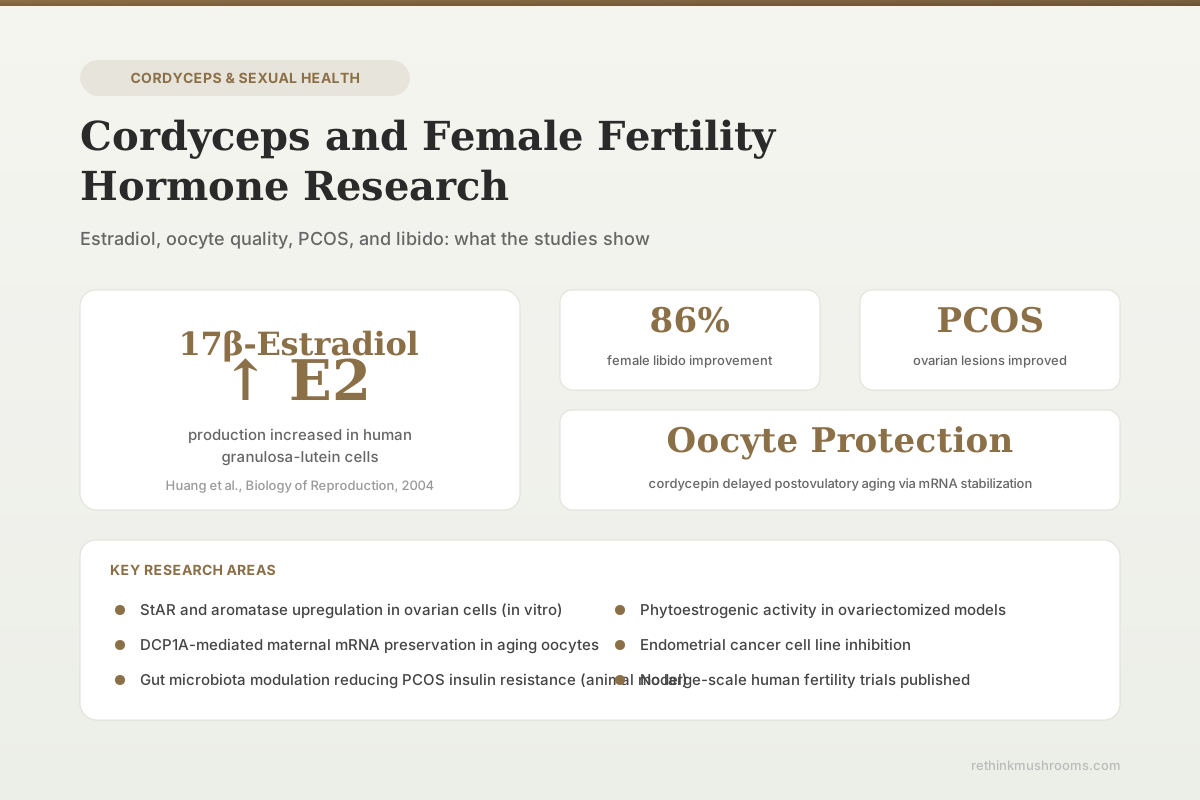
17β-estradiol production increased
Huang et al. (2004) showed that Cordyceps sinensis mycelium upregulated StAR protein and aromatase expression in human granulosa-lutein cells, increasing 17β-estradiol biosynthesis in a dose- and time-dependent manner.
Huang et al., Biology of Reproduction, 2004
Oocyte protection
cordycepin delayed postovulatory aging
PCOS model
polysaccharide improved ovarian lesions
86% improvement
in female libido (clinical report)
Huang et al., Biology of Reproduction, 2004
 View as image ↗
If you only read one thing
Cordyceps shows real, peer-reviewed effects on female reproductive biology — but only in cells and animals, never in a controlled human trial. The strongest findings: in human ovarian cells, cordyceps raised 17β-estradiol by switching on the enzymes StAR and aromatase (Huang 2004); cordycepin delayed oocyte aging in mice by protecting maternal mRNA (Li 2023); and cordyceps polysaccharide improved PCOS-related ovarian damage in rats by calming gut-driven inflammation (Zhang 2024). The widely-quoted ‘86% libido improvement’ comes from a poorly-documented clinical report, not a rigorous trial. Bottom line: the mechanisms are biologically plausible and well-characterized, but no randomized human study has tested cordyceps for female fertility, hormones, or sexual function. This is not medical advice — talk to your doctor before using cordyceps while trying to conceive or treating a reproductive condition.
Cordyceps has been used in traditional Chinese medicine for centuries with claims of enhancing fertility and sexual function, but formal research into its effects on female reproductive biology is relatively recent and still primarily preclinical. The strongest mechanistic evidence comes from cell culture work showing that Cordyceps sinensis mycelium can increase 17β-estradiol (E2) production in human ovarian cells by upregulating steroidogenic enzymes.[1] From there, the evidence branches into oocyte aging protection, PCOS treatment in animal models, phytoestrogenic effects, and limited clinical data on libido. For research on cordyceps and male sexual function, including testosterone and erectile function, see Cordyceps and libido: research on sexual function. For testosterone-specific data, see Cordyceps and testosterone: does it increase male hormones.
Key Takeaways
- Huang et al. (2004) demonstrated that Cordyceps sinensis mycelium increased 17β-estradiol production in human granulosa-lutein cells by upregulating StAR protein and aromatase expression, with effects blocked completely by an aromatase inhibitor
- Li et al. (2023) showed cordycepin delayed postovulatory aging of mouse oocytes by inhibiting DCP1A-mediated maternal mRNA degradation, preserving spindle morphology, mitochondrial function, and embryonic developmental competence
- Zhang et al. (2024) found Cordyceps polysaccharide improved polycystic ovarian lesions and restored estrous cycling in a PCOS rat model by modulating gut microbiota and suppressing the LPS/TLR4 inflammatory pathway
- Zhang et al. (2014) reported Cordyceps sinensis isoflavones increased serum estradiol and osteocalcin while decreasing bone loss markers in ovariectomized rats, demonstrating phytoestrogenic activity
- A 2016 review by Jiraungkoorskul and Jiraungkoorskul cited clinical reports of 86% improvement in libido-related symptoms among women receiving Cordyceps supplementation, though the original trial details are poorly documented
- No large, well-controlled human clinical trial has specifically tested cordyceps for female fertility, ovarian function, or hormone regulation
Estradiol Production in Human Ovarian Cells
The most mechanistically detailed study on cordyceps and female reproductive biology comes from Huang et al. (2004), published in Biology of Reproduction. The team treated human granulosa-lutein cells (GLCs), the ovarian cells responsible for producing estradiol during the menstrual cycle and early pregnancy, with Cordyceps sinensis mycelium extract.[1]
Cordyceps induced E2 production in a dose-dependent and time-dependent manner. After three hours of treatment, mRNA levels for three steroidogenic enzymes increased: P450 side chain cleavage enzyme (P450scc), 3β-hydroxysteroid dehydrogenase (3β-HSD), and aromatase. Western blot analysis confirmed protein-level increases in steroidogenic acute regulatory protein (StAR) and aromatase, the two enzymes most critical for the final conversion of androgens to estradiol.
Two control experiments clarified the mechanism. First, cycloheximide (a protein synthesis inhibitor) blocked Cordyceps-induced E2 production entirely, confirming that new protein synthesis was required. Second, aminoglutethimide (an aromatase inhibitor) completely abolished E2 production, confirming aromatase as the essential endpoint enzyme. The authors concluded these findings "may help in the development of treatment regimens to improve the success rate of in vitro fertilization."
Huang et al. (2004) · Biology of Reproduction
- Population
- Human granulosa-lutein cells isolated from women undergoing IVF (in vitro)
- Intervention
- Cordyceps sinensis mycelium extract
- Comparator
- Untreated cells; aromatase- and protein-synthesis-inhibitor controls
- Finding
- Dose- and time-dependent rise in 17β-estradiol. After 3h, StAR and aromatase protein increased; an aromatase inhibitor abolished the effect entirely.
preliminary Mechanistically clean and the most detailed study in this area — but it is cell-culture only. Whether oral cordyceps reaches granulosa cells at active concentrations is untested.
Huang et al. (2004), Biology of Reproduction
This matters because 17β-estradiol directly influences oocyte maturation quality and IVF outcomes. If Cordyceps reliably enhances E2 production in ovarian support cells, it could theoretically improve follicular development. The limitation: this was an in vitro study using cells isolated from women undergoing IVF. Whether oral Cordyceps supplementation delivers bioactive compounds to granulosa cells at sufficient concentrations remains untested.
Earlier work by Wang et al. (1998) had already demonstrated that a water-soluble Cordyceps sinensis extract stimulated steroidogenesis in rat adrenocortical cells through a protein kinase C (PKC)-dependent pathway, independent of the standard ACTH/cAMP signaling route.[2] Corticosterone production increased in a dose-dependent manner, reaching maximum stimulation at 25 μg/ml. This study established that Cordyceps could modulate steroid hormone production through a non-canonical signaling pathway, providing context for the later ovarian cell findings.
Cordycepin and Oocyte Aging
Oocyte quality declines with time after ovulation, a process called postovulatory aging. Aging oocytes show fragmentation, spindle disassembly, chromosome misalignment, and mitochondrial dysfunction, all of which reduce fertilization success and increase early pregnancy loss.
Li et al. (2023), published in Cellular and Molecular Life Sciences, investigated whether cordycepin (3'-deoxyadenosine, the primary bioactive nucleoside from Cordyceps militaris) could delay this process.[3]
In mouse oocytes aged in vitro, cordycepin treatment reduced fragmentation rates, preserved normal spindle and chromosome morphology, maintained mitochondrial membrane potential, and improved subsequent embryonic developmental competence compared to untreated aging controls.
The mechanism centered on mRNA stability. During postovulatory aging, a protein called DCP1A (decapping enzyme 1A) becomes elevated through polyadenylation, accelerating the degradation of maternal mRNAs that the oocyte needs for early embryonic development. Cordycepin suppressed DCP1A polyadenylation, which in turn slowed the decapping and destruction of critical maternal transcripts.
Li et al. (2023) · Cellular and Molecular Life Sciences
- Population
- Mouse oocytes aged in vitro; DCP1A mechanism confirmed in human oocytes
- Intervention
- Cordycepin (3'-deoxyadenosine, from Cordyceps militaris)
- Comparator
- Untreated aging oocytes
- Finding
- Reduced fragmentation, preserved spindle/chromosome morphology and mitochondrial function, and improved embryonic developmental competence by suppressing DCP1A-driven maternal mRNA degradation.
preliminary Strong mechanistic story with a human-oocyte confirmation of the pathway — but dosing, timing, and delivery for any clinical use remain entirely undefined.
Li et al. (2023), Cellular and Molecular Life Sciences
Proteomic and RNA sequencing confirmed the breadth of this effect: cordycepin preserved levels of multiple maternal proteins and mRNAs that normally decline during aging. The team also showed that in human oocytes, the aging-related increase in DCP1A and decrease in total mRNA were similarly inhibited by cordycepin.
The clinical relevance is significant but unproven. If cordycepin can delay oocyte aging in humans, it could extend the window for successful fertilization after ovulation. The gap: no clinical trial has tested this. The mouse data are promising, and the human oocyte confirmation of the DCP1A mechanism is encouraging, but dosing, timing, and delivery method for a clinical application remain undefined.
PCOS: Gut Microbiota and Insulin Resistance
Polycystic ovary syndrome affects 6-12% of reproductive-age women and is characterized by ovarian cysts, irregular menstruation, elevated androgens, and insulin resistance. Zhang et al. (2024), published in the International Journal of Biological Macromolecules, tested Cordyceps polysaccharide (CP) extracted from Cordyceps gunnii in a PCOS rat model.[4]
CP treatment improved polycystic ovarian lesions on histological examination and restored regular estrous cycling. The mechanistic pathway ran through the gut-endocrine axis. CP modulated gut microbiota composition by reducing gram-negative bacteria (specifically norank_f_Desulfovibrionaceae and Helicobacter), which decreased lipopolysaccharide (LPS) production and translocation into systemic circulation.
With less circulating LPS, the TLR4/MyD88/NF-κB inflammatory cascade in liver and adipose tissue was suppressed. This reduced chronic low-grade inflammation, which in turn improved insulin signaling and restored insulin sensitivity. Since insulin resistance drives many PCOS symptoms, including hyperandrogenism and anovulation, restoring insulin sensitivity improved the hormonal and reproductive picture.
CP also corrected glucose-lipid metabolic disturbances in the model rats. The study's strength lies in tracing a complete pathway from gut microbiota through systemic inflammation to ovarian pathology. The weakness: this is a single animal study with an induced PCOS model (letrozole-based), which may not fully replicate human PCOS pathophysiology. Whether oral Cordyceps polysaccharide produces the same gut microbiome shifts in humans is unknown. For related research on cordyceps and blood sugar regulation, see Cordyceps and blood sugar: hypoglycemic research.
Phytoestrogenic Effects and Bone Health
Zhang et al. (2014), published in BMC Complementary and Alternative Medicine, tested isoflavones isolated from Cordyceps sinensis (CSIF) in ovariectomized rats, a standard model for postmenopausal estrogen deficiency.[5]
Ovariectomy caused marked uterine atrophy, bone mineral density loss, and altered serum markers. CSIF treatment increased serum estradiol and osteocalcin levels. Alkaline phosphatase (ALP) activity, tartrate-resistant acid phosphatase (TRAP) activity, C-terminal telopeptide of type I collagen (CTX, a bone resorption marker), and interferon-γ levels all decreased. Uterine size increased toward normal in CSIF-treated animals.
These results demonstrate that Cordyceps sinensis contains compounds with measurable phytoestrogenic activity, compounds that bind estrogen receptors or otherwise mimic estrogen's effects on target tissues. The bone protection and uterine trophic effects are consistent with weak estrogenic signaling.
The clinical implication for female reproductive health extends beyond bone: if Cordyceps isoflavones exert estrogenic effects, they could influence menstrual regulation, menopausal symptoms, and fertility parameters. The caution: isoflavone content varies dramatically across Cordyceps preparations, species (C. sinensis vs. C. militaris), and extraction methods. A supplement marketed as "cordyceps" may contain little to no isoflavone content depending on how it was produced.
Libido and Sexual Function: Clinical Reports
A 2016 review by Jiraungkoorskul and Jiraungkoorskul in Pharmacognosy Reviews compiled the available evidence for Ophiocordyceps sinensis in sexual dysfunction.[6] The review cited a clinical report in which 86% of women receiving Cordyceps supplementation showed improvement in libido-related symptoms, compared to placebo controls.
This figure appears in multiple secondary sources and is frequently cited in the cordyceps literature, but the original trial methodology deserves scrutiny. The study involved elderly patients with decreased libido and used a relatively short supplementation period (approximately 40 days). Sample size was small (reported as 21 women in the Cordyceps group). Blinding procedures and outcome measurement tools were not described in detail in the available English-language literature.
The review also referenced a larger Chinese clinical report involving 189 male and female participants, where 66% reported improved sexual desire after Cordyceps supplementation. Again, methodological details are sparse.
Fact Check
The '86% improvement in female libido' figure
The claim
“Cordyceps improves female libido in 86% of women, so it's a proven sexual-health supplement.”
A figure repeated across supplement marketing and secondary sources, traced to a clinical report cited in a 2016 Pharmacognosy Reviews paper.
What research shows
OverstatedThe 86% number comes from a small, poorly-documented report (around 21 women, ~40 days, in elderly patients with decreased libido). Blinding and outcome tools were never clearly described in the available literature. A separate report of 189 mixed-sex participants found 66% improvement — also methodologically thin.
A real signal may exist, but these are hypothesis-generating reports, not rigorous trials. No modern study has tested cordyceps for female sexual function using a validated instrument like the Female Sexual Function Index.
Jiraungkoorskul & Jiraungkoorskul (2016), Pharmacognosy Reviews
These clinical reports suggest a signal worth investigating, but they fall well short of the evidence standard required to draw conclusions. No modern, well-powered, rigorously controlled clinical trial has specifically tested Cordyceps for female sexual dysfunction using validated assessment instruments (such as the Female Sexual Function Index). For related data on cordyceps and libido across both sexes, see Cordyceps and libido: research on sexual function. For the male-specific evidence on sperm parameters, see Cordyceps and sperm quality: what the studies show. Erectile function data is covered in Cordyceps for erectile dysfunction: evidence and mechanisms.
Endometrial and Uterine Research
Research on cordyceps and uterine tissue has focused primarily on cancer cell lines rather than healthy endometrial function. Hahne et al. (2014), published in the International Journal of Oncology, tested Cordyceps extract on human endometrial cancer cell lines (Ishikawa and HEC-1A) in vitro.[7]
Cordyceps extract showed a dose-dependent inhibitory effect on endometrial cancer cell proliferation and induced apoptosis in Ishikawa cells. The combination of Cordyceps with Ganoderma lucidum and Agaricus blazei Murill extracts showed additive inhibitory effects. These findings are relevant to understanding how Cordyceps interacts with uterine tissue but do not directly address fertility or healthy endometrial function.
Separate preclinical work (not yet replicated in published trials) has investigated cordycepin's effects on endometrial hyperplasia, with preliminary animal data suggesting cordycepin may reduce uterine lining overgrowth through PTEN/PI3K/Akt pathway modulation. This is early-stage research without human data.
What the Evidence Does and Does Not Show
The existing research on cordyceps and female reproductive health follows a pattern common in medicinal mushroom science: compelling mechanistic data from cell culture and animal models, with very limited clinical confirmation.
The strongest evidence supports three specific mechanisms: Cordyceps can increase estradiol production in ovarian support cells through StAR and aromatase upregulation; cordycepin can delay oocyte aging through mRNA stabilization; and Cordyceps polysaccharide can improve PCOS-related ovarian pathology through gut-microbiota-mediated reduction of systemic inflammation.
Each of these mechanisms is biologically plausible and supported by peer-reviewed experimental data. None has been validated in a well-designed human clinical trial. The clinical libido reports suggest a functional effect in women, but the methodology of those reports makes them hypothesis-generating rather than conclusive.
Evidence Map
Five mechanisms, zero human trials
Every cordyceps mechanism relevant to female reproduction has been shown only in isolated cells, animals, or undocumented clinical reports. None has been confirmed in a controlled human fertility or hormone trial — the translation gap is the whole story.
- Cell study
Estradiol production
Cordyceps mycelium upregulates StAR + aromatase, raising 17β-estradiol
Human ovarian cells (in vitro)
Huang 2004
- Animal study
Oocyte aging delay
Cordycepin suppresses DCP1A, preserving maternal mRNA after ovulation
Mouse oocytes (mechanism seen in human oocytes)
Li 2023
- Animal study
PCOS improvement
Polysaccharide shifts gut microbiota → less LPS → calms TLR4 inflammation
PCOS rat model (letrozole-induced)
Zhang 2024
- Animal study
Phytoestrogen activity
Isoflavones raise serum estradiol and slow bone loss
Ovariectomized rats
Zhang 2014
- Weak clinical report
Libido / desire
86% (women) and 66% (mixed) reported improvement — methodology unclear
Clinical reports (poorly documented)
Jiraungkoorskul 2016
The missing rung: a randomized controlled trial in women with documented subfertility, diminished ovarian reserve, or PCOS, using validated hormonal and fertility endpoints. Until that exists, these mechanisms remain hypothesis-generating.
- Cell & Lab Studiescompleted
Estradiol/StAR/aromatase upregulation in human granulosa-lutein cells (Huang 2004); endometrial cancer cell apoptosis (Hahne 2014)
- Animal Studiescurrent
Oocyte aging delay in mice (Li 2023); PCOS improvement in rats (Zhang 2024); phytoestrogen/bone effects in ovariectomized rats (Zhang 2014)
- Case Reports & Early Seriesmissing
Only poorly-documented libido reports exist; no rigorous case series for fertility or hormone outcomes
- Small Human Trialsmissing
No controlled trial has tested cordyceps for female fertility, ovarian function, or hormone regulation
- Large Randomized Trialsmissing
None
- Meta-Analyses & Systematic Reviewsmissing
None specific to female reproductive endpoints
The evidence sits firmly at the cell-and-animal rungs. Every mechanism is preclinical; the human side is limited to undocumented libido reports. The translation to controlled human fertility or hormone data has not happened.
Aggregate of Huang 2004, Li 2023, Zhang 2024, Zhang 2014, Hahne 2014, and Jiraungkoorskul 2016
Safety & context
ModerateCordyceps and trying to conceive: what the research does and doesn't cover
Concern
Cordyceps is sometimes marketed as a fertility aid, but the studies behind that claim were done in cells and animals, not pregnant or actively-conceiving humans. Formal reproductive toxicology in humans has not been published, and supplement potency (especially cordycepin and isoflavone content) varies widely between products and species.
What the research says
Treat cordyceps as unproven for fertility and hormone outcomes in women. If you are trying to conceive, pregnant, breastfeeding, or managing a condition like PCOS, do not substitute it for evidence-based care.
Particularly relevant for: Women who are pregnant, breastfeeding, trying to conceive, or being treated for a reproductive or hormonal condition
What to do
Talk to your doctor before starting cordyceps in these situations. This article is research education, not medical advice.
Synthesis of the cited preclinical literature; no human reproductive safety trials exist
The research gap is specific and addressable. A randomized controlled trial testing standardized Cordyceps supplementation in women with documented subfertility, diminished ovarian reserve, or PCOS, using validated hormonal and fertility endpoints, would substantially clarify whether the preclinical promise translates to clinical benefit. For research on cordyceps' effects on cellular energy that may underlie reproductive function, see Cordyceps and ATP: how it boosts cellular energy. For broader cordyceps and aging research, see Cordyceps and anti-aging: research on longevity.
The Bottom Line
Cordyceps research in female reproductive health spans estradiol production in human ovarian cells, oocyte aging protection via mRNA stabilization, PCOS improvement through gut-microbiota pathways, and phytoestrogenic activity in ovariectomized models. Clinical reports suggest libido benefits, but no well-controlled human trial has tested cordyceps specifically for female fertility or hormonal outcomes. The preclinical mechanisms are well-characterized; the clinical translation remains an open question.
Frequently Asked Questions
Sources & References
- 1RTHM-00069·Huang, Bu-Miin et al. (2004). “Upregulation of steroidogenic enzymes and ovarian 17beta-estradiol in human granulosa-lutein cells by Cordyceps sinensis mycelium..” Biology of reproduction.Study breakdown →PubMed →↩
- 2RTHM-00027·Wang, S M et al. (1998). “Effects of a water-soluble extract of Cordyceps sinensis on steroidogenesis and capsular morphology of lipid droplets in cultured rat adrenocortical cells..” Journal of cellular biochemistry.Study breakdown →PubMed →↩
- 3RTHM-00838·Li, Chong et al. (2023). “Cordycepin delays postovulatory aging of oocytes through inhibition of maternal mRNAs degradation via DCP1A polyadenylation suppression..” Cellular and molecular life sciences : CMLS.Study breakdown →PubMed →↩
- 4RTHM-00917·Zhang, Huiwen et al. (2024). “Cordyceps polysaccharide improves polycystic ovary syndrome by inhibiting gut-derived LPS/TLR4 pathway to attenuates insulin resistance..” International journal of biological macromolecules.Study breakdown →PubMed →↩
- 5RTHM-00359·Zhang, Da-wei et al. (2014). “The effects of Cordyceps sinensis phytoestrogen on estrogen deficiency-induced osteoporosis in ovariectomized rats..” BMC complementary and alternative medicine.Study breakdown →PubMed →↩
- 6RTHM-00428·Jiraungkoorskul, Kanitta et al. (2016). “Review of Naturopathy of Medical Mushroom, Ophiocordyceps Sinensis, in Sexual Dysfunction..” Pharmacognosy reviews.Study breakdown →PubMed →↩
- 7RTHM-00324·Hahne, Jens C et al. (2014). “The effect of Cordyceps extract and a mixture of Ganoderma lucidum/Agaricus Blazi Murill extract on human endometrial cancer cell lines in vitro..” International journal of oncology.Study breakdown →PubMed →↩