Cordyceps and Anti-Aging
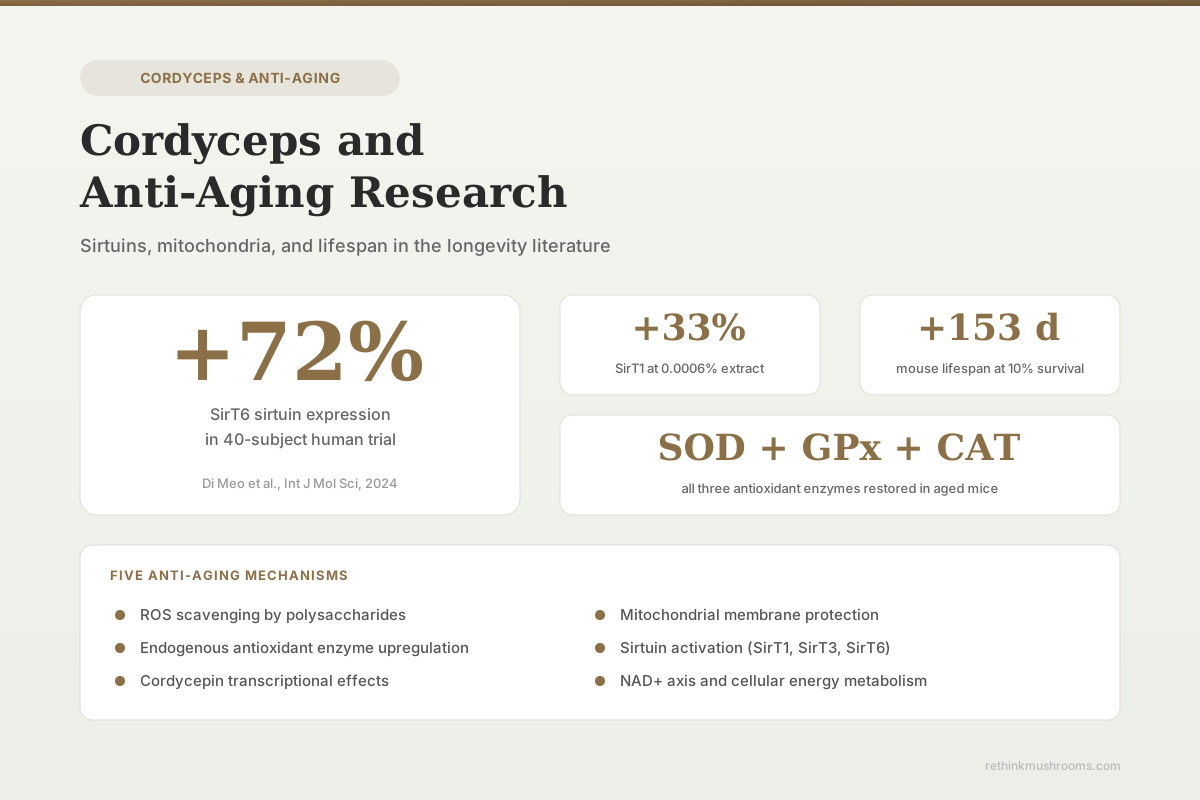
+72% SirT6 expression
Cordyceps sinensis extract raised SirT6 sirtuin expression 72% in a double-blind placebo-controlled trial of 40 subjects, alongside 33% SirT1 and 10% SirT3 gains.
Di Meo et al., Int J Mol Sci, 2024
d-galactose model
SOD, GPx, catalase all restored
Cs-4 in mice
lifespan +45 to +153 days at 10% survival
5 mechanisms
ROS, mitochondria, NAD+, sirtuins, autophagy
Di Meo et al., Int J Mol Sci, 2024
 View as image ↗
Cordyceps has been sold as a longevity tonic in Chinese markets for centuries. The modern research record is narrower than the marketing but not empty. A 2024 double-blind placebo-controlled trial in 40 subjects documented significant increases in sirtuin expression, the NAD+-dependent enzyme family that regulates cellular aging. Rodent studies using the d-galactose accelerated-aging model consistently show restoration of antioxidant enzyme activity, and a 2011 FASEB Journal study (Tan et al.) reported lifespan extension in normal aged mice fed Cs-4 extract. For the broader mechanistic picture, see How Cordyceps May Slow Biological Aging.
The evidence splits across three extract types with different dominant active compounds: water-extracted polysaccharides from Cordyceps militaris, hot-water and hydroethanolic extracts of Cordyceps sinensis mycelium (including standardized Cs-4), and purified cordycepin, the signature nucleoside analog. Each acts through overlapping but distinct anti-aging pathways.
Key Takeaways
- Cordyceps sinensis hydroethanolic mycelium extract at 0.0006% increased SirT1 expression by 33%, SirT3 by 10%, and SirT6 by 72% versus control in a 40-subject double-blind placebo-controlled trial (Di Meo et al., 2024)
- Cordyceps militaris polysaccharides (CMP) protected mouse liver mitochondria by scavenging ROS, inhibiting mitochondrial swelling, and raising catalase, SOD, and glutathione peroxidase activities in d-galactose-aged mice (Li et al., 2010)
- Cordyceps sinensis extract improved SOD, GPx, and catalase activity while lowering lipid peroxidation and monoamine oxidase in d-galactose-aged mice and improved water maze and step-down avoidance performance (Ji et al., 2009)
- Cordyceps militaris extract attenuated d-galactose-induced memory impairment in mice through antioxidant activity, reinforcing the CNS dimension of its anti-aging effect (Li et al., 2012)
- Cordycepin, the signature C. militaris nucleoside, was significantly enriched in the stage-4 aging period of fruiting body development alongside mannitol, GABA, and xylitol (Oh et al., 2019)
- In normal aged mice, Cs-4 at 0.5-1.5 g/kg extended lifespan by 10-66 days at 50% survival and 45-153 days at 10% survival, with the longest-surviving mice gaining more than 210 days at some doses (Tan et al., 2011, FASEB Journal)
Why Cordyceps Got the Longevity Reputation
Cordyceps sinensis is the scientific name for a parasitic fungus that infects the larvae of ghost moths at high altitude in Tibet and the Himalayas. In Chinese medicine it was classed as a tonic that restores jing, or constitutional essence, and was prescribed for the elderly, the exhausted, and the convalescent. Cordyceps militaris is a related species that can be cultivated on grain substrates and now supplies most of the global commercial market.
Both species produce adenosine, cordycepin (3'-deoxyadenosine), beta-glucan polysaccharides, sterols, and mannitol. Cordycepin is the most pharmacologically distinctive compound because it is a nucleoside analog structurally similar to adenosine but missing the 3' hydroxyl group. This allows it to interfere with RNA polyadenylation and affect transcription, DNA repair, and energy metabolism pathways that intersect with aging biology. For the specific metabolic angle, see Cordyceps and NAD+ Metabolism: The Anti-Aging Energy Connection.
The d-Galactose Aging Model
The workhorse animal model in the cordyceps anti-aging literature is chronic subcutaneous injection of d-galactose. At 100 to 125 mg/kg/day for 6 to 8 weeks, d-galactose produces accelerated aging phenotypes in mice: elevated reactive oxygen species, declining antioxidant enzyme activity, mitochondrial dysfunction, cognitive impairment, and reduced lifespan. The mechanism involves excess d-galactose being metabolized to reactive aldehydes that generate advanced glycation end products (AGEs) and drive oxidative damage. It is a pharmacological model of oxidative aging, not natural senescence, which matters for how the results should be read.
Antioxidant Enzyme Restoration
Li et al. (2010) injected d-galactose into mice for 7 weeks and then treated them with water-extracted C. militaris polysaccharides (CMP).[1] CMP concentration-dependently inhibited Fe2+/L-cysteine-induced mitochondrial swelling in vitro and scavenged superoxide anions. In vivo, CMP treatment significantly raised the activities of catalase, superoxide dismutase, and glutathione peroxidase in mouse liver. These three enzymes are the primary endogenous defense system against reactive oxygen species. D-galactose treatment typically suppresses them, and the CMP intervention reversed that suppression.
Ji et al. (2009) ran a parallel experiment with Cordyceps sinensis extract (CSE) in d-galactose-aged mice and castrated rats.[2] CSE improved SOD, GPx, and catalase activity, lowered lipid peroxidation, and reduced monoamine oxidase activity. Elevated MAO is a marker of neurochemical aging. The study also tested cognition using water maze and step-down passive avoidance tasks. CSE shortened escape latency, prolonged step-down latency, and reduced error counts, all consistent with improved learning and memory retention in the aged mice.
Memory and Cognitive Aging
Li et al. (2012) tested C. militaris extract in d-galactose-treated mice with a specific focus on memory impairment.[4] The extract rescued learning and memory deficits, an effect the authors attributed to its antioxidant capacity. Oxidative stress in the hippocampus and cortex is a well-characterized mechanism of age-related cognitive decline, and the d-galactose model reliably reproduces this pattern. The fact that three independent studies using two different cordyceps species converge on the same pattern (antioxidant enzyme restoration plus cognitive preservation) strengthens the signal, even though the model itself is artificial.
For the specific oxidative-stress arm of the mechanism, see Cordyceps and Cellular Aging: Oxidative Stress Protection.
Sirtuin Activation: The Most Recent Human Evidence
The single human clinical trial on cordyceps and aging biomarkers is Di Meo et al. (2024), published in the International Journal of Molecular Sciences.[3] The researchers standardized a C. sinensis mycelium hydroethanolic extract (CsEx) by cordycepin and adenosine content using UHPLC-DAD, then tested it in vitro and in a double-blind, placebo-controlled clinical trial of 40 subjects.
The in vitro results documented significant sirtuin upregulation at 0.0006% concentration: SirT1 increased 33%, SirT3 increased 10%, and SirT6 increased 72% relative to untreated controls. Sirtuins are NAD+-dependent deacetylases that regulate metabolic homeostasis, DNA repair, and cellular senescence. Sirtuin activation is one of the most durable pharmacological strategies in modern longevity research, pursued through caloric restriction mimetics, NAD+ precursors, and resveratrol-class compounds. The SirT6 signal is particularly relevant because SirT6 has been linked to lifespan extension in mouse genetic studies and regulates chromatin stability and glucose metabolism.
The clinical arm of the trial focused on skin longevity endpoints rather than systemic aging markers. The published abstract truncates the full results, but the study represents the first time a cordyceps extract has been tested in humans with sirtuin and NAD+ outcomes as primary endpoints. For the specific skin-related findings, see Cordyceps and Skin Aging: Antioxidant Research.
Lifespan Extension in Normal Aged Mice
The most direct test of anti-aging activity is whether an intervention extends lifespan in animals allowed to age naturally. Tan et al. (2011) reported results from a Kaplan-Meier survival analysis in male and female ICR mice fed Cs-4 (a standardized Cordyceps sinensis mycelium extract) at 0.5, 1.0, or 1.5 g/kg starting at 1 year of age, with 48 mice per group. The results appeared in a FASEB Journal supplement rather than a full journal article, which limits the methodological detail available.
The reported effects: lifespan at the 50% survival mark extended by 10 to 66 days across Cs-4 doses. At the 10% survival mark (the last 10% of mice alive), lifespan extended by 45 to 153 days. The oldest surviving mice in the Cs-4 0.5 g/kg and 1.0 g/kg groups lived more than 210 days longer than controls. The 0.5 g/kg dose produced the lowest risk of death (p = 0.03, Kaplan-Meier). The authors attributed the effect to improvements in glucose, lipid, and energy metabolism combined with antioxidant and anti-fatigue activity.
No full peer-reviewed lifespan study has replicated this result. Mouse lifespan studies are expensive and take 3+ years to run, which limits replication independent of industry funding. The Cs-4 finding is consistent with the d-galactose data but should not be treated as established.
Cordycepin and the Senescence Connection
Oh et al. (2019) took a different angle: rather than studying cordyceps as an anti-aging intervention, they studied aging within the cordyceps itself.[5] Using GC-MS metabolomics across C. militaris fruiting body developmental stages, they documented that cordycepin accumulates most heavily in stage 4, the aging period of the fungus. Mannitol, GABA, and xylitol also concentrated in stage 4.
The relevance for human anti-aging research is indirect but practical. Commercial extracts of cordyceps vary dramatically in cordycepin content, and harvest timing is one of the variables. Optimized cultivation that harvests at stage 4 produces higher-cordycepin fruiting bodies. If cordycepin is a primary active compound for anti-aging effects, the extract a consumer buys may contain anywhere from trace amounts to commercially standardized levels. Most sirtuin, cognitive, and mitochondrial research uses extracts with defined cordycepin content, which does not necessarily match retail supplements.
Five Anti-Aging Mechanisms
The collective evidence points to five distinct mechanisms, which may act independently or in concert.
- Reactive oxygen species scavenging. Direct antioxidant activity of polysaccharides and phenolic compounds reduces ROS-mediated damage to proteins, lipids, and DNA.[1]
- Endogenous antioxidant enzyme upregulation. Cordyceps extracts restore SOD, GPx, and catalase activity in aged tissue, likely through Nrf2 pathway activation.[2]
- Mitochondrial protection. CMP inhibits mitochondrial swelling and membrane permeability transition, preserving ATP generation in aged cells.[1]
- Sirtuin activation. CsEx raises SirT1, SirT3, and especially SirT6 expression, linking cordyceps to the NAD+-sirtuin axis that underlies multiple modern longevity interventions.[3]
- Cordycepin-mediated transcriptional effects. As a nucleoside analog, cordycepin modifies RNA polyadenylation and may influence senescence-associated gene expression patterns.[5]
Each mechanism has separate preclinical support. None has been proven to operate in intact human tissue at the doses present in commercial supplements.
Limitations
The d-galactose model is pharmacological, not natural aging. It accelerates oxidative damage but does not reproduce the full cellular senescence, telomere shortening, stem-cell exhaustion, or proteostasis loss that characterize mammalian aging. Interventions that perform well against d-galactose aging do not automatically extend lifespan or healthspan in normally aged animals.
Human evidence is limited to the single 40-subject Di Meo et al. (2024) trial and a handful of small studies on secondary endpoints. No long-term human trial has tested cordyceps against objective aging biomarkers (epigenetic clocks, telomere length, senescence markers) or clinical endpoints (all-cause mortality, age-related disease incidence). The 2011 Tan mouse lifespan study is not a peer-reviewed full paper and has not been replicated.
Extract standardization is inconsistent. Commercial cordyceps products range from Cs-4 mycelium with defined adenosine and cordycepin content to wild C. sinensis fruiting body to C. militaris cultivated on grain. Cordycepin levels vary from effectively zero to standardized double-digit milligrams per gram. Research results should not be assumed to transfer between preparations.
Finally, cordyceps is often taken alongside other medicinal mushrooms, NAD+ precursors, and dietary supplements. Studies that find benefit in combination protocols cannot distinguish cordyceps-specific effects from the combined intervention.
The Bottom Line
Cordyceps extracts activate sirtuins (33% SirT1 and 72% SirT6 in a 40-subject human trial), restore antioxidant enzyme activity in d-galactose-aged rodents, and have been reported to extend mouse lifespan by 45 to 153 days at low dose in one unreplicated study. Five mechanisms converge on oxidative stress, mitochondrial integrity, NAD+-sirtuin signaling, and cordycepin-mediated transcriptional effects. The animal evidence is consistent but relies heavily on the artificial d-galactose model, and the single human clinical trial measured only near-term skin and cellular endpoints.
Frequently Asked Questions
Sources & References
- 1RTHM-00191·Li, Xing-Tai et al. (2010). “Protective effects on mitochondria and anti-aging activity of polysaccharides from cultivated fruiting bodies of Cordyceps militaris..” The American journal of Chinese medicine.Study breakdown →PubMed →↩
- 2RTHM-00156·Ji, Deng-Bo et al. (2009). “Antiaging effect of Cordyceps sinensis extract..” Phytotherapy research : PTR.Study breakdown →PubMed →↩
- 3RTHM-00873·Di Lorenzo, Ritamaria et al. (2024). “NAD-Driven Sirtuin Activation by Cordyceps sinensis Extract: Exploring the Adaptogenic Potential to Promote Skin Longevity..” International journal of molecular sciences.Study breakdown →PubMed →↩
- 4RTHM-00253·Li, Zaixin et al. (2012). “Cordyceps militaris extract attenuates D-galactose-induced memory impairment in mice..” Journal of medicinal food.Study breakdown →PubMed →↩
- 5RTHM-00582·Oh, Junsang et al. (2019). “Metabolomic profiling reveals enrichment of cordycepin in senescence process of Cordyceps militaris fruit bodies..” Journal of microbiology (Seoul.Study breakdown →PubMed →↩