Cordyceps and Anti-Aging
+72% SirT6 Expression
A 2024 study found that Cordyceps sinensis extract at 0.0006% concentration increased sirtuin 6 expression by 72%, sirtuin 1 by 33%, and NAD+ synthesis by 20% in human keratinocytes.
Di Lorenzo et al., IJMS, 2024
+68% ATP
in skin cells treated with CS extract
40-Person Trial
double-blind placebo-controlled
28% Wrinkle Reduction
at day 28 in clinical trial
Di Lorenzo et al., IJMS, 2024
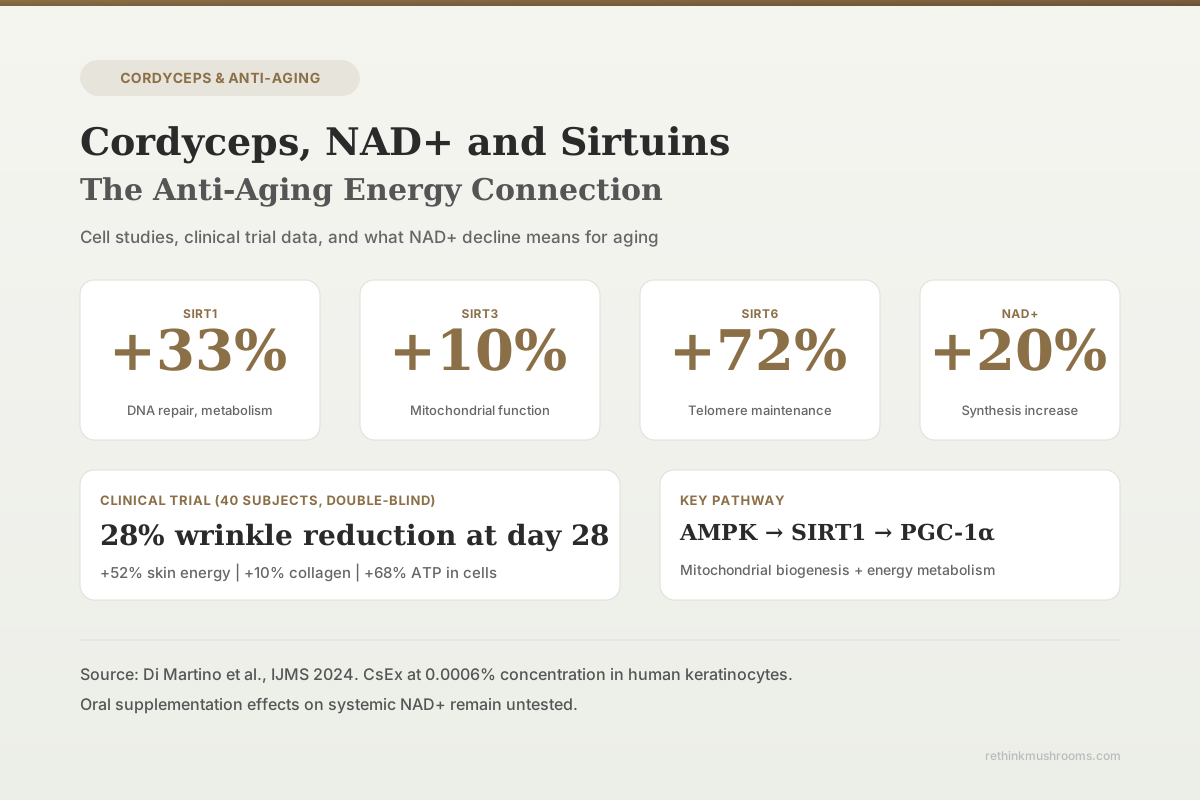 View as image ↗
NAD+ (nicotinamide adenine dinucleotide) levels decline with age across virtually every tissue in the body. This decline is linked to reduced sirtuin activity, impaired mitochondrial function, and accelerated cellular senescence. Cordyceps sinensis contains cordycepin and adenosine, both nucleoside compounds that interact with cellular energy pathways. A 2024 study published in the International Journal of Molecular Sciences provided the first direct evidence that a cordyceps extract can activate sirtuins and boost NAD+ synthesis in human cells, with supporting data from a double-blind clinical trial. For the broader evidence on cordyceps and aging, see Cordyceps and Anti-Aging: Research on Longevity. If you are looking for the oxidative stress angle specifically, Cordyceps and Cellular Aging: Oxidative Stress Protection covers that research.
Key Takeaways
- Cordyceps sinensis extract increased SirT1 expression by 33%, SirT3 by 10%, and SirT6 by 72% in human keratinocytes, with a 20% increase in NAD+ synthesis (Di Lorenzo et al., IJMS, 2024)
- The same extract boosted ATP production by 68% in skin cells and reduced reactive oxygen species by 30% at 0.0006% concentration
- A 40-person double-blind, placebo-controlled trial showed 28% wrinkle reduction and 52% skin energy increase at day 28 (Di Lorenzo et al., IJMS, 2024)
- Cordycepin activated SIRT1 expression in human mesenchymal stem cells via the AMPK-SIRT1 pathway, delaying cellular senescence and maintaining telomere activity (Chueaphromsri et al., In Vivo, 2023)
- Cordycepin exhibited anti-fatigue effects through the TIGAR/SIRT1/PGC-1α signaling pathway, linking sirtuin activation to energy metabolism (Chai et al., 2022)
- Cordyceps sinensis polysaccharides protected mitochondrial membrane potential and increased SOD activity in aging mouse models (Li et al., Molecules, 2010)
NAD+ Decline and Why It Matters for Aging
NAD+ serves as a cofactor for over 500 enzymatic reactions in human cells. It is essential for mitochondrial electron transport (energy production), DNA repair, and chromatin remodeling. The sirtuins, a family of seven NAD+-dependent deacetylases (SirT1 through SirT7), regulate cellular stress responses, inflammation, and metabolic homeostasis. When NAD+ drops, sirtuin activity drops with it, and the downstream consequences include impaired DNA repair, mitochondrial dysfunction, increased inflammation, and accelerated cell death.
NAD+ levels in human tissue decline roughly 50% between ages 40 and 60. This is not a single-cause phenomenon: both increased consumption (by enzymes like CD38 and PARP) and decreased synthesis contribute. The question for cordyceps research is whether its bioactive compounds can support NAD+ synthesis or sirtuin activity directly.
The Di Lorenzo 2024 Study: NAD+ and Sirtuins
The most comprehensive study linking cordyceps to NAD+ metabolism was published by Di Lorenzo and colleagues in the International Journal of Molecular Sciences in 2024.[1] They tested a Cordyceps sinensis mycelium hydroethanolic extract (CsEx) standardized for cordycepin and adenosine content using UHPLC-DAD analysis.
In Vitro Results
In HaCaT human keratinocytes treated with CsEx at 0.0006% concentration:
- SirT1 expression: +33% versus control (p < 0.05)
- SirT3 expression: +10% versus control (p < 0.05)
- SirT6 expression: +72% versus control (p < 0.05)
- NAD+ synthesis: +20% versus control (p < 0.001)
- ATP production: +68% versus control
- ROS reduction: -30% in cytosolic reactive oxygen species (p < 0.05)
- Collagen production: +69% versus control (p < 0.01)
The SirT6 result stands out. Sirtuin 6 is specifically involved in DNA double-strand break repair and telomere maintenance. A 72% increase in expression at a very low concentration (0.0006%) suggests high potency for this particular pathway.
Effect Sizes · One Cell Study
What a Cordyceps Extract Did to Sirtuins and NAD+
Percent change versus untreated control in human skin cells (HaCaT keratinocytes) exposed to a standardized Cordyceps sinensis extract at 0.0006%. The DNA-repair sirtuin SirT6 and cellular ATP move the most; NAD+ synthesis itself rises a more modest 20%. Read as one in vitro snapshot, not a systemic dose response.
SirT6 expression
+72%DNA-repair / telomere sirtuin — the standout response (p < 0.05)
ATP production
+68%Cellular energy output in treated keratinocytes
SirT1 expression
+33%Master metabolic sirtuin (p < 0.05)
NAD+ synthesis
+20%The cofactor sirtuins depend on (p < 0.001)
SirT3 expression
+10%Mitochondrial sirtuin (p < 0.05)
These are measurements in cultured skin cells and a topical trial. Whether oral cordyceps produces comparable sirtuin activation or NAD+ synthesis in internal tissues has not been tested in humans.
Source: Di Lorenzo et al. (2024), Int. J. Mol. Sci. [ref 1] — values verified against the published abstract.
Clinical Trial Results
The same group conducted a double-blind, placebo-controlled clinical trial with 40 human subjects to test topical application of the CsEx formulation.
At day 28:
- Wrinkle reduction: 28% (p < 0.001)
- Skin energy: +52% (p < 0.01)
- Collagen production in vivo: +10% versus baseline (p < 0.01)
This is one of the few cordyceps studies that pairs molecular data with a controlled human trial. The limitation: this tested topical application for skin aging, not oral supplementation for systemic NAD+ effects. Whether oral cordyceps produces similar sirtuin activation in internal tissues remains untested. For related cordyceps skin research, see Cordyceps and Skin Aging: Antioxidant Research.
Cordycepin and SIRT1: The Stem Cell Connection
Chueaphromsri and colleagues published a 2023 study in the journal In Vivo examining cordycepin's effect on SIRT1 in human mesenchymal stem cells (MSCs).[10] Cordycepin activated SIRT1 expression through the AMPK-SIRT1 signaling pathway. The consequences of this activation were multiple:
- SIRT1 deacetylated SOX2, maintaining stemness of MSCs
- Cellular senescence was delayed, as measured by senescence-associated beta-galactosidase activity
- Proliferation rate was maintained in treated cells
- Telomere activity increased
- Autophagy was enhanced, clearing damaged cellular components
This study matters because mesenchymal stem cells are involved in tissue repair throughout the body. Their decline with age contributes to reduced regenerative capacity. If cordycepin can maintain MSC stemness by sustaining SIRT1 activity, the implications extend beyond any single tissue. The connection between cordycepin and adenosine signaling adds mechanistic context for how this nucleoside analog interacts with cellular pathways.
SIRT1/PGC-1α: Linking Sirtuins to Energy Metabolism
Chai and colleagues (2022) demonstrated that cordycepin exhibits anti-fatigue effects through a specific molecular cascade: the TIGAR/SIRT1/PGC-1α signaling pathway.[2] PGC-1α (peroxisome proliferator-activated receptor gamma coactivator 1-alpha) is the master regulator of mitochondrial biogenesis. When SIRT1 deacetylates PGC-1α, it activates the production of new mitochondria and increases oxidative phosphorylation capacity.
This creates a direct link between cordycepin's sirtuin activation and the exercise performance benefits observed in separate clinical trials. The clinical trial evidence on cordyceps and exercise performance shows improvements in VO₂max and time to exhaustion, and the SIRT1/PGC-1α pathway offers a molecular explanation for those findings.
Huang and colleagues (2022) provided additional evidence that cordycepin acts through the Sirt1/Foxo3a pathway, demonstrating protective effects against oxidative damage in a diabetes model.[3] Foxo3a is a transcription factor downstream of SIRT1 that controls antioxidant enzyme expression, autophagy, and cell survival decisions. This represents a second sirtuin-dependent pathway through which cordycepin may modulate aging.
Mitochondrial Protection and Energy Production
Separate from the sirtuin pathway, cordyceps polysaccharides have been shown to protect mitochondrial function directly.
Li and colleagues (2010) tested polysaccharides from cultivated Cordyceps militaris fruiting bodies in a D-galactose-induced aging mouse model.[4] The polysaccharides protected mitochondrial membrane potential (a marker of mitochondrial health) and increased superoxide dismutase (SOD) activity (a key antioxidant enzyme). They also reduced malondialdehyde (MDA), a marker of lipid peroxidation from oxidative damage.
Choi and colleagues (2020) found that Cordyceps militaris extract increased ATP-related biomarkers and slightly improved grip strength in mice, suggesting a direct effect on cellular energy production.[5] For a deeper look at cordyceps and ATP production, that topic gets its own analysis.
Cordycepin Pharmacokinetics: Can It Reach Target Tissues?
A critical question for any NAD+-related intervention is whether the bioactive compound reaches tissues in sufficient concentration to produce the observed in vitro effects.
Tsai and colleagues (2010) studied the pharmacokinetics of adenosine and cordycepin from Cordyceps sinensis in rats.[6] Cordycepin is rapidly metabolized by adenosine deaminase in the bloodstream, which limits its systemic bioavailability. This is a real limitation: the potent in vitro effects at 0.0006% concentration may not translate to equivalent effects after oral supplementation, because cordycepin may not reach target tissues at that concentration.
Oh and colleagues (2019) used metabolomic profiling to show that cordycepin accumulates in Cordyceps militaris fruit bodies during the senescence process.[7] The timing of harvest affects cordycepin concentration, which means supplement quality depends on manufacturing practices, not just species selection. This connects to the broader question of whether adaptogenic mushroom supplements deliver consistent bioactive concentrations.
Cordycepin's metabolic fate further complicates dose-response predictions. Because it is rapidly deaminated in the bloodstream — the pharmacokinetic limitation described above — some of its biological activity may be carried by downstream metabolites rather than by intact cordycepin reaching target tissues. If that is the case, the relevant variable is not just cordycepin blood levels but the activity of those metabolic products, which may depend on individual metabolic variation as much as on the amount of cordycepin consumed.
The Earlier Anti-Aging Evidence
Before the NAD+/sirtuin connection was established, Ji and colleagues (2009) tested Cordyceps sinensis extract for general anti-aging effects.[8] They found improvements in antioxidant enzyme activity and reductions in oxidative damage markers in aging animal models. At the time, the specific molecular targets were unclear. The 2024 Di Lorenzo study retroactively provides a mechanistic explanation: the observed anti-aging effects likely operated through sirtuin activation and NAD+ metabolism.
Li and colleagues (2023) demonstrated that cordycepin delays postovulatory aging of oocytes through inhibition of maternal mRNA degradation.[9] This is a highly specific anti-aging effect in reproductive cells, showing that cordycepin's influence on cellular aging extends beyond the skin and metabolic tissues. For the broader aging picture, see How Cordyceps May Slow Biological Aging.
What Is Established and What Is Not
Established by published evidence:
- Cordyceps sinensis extract activates SirT1, SirT3, and SirT6 expression and increases NAD+ synthesis in human keratinocytes
- Cordycepin activates SIRT1 via the AMPK-SIRT1 pathway in mesenchymal stem cells
- Cordycepin links to energy metabolism through SIRT1/PGC-1α and reduces fatigue in animal models
- A 40-person clinical trial confirmed measurable anti-aging effects from topical cordyceps application
Not established:
- Whether oral cordyceps supplementation increases systemic NAD+ levels in humans
- Whether the sirtuin activation observed in skin cells occurs in brain, muscle, or other aging-relevant tissues after oral dosing
- Optimal dose for NAD+/sirtuin effects in humans
- Long-term anti-aging outcomes from cordyceps supplementation
- How cordyceps compares to direct NAD+ precursors (NMN, NR) for sirtuin activation
The gap between topical and systemic evidence is the largest open question. The in vitro and clinical data for skin aging are unusually strong for a mushroom extract. Whether those findings generalize to systemic anti-aging remains speculative until oral supplementation trials measure tissue NAD+ levels and sirtuin activity directly.
The Bottom Line
Cordyceps sinensis extract activates sirtuin enzymes (SirT1 +33%, SirT6 +72%) and increases NAD+ synthesis (+20%) in human skin cells, with a 40-person clinical trial confirming wrinkle reduction and energy improvements from topical application. Cordycepin separately activates SIRT1 in stem cells through the AMPK pathway, maintaining stemness and delaying senescence. The connection to energy metabolism runs through SIRT1/PGC-1α, the master switch for mitochondrial biogenesis. Whether oral cordyceps produces equivalent systemic NAD+ effects has not been tested in human trials.
Frequently Asked Questions
Sources & References
- 1RTHM-00873·Di Lorenzo, Ritamaria et al. (2024). “NAD-Driven Sirtuin Activation by Cordyceps sinensis Extract: Exploring the Adaptogenic Potential to Promote Skin Longevity..” International journal of molecular sciences.Study breakdown →PubMed →↩
- 2RTHM-00749·Chai, Xiaoming et al. (2022). “Cordycepin exhibits anti-fatigue effect via activating TIGAR/SIRT1/PGC-1α signaling pathway..” Biochemical and biophysical research communications.Study breakdown →PubMed →↩
- 3RTHM-00767·Huang, Tao et al. (2022). “Cordycepin, a major bioactive component of Cordyceps militaris, ameliorates diabetes-induced testicular damage through the Sirt1/Foxo3a pathway..” Andrologia.Study breakdown →PubMed →↩
- 4RTHM-00191·Li, Xing-Tai et al. (2010). “Protective effects on mitochondria and anti-aging activity of polysaccharides from cultivated fruiting bodies of Cordyceps militaris..” The American journal of Chinese medicine.Study breakdown →PubMed →↩
- 5RTHM-00613·Choi, Eunhyun et al. (2020). “Beneficial Effect of Cordyceps militaris on Exercise Performance via Promoting Cellular Energy Production..” Mycobiology.Study breakdown →PubMed →↩
- 6RTHM-00199·Tsai, Yung-Jen et al. (2010). “Pharmacokinetics of adenosine and cordycepin, a bioactive constituent of Cordyceps sinensis in rat..” Journal of agricultural and food chemistry.Study breakdown →PubMed →↩
- 7RTHM-00582·Oh, Junsang et al. (2019). “Metabolomic profiling reveals enrichment of cordycepin in senescence process of Cordyceps militaris fruit bodies..” Journal of microbiology (Seoul.Study breakdown →PubMed →↩
- 8RTHM-00156·Ji, Deng-Bo et al. (2009). “Antiaging effect of Cordyceps sinensis extract..” Phytotherapy research : PTR.Study breakdown →PubMed →↩
- 9RTHM-00838·Li, Chong et al. (2023). “Cordycepin delays postovulatory aging of oocytes through inhibition of maternal mRNAs degradation via DCP1A polyadenylation suppression..” Cellular and molecular life sciences : CMLS.Study breakdown →PubMed →↩
- 10RTHM-00820·Chueaphromsri, Phongsakorn et al. (2023). “Cordycepin Enhances SIRT1 Expression and Maintains Stemness of Human Mesenchymal Stem Cells..” In vivo (Athens.Study breakdown →PubMed →↩