Cordyceps Energy
+10.5% metabolic threshold
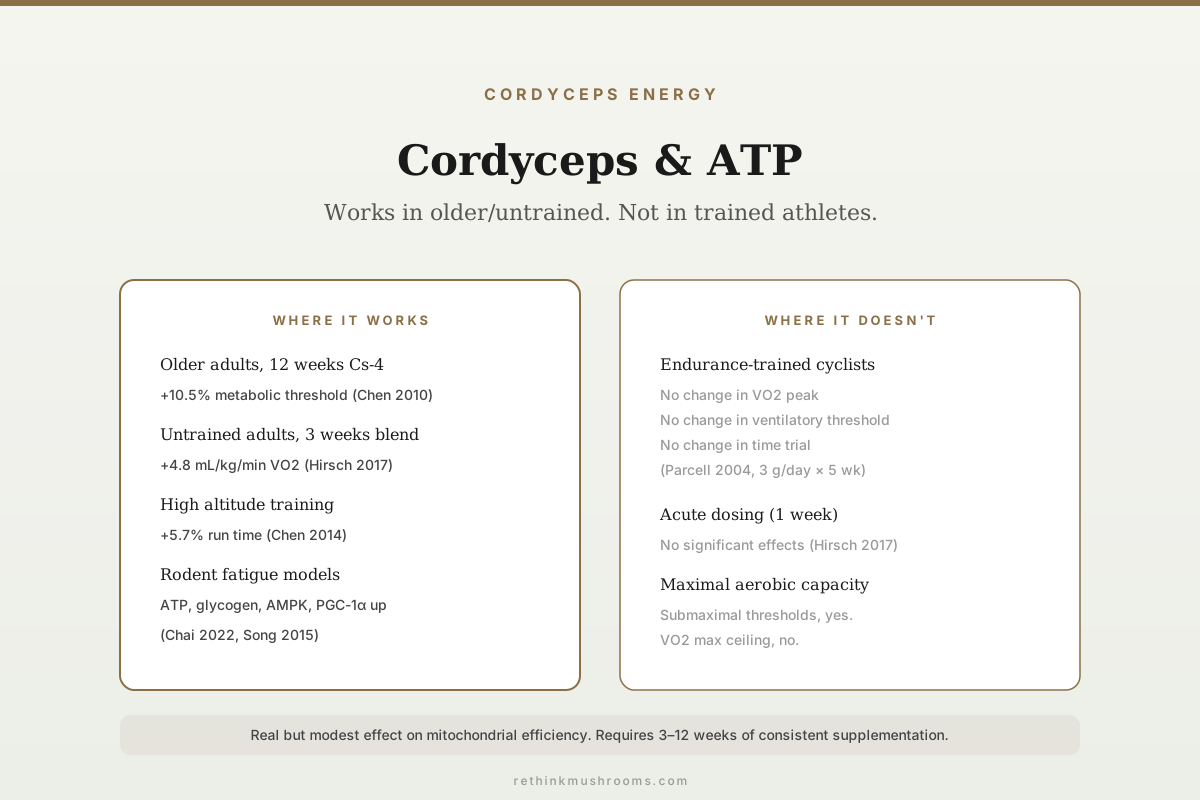
Chen et al. (2010) documented a 10.5% increase in metabolic threshold in healthy older adults taking Cs-4 Cordyceps sinensis 333 mg three times daily for 12 weeks, without a matching improvement in VO2 max, consistent with an effect on energy metabolism rather than maximal oxygen uptake.
Chen et al., Journal of Alternative and Complementary Medicine, 2010
Muscle ATP, glycogen up
in rodent fatigue models (Song 2015, Chai 2022)
TIGAR/SIRT1/PGC-1α
activated energy metabolism pathway (Chai 2022)
Mixed clinical results
older adults yes, trained cyclists no
Chen et al., Journal of Alternative and Complementary Medicine, 2010
 View as image ↗
Cordyceps and ATP production is the most consistently demonstrated bioactivity of the genus in the energy metabolism literature. Cordyceps extract reliably raises muscle ATP content, liver and muscle glycogen, and antioxidant enzyme activity in rodent fatigue models, with defined signaling through AMPK/mTOR and the TIGAR/SIRT1/PGC-1α axis. In humans, the evidence is more mixed: older or less-trained populations show clear improvements in metabolic and ventilatory thresholds, while endurance-trained cyclists show no benefit. The pattern is consistent with a real but modest effect on mitochondrial energy metabolism that is most detectable in populations with baseline metabolic inefficiency or deconditioning.
For related cluster coverage, see the sibling articles cordyceps and mitochondrial function: research on energy metabolism, cordyceps for fatigue: clinical evidence on energy levels, cordyceps and creatine phosphate: dual pathways to cellular energy, and how cordycepin enhances adenosine signaling.
Key Takeaways
- Chai et al. (2022) showed that cordycepin 20 and 40 mg/kg in mice for 28 days before weight-loaded swimming significantly prolonged swimming time, increased muscle and liver glycogen and ATP, and raised SOD and glutathione through TIGAR/SIRT1/PGC-1α/NRF1/TFAM pathway activation (Biochemical and Biophysical Research Communications)
- Song et al. (2015) demonstrated that Cordyceps militaris fruit body extract increased ATP levels and antioxidant enzyme activity while decreasing lactic acid, LDH, and ROS in mouse fatigue models, with fatigue recovery mediated primarily through AMPK activation and AKT/mTOR signaling (Evidence-Based Complementary and Alternative Medicine)
- Chen et al. (2010), in a 12-week double-blind placebo-controlled trial of 20 healthy older adults (age 50-75), reported a 10.5% increase in metabolic threshold and 8.5% increase in ventilatory threshold with Cs-4 Cordyceps sinensis 333 mg three times daily, without change in VO2 max (Journal of Alternative and Complementary Medicine)
- Hirsch et al. (2017) tested a Cordyceps militaris-containing mushroom blend in 28 subjects and found significant improvements in VO2 max (+4.8 mL/kg/min) and ventilatory threshold (+0.7 L/min) after 3 weeks but not after 1 week of supplementation (Journal of Dietary Supplements)
- Parcell et al. (2004) tested CordyMax Cs-4 3 g/day for 5 weeks in 22 endurance-trained male cyclists and found no effect on VO2 peak, ventilatory threshold, or time trial performance, demonstrating that the Cordyceps benefit does not extend to already-trained endurance populations (Journal of Alternative and Complementary Medicine)
- Chen et al. (2014) tested Rhodiola crenulata plus Cordyceps sinensis supplementation during 2-week high altitude training and found 5.7% improvement in exhaustive run time versus 2.2% for placebo, with better parasympathetic nervous system preservation and reduced erythropoietin response (High Altitude Medicine & Biology)
What "Boosts Cellular Energy" Actually Means
The claim that cordyceps boosts cellular energy refers to a specific set of measurable changes in energy metabolism rather than a general subjective feeling of having more energy. The concrete measurements that have been published:
- Increased ATP content in skeletal muscle and liver
- Increased muscle and liver glycogen stores
- Increased activity of antioxidant enzymes (SOD, glutathione, NADPH)
- Decreased accumulation of lactic acid during exercise
- Decreased malondialdehyde (marker of oxidative damage)
- Activation of AMPK, AKT/mTOR, and TIGAR/SIRT1/PGC-1α signaling
These are mechanistic and biochemical endpoints, not subjective. The subjective feeling of energy in humans after cordyceps consumption has not been measured rigorously in published trials, and the quality of the biochemical changes in animals does not automatically translate to subjective perception in humans.
The Preclinical Mechanistic Picture
Chai et al. (2022), publishing in Biochemical and Biophysical Research Communications, mapped the cordycepin energy metabolism pathway in detail.[1] Mice received 20 mg/kg or 40 mg/kg cordycepin (with 500 mg/kg taurine as positive control) for 28 days and then performed weight-loaded swimming to exhaustion. Cordycepin significantly prolonged swimming time at both doses and produced the following biochemical changes:
- Increased muscle glycogen (gastrocnemius)
- Increased hepatic glycogen
- Increased ATP content
- Increased superoxide dismutase (SOD)
- Increased glutathione
- Increased NADPH
- Decreased lactic acid
- Decreased blood urea nitrogen
- Decreased malondialdehyde
At the signaling level, cordycepin significantly enhanced the protein levels of TIGAR (TP53-induced glycolysis and apoptosis regulator), SIRT1 (sirtuin 1), PGC-1α (peroxisome proliferator-activated receptor gamma coactivator 1-alpha), NRF1 (nuclear respiratory factor 1), and TFAM (mitochondrial transcription factor A) in the gastrocnemius muscle. This cluster of proteins drives mitochondrial biogenesis, regulates the pentose phosphate pathway, and maintains mitochondrial DNA replication. Activating this axis produces more mitochondria, higher oxidative capacity, and better energy availability during exertion.
Song et al. (2015), publishing in Evidence-Based Complementary and Alternative Medicine, characterized a complementary mechanism in whole Cordyceps militaris fruit body extract.[2] Two weeks of extract administration in mice delayed fatigue across rotating rod, forced swimming, and forced running tests, with increased ATP, increased antioxidative enzyme activity, and decreased lactate, LDH, and ROS compared with control. The signaling driver was AMPK activation with AKT/mTOR co-activation, and AMPK phosphorylation was also linked to the antioxidant response.
The two pathways (AMPK/mTOR from Song 2015 and TIGAR/SIRT1/PGC-1α from Chai 2022) are not competing explanations; they operate in parallel and intersect at mitochondrial biogenesis and fatty-acid oxidation. The mouse-level mechanistic picture is coherent: cordyceps and cordycepin increase mitochondrial capacity, raise the efficiency of energy production, and reduce the oxidative cost of exertion.
The Clinical Evidence: Where It Works
Chen et al. (2010), publishing in the Journal of Alternative and Complementary Medicine, ran a 12-week double-blind placebo-controlled trial of Cs-4 Cordyceps sinensis 333 mg three times daily in 20 healthy adults aged 50-75.[3] Results:
- Metabolic threshold increased 10.5% (0.83 to 0.93 L/min, p<0.02)
- Ventilatory threshold increased 8.5% (1.25 to 1.36 L/min)
- No change in VO2 max
- No corresponding changes in the placebo group
The metabolic threshold is the exercise intensity above which blood lactate begins to accumulate faster than it can be cleared. An increase means that the subject can exercise harder before tipping into anaerobic metabolism. The ventilatory threshold is the exercise intensity above which unbuffered hydrogen ions stimulate ventilation. Both thresholds shifting upward without a VO2 max change indicates an efficiency improvement rather than a capacity increase. This is the pattern predicted by the preclinical mitochondrial biogenesis mechanism.
Hirsch et al. (2017), publishing in the Journal of Dietary Supplements, tested a Cordyceps militaris-containing mushroom blend at 4 g/day in 28 subjects using a randomized double-blind placebo-controlled design.[4] After 1 week of supplementation, no significant effects were observed. After 3 weeks, VO2 max improved by 4.8 mL/kg/min (p=0.042) in the mushroom blend group but not in placebo, with additional improvements in time-to-exhaustion (+69.8 seconds) and ventilatory threshold (+0.7 L/min). The pattern supports a chronic supplementation requirement rather than an acute ergogenic effect.
Chen et al. (2014), publishing in High Altitude Medicine & Biology, tested a Rhodiola crenulata plus Cordyceps sinensis combination (1400 mg R + 600 mg C daily) during 2-week high-altitude training in 18 male subjects.[5] The combination group showed 5.7% improvement in exhaustive run time versus 2.2% in placebo, preserved parasympathetic nervous system activity (-41% vs -51% decline), and required less erythropoietin response despite comparable hematological adaptations. The finding is useful because it demonstrates benefit in a stressed physiological context (altitude hypoxia) rather than in rested subjects. The caveat is that the combination design does not isolate the cordyceps contribution from the rhodiola contribution.
The Clinical Evidence: Where It Fails
Parcell et al. (2004), publishing in the Journal of Alternative and Complementary Medicine, tested CordyMax Cs-4 at 3 g/day for 5 weeks in 22 endurance-trained male cyclists.[6] Outcomes:
- VO2 peak: no change in either group (placebo 59.9 → 60.1; treatment 59.1 → 57.1 mL/kg/min)
- Ventilatory threshold: no change in either group (stayed at ~72% of VO2 peak)
- Time trial performance: no change in either group (placebo 61.4 min; treatment 62.1 min)
The trial was well-conducted, well-powered for its endpoints, and produced a clear null result. The interpretation is that endurance-trained cyclists, who are already operating at high oxidative efficiency and high mitochondrial density, do not have residual room for cordyceps to improve what is already optimized. This is consistent with the older-adults finding in Chen 2010: the Cordyceps signal is detectable in populations with metabolic inefficiency or deconditioning and disappears in populations already optimized.
What the Overall Pattern Supports
Combining the preclinical and clinical evidence, the defensible statements about cordyceps and cellular energy are:
- Cordyceps and cordycepin raise muscle and liver ATP and glycogen in rodent fatigue models, with defined signaling through AMPK/mTOR and TIGAR/SIRT1/PGC-1α axes
- Cordyceps improves submaximal exercise thresholds (metabolic threshold, ventilatory threshold, time to exhaustion) in older or untrained humans
- Cordyceps does not improve VO2 max or endurance performance in already-trained endurance athletes
- The improvement in mitochondrial efficiency is detectable only after chronic supplementation (3-12 weeks) and not after acute dosing
- The magnitude of improvement in humans is modest (5-10% on threshold endpoints) and is most pronounced when baseline metabolic efficiency is low
These statements are stronger than "cordyceps boosts energy" and more accurate than "cordyceps is ineffective." The picture is of a specific, modest, context-dependent ergogenic effect supported by coherent preclinical mechanisms and mixed but interpretable human trial data.
What Is Not Established
No dose-response study in humans. The published trials used Cs-4 at 333 mg × 3, 3 g/day, and 4 g/day of a mushroom blend, with no systematic comparison of doses and no validated minimum effective dose.
No pharmacokinetic data for cordycepin or other active compounds in human exercise populations. Plasma concentrations during chronic supplementation have not been published.
No direct head-to-head comparison with established ergogenic aids. Creatine, beta-alanine, and beetroot nitrate all have stronger and more consistent clinical evidence for threshold and endurance improvements, and cordyceps has not been benchmarked against them.
No long-term safety data at supplement doses. Trial durations are typically 2-12 weeks. Chronic multi-year supplementation has not been studied.
For the broader mitochondrial context, see the sibling cordyceps and mitochondrial function: research on energy metabolism. For the subjective fatigue-reduction angle, see cordyceps for fatigue: clinical evidence on energy levels. For a cross-cluster view of cordycepin's broader mechanism profile, see cordycepin and leukemia research: preclinical findings.
Reading Cordyceps Product Claims Against This Evidence
The mismatch between product marketing and published evidence is specific and worth naming.
Marketing claim: cordyceps is an adaptogenic energy booster for all populations. The published evidence supports energy-metabolism improvements in older or untrained humans and rodent fatigue models. It does not support effects in already-optimized endurance athletes (Parcell 2004 produced a clear null result).
Marketing claim: cordyceps provides immediate energy. The published evidence shows no acute effect at 1 week (Hirsch 2017) and requires 3-12 weeks of consistent supplementation to reach measurable changes in exercise thresholds.
Marketing claim: cordyceps increases ATP and powers cellular energy. The published evidence shows this in mouse muscle and liver. Human tissue ATP content after cordyceps supplementation has not been measured directly in any published trial.
Marketing claim: cordyceps is an ergogenic aid for athletic performance. The published evidence supports submaximal threshold improvements, not maximal performance. For an athlete training at or near VO2 max, cordyceps does not improve the variables that determine competitive performance.
The accurate framing is that cordyceps has a coherent preclinical mechanism for mitochondrial and energy-metabolism improvement, limited but real clinical validation in older and untrained populations, and null results in trained endurance athletes. For readers in the middle (recreational exercisers, deconditioned individuals returning to activity, older adults seeking improved submaximal capacity), the evidence is more favorable than marketing-skeptical framing suggests.
The Bottom Line
Cordyceps and cordycepin increase ATP, glycogen, and antioxidant enzyme activity in rodent fatigue models through AMPK/mTOR and TIGAR/SIRT1/PGC-1α pathways. In humans, submaximal exercise thresholds improve in older adults and untrained populations after 3-12 weeks of supplementation; endurance-trained cyclists show no benefit. The effect is real, modest, and most detectable in populations with baseline metabolic inefficiency.
Frequently Asked Questions
Sources & References
- 1RTHM-00749·Chai, Xiaoming et al. (2022). “Cordycepin exhibits anti-fatigue effect via activating TIGAR/SIRT1/PGC-1α signaling pathway..” Biochemical and biophysical research communications.Study breakdown →PubMed →↩
- 2RTHM-00401·Song, Jingjing et al. (2015). “Studies on the Antifatigue Activities of Cordyceps militaris Fruit Body Extract in Mouse Model..” Evidence-based complementary and alternative medicine : eCAM.Study breakdown →PubMed →↩
- 3RTHM-00176·Chen, Steve et al. (2010). “Effect of Cs-4 (Cordyceps sinensis) on exercise performance in healthy older subjects: a double-blind, placebo-controlled trial..” Journal of alternative and complementary medicine (New York.Study breakdown →PubMed →↩
- 4RTHM-00473·Hirsch, Katie R et al. (2017). “Cordyceps militaris Improves Tolerance to High-Intensity Exercise After Acute and Chronic Supplementation..” Journal of dietary supplements.Study breakdown →PubMed →↩
- 5RTHM-00313·Chen, Chung-Yu et al. (2014). “Rhodiola crenulata- and Cordyceps sinensis-based supplement boosts aerobic exercise performance after short-term high altitude training..” High altitude medicine & biology.Study breakdown →PubMed →↩
- 6RTHM-00075·Parcell, Allen C et al. (2004). “Cordyceps Sinensis (CordyMax Cs-4) supplementation does not improve endurance exercise performance..” International journal of sport nutrition and exercise metabolism.Study breakdown →PubMed →↩