Cordyceps and Cellular Energy
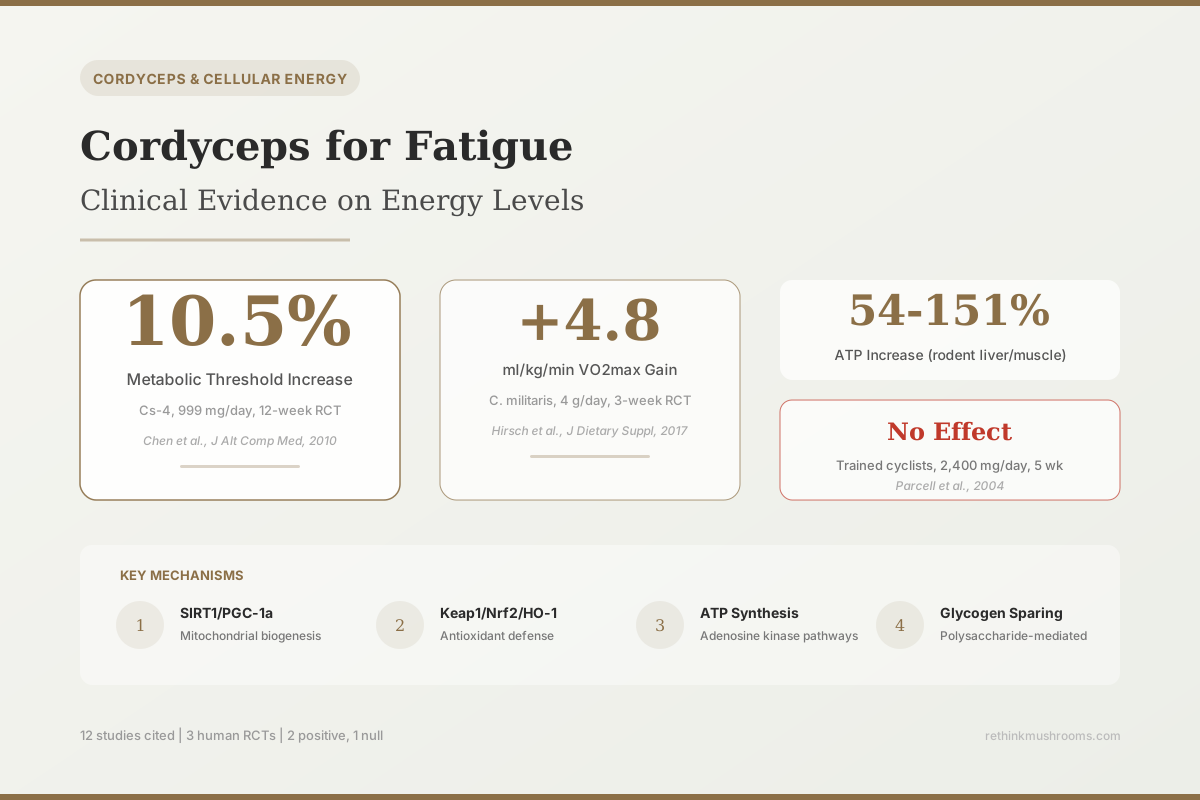
10.5% Metabolic Threshold Increase
In a 12-week placebo-controlled trial, older adults taking Cs-4 (Cordyceps sinensis) at 999 mg/day increased their metabolic threshold by 10.5%, while the placebo group declined 3.9%.
Chen et al., J Alternative & Complementary Medicine, 2010
+4.8 ml/kg/min
VO2max gain after 3 weeks C. militaris
54-151%
ATP increase in rodent liver/muscle
2 Human RCTs
positive results on exercise tolerance
Chen et al., J Alternative & Complementary Medicine, 2010
 View as image ↗
Cordyceps has been used in traditional Chinese medicine for centuries to combat fatigue, with historical texts describing its use by Tibetan herders who noticed their yaks became more energetic after grazing on the wild fungus. The modern research picture is more specific and more mixed than the traditional claims suggest. Two randomized controlled trials in humans show measurable improvements in exercise thresholds and oxygen uptake. Multiple preclinical studies identify mechanisms through ATP production, antioxidant defense, and mitochondrial function. One well-designed trial found no benefit at all. The evidence is promising but incomplete, and separating the real signals from the noise requires looking at each study's design, dose, population, and endpoints.
Key Takeaways
- A 12-week RCT in 20 older adults found Cs-4 (Cordyceps sinensis) at 999 mg/day increased metabolic threshold by 10.5% and ventilatory threshold by 8.5%, while placebo declined on both measures (Chen et al., J Alternative & Complementary Medicine, 2010)
- A 3-week RCT in 28 young adults found 4 g/day of Cordyceps militaris increased VO2max by 4.8 ml/kg/min and time to exhaustion by 69.8 seconds versus placebo (Hirsch et al., J Dietary Supplements, 2017)
- In mice, C. militaris fruit body extract at 2 g/kg increased tissue ATP levels by 54.6-151.2% and reduced blood lactate by 17-39% after forced swimming (Song et al., eCAM, 2015)
- A 2025 study found cordycepin enhanced exercise endurance in mice by increasing glycogen stores and activating the Keap1/Nrf2/HO-1 antioxidant pathway (Cheng et al., Scientific Reports, 2025)
- One 5-week RCT in trained male cyclists found Cs-4 at 2,400 mg/day produced no improvement in endurance performance, highlighting that effects may depend on population and fitness level (Parcell et al., Int J Sport Nutrition, 2004)
- The active compounds cordycepin and polysaccharides appear to work through distinct anti-fatigue pathways: cordycepin via SIRT1/PGC-1a energy metabolism, polysaccharides via glycogen preservation and antioxidant enzymes
Human Clinical Trials: What the Data Shows
The Cs-4 Trial in Older Adults
The most frequently cited human trial on cordyceps and fatigue was conducted by Chen and colleagues, published in the Journal of Alternative and Complementary Medicine in 2010.[1] This double-blind, placebo-controlled trial enrolled 20 healthy adults aged 50 to 75 and randomized them to receive either Cs-4 (a standardized fermentation product of Cordyceps sinensis) at 333 mg three times daily (999 mg/day total) or placebo for 12 weeks. Participants underwent incremental exercise testing on a cycle ergometer at baseline and week 12.
The Cs-4 group showed two statistically significant improvements. Their metabolic threshold, the point at which lactate begins accumulating in the blood, increased by 10.5% (from 0.83 to 0.93 L/min oxygen consumption, p=0.022). Their ventilatory threshold, the point at which breathing rate spikes disproportionately to oxygen demand, increased by 8.5% (from 1.25 to 1.36 L/min, p=0.031). The placebo group declined on both measures: metabolic threshold dropped 3.9%, and ventilatory threshold dropped 32.5%.
VO2max itself did not change significantly in either group. This is an important distinction: cordyceps appeared to extend the range of comfortable exercise intensity without changing peak aerobic capacity. The practical implication is that daily activities and moderate exercise might feel less taxing, even if maximum physical limits remain the same.
The study's primary limitation is its sample size. Only 15 participants completed the trial (8 in the Cs-4 group, 7 in placebo). The authors explicitly described it as a "small pilot study." The effect sizes are large enough to warrant larger trials, but the confidence intervals are wide.
The Cordyceps militaris Trial in Young Adults
Hirsch and colleagues published a contrasting study in the Journal of Dietary Supplements in 2017, testing Cordyceps militaris rather than C. sinensis.[2] This randomized, double-blind, placebo-controlled trial enrolled 28 participants (mean age 22.7 years) and administered 4 g/day of a mushroom blend containing C. militaris or placebo. The study had two phases: 1 week and 3 weeks of supplementation.
After 1 week, VO2max did not significantly differ between groups, but time to exhaustion increased by 28.1 seconds in the mushroom group. After 3 weeks, the differences became more pronounced: the mushroom group gained 4.8 ml/kg/min in VO2max compared to 0.9 ml/kg/min for placebo (p=0.042). Time to exhaustion increased by 69.8 seconds. Ventilatory threshold improved by 41.2% in the treatment group.
These are substantial improvements for 3 weeks of supplementation. The dose was higher than in the Chen trial (4 g/day versus ~1 g/day), and the population was younger and more active. The results suggest that both dose and duration matter: the 1-week data showed minimal differences, while 3 weeks produced statistically significant separation from placebo. The supplement was a mushroom blend, not pure C. militaris isolate, which makes attribution to cordyceps specifically less certain.
The Negative Trial: When Cordyceps Did Not Work
Parcell and colleagues reported a null result in the International Journal of Sport Nutrition and Exercise Metabolism in 2004.[3] Their double-blind, placebo-controlled trial gave trained male cyclists 2,400 mg/day of CordyMax Cs-4 for 5 weeks. VO2max, ventilatory threshold, time to exhaustion, and submaximal exercise responses showed no significant improvement compared to placebo.
This result is not necessarily contradictory to the positive trials. The population was different: trained cyclists already operating near their physiological ceilings. The dose was intermediate (higher than Chen's 999 mg/day but using a different formulation). The duration was 5 weeks, between the 3-week Hirsch timepoint and Chen's 12-week endpoint. The most likely interpretation is that cordyceps may benefit untrained or moderately trained individuals more than elite athletes, a pattern seen with many ergogenic supplements. It is also possible that 5 weeks was insufficient for this particular formulation, or that trained athletes require higher doses to see measurable effects.
Cordyceps at High Altitude
Chen and colleagues (different research group) tested a combined Rhodiola crenulata and Cordyceps sinensis supplement in a 2014 study.[4] After short-term high altitude training, the supplement group showed improved aerobic exercise performance compared to controls. Singh and colleagues separately demonstrated that Cordyceps sinensis increases hypoxia tolerance in human lung epithelial cells by inducing heme oxygenase-1 through Nrf2 activation.[5] These studies suggest cordyceps may be particularly relevant in oxygen-limited conditions, though the combination supplement makes it impossible to isolate cordyceps' contribution.
Preclinical Evidence: Mechanisms of Anti-Fatigue Action
Cordycepin and Energy Metabolism
Cordycepin (3'-deoxyadenosine), the signature bioactive compound in Cordyceps militaris, has been studied specifically for anti-fatigue mechanisms. Chai and colleagues published a detailed mechanistic study in Biochemical and Biophysical Research Communications in 2022, demonstrating that cordycepin activates the TIGAR/SIRT1/PGC-1a signaling pathway in fatigued mice.[6] SIRT1 is a master regulator of cellular energy homeostasis. PGC-1a drives mitochondrial biogenesis, the creation of new mitochondria. Activating this pathway means more cellular energy production capacity, not just a temporary energy boost. For a deeper look at how cordycepin interacts with adenosine receptors and energy signaling, see how cordycepin enhances adenosine signaling.
A 2025 study by Cheng and colleagues in Scientific Reports extended this work, showing that oral cordycepin enhanced exercise endurance in mice, increased liver and muscle glycogen content, and reduced serum lactic acid, lactate dehydrogenase, creatine kinase, and blood urea nitrogen.[7] The anti-fatigue effect involved modulation of the Keap1/Nrf2/HO-1 signaling pathway, the body's primary antioxidant defense system, and enhanced BDNF (brain-derived neurotrophic factor) levels. This dual mechanism, reducing oxidative damage while supporting neuroplasticity, suggests cordycepin's anti-fatigue effects extend beyond muscle energy to include cognitive fatigue. In the excessive exercise model, learning and memory ability dropped to 40% of control levels; cordycepin substantially reversed this decline.
Whole Extract: The ATP Connection
Song and colleagues conducted the most comprehensive preclinical anti-fatigue study using Cordyceps militaris whole fruit body extract in 2015.[8] Mice received 0.5, 1.0, or 2.0 g/kg of extract daily for 14 days. The extract contained 29.1% polysaccharides, 20.5% total proteins, 6.1% cordycepic acid, 0.2% adenosine, and 0.4% cordycepin.
At the highest dose (2.0 g/kg), swimming endurance increased by 3.0 to 3.4 minutes compared to controls. Blood lactate after 20 minutes of swimming decreased by 17.0-36.6% in females and 17.0-38.9% in males. ATP levels in liver and muscle tissue increased by 54.6-151.2%. Antioxidant enzymes SOD and GSH-Px both increased, while oxidative damage markers (malondialdehyde and reactive oxygen species) decreased. Rotating rod residence time, a measure of coordination and resistance to physical fatigue, improved approximately 100-116% (p<0.05). The relationship between cordyceps and cellular ATP production is covered in detail in the companion article.
Polysaccharides and Glycogen Preservation
Xu published a focused study on C. militaris polysaccharides and physical fatigue in the International Journal of Medicinal Mushrooms in 2016.[9] The polysaccharide fraction alone, separated from cordycepin and other small molecules, delayed fatigue in the forced swimming test. This is significant because it means multiple active compounds contribute to anti-fatigue effects through distinct pathways: cordycepin acts through adenosine signaling and SIRT1/PGC-1a activation, while polysaccharides preserve glycogen stores and support antioxidant defense.
Cellular Energy Production Mechanisms
Choi and colleagues reviewed the cellular energy mechanisms in Mycobiology in 2020, compiling evidence that Cordyceps militaris promotes exercise performance by increasing ATP synthesis through adenosine kinase pathways, enhancing mitochondrial electron transport chain efficiency, and reducing ATP-wasting processes like inflammation and oxidative stress.[10] Ashraf and colleagues published a comprehensive review of cordycepin's pharmacology in Molecules in 2020, cataloging its anti-inflammatory, antioxidant, and energy-modulating properties and noting that these multiple mechanisms may work synergistically to combat fatigue at the cellular level.[11]
What the Evidence Does Not Support
The clinical trial data has real gaps. Both positive human trials used small sample sizes (15 and 28 completers). Neither measured subjective fatigue or daily energy levels; both used exercise testing endpoints. No published human RCT has tested cordyceps specifically in people with chronic fatigue, cancer-related fatigue, or post-viral fatigue, populations where an anti-fatigue intervention would matter most.
The Parcell negative trial raises a legitimate question about whether cordyceps benefits only sedentary or moderately active people. If the mechanism primarily involves raising metabolic and ventilatory thresholds, individuals already operating near their genetic ceiling for those parameters may not respond.
Dose-response data in humans is almost nonexistent. The two positive trials used different species, different formulations, and different doses (999 mg/day Cs-4 versus 4 g/day C. militaris blend). It is not possible to establish optimal dosing from two trials with different preparations.
The preclinical studies, while mechanistically detailed, all used rodent models. Mice swimming to exhaustion is a poor proxy for a human feeling tired at 3 PM. The ATP increases of 54-151% measured in rodent tissue may not translate proportionally to humans.
The Species Question: C. sinensis vs. C. militaris
Most supplement products use Cordyceps militaris (cultivated, affordable, standardizable) rather than Cordyceps sinensis (wild-harvested, expensive, ecologically threatened). The two species share cordycepin as a primary active compound but differ in secondary metabolite profiles. The Ontawong 2024 randomized controlled trial on C. militaris beverage in healthy adults confirmed that cultivated C. militaris has measurable biological activity in humans, showing immune parameter changes that reached statistical significance.[12]
The Chen 2010 trial used a C. sinensis fermentation product (Cs-4), while the Hirsch 2017 trial used a C. militaris-containing blend. Both showed positive results. The negative Parcell 2004 trial also used Cs-4. This makes it difficult to determine whether one species is superior for fatigue, since the confounding variables (dose, population, duration) are larger than the species difference.
The Bottom Line
Cordyceps shows credible but preliminary evidence for reducing fatigue and improving exercise tolerance. Two small RCTs found meaningful improvements in metabolic threshold, ventilatory threshold, and VO2max; one trial in trained athletes found no effect. Preclinical research identifies specific mechanisms through SIRT1/PGC-1a activation, ATP production, glycogen preservation, and antioxidant defense. The evidence base is limited by small sample sizes, lack of disease-population trials, and uncertainty about optimal dosing. The most honest summary: cordyceps appears to do something real for energy metabolism, but the clinical evidence is not yet strong enough to specify who benefits, how much, or at what dose.
Frequently Asked Questions
Sources & References
- 1RTHM-00176·Chen, Steve et al. (2010). “Effect of Cs-4 (Cordyceps sinensis) on exercise performance in healthy older subjects: a double-blind, placebo-controlled trial..” Journal of alternative and complementary medicine (New York.Study breakdown →PubMed →↩
- 2RTHM-00473·Hirsch, Katie R et al. (2017). “Cordyceps militaris Improves Tolerance to High-Intensity Exercise After Acute and Chronic Supplementation..” Journal of dietary supplements.Study breakdown →PubMed →↩
- 3RTHM-00075·Parcell, Allen C et al. (2004). “Cordyceps Sinensis (CordyMax Cs-4) supplementation does not improve endurance exercise performance..” International journal of sport nutrition and exercise metabolism.Study breakdown →PubMed →↩
- 4RTHM-00313·Chen, Chung-Yu et al. (2014). “Rhodiola crenulata- and Cordyceps sinensis-based supplement boosts aerobic exercise performance after short-term high altitude training..” High altitude medicine & biology.Study breakdown →PubMed →↩
- 5RTHM-00305·Singh, Mrinalini et al. (2013). “Cordyceps sinensis increases hypoxia tolerance by inducing heme oxygenase-1 and metallothionein via Nrf2 activation in human lung epithelial cells..” BioMed research international.Study breakdown →PubMed →↩
- 6RTHM-00749·Chai, Xiaoming et al. (2022). “Cordycepin exhibits anti-fatigue effect via activating TIGAR/SIRT1/PGC-1α signaling pathway..” Biochemical and biophysical research communications.Study breakdown →PubMed →↩
- 7RTHM-02068·Cheng, Chunfang et al. (2025). “Cordycepin combined with antioxidant effects improves fatigue caused by excessive exercise..” Scientific reports.Study breakdown →PubMed →↩
- 8RTHM-00401·Song, Jingjing et al. (2015). “Studies on the Antifatigue Activities of Cordyceps militaris Fruit Body Extract in Mouse Model..” Evidence-based complementary and alternative medicine : eCAM.Study breakdown →PubMed →↩
- 9RTHM-00844·Xu, Yan-Feng (2016). “Effect of Polysaccharide from Cordyceps militaris (Ascomycetes) on Physical Fatigue Induced by Forced Swimming..” International journal of medicinal mushrooms.Study breakdown →PubMed →↩
- 10RTHM-00613·Choi, Eunhyun et al. (2020). “Beneficial Effect of Cordyceps militaris on Exercise Performance via Promoting Cellular Energy Production..” Mycobiology.Study breakdown →PubMed →↩
- 11RTHM-00605·Ashraf, Syed Amir et al. (2020). “Cordycepin for Health and Wellbeing: A Potent Bioactive Metabolite of an Entomopathogenic Cordyceps Medicinal Fungus and Its Nutraceutical and Therapeutic Potential..” Molecules (Basel.Study breakdown →PubMed →↩
- 12RTHM-00899·Ontawong, Atcharaporn et al. (2024). “A randomized controlled clinical trial examining the effects of Cordyceps militaris beverage on the immune response in healthy adults..” Scientific reports.Study breakdown →PubMed →↩