Cordyceps and Respiratory Health
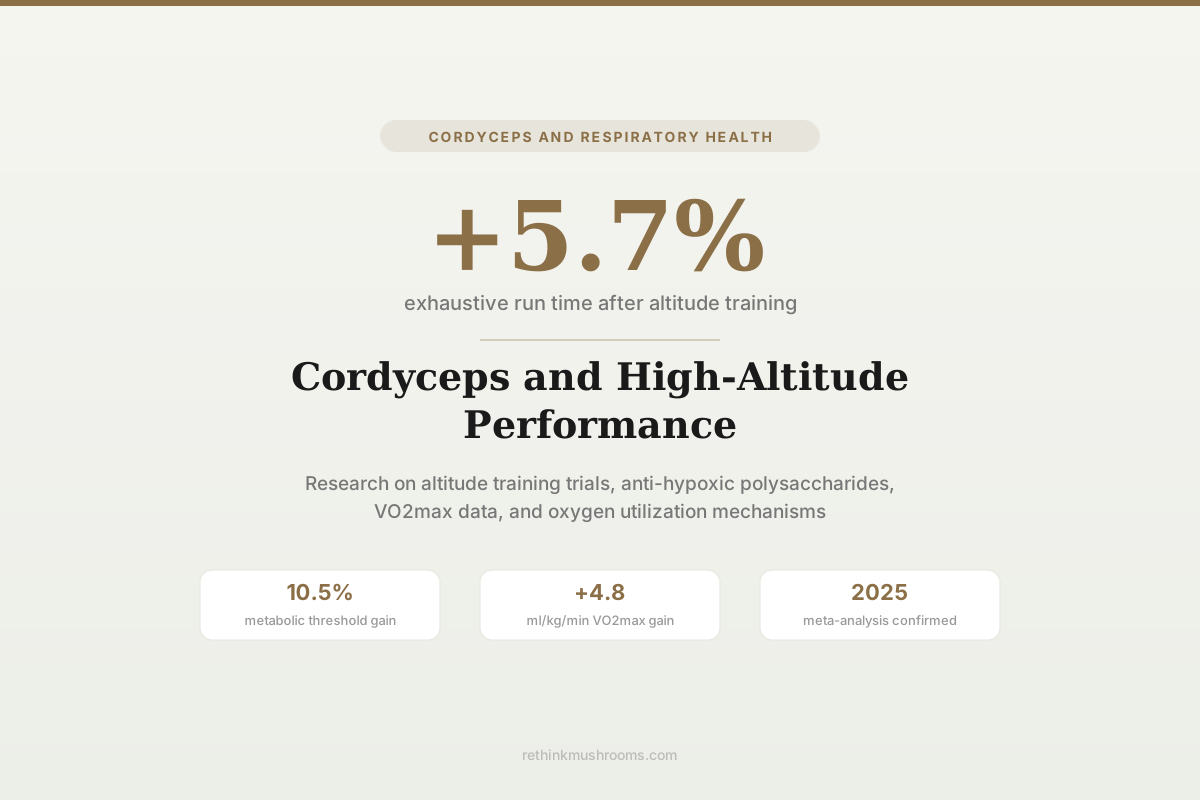
+5.7% exhaustive run time
Athletes supplementing with a Cordyceps sinensis and Rhodiola crenulata blend during two weeks of altitude training at 2,200 meters ran 5.7% longer to exhaustion compared to 2.2% in placebo.
Chen et al., High Altitude Medicine & Biology, 2014
10.5% threshold gain
metabolic threshold in Cs-4 trial
3,500-5,000m native range
Tibetan Plateau habitat
2025 meta-analysis
confirmed VO2peak and VT gains
Chen et al., High Altitude Medicine & Biology, 2014
 View as image ↗
Cordyceps sinensis grows wild on the Tibetan Plateau at elevations between 3,500 and 5,000 meters, parasitizing ghost moth larvae beneath alpine grasslands. Tibetan and Chinese herders have used it for centuries to sustain energy at altitude, and that traditional use is now the subject of formal exercise physiology research. The evidence base spans altitude training trials, laboratory exercise tests, anti-hypoxic polysaccharide studies, and one 2025 meta-analysis pooling data across multiple human trials. For the related question of how cordyceps affects oxygen transport at the cellular level, see Cordyceps and oxygen utilization at high altitude. For cordyceps and respiratory disease, see Cordyceps and COPD: can it improve breathing.
Key Takeaways
- Chen et al. (2014) found that athletes taking Cordyceps sinensis plus Rhodiola crenulata during altitude training at 2,200 meters increased exhaustive run time by 5.7% versus 2.2% for placebo
- Hirsch et al. (2017) reported that three weeks of Cordyceps militaris supplementation at 4 g/day increased VO2max by 4.8 ml/kg/min and time to exhaustion by 69.8 seconds in healthy adults
- Chen et al. (2010) demonstrated a 10.5% increase in metabolic threshold and 8.5% increase in ventilatory threshold after 12 weeks of Cs-4 supplementation in adults aged 50 to 75
- A 2025 meta-analysis by Shu et al. confirmed cordyceps supplementation at 2 to 3 g/day improved endurance performance (p = 0.05), ventilatory threshold (p = 0.03), and VO2peak (p = 0.04)
- Dong et al. (2015) identified a purified Cordyceps militaris polysaccharide (CMN1) that matched the anti-hypoxic effect of rhodiola oral liquid in three hypoxia models
- Parcell et al. (2004) found no improvement in VO2peak, ventilatory threshold, or time trial performance in trained cyclists after five weeks of 3 g/day Cs-4 supplementation
The Altitude Training Trial: Cordyceps Plus Rhodiola at 2,200 Meters
The most direct test of cordyceps at altitude comes from Chen et al. (2014), who studied eighteen male long-distance track athletes during a two-week training camp at 2,200 meters elevation. Nine athletes received a daily combination of 1,400 mg Rhodiola crenulata plus 600 mg Cordyceps sinensis; nine received placebo.[1]
After the altitude camp, the supplement group increased their exhaustive run time by 5.7%, compared to 2.2% in the placebo group. The difference was statistically significant. The study also tracked autonomic nervous system activity and found that the supplement group preserved parasympathetic tone better during altitude training: a 41% decline in parasympathetic activity versus 51% in placebo.
Both groups showed similar increases in red blood cells, hematocrit, and hemoglobin, the expected hematological response to altitude exposure. But erythropoietin (EPO) levels remained 48% higher in the placebo group at the end of the training camp, suggesting the supplement group may have adapted to altitude faster and no longer needed the same EPO stimulus.
The limitation is design: this was a combined Rhodiola-Cordyceps supplement, making it impossible to attribute effects to cordyceps alone. Rhodiola crenulata is itself a well-studied adaptogen with independent altitude-protective properties, so the relative contribution of each ingredient is unknown. The sample was small (nine per group), the training period was short (two weeks), and the altitude was moderate at 2,200 meters. Whether cordyceps by itself produces the same benefit at higher altitudes, where oxygen partial pressure drops below 50% of sea-level values, remains untested. The study also used competitive athletes, making results difficult to generalize to recreational hikers or trekkers at altitude.
VO2max and Ventilatory Threshold: Human Exercise Trials
Three human trials have measured cordyceps effects on aerobic capacity markers, with results that split along training status and supplementation duration.
Hirsch et al. (2017) conducted a randomized, double-blind, placebo-controlled trial with twenty-eight participants consuming either 4 g/day of a Cordyceps militaris mushroom blend or placebo. After one week, no significant differences emerged in VO2max, ventilatory threshold, or time to exhaustion. After three weeks, the supplement group's VO2max increased by 4.8 ml/kg/min while placebo gained only 0.9 ml/kg/min (p = 0.042). Time to exhaustion improved by 69.8 seconds in the supplement group after three weeks, with additional gains in ventilatory threshold (+0.7 L/min).[2]
Chen et al. (2010) tested Cs-4 (a cultivated Cordyceps sinensis strain) in twenty healthy adults aged 50 to 75, giving them 999 mg/day for twelve weeks. The metabolic threshold, the point at which lactate starts accumulating, increased by 10.5% (from 0.83 to 0.93 L/min). The ventilatory threshold increased by 8.5% (from 1.25 to 1.36 L/min). Neither group showed changes in VO2max itself.[3]
A 2025 systematic review and meta-analysis by Shu et al. pooled data from multiple cordyceps exercise trials. The analysis found that cordyceps supplementation at 2 to 3 g/day produced statistically significant improvements in endurance performance (p = 0.05), ventilatory threshold (p = 0.03), and VO2peak (p = 0.04). The review noted that benefits appeared more consistently in runners than in cyclists, and that commercially cultivated cordyceps preparations showed weaker effects than wild or higher-quality cultivated products.[4]
These threshold shifts, rather than peak oxygen consumption changes, are the more consistent finding across trials. The distinction matters for altitude performance, where working efficiently below the anaerobic threshold determines endurance capacity. At altitude, the body's ability to sustain aerobic metabolism at lower oxygen availability becomes the limiting factor, making threshold improvements potentially more relevant than VO2max gains.
The Shu et al. meta-analysis also raised the question of supplement quality. Wild Ophiocordyceps sinensis contains a broader spectrum of bioactive compounds than commercially cultivated Cordyceps militaris, and the two species differ in their cordycepin, polysaccharide, and adenosine content. Some negative results in the literature may reflect product variability rather than biological inefficacy.
Anti-Hypoxic Polysaccharides: Direct Oxygen Deprivation Research
Beyond exercise performance, researchers have tested whether cordyceps compounds protect cells and organisms against hypoxia directly, the type of oxygen deprivation that occurs at high altitude.
Dong et al. (2015) purified polysaccharides from Cordyceps militaris fruiting bodies, isolating a fraction called CMN1 with a molecular weight of 37,842 Da. The polysaccharide contained L-rhamnose, L-arabinose, D-mannose, and D-galactose in its monosaccharide composition. The team tested CMN1 in three hypoxia models: a sodium nitrite toxicosis test, an acute cerebral ischemia/hypoxia test, and a normobaric hypoxia test. At a dose of 0.5 g/kg, CMN1 showed anti-hypoxic effects comparable to rhodiola oral liquid, an established adaptogen used for altitude acclimatization.[5]
This study provides a mechanistic bridge between traditional Tibetan use and laboratory evidence: a specific, purifiable component of cordyceps can protect against oxygen deprivation in controlled models. The backbone structure of CMN1 comprised (1-2) and (1-3) linkages with branched (1-6) and (1-4) linkages, giving it structural specificity that could be reproduced synthetically or standardized in extracts.
The limitation is that these were animal and in vitro models, not human altitude studies. Whether oral consumption of cordyceps delivers enough CMN1 to the bloodstream to replicate these effects at altitude has not been tested. The dose used (0.5 g/kg in mice) would translate to an impractically large human dose if scaled linearly, though allometric scaling typically reduces the required human-equivalent dose. For broader lung health effects of cordyceps, including asthma research, see Cordyceps and asthma: anti-inflammatory airway effects. For an overview of all cordyceps respiratory research, see Cordyceps for lung health: what the research shows.
The ATP and Mitochondrial Connection
High-altitude performance depends on how efficiently muscles produce energy under reduced oxygen availability. Two lines of cordyceps research converge on mitochondrial function and ATP production.
Song et al. (2015) administered Cordyceps militaris fruit body extract to mice for two weeks, then measured performance across three fatigue tests: rotating rod, forced swimming, and forced running. The extract delayed fatigue onset in all three tests. Biochemical analysis revealed increased ATP levels and elevated antioxidant enzyme activity (SOD, CAT, GPx), alongside reduced lactic acid, lactate dehydrogenase, malondialdehyde, and reactive oxygen species. The team identified AMPK activation and AKT/mTOR pathway modulation as the primary signaling mechanisms.[6]
Choi et al. (2020) investigated Cordyceps militaris ethyl acetate extract in mice using grip strength tests over multiple weeks. The extract slightly increased grip strength, comparable to red ginseng. The key finding was that improvements correlated with biomarkers of ATP generation rather than markers of reduced muscle fatigue. The authors concluded that cordyceps improves exercise capacity by enhancing energy production, not by buffering fatigue byproducts.[7]
Li et al. (2010) provided the mitochondrial evidence. Polysaccharides from cultivated Cordyceps militaris fruiting bodies inhibited mitochondrial swelling and injury induced by Fe2+-L-Cysteine in a concentration-dependent manner. In an aging mouse model, the polysaccharides increased activities of catalase, superoxide dismutase, glutathione peroxidase, and anti-hydroxyl radical capacity in liver tissue. The conclusion: cordyceps polysaccharides protect mitochondria by scavenging reactive oxygen species and preventing oxidative damage.[8]
This ATP-mitochondrial pathway has clear relevance to altitude: when oxygen is scarce, mitochondrial efficiency becomes the bottleneck for sustained performance. For a deeper look at the ATP mechanism, see Cordyceps and ATP: how it boosts cellular energy.
When Cordyceps Did Not Work: The Negative Evidence
The evidence is not uniformly positive. Parcell et al. (2004) tested CordyMax Cs-4 at 3 g/day for five weeks in twenty-two endurance-trained male cyclists. VO2peak was 59.9 ml/kg/min in the placebo group and 59.1 in the treatment group before supplementation, and neither value changed after five weeks. Ventilatory threshold, measured at 72% of VO2peak, did not shift. Time trial performance showed no difference between groups.[9]
This null result carries weight because the study used adequate dosing (3 g/day), a meaningful duration (five weeks), and objective performance measures. The most likely explanation is a ceiling effect: athletes already training at high aerobic capacity may have less room for improvement from a nutritional supplement than sedentary or moderately trained individuals. The 2025 Shu et al. meta-analysis reached a similar conclusion, noting that runners showed more consistent benefits than cyclists using commercially cultivated preparations.
The broader pattern across exercise studies: benefits appear in recreationally active adults, older adults, and altitude-training athletes, but not in elite endurance athletes already at peak aerobic capacity. Supplementation duration also matters. One-week protocols consistently show no effect; three-week and twelve-week protocols show measurable gains. For considerations on supplementation timing, see Best time to take cordyceps: morning, pre-workout, or evening.
Cordycepin: The Active Compound and Its Pharmacokinetic Challenge
Cordycepin (3'-deoxyadenosine) is the most studied bioactive compound in cordyceps, and its pharmacokinetics create a challenge for sustained athletic benefit. Tsai et al. (2010) used liquid chromatography coupled with microdialysis sampling to track cordycepin and adenosine in rat blood and liver after administration. Both compounds declined rapidly, with blood levels dropping within thirty minutes of administration. Cordycepin was metabolized through adenosine deaminase, the same enzyme that degrades adenosine. When the researchers blocked this enzyme with EHNA (a potent adenosine deaminase inhibitor), cordycepin levels persisted longer.[10]
This rapid clearance means that a single dose of cordyceps likely provides only a brief window of elevated cordycepin levels. The clinical implications: chronic daily supplementation (as used in the positive trials) may maintain a baseline effect through repeated dosing, while acute pre-exercise supplementation may be insufficient. This pharmacokinetic reality aligns with the trial data, where one-week protocols failed but three-week and twelve-week protocols succeeded.
Tibetan Tradition and the 1993 Chinese Track Records
The traditional context for cordyceps at altitude is Tibetan and Nepali herders who consumed the fungus during seasonal migrations across high-altitude grasslands. Ophiocordyceps sinensis (the wild form) was valued as a tonic for stamina at elevations where oxygen partial pressure drops to roughly 60% of sea-level values. Traditional use was not formalized in controlled conditions, but the geographic overlap between the fungus's native range (3,500 to 5,000 meters) and the populations who used it creates a consistent ethnobotanical record.
The modern performance narrative gained traction in 1993, when Chinese female runners broke world records in the 1,500m, 3,000m, and 10,000m events at the Chinese National Games. Their coach attributed the results partly to cordyceps supplementation. No controlled study verified that claim, and subsequent doping investigations raised questions about the team's broader supplement regimen. The 1993 records remain scientifically ambiguous: a famous anecdote, not evidence.
The research since then has moved toward isolating what cordyceps actually does in controlled settings. The altitude training trial by Chen et al. represents the closest modern test of the traditional use case: athletes training at moderate altitude, taking cordyceps daily, and showing measurable performance gains. The gap between traditional use at 4,000+ meters and controlled research at 2,200 meters remains largely unfilled.
The Bottom Line
The research on cordyceps and high-altitude performance includes one altitude training trial showing a 5.7% improvement in exhaustive run time, multiple exercise trials demonstrating gains in ventilatory and metabolic thresholds, and laboratory evidence that cordyceps polysaccharides protect against hypoxia in animal models. A 2025 meta-analysis confirms that 2 to 3 g/day of cordyceps supplementation improves endurance markers in moderately trained individuals. The evidence does not support benefits in elite athletes already at peak aerobic capacity, and no study has tested cordyceps at the extreme altitudes (above 4,000 meters) where traditional Tibetan use originated.
Frequently Asked Questions
Sources & References
- 1RTHM-00313·Chen, Chung-Yu et al. (2014). “Rhodiola crenulata- and Cordyceps sinensis-based supplement boosts aerobic exercise performance after short-term high altitude training..” High altitude medicine & biology.Study breakdown →PubMed →↩
- 2RTHM-00473·Hirsch, Katie R et al. (2017). “Cordyceps militaris Improves Tolerance to High-Intensity Exercise After Acute and Chronic Supplementation..” Journal of dietary supplements.Study breakdown →PubMed →↩
- 3RTHM-00176·Chen, Steve et al. (2010). “Effect of Cs-4 (Cordyceps sinensis) on exercise performance in healthy older subjects: a double-blind, placebo-controlled trial..” Journal of alternative and complementary medicine (New York.Study breakdown →PubMed →↩
- 4RTHM-00951·Shu, Meng-Yuan et al. (2025). “Effects of fungal supplementation on endurance, immune function, and hematological profiles in adult athletes: a systematic review and meta-analysis..” Frontiers in nutrition.Study breakdown →PubMed →↩
- 5RTHM-00369·Dong, Yuan et al. (2015). “Purification of polysaccharides from Cordyceps militaris and their anti‑hypoxic effect..” Molecular medicine reports.Study breakdown →PubMed →↩
- 6RTHM-00401·Song, Jingjing et al. (2015). “Studies on the Antifatigue Activities of Cordyceps militaris Fruit Body Extract in Mouse Model..” Evidence-based complementary and alternative medicine : eCAM.Study breakdown →PubMed →↩
- 7RTHM-00613·Choi, Eunhyun et al. (2020). “Beneficial Effect of Cordyceps militaris on Exercise Performance via Promoting Cellular Energy Production..” Mycobiology.Study breakdown →PubMed →↩
- 8RTHM-00191·Li, Xing-Tai et al. (2010). “Protective effects on mitochondria and anti-aging activity of polysaccharides from cultivated fruiting bodies of Cordyceps militaris..” The American journal of Chinese medicine.Study breakdown →PubMed →↩
- 9RTHM-00075·Parcell, Allen C et al. (2004). “Cordyceps Sinensis (CordyMax Cs-4) supplementation does not improve endurance exercise performance..” International journal of sport nutrition and exercise metabolism.Study breakdown →PubMed →↩
- 10RTHM-00199·Tsai, Yung-Jen et al. (2010). “Pharmacokinetics of adenosine and cordycepin, a bioactive constituent of Cordyceps sinensis in rat..” Journal of agricultural and food chemistry.Study breakdown →PubMed →↩