Cordyceps Respiratory Health
1,238 patients
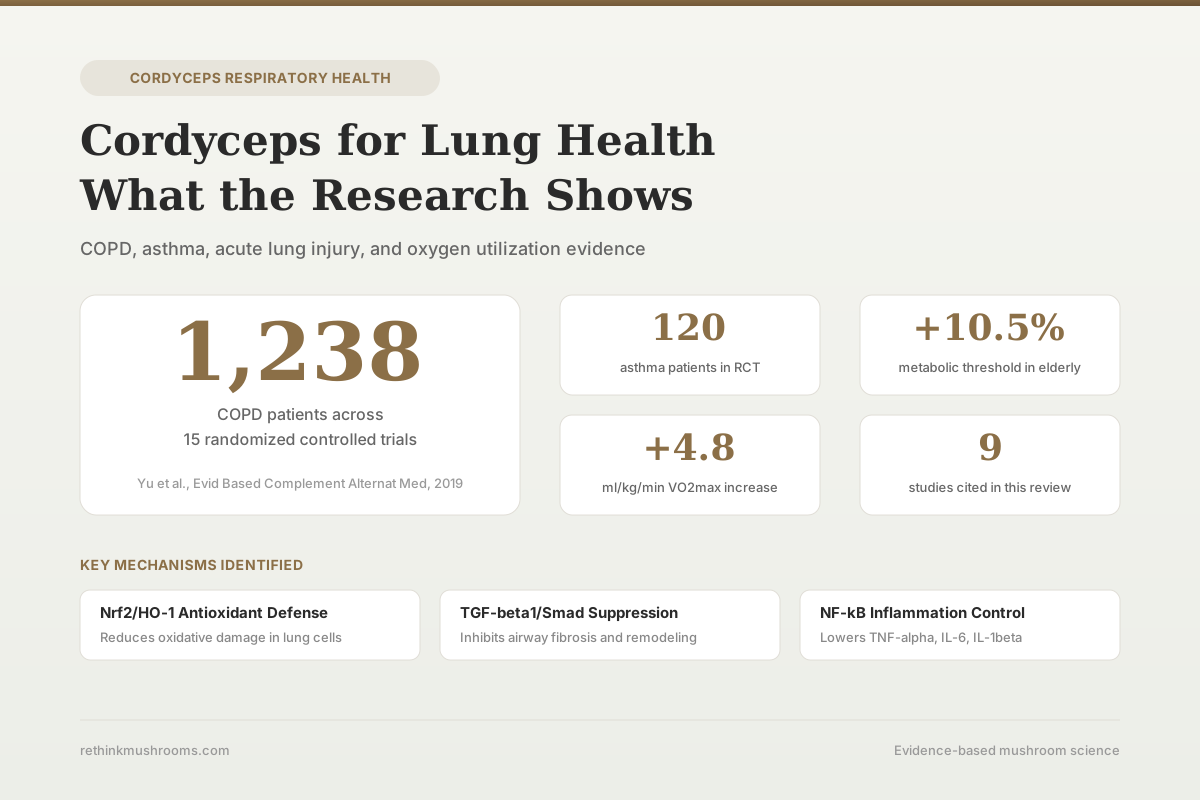
A 2019 systematic review analyzed 15 randomized controlled trials enrolling 1,238 COPD patients treated with Cordyceps sinensis. Both standalone preparations and combination formulas showed potential benefits in lung function and exercise endurance.
Yu et al., Evid Based Complement Alternat Med, 2019
15 RCTs
in COPD meta-analysis
85%
effective rate in chronic bronchitis trial
+10.5%
metabolic threshold increase in elderly
Yu et al., Evid Based Complement Alternat Med, 2019
 View as image ↗
Cordyceps has been used in traditional Chinese medicine as a lung tonic for centuries, prescribed for chronic cough, phlegm, and respiratory weakness. Modern research has put this tradition under the microscope with clinical trials in COPD patients, a randomized controlled trial in asthma, and preclinical studies on airway remodeling, acute lung injury, and hypoxia tolerance. The evidence spans both Cordyceps sinensis (the wild Himalayan species) and Cordyceps militaris (the cultivated alternative). A 2019 meta-analysis pooling 15 COPD trials with 1,238 participants represents the single largest body of respiratory evidence, though the studies were conducted exclusively in China and none used placebo controls. This article covers every lung-related endpoint cordyceps has been tested on and the specific molecular pathways identified so far. For the more focused analyses, see Cordyceps and COPD and Cordyceps and Asthma.
Key Takeaways
- A 2019 meta-analysis of 15 RCTs (1,238 COPD patients) found cordyceps preparations improved lung function, exercise endurance, and quality of life with no serious adverse events reported (Yu et al., 2019)
- In a 120-patient RCT, 3 months of Cordyceps sinensis alongside inhaled corticosteroids improved asthma quality-of-life scores, lung function, and reduced serum IgE and IL-4 compared to controls (Wang et al., 2016)
- Cordyceps sinensis reduced airway wall thickening, collagen deposition, and smooth muscle hypertrophy in COPD rats by suppressing TGF-beta1/Smad signaling (Yang et al., 2018)
- C. sinensis extract maintained antioxidant status and increased hypoxia tolerance in human lung epithelial cells through Nrf2 activation and HO-1 induction (Singh et al., 2013)
- C. militaris extract inhibited immune cell infiltration, tissue fibrosis, and mucus overproduction in a mouse model of acute lung injury (Seong et al., 2025)
- After 3 weeks of C. militaris supplementation, VO2max increased by 4.8 ml/kg/min compared to placebo in healthy adults (Hirsch et al., 2017)
How Cordyceps Acts on the Lungs: Proposed Mechanisms
Three molecular pathways recur across the respiratory research. Each has been identified in lung tissue or lung-derived cell lines, not extrapolated from other organ systems.
Nrf2/HO-1 antioxidant defense. Singh et al. (2013) exposed A549 human lung epithelial cells to hypoxic conditions and found that aqueous C. sinensis extract activated Nrf2 (nuclear factor erythroid-derived 2-like 2), which upregulated heme oxygenase-1 (HO-1) and metallothionein. This attenuated hypoxia-induced reactive oxygen species (ROS), lipid peroxidation, and protein oxidation. The extract simultaneously lowered NF-kB and TNF-alpha levels. Under normal oxygen conditions, the extract had no effect on these transcription factors, suggesting the response is specific to oxidative stress rather than a blanket suppressive effect.[1]
TGF-beta1/Smad pathway and airway remodeling. Yang et al. (2018) administered C. sinensis to COPD rats at three doses (2.5, 5, and 7.5 g/kg/day) for 12 weeks and measured structural changes in airway tissue. The treatment reduced airway wall thickening, collagen deposition, smooth muscle hypertrophy, and epithelial hyperplasia. The mechanism: cordyceps lowered TGF-beta1 expression and its receptor levels, reduced phosphorylated Smad2 and Smad3, and increased the inhibitory Smad7. It also reduced TNF-alpha, IL-8, and TGF-beta1 in bronchoalveolar lavage fluid.[2] For more on the COPD-specific findings, see Cordyceps and COPD: Can It Improve Breathing?.
Metabolic reprogramming under oxidative stress. Liu et al. (2025) used metabolomics to identify how C. sinensis affected COPD rats at the metabolite level. The treatment modulated glycerophospholipid metabolism, glutathione metabolism, and tryptophan metabolism. Oxidative stress markers (MDA, GSSG) decreased while antioxidant markers (SOD, GSH) increased. Inflammatory cytokines TNF-alpha, IL-8, and MMP-9 were all suppressed, with corresponding improvements in lung tissue pathology.[3]
These pathways overlap with the anti-inflammatory mechanisms identified in cordyceps inflammation research. The respiratory-specific contribution is the demonstration of these effects in lung tissue cells and airway fluid rather than systemic markers alone.
COPD: The Largest Body of Human Evidence
Chronic obstructive pulmonary disease is where cordyceps respiratory research is most concentrated. The most comprehensive synthesis is the Yu et al. (2019) systematic review and meta-analysis, which identified 15 randomized controlled trials enrolling 1,238 participants with stable COPD (GOLD stages 2-3).[4]
The meta-analysis included both standalone C. sinensis preparations (Bailing Capsule, Jinshuibao Capsule, and other fermented mycelium products) and combination formulas containing cordyceps alongside other Chinese herbs. Key findings across the pooled data:
- Lung function parameters (FEV1, FEV1/FVC ratio) improved in cordyceps groups versus controls
- Exercise endurance, measured by 6-minute walk distance, increased
- Quality-of-life scores improved based on validated respiratory questionnaires
- Symptom scores (cough, sputum, dyspnea) showed reductions
- No serious adverse events were reported across any of the 15 trials
The critical limitation: no trial in the meta-analysis used a placebo control. All compared cordyceps (added to standard COPD treatment) against standard treatment alone. All 15 trials were conducted in China, and the reviewers rated the overall methodological quality as low. The absence of sham controls and blinding means the measured improvements cannot be separated from placebo effects or observer bias.
The animal model data from Yang et al. (2018) and Liu et al. (2025) provide mechanistic plausibility for the clinical observations but do not substitute for the missing placebo-controlled human data.[2][3]
Asthma: A Single RCT With 120 Patients
Wang et al. (2016) conducted the only randomized controlled trial testing cordyceps in asthma patients. The study enrolled 120 adults with moderate-to-severe persistent asthma and randomized them to receive Corbin Capsule (a C. sinensis preparation) for 3 months plus standard inhaled corticosteroids and as-needed beta-agonists, or standard treatment alone.[5]
The cordyceps group showed:
- Significant improvement in Juniper's Asthma Quality of Life Questionnaire (AQLQ) scores
- Improved lung function parameters compared to the control group
- Decreased serum IgE, ICAM-1, IL-4, and MMP-9 (inflammatory markers)
- Increased serum IgG levels
The inflammatory marker changes suggest cordyceps may modulate the Th2-driven immune response characteristic of allergic asthma, reducing IgE production and shifting cytokine balance. The study is registered (ChiCTR-IPC-16008730), which adds transparency, but it shares the common limitation of being unblinded with no placebo control. See the detailed analysis in Cordyceps and Asthma: Anti-Inflammatory Airway Effects.
Acute Lung Injury: Animal Model Evidence
Seong et al. (2025) tested Cordyceps militaris ARA301 extract (CME) against lipopolysaccharide (LPS)-induced acute lung injury in mice. Mice received oral CME for three consecutive days before intranasal LPS challenge from Klebsiella pneumoniae.[6]
The extract inhibited immune cell infiltration into lung tissue, reduced tissue fibrosis, and prevented excessive mucus deposition. Specifically, CME suppressed MUC5AC (a mucus-producing protein), iNOS, and COX-2 expression in lung tissue. In bronchoalveolar lavage fluid, the pro-inflammatory cytokines IL-1beta, IL-6, TNF-alpha, and the chemokine CXCL1 were all reduced. Total immune cells, neutrophils, monocytes, and eosinophils in the lavage fluid decreased.
In vitro work with RAW 264.7 macrophages confirmed the mechanism: CME inhibited phosphorylation of NF-kB p65, IkBalpha, and IKKalpha, placing the anti-inflammatory effect upstream at the NF-kB signaling cascade.
This is a prevention model (pre-treatment before injury), not a treatment model. Whether cordyceps can rescue established acute lung injury remains untested. The study also used a standardized extract (ARA301) that may not reflect commercial supplements.
Hypoxia Tolerance and Oxygen Utilization
The traditional use of cordyceps among Tibetan and Nepalese populations at high altitude has prompted research into oxygen-related physiology. Singh et al. (2013) demonstrated that C. sinensis extract increased hypoxia tolerance in A549 human lung epithelial cells by activating HIF-1 (hypoxia-inducible factor-1) and its downstream targets: erythropoietin, VEGF (vascular endothelial growth factor), and GLUT-1 (glucose transporter-1). These are the canonical cellular responses to low oxygen, and the cordyceps extract appeared to amplify them while simultaneously dampening the oxidative damage that hypoxia causes.[1]
The exercise performance data adds a functional dimension to these cellular findings. Chen et al. (2010) conducted a double-blind, placebo-controlled trial in 20 healthy elderly adults (ages 50-75) taking Cs-4 (C. sinensis) at 999 mg/day for 12 weeks. The metabolic threshold, the exercise intensity above which lactate accumulates, increased by 10.5% (from 0.83 to 0.93 L/min, p < 0.02). Ventilatory threshold increased by 8.5%. VO2max did not change in either group.[7]
Hirsch et al. (2017) tested a mushroom blend containing C. militaris (4 g/day) in 28 young healthy adults using a double-blind, placebo-controlled design. After 3 weeks, VO2max improved by 4.8 ml/kg/min in the cordyceps group versus 0.9 ml/kg/min in placebo (p = 0.042). Time to exhaustion increased by 69.8 seconds after 3 weeks.[8]
The distinction between improved submaximal efficiency (Chen 2010) and improved maximal capacity (Hirsch 2017) may reflect different supplementation durations, species, or population differences. For the full analysis of exercise data, see Cordyceps and Exercise Performance. The connection between high-altitude performance and oxygen utilization is explored in dedicated articles.
Lung Cancer: Preclinical Pathways
Lu et al. (2024) used a combined transcriptomics and proteomics approach to study how C. sinensis affected non-small cell lung cancer (NSCLC) in a murine model. The treatment suppressed tumor fluorescence values, improved lung tissue pathology, and ameliorated inflammatory cytokines (TNF-alpha, IL-6, IL-10) and oxidative stress indicators (SOD, MDA, glutathione peroxidase).[9]
The multi-omics analysis identified two primary mechanisms. Transcriptomics pointed to T cell differentiation and activation pathways. Proteomics identified the MAPK pathway as the primary route through which cordyceps recruited immune cells and suppressed tumor cell proliferation. Experimental validation confirmed that C. sinensis decreased VEGF and Ki67 expression (markers of angiogenesis and proliferation), downregulated RhoA, Raf-1, and c-fos (involved in cell migration), increased hematopoietic factors (EPO, GM-CSF), and improved percentages of NK cells, dendritic cells, and CD4+/CD8+ T lymphocytes.
This is a preclinical study with no human lung cancer data. The immune-mediated mechanism aligns with what has been observed in other cancer models studied with cordyceps. See Cordyceps and Cancer: What the Research Shows for the broader oncology evidence.
C. sinensis vs. C. militaris: Which Has More Lung Data?
Most clinical lung research uses C. sinensis preparations, specifically fermented mycelium products like Bailing Capsule, Jinshuibao Capsule, and Cs-4. All 15 COPD trials in the Yu et al. (2019) meta-analysis and the Wang et al. (2016) asthma trial used C. sinensis-based products.
C. militaris appears in the preclinical lung literature. The Seong et al. (2025) acute lung injury study and the Hirsch et al. (2017) exercise performance trial both used C. militaris. The two species share some bioactive compounds, most prominently cordycepin and adenosine, but differ in their polysaccharide and triterpenoid profiles. Whether these compositional differences translate to different respiratory effects is not established by direct comparison studies. For a deeper look at the bioactive compounds driving these effects, see Cordyceps Bioactive Compounds: Cordycepin, Adenosine, and Polysaccharides.
What the Evidence Does Not Establish
The respiratory evidence for cordyceps has consistent gaps across all conditions studied:
No placebo-controlled COPD trial exists. The entire COPD meta-analysis (Yu et al., 2019) compares cordyceps-plus-standard-therapy to standard-therapy-alone. Without blinding or placebo, treatment effects cannot be separated from expectation effects.
Asthma evidence rests on a single unblinded trial. The Wang et al. (2016) study is well-designed by open-label standards but cannot rule out observer bias or placebo response in self-reported quality-of-life measures.
Acute lung injury and lung cancer data are entirely preclinical. Mouse and cell models demonstrate mechanisms but not clinical efficacy.
Exercise studies use small samples. The Chen (2010) trial enrolled 20 participants, and the Hirsch (2017) trial enrolled 28. Neither is powered for definitive respiratory conclusions.
All COPD clinical trials come from Chinese research centers. Geographic and methodological diversity is lacking.
These are not reasons to dismiss the evidence. They are reasons to read it precisely for what it demonstrates: plausible biological mechanisms, consistent trends across animal models, and suggestive (not confirmatory) human data.
The Bottom Line
Cordyceps has accumulated more respiratory research than most medicinal mushrooms, spanning COPD (15 clinical trials, 1,238 patients), asthma (one 120-patient RCT), acute lung injury (preclinical), hypoxia tolerance (cell and exercise studies), and lung cancer (preclinical multi-omics). The mechanisms converge on Nrf2-driven antioxidant defense, TGF-beta1/Smad-mediated airway remodeling suppression, and NF-kB-mediated inflammation reduction. The clinical evidence consistently trends positive but is limited by absent placebo controls, small sample sizes, and geographic concentration in Chinese trial centers.
Frequently Asked Questions
Sources & References
- 1RTHM-00305·Singh, Mrinalini et al. (2013). “Cordyceps sinensis increases hypoxia tolerance by inducing heme oxygenase-1 and metallothionein via Nrf2 activation in human lung epithelial cells..” BioMed research international.Study breakdown →PubMed →↩
- 2RTHM-00537·Yang, Lei et al. (2018). “Cordyceps sinensis inhibits airway remodeling in rats with chronic obstructive pulmonary disease..” Experimental and therapeutic medicine.Study breakdown →PubMed →↩
- 3RTHM-00939·Liu, Ying-Ying et al. (2025). “Therapeutic potential of Cordyceps sinensis targeting oxidative stress and inflammatory response in the treatment of COPD rats: insights from metabolomics analysis..” Journal of Asian natural products research.Study breakdown →PubMed →↩
- 4RTHM-00602·Yu, Xuhua et al. (2019). “Effectiveness and Safety of Oral Cordyceps sinensis on Stable COPD of GOLD Stages 2-3: Systematic Review and Meta-Analysis..” Evidence-based complementary and alternative medicine : eCAM.Study breakdown →PubMed →↩
- 5RTHM-00456·Wang, Ningqun et al. (2016). “Herbal Medicine Cordyceps sinensis Improves Health-Related Quality of Life in Moderate-to-Severe Asthma..” Evidence-based complementary and alternative medicine : eCAM.Study breakdown →PubMed →↩
- 6RTHM-02176·Seong, Hye Kang et al. (2025). “The Inhibitory Effects of Cordyceps militaris ARA301 Extract on Lipopolysaccharide-Induced Lung Injury in vivo..” Journal of microbiology and biotechnology.Study breakdown →PubMed →↩
- 7RTHM-00176·Chen, Steve et al. (2010). “Effect of Cs-4 (Cordyceps sinensis) on exercise performance in healthy older subjects: a double-blind, placebo-controlled trial..” Journal of alternative and complementary medicine (New York.Study breakdown →PubMed →↩
- 8RTHM-00473·Hirsch, Katie R et al. (2017). “Cordyceps militaris Improves Tolerance to High-Intensity Exercise After Acute and Chronic Supplementation..” Journal of dietary supplements.Study breakdown →PubMed →↩
- 9RTHM-01939·Lu, Tianming et al. (2024). “Cordyceps sinensis relieves non-small cell lung cancer by inhibiting the MAPK pathway..” Chinese medicine.Study breakdown →PubMed →↩