Cordyceps & Respiratory Health
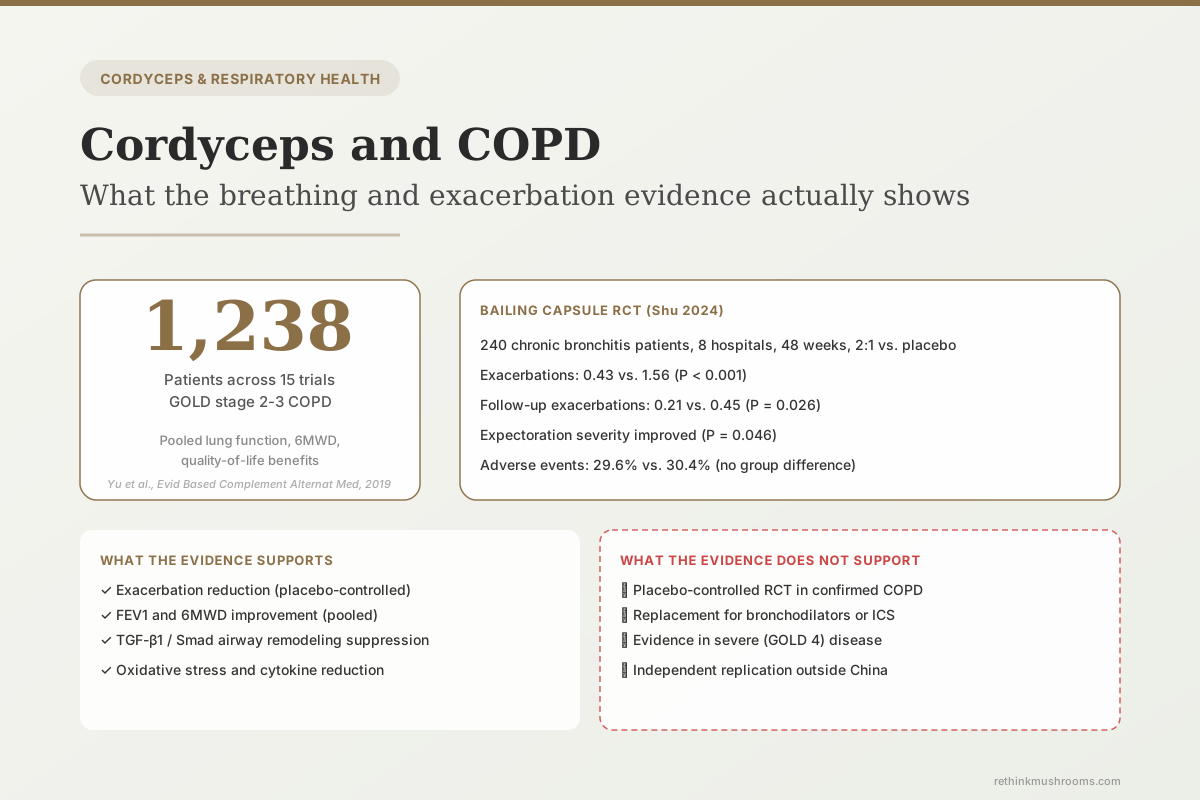
1,238 patients in 15 trials
A 2019 systematic review and meta-analysis pooled 15 randomized trials of Cordyceps sinensis in 1,238 patients with stable GOLD stage 2-3 COPD, reporting benefits in lung function, exercise endurance, and quality of life, but with no placebo-controlled or high-quality trials included.
Yu et al., Evidence-Based Complementary and Alternative Medicine, 2019
AECB 0.43 vs. 1.56
Bailing capsule vs. placebo acute exacerbations in chronic bronchitis (Shu 2024)
TGF-β1 / Smad
airway remodeling pathway suppressed in rat COPD (Yang 2018)
GOLD 2-3 only
no meta-analysis evidence in severe or end-stage COPD
Yu et al., Evidence-Based Complementary and Alternative Medicine, 2019
 View as image ↗
Cordyceps sinensis is one of the most widely used complementary treatments for chronic obstructive pulmonary disease in China, where it is sold under preparation names like Bailing capsule and JinShuiBao. The research question is not whether patients take it, but whether the evidence supports the claim that it improves breathing, lung function, or exacerbation risk. A 2019 meta-analysis of 15 randomized trials in 1,238 stable GOLD stage 2-3 COPD patients reported pooled benefits across lung function, exercise endurance, and quality of life, while explicitly noting that none of the included trials were placebo-controlled or of high methodological quality. A 2024 multicenter randomized double-blind placebo-controlled trial of Bailing capsule in chronic bronchitis reported a large reduction in acute exacerbations. Rat models of cigarette-smoke COPD show Cordyceps sinensis suppressing airway remodeling, inflammatory cytokines, and cellular senescence. For the broader respiratory picture, see cordyceps for lung health: what the research shows and cordyceps and asthma: anti-inflammatory airway effects.
Key Takeaways
- Yu et al. (2019) meta-analyzed 15 randomized trials of Cordyceps sinensis in 1,238 stable GOLD stage 2-3 COPD patients and reported pooled benefits in lung function, exercise endurance, quality of life, and symptoms, with no serious adverse events and no high-quality placebo-controlled trials in the pool (Evidence-Based Complementary and Alternative Medicine)
- Shu et al. (2024) randomized 240 patients with chronic bronchitis across eight Chinese hospitals 2:1 to Bailing capsule (Hirsutella sinensis, Cs-C-Q80) or placebo for 48 weeks and reported acute exacerbation frequency of 0.43 ± 0.82 versus 1.56 ± 1.34 (P less than 0.001), with adverse event rates of 29.6% versus 30.4% (Frontiers in Pharmacology)
- Yang et al. (2018) tested Cordyceps sinensis 2.5, 5, and 7.5 g/kg/day orally in a rat cigarette-smoke COPD model for 12 weeks and showed reduced airway wall thickening, collagen deposition, smooth muscle hypertrophy, and epithelial hyperplasia, with suppression of TGF-β1, p-Smad2, p-Smad3 and increased Smad7 expression (Experimental and Therapeutic Medicine)
- Liu et al. (2025) used a metabolomics approach in COPD rats and reported that Cordyceps sinensis modulated glycerophospholipid, glutathione, and tryptophan metabolism, decreased MDA and GSSG while increasing SOD and GSH, and reduced TNF-α, IL-8, and MMP-9 (Journal of Asian Natural Products Research)
- Phull et al. (2022) reviewed Cordyceps militaris anti-inflammatory mechanisms and confirmed NF-κB suppression, TNF-α reduction, and cytokine modulation as reproducible effects across inflammatory disease models, providing the mechanistic scaffold for what the COPD studies measure (Microorganisms)
- Chen et al. (2023) identified adenosine deaminase rapid deamination of cordycepin as the primary barrier to clinical translation of cordycepin-specific pharmacology, with bioavailability enhancement strategies as an active research area (Phytotherapy Research)
- Wang et al. (2016) tested a Cordyceps sinensis formulation in 120 moderate-to-severe asthma patients and reported improved lung function (FEV1), symptom control, quality of life, and serum IgE versus placebo over three months, providing the closest parallel human airway disease evidence to the COPD literature (Evidence-Based Complementary and Alternative Medicine)
COPD Pathology the Research Targets
Chronic obstructive pulmonary disease is not a single disease but a constellation of airway and parenchymal changes driven primarily by long-term exposure to cigarette smoke or biomass smoke. The measurable features include persistent airflow limitation (reduced FEV1 and FEV1/FVC ratio), small airway remodeling (airway wall thickening, fibrosis, smooth muscle hypertrophy, goblet cell metaplasia), emphysematous destruction of alveolar walls, chronic neutrophilic and macrophage-driven inflammation, oxidative stress from cigarette smoke constituents, and accelerated cellular senescence in airway epithelial cells.
This is a different pathology from the Th2-driven allergic asthma covered in the cordyceps asthma article. The relevant molecular targets in COPD are TNF-α, IL-8, neutrophil elastase, matrix metalloproteinases (particularly MMP-9), TGF-β1 and the Smad signalling axis that drives fibrotic remodeling, and the oxidative stress system (malondialdehyde, glutathione, superoxide dismutase). A therapy that measurably reduces these markers while improving FEV1 and exacerbation frequency would be intervening at the right targets. The cordyceps COPD literature claims effects on all of these, but the evidence strength varies sharply by marker and by study design.
The Meta-Analysis: Pooled Benefits, Limited Quality
Yu et al. (2019), published in Evidence-Based Complementary and Alternative Medicine, searched nine major electronic databases and included 15 randomized controlled trials totaling 1,238 participants with stable COPD at GOLD stages 2-3.[1] The pooled analysis compared Cordyceps sinensis preparations (both natural and fermented mycelium products) and Cordyceps-containing herbal formulae against conventional Western treatment controls. The authors reported statistically significant improvements in lung function endpoints (FEV1% predicted and FEV1/FVC ratio), six-minute walk distance as a measure of exercise endurance, symptom scores, and health-related quality of life instruments. No serious adverse events were reported across the 15 trials.
The limitations in this meta-analysis are not peripheral. The authors state explicitly that none of the included studies were placebo-controlled, and that methodological quality across the included trials was uniformly low. Almost all trials compared cordyceps plus standard care against standard care alone, which is open-label and subject to substantial performance and reporting bias. Blinding was generally absent. Allocation concealment was rarely described. The trials were conducted in China with heterogeneous cordyceps preparations and dosing. The pooled effect sizes should therefore be read as consistent signals rather than confirmed magnitudes. This is the single most important caveat in the cordyceps COPD literature: the quantity of trials is real, but their methodological rigor does not meet the standard required to confirm clinical efficacy.
The Placebo-Controlled Bailing Capsule Trial
Shu et al. (2024), published in Frontiers in Pharmacology, is the most rigorous cordyceps respiratory trial published to date in any indication.[2] The trial was randomized, double-blind, placebo-controlled, and conducted across eight hospitals in China between May 2019 and December 2020 (registration ChiCTR1900025707). The target population was chronic bronchitis rather than COPD per se, but the two conditions overlap substantially in pathology and many COPD patients meet the chronic bronchitis definition of chronic productive cough. Two hundred forty patients were randomized 2:1 to Bailing capsule (Hirsutella sinensis, Cs-C-Q80, the fermented mycelial product licensed in China as a pharmaceutical-grade cordyceps preparation) or matched placebo at 2.0 g three times daily for 48 weeks. Two hundred thirty-eight patients (159 Bailing, 79 placebo) were included in the primary analysis.
The primary finding was a large reduction in acute exacerbation of chronic bronchitis frequency: 0.43 ± 0.82 events during treatment in the Bailing group versus 1.56 ± 1.34 events in the placebo group (P less than 0.001). This effect persisted during follow-up (0.21 ± 0.64 versus 0.45 ± 0.93; P = 0.026). The severity of expectoration (P = 0.046) and wheezing (P = 0.010) during exacerbations improved in the Bailing group, and overall chronic bronchitis severity at end of treatment was better in the Bailing group (P = 0.035), again with larger differences in expectoration and wheezing specifically. Adverse event rates were essentially identical between groups (29.6% versus 30.4%), mostly infections and gastrointestinal symptoms, with no group difference in serious adverse events.
Shu et al. is important for what it demonstrates and for what it does not. It demonstrates that Bailing capsule, at a defined dose of a specific fermented mycelial preparation, produces a placebo-controlled reduction in exacerbation frequency in chronic bronchitis over nearly a year of treatment. It does not demonstrate that any generic cordyceps supplement does the same, that natural Cordyceps sinensis matches the Hirsutella sinensis fermentation product in effect, or that patients with more advanced COPD (GOLD 3-4) would show the same magnitude of benefit. The finding is strong but preparation-specific.
The Preclinical Foundation: Airway Remodeling
Yang et al. (2018), published in Experimental and Therapeutic Medicine, addressed the mechanistic question of whether Cordyceps sinensis affects the airway remodeling process that underlies persistent airflow limitation in COPD.[3] Rats with cigarette-smoke induced COPD received oral Cordyceps sinensis at 2.5, 5, or 7.5 g/kg/day for 12 weeks. Histopathology showed dose-related reductions in airway wall thickening, subepithelial collagen deposition, smooth muscle hypertrophy, and epithelial hyperplasia. Bronchoalveolar lavage fluid analysis showed reduced inflammatory cell accumulation and reduced TNF-α, IL-8, and TGF-β1.
The molecular finding was the specific signalling interrogation. Western blot of lung tissue showed reduced phosphorylated Smad2 and Smad3, reduced TGF-β1 receptor expression, and increased expression of Smad7, the inhibitory Smad that blocks TGF-β signal transduction. Tissue α-smooth muscle actin and collagen I, the two canonical markers of myofibroblast activation and fibrotic matrix deposition, were both decreased. This is a mechanistically coherent package: the TGF-β1/Smad2-3 pathway is the canonical driver of airway fibrosis in COPD, and Cordyceps sinensis at these doses intervenes at multiple nodes in that pathway.
The translational caveat is substantial. The doses used in the rat model (2.5-7.5 g/kg/day) scale by allometric conversion to human equivalent doses in the range of roughly 400-1,200 mg/kg, which is far above any oral cordyceps supplement dose achievable in humans. The Bailing capsule dose in Shu et al. (2024) works out to 6 g per day total in a 70-kg adult, or roughly 0.086 g/kg, more than an order of magnitude below the lowest rat dose. Whether the airway remodeling effect translates at the lower human exposures is the open question.
The Metabolomics and Oxidative Stress Data
Liu et al. (2025), published in the Journal of Asian Natural Products Research, used an untargeted metabolomics approach to map the lung metabolic changes induced by wild Cordyceps sinensis treatment in a COPD rat model.[4] The metabolomic profiling identified modulation of three metabolic pathways: glycerophospholipid metabolism (relevant to surfactant and membrane integrity), glutathione metabolism (the primary cellular antioxidant defense), and tryptophan metabolism (which connects to kynurenine pathway immunomodulation).
The biochemical parameters were consistent with the metabolomic map. Cordyceps sinensis treatment decreased malondialdehyde (MDA, a lipid peroxidation product) and oxidized glutathione (GSSG), while increasing superoxide dismutase (SOD) and reduced glutathione (GSH). The net effect was a measurable shift in the redox state of lung tissue toward reduced oxidative stress. Inflammatory markers TNF-α, IL-8, and MMP-9 were all reduced. This is mechanistically consistent with Yang et al. (2018) on the inflammatory cytokine side, and it adds the oxidative stress axis that is specifically relevant to smoke-induced COPD pathology.
Phull et al. (2022) placed both of these rodent studies in the broader context of Cordyceps militaris anti-inflammatory pharmacology.[5] The review catalogued NF-κB suppression and TNF-α reduction as reproducible findings across multiple inflammatory disease models. The mechanism is not COPD-specific. Cordyceps modulates a general inflammatory and oxidative stress pathway that happens to be one of the pathways driving COPD progression.
The Cordycepin Bioavailability Constraint
Chen et al. (2023) reviewed the pharmacokinetic barrier that complicates extrapolation from isolated-cordycepin preclinical work to oral cordyceps supplementation.[6] Cordycepin (3'-deoxyadenosine) is rapidly deaminated in vivo by adenosine deaminase to inactive 3'-deoxyinosine. Oral bioavailability of free cordycepin is consequently low. Most parenteral cordycepin studies in cell culture and rodents use doses that cannot be achieved from oral cordyceps products.
The practical implication for COPD is interpretive. The Bailing capsule in Shu et al. (2024) and the whole Cordyceps sinensis preparations in Yu et al. (2019) and Yang et al. (2018) deliver cordycepin within a complex matrix including polysaccharides, adenosine, N6-(2-hydroxyethyl) adenosine, and other nucleoside analogues. The clinical effects observed are therefore whole-preparation effects, not cordycepin-specific effects, and they do not depend on achieving the high plasma cordycepin concentrations used in preclinical mechanistic studies. This is one of the reasons that whole-preparation human trials continue to be the relevant evidence base for respiratory indications even though isolated cordycepin remains the more extensively characterized molecule in preclinical research.
Cordyceps sinensis vs. Cordyceps militaris for COPD
Nearly all of the COPD-specific clinical evidence uses Cordyceps sinensis (now Ophiocordyceps sinensis) or its fermented mycelial products such as Bailing capsule and JinShuiBao. The asthma literature, by contrast, uses more Cordyceps militaris and isolated cordycepin. The species are not interchangeable. Cordyceps sinensis has historically been used for respiratory tonification in traditional Chinese medicine, and the modern clinical trial base reflects that preparation lineage. Cordyceps militaris has higher cordycepin concentration and a different polysaccharide profile.
Whether C. militaris would produce equivalent effects in COPD is not empirically settled. The single C. militaris COPD paper that has appeared in recent literature points to gut microbiota and short-chain fatty acid modulation as additional mechanisms, which would represent a different mechanistic angle from the airway-remodeling and oxidative-stress pathways characterized for C. sinensis. For a consumer reading a supplement label, this matters. A Cordyceps militaris fruiting body extract is not the same product as a Hirsutella sinensis fermentation preparation, and the COPD evidence for the latter does not automatically carry over to the former.
Cross-reference the broader cordyceps for lung health: what the research shows article and cordyceps militaris vs. sinensis: which is better for the species comparison. For the related exercise and altitude literature, see cordyceps and high-altitude performance and cordyceps and oxygen utilization at high altitude.
What the Evidence Does and Does Not Support
The cordyceps COPD evidence supports specific claims. Cordyceps sinensis preparations, taken alongside conventional COPD treatment in stable GOLD stage 2-3 patients, are associated with improvements in FEV1, six-minute walk distance, symptoms, and quality of life across 15 open-label trials totalling 1,238 patients. The Hirsutella sinensis fermentation product Bailing capsule at 6 g per day for 48 weeks reduces acute exacerbation frequency and severity in chronic bronchitis in a placebo-controlled design. Rat cigarette-smoke COPD models show reproducible effects on airway remodeling, TGF-β1/Smad signalling, oxidative stress markers, and inflammatory cytokines.
The evidence does not support broader claims. There is no high-quality placebo-controlled RCT of Cordyceps sinensis in COPD patients specifically (the Shu et al. trial is in chronic bronchitis). There is no evidence that cordyceps substitutes for inhaled bronchodilators or corticosteroids. There is no evidence in severe or end-stage (GOLD 4) COPD. There is no dose-response characterization in humans for any cordyceps preparation in COPD. There is no head-to-head comparison of cordyceps preparations (natural C. sinensis versus Bailing versus JinShuiBao versus C. militaris) in any respiratory indication. And the entirety of the high-quality evidence comes from Chinese research groups, with no independent replication outside China published to date.
Research Gaps Worth Monitoring
Three gaps are specifically open. First, a placebo-controlled RCT of a defined Cordyceps sinensis preparation in confirmed COPD (not chronic bronchitis) with FEV1 decline as a pre-specified primary endpoint has not been published. This is the most important missing piece of evidence. Second, independent replication of the Shu et al. (2024) Bailing capsule finding outside China would address generalizability concerns tied to single-country trial clusters. Third, direct cordycepin pharmacokinetics in respiratory tissue after oral cordyceps dosing in humans have not been comprehensively characterized, which means the mechanistic bridge between preclinical cordycepin studies and clinical whole-preparation effects remains indirect.
The Bottom Line
Cordyceps sinensis has a 15-trial 1,238-patient pooled evidence base for stable GOLD 2-3 COPD showing benefits in FEV1, exercise capacity, and quality of life, but none of those trials were placebo-controlled or of high methodological quality. The single rigorous placebo-controlled RCT to date (Shu 2024, Bailing capsule in chronic bronchitis) reported a large reduction in acute exacerbations over 48 weeks. Rat COPD models show Cordyceps sinensis suppresses TGF-β1/Smad-driven airway remodeling, reduces TNF-α, IL-8, and MMP-9, and shifts lung oxidative stress balance toward reduced damage. The preparation specificity is real: Bailing capsule evidence does not extrapolate automatically to generic supplements or to Cordyceps militaris.
Frequently Asked Questions
Sources & References
- 1RTHM-00602·Yu, Xuhua et al. (2019). “Effectiveness and Safety of Oral Cordyceps sinensis on Stable COPD of GOLD Stages 2-3: Systematic Review and Meta-Analysis..” Evidence-based complementary and alternative medicine : eCAM.Study breakdown →PubMed →↩
- 2RTHM-00910·Shu, Xinyang et al. (2024). “Efficacy and safety of Cordyceps sinensis (Hirsutella sinensis, Cs-C-Q80) in chronic bronchitis..” Frontiers in pharmacology.Study breakdown →PubMed →↩
- 3RTHM-00537·Yang, Lei et al. (2018). “Cordyceps sinensis inhibits airway remodeling in rats with chronic obstructive pulmonary disease..” Experimental and therapeutic medicine.Study breakdown →PubMed →↩
- 4RTHM-00939·Liu, Ying-Ying et al. (2025). “Therapeutic potential of Cordyceps sinensis targeting oxidative stress and inflammatory response in the treatment of COPD rats: insights from metabolomics analysis..” Journal of Asian natural products research.Study breakdown →PubMed →↩
- 5RTHM-00790·Phull, Abdul-Rehman et al. (2022). “Cordyceps militaris as a Bio Functional Food Source: Pharmacological Potential, Anti-Inflammatory Actions and Related Molecular Mechanisms..” Microorganisms.Study breakdown →PubMed →↩
- 6RTHM-00817·Chen, Min et al. (2023). “Cordycepin: A review of strategies to improve the bioavailability and efficacy..” Phytotherapy research : PTR.Study breakdown →PubMed →↩
- 7RTHM-00456·Wang, Ningqun et al. (2016). “Herbal Medicine Cordyceps sinensis Improves Health-Related Quality of Life in Moderate-to-Severe Asthma..” Evidence-based complementary and alternative medicine : eCAM.Study breakdown →PubMed →↩