Cordyceps & Respiratory Health
1 human trial — randomised, never blinded
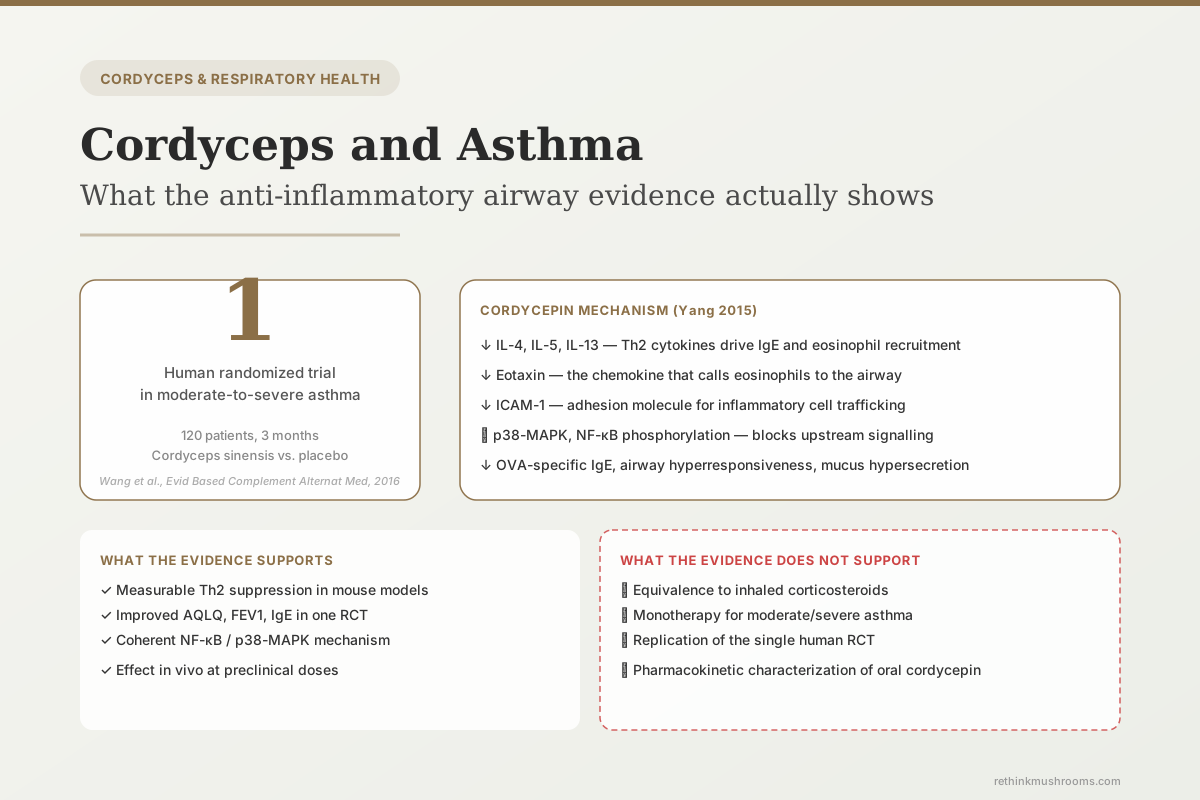
One randomized trial in moderate-to-severe asthma (120 patients, Cordyceps sinensis added to inhaled steroid therapy) reported better asthma quality of life, lung function and serum inflammatory markers. Its control group received no capsule at all — not a placebo — so nobody in the trial was blinded. Supporting rodent data show consistent Th2 cytokine suppression across four different cordyceps preparations.
Wang et al., Evidence-Based Complementary and Alternative Medicine, 2016
No placebo arm
the control group in the only human trial received nothing, so no one was blinded
Th2 cytokines
cordycepin reduces IL-4, IL-5, IL-13 and eotaxin in mouse BAL fluid
Beaten by steroids
C. militaris underperformed prednisolone and montelukast head-to-head in mice
Wang et al., Evidence-Based Complementary and Alternative Medicine, 2016
 View as image ↗
Cordyceps has a long traditional use for respiratory conditions in Chinese medicine, and modern research has started to test this systematically for asthma. The claim is that cordyceps extracts, or the isolated nucleoside cordycepin, reduce airway inflammation through measurable anti-Th2 effects on cytokines, eosinophils and airway hyperreactivity. The evidence supporting this claim is mostly preclinical: several well-characterised rodent models of allergic asthma show clear effects, while human data is limited to a single randomised trial that, on close reading, was not placebo-controlled. This article examines what the asthma-specific cordyceps research actually shows, which preparation each finding belongs to, and where the gap between animal and human data is still open. For the broader respiratory picture, see cordyceps for lung health: what the research shows and cordyceps and COPD: can it improve breathing?.
Key Takeaways
- Wang et al. (2016) randomized 120 patients with moderate-to-severe persistent asthma to a Corbin capsule containing Cordyceps sinensis for three months, or to a control group that received no capsule — this was a no-treatment control, not a placebo, so neither patients nor assessors were blinded (Evidence-Based Complementary and Alternative Medicine)
- Both arms of that trial stayed on inhaled corticosteroid plus as-needed beta-agonists, which means cordyceps was tested strictly as an add-on to standard therapy and never as a replacement for it (Evidence-Based Complementary and Alternative Medicine)
- The trial's objective findings are the ones that survive the missing placebo: serum IgE, ICAM-1, IL-4 and MMP-9 all decreased and IgG increased, whereas the headline quality-of-life result rests on a patient-completed questionnaire in an unblinded study (Evidence-Based Complementary and Alternative Medicine)
- Yang et al. (2015) tested cordycepin at 10, 20 and 40 mg/kg in ovalbumin-driven asthmatic mice and reported attenuated airway hyperresponsiveness, less mucus hypersecretion, lower ovalbumin-specific IgE, fewer BAL eosinophils and macrophages, reduced IL-4, IL-5, IL-13, eotaxin and ICAM-1, and blocked p38-MAPK and NF-κB activation (International Immunopharmacology)
- Hsu et al. (2008) is the field's clearest negative result: whole Cordyceps militaris given by oral gavage reduced airway inflammation less effectively than prednisolone or montelukast, and its reversal of airway hyperreactivity disappeared at higher methacholine doses, leading the authors to conclude it "is unable to adequately block the potent mediators of asthmatic airway inflammation" (Pediatrics and Neonatology)
- Song et al. (2023) obtained a full anti-asthmatic result in mice from a purified Cordyceps militaris polysaccharide with no cordycepin involved, acting through Nrf2/HO-1 and NF-κB and reversing gut dysbiosis — evidence that the active fraction may not be the nucleoside the industry markets on (International Journal of Biological Macromolecules)
- Chen et al. (2020) found that Cs-4, a Cordyceps sinensis mycelium culture extract, suppressed IL-4, IL-5 and IL-13 in rat lung tissue and lowered IgE, though the study was funded by a supplement company that also supplied a co-author (Molecules)
- Chen et al. (2023) identified rapid deamination by adenosine deaminase as the main barrier to cordycepin's clinical translation, naming three workarounds: co-administered ADA inhibitors, structurally modified derivatives, and new drug delivery systems (Phytotherapy Research)
Before you read further
CriticalAsthma is the wrong condition to experiment on
Concern
Moderate-to-severe asthma can kill quickly when controller therapy is reduced or stopped. Nothing in the cordyceps literature has ever tested it as a substitute for an inhaled corticosteroid, and the one head-to-head animal comparison found cordyceps clearly weaker than both prednisolone and montelukast.
What the research says
Every study described on this page either added cordyceps on top of standard asthma therapy or used it in animals that were not receiving any. There is no published evidence base for replacement, and no trial has measured what happens to exacerbation risk if controller medication is reduced.
Particularly relevant for: Anyone with diagnosed asthma, especially moderate-to-severe or steroid-dependent asthma
What to do
Do not change, taper or stop any prescribed inhaler or asthma medication based on this research. Discuss any supplement with the clinician managing your asthma, including because immune-modulating products may interact with your existing treatment. This article is research explanation, not medical advice.
Hsu et al., 2008 (PMID 19133568); Wang et al., 2016 (PMID 28050193)
Asthma Pathology the Research Targets
Allergic asthma is driven primarily by a Th2-biased adaptive immune response. The cytokines IL-4, IL-5 and IL-13 orchestrate IgE production, eosinophil recruitment, mucus hypersecretion and smooth muscle hyperresponsiveness. NF-κB and p38-MAPK are upstream signalling nodes that regulate transcription of these cytokines and of adhesion molecules such as ICAM-1 that bring inflammatory cells to the airway. Eotaxin is the specific chemokine that recruits eosinophils.
This is the pathway map against which cordyceps and cordycepin have been tested. A compound that measurably reduces IL-4, IL-5, IL-13, eotaxin and eosinophil counts in the airway while blocking NF-κB and p38-MAPK is intervening at the correct molecular targets. Whether it does so strongly enough, safely enough and reproducibly enough in humans to matter clinically is a separate question — and it is the question the evidence has not answered.
The One Human Trial, and What Its Control Group Actually Received
Wang et al. (2016), published in Evidence-Based Complementary and Alternative Medicine, randomized 120 patients with moderate-to-severe persistent asthma.[1] Sixty received a Corbin capsule containing Cordyceps sinensis for three months. The other sixty, in the trial's own words, "did not receive treatment with Corbin capsule." There was no dummy capsule and no sham procedure. This is the single most important and most frequently misreported fact about the study: it was randomised, but it was not placebo-controlled, and nobody involved was blinded.
Both groups continued on inhaled corticosteroid and as-needed beta-agonists throughout. That detail is often lost too, and it cuts in the study's favour on one point and against it on another. In its favour: this was a genuine add-on design, so any benefit sits on top of proper controller therapy rather than replacing it. Against it: it means the trial can say nothing at all about cordyceps used alone.
Health-related quality of life was measured with Juniper's Asthma Quality of Life Questionnaire. Asthma exacerbation incidence, pulmonary function testing and serum inflammatory mediators were also evaluated. The treatment group showed significantly higher AQLQ scores and lung function than the control group, and its serum markers moved coherently: IgE, ICAM-1, IL-4 and MMP-9 all decreased while IgG increased.
Wang et al. (2016) · Evidence-Based Complementary and Alternative Medicine
- Population
- 120 patients with moderate-to-severe persistent asthma; 60 treated, 60 control
- Intervention
- Corbin capsule containing Cordyceps sinensis for 3 months, on top of inhaled corticosteroid and as-needed beta-agonists
- Comparator
- No capsule at all — an untreated control arm, not a placebo. No blinding of patients or assessors.
- Finding
- Higher AQLQ scores and lung function versus control. Serum IgE, ICAM-1, IL-4 and MMP-9 decreased; IgG increased.
preliminary Registered as ChiCTR-IPC-16008730 and declaring no conflict of interest, but the absence of a placebo arm leaves the patient-reported primary endpoint wide open to expectation effects. The serum marker changes are the durable part of the result. No independent replication has been published.
Wang et al., Evidence-Based Complementary and Alternative Medicine, 2016 (PMID 28050193)
The missing placebo does not make the trial worthless, but it does mean its endpoints have to be read at different strengths. A patient who knows they were handed a capsule and a patient who knows they were handed nothing are not answering the same questionnaire. Serum IL-4, by contrast, does not care what anyone believes.
Randomised — but not placebo-controlled
What the Control Group in the Only Human Trial Actually Received
Wang et al. 2016 is almost always described as placebo-controlled. It was not. The control arm “did not receive treatment with Corbin capsule” — no dummy capsule, no sham. Nobody was blinded. That does not make the trial worthless; it makes some of its endpoints much stronger than others. Read them separately.
Treatment arm (n = 60)
Corbin capsule containing Cordyceps sinensis, 3 months+ inhaled corticosteroid + as-needed β-agonist
Control arm (n = 60)
No Corbin capsule — and no placebo capsule either+ inhaled corticosteroid + as-needed β-agonist
Both arms stayed on standard controller therapy. This was cordyceps added to an inhaled steroid, never tested as a substitute for one.
Health-related quality of life
Blinding-dependentMeasured by: Juniper's AQLQ — patient-completed questionnaire
Reported: Significant increase vs control
Entirely self-reported. A patient who knows they were given the capsule, and a patient who knows they were given nothing, are answering two different questions.
Asthma symptoms
Blinding-dependentMeasured by: Patient-reported symptom burden
Reported: Reported as improved
Same problem. Symptom perception in asthma is famously responsive to expectation, which is why asthma trials are normally sham-controlled.
Lung function
Partly exposedMeasured by: Pulmonary function testing
Reported: Significant increase vs control
Instrument-measured, but spirometry is effort-dependent and the technician was not blinded either. Harder to move by belief than a questionnaire, not immune to it.
Serum IgE, ICAM-1, IL-4, MMP-9
Survives unblindingMeasured by: Laboratory assay of serum inflammatory mediators
Reported: All four decreased vs control
A patient cannot will their serum IL-4 down because they know they got the capsule. This is the part of the trial that the missing placebo does not touch.
Serum IgG
Survives unblindingMeasured by: Laboratory assay
Reported: Increased vs control
Same reasoning. Objective biochemistry, independent of expectation.
The honest reading: the headline result — “cordyceps improved asthma quality of life” — rests on the endpoint most vulnerable to the missing placebo. The finding that deserves follow-up is the quieter one, that four serum inflammatory markers moved in the direction the mouse mechanism predicts. One unblinded trial cannot settle this either way. It can justify running the blinded one.
Source: Wang et al., Evidence-Based Complementary and Alternative Medicine, 2016 (RTHM-00838, PMID 28050193, ChiCTR-IPC-16008730). Endpoint list and results as reported in the published abstract; the blinding-exposure rating is this article’s assessment, not the trial authors’.
Two further limitations matter. The Corbin capsule's extract composition and cordycepin content are not characterised in the published abstract, so even a well-funded replication attempt would have to guess at what it was replicating. And three months speaks to neither long-term safety nor durability of effect.
The Preclinical Foundation
Yang et al. (2015) provides the most mechanistically detailed work in the file.[2] Using the ovalbumin sensitisation-and-challenge mouse model, the researchers tested cordycepin at 10, 20 and 40 mg/kg and measured airway hyperresponsiveness, bronchoalveolar lavage cell counts and cytokines, serum IgE and lung tissue signalling. Cordycepin attenuated airway hyperresponsiveness and mucus hypersecretion, lowered ovalbumin-specific IgE, and reduced eosinophils and macrophages in BAL fluid. It reduced eotaxin, ICAM-1, IL-4, IL-5 and IL-13, and markedly blocked activation of the p38-MAPK and NF-κB pathways. Every node in the allergic asthma cascade moved in the expected direction.
The caveats are real. This is a purified compound rather than anything sold as a supplement, and the published abstract does not state the route of administration, so no oral-dose equivalence can be read off it.
Hsu et al. (2008) tested whole Cordyceps militaris rather than isolated cordycepin, and it deserves more weight than it usually gets because it is the only study here that ran proper positive controls.[3] Sensitised BALB/c mice received C. militaris, prednisolone, montelukast or placebo by gavage from Days 15 to 27. Prednisolone and montelukast inhibited the airway inflammatory response; C. militaris "reduced airway inflammation less effectively." It initially reversed airway hyperreactivity, but that effect disappeared at higher methacholine doses. The authors' own conclusion is unusually blunt for this literature: C. militaris "is unable to adequately block the potent mediators of asthmatic airway inflammation."
That is a finding, not a footnote. The asthma literature is not claiming cordyceps matches inhaled corticosteroids or leukotriene antagonists. When someone ran the comparison directly, cordyceps lost.
Song et al. (2023) changes the shape of the argument.[4] Rather than cordycepin, this group isolated and purified a Cordyceps militaris polysaccharide — an α-pyranose of 15.94 kDa composed of glucose, mannose, galactose, xylose, arabinose and glucuronic acid in a characterised molar ratio — and tested it in ovalbumin-induced allergic asthma mice. It improved inflammatory cytokine levels and lung and intestinal histopathology, acted through the Nrf2/HO-1 and NF-κB signalling pathways, and reversed gut dysbiosis at the phylum and family levels. Lung cytokine levels correlated significantly with intestinal microbial communities. No cordycepin was administered at any point.
Chen et al. (2020) tested a third kind of preparation: Cs-4, a water extract of Cordyceps sinensis mycelium culture, in a rat asthma model alongside a mouse allergic rhinitis model.[5] Cs-4 decreased airway responsiveness, reduced plasma and BAL IgE and eosinophil peroxidase, and completely suppressed the increases in IL-4, IL-5 and IL-13 in rat lung tissue. This is directly relevant to the consumer market, because cultivated mycelium is what many commercial cordyceps products actually contain. It also carries a disclosure worth stating plainly: the work was funded by Royal Medic Group Holding Limited, which also supplied one of the co-authors.
Phull et al. (2022) sits at a different altitude — a review positioning Cordyceps militaris as an anti-inflammatory functional food, covering inflammatory conditions including cancer, colitis and allergies, with regulation of proinflammatory cytokines as the recurring theme.[6] Its usefulness here is contextual rather than asthma-specific: cordyceps affects a general inflammatory pathway that happens to be the pathway driving allergic asthma.
Five substances, two species, one human trial
“Cordyceps for Asthma” Is Five Different Experiments
The asthma literature does not test a mushroom. It tests an isolated nucleoside, a cultivated fruiting-body extract, a purified polysaccharide, a mycelium culture broth, and a proprietary capsule — across two species that differ in chemistry. Findings do not transfer between rows, and a supplement bought off a shelf is none of these.
Cordycepin (isolated nucleoside)
from C. militarisMouse onlyTested in: Ovalbumin-driven asthmatic mice, 10 / 20 / 40 mg/kg (Yang 2015)
Found: Attenuated airway hyperresponsiveness and mucus hypersecretion; lowered OVA-specific IgE; fewer BAL eosinophils and macrophages; reduced eotaxin, ICAM-1, IL-4, IL-5, IL-13; blocked p38-MAPK and NF-κB activation
What it cannot carry: Purified compound, not a supplement. The abstract does not state the route of administration, so no oral-dose equivalence can be read off it.
Whole cultivated extract
C. militarisMouse — underperformedTested in: OVA mice, oral gavage Days 15–27, vs prednisolone, montelukast and placebo (Hsu 2008)
Found: Reduced airway inflammation and initially reversed airway hyperreactivity
What it cannot carry: The clearest negative result in the file: less effective than both standard drugs, and the hyperreactivity benefit "disappeared at higher methacholine doses." The authors conclude it "is unable to adequately block the potent mediators of asthmatic airway inflammation."
Purified polysaccharide (CMP)
C. militarisMouse onlyTested in: OVA allergic asthma mice; 15.94 kDa α-pyranose, six-sugar composition characterised (Song 2023)
Found: Improved inflammatory cytokines and lung + intestinal histopathology via Nrf2/HO-1 and NF-κB; reversed gut dysbiosis, with lung cytokines correlating to intestinal microbial communities
What it cannot carry: A different active fraction and a different mechanism from the cordycepin story — no cordycepin required. Mouse only, and correlation between gut flora and lung cytokines is not proof of causation.
Cs-4 mycelium culture extract
C. sinensisRodent — industry fundedTested in: Rat asthma model plus mouse allergic rhinitis model (Chen 2020)
Found: Decreased airway responsiveness; lowered plasma and BAL IgE and eosinophil peroxidase; "completely suppressed" the rise in IL-4, IL-5 and IL-13 in rat lung tissue
What it cannot carry: Funded by Royal Medic Group Holding Limited, which also supplied a co-author — an industry-funded result on the company’s own class of product. Rodent only.
Corbin capsule (proprietary)
C. sinensisHuman — unblindedTested in: 120 moderate-to-severe asthma patients, 3 months, added to inhaled steroid (Wang 2016)
Found: Higher AQLQ scores and lung function; serum IgE, ICAM-1, IL-4 and MMP-9 down, IgG up
What it cannot carry: The only human data. Randomised but unblinded — the control arm received nothing at all. Extract composition and cordycepin content are not characterised in the published abstract.
Two of the five rows are the same species. None of the five is the capsule on a shop shelf. The one row with human data used a proprietary formulation whose composition was never published, which means even a perfect replication attempt would have to guess at what to replicate.
Sources: Yang et al., 2015 (RTHM-00750, PMID 25912153); Hsu et al., 2008 (RTHM-00254, PMID 19133568); Song et al., 2023 (RTHM-02445, PMID 37030458); Chen et al., 2020 (RTHM-02444, PMID 32899766); Wang et al., 2016 (RTHM-00838, PMID 28050193).
The Cordycepin Bioavailability Problem
Cordycepin (3'-deoxyadenosine) is the single most studied bioactive in Cordyceps militaris, with strong anti-inflammatory, anti-tumour and antiviral activity in cell culture and animal models. Its translation to oral human use runs into a specific pharmacokinetic obstacle. Chen et al. (2023) reviewed the problem: cordycepin undergoes rapid deamination by adenosine deaminase in vivo, which shortens its half-life and decreases its bioavailability.[7] The review identifies three routes around it — co-administering an ADA inhibitor, developing structurally modified derivatives that resist deamination, and applying new drug delivery systems.
The obvious conclusion is that oral cordyceps faces a real pharmacokinetic headwind. But the obvious conclusion sits awkwardly beside the animal data, because three of the four positive asthma-model results used whole preparations given by mouth — and one of them contained no cordycepin at all.
A contradiction worth naming
If Oral Cordycepin Barely Survives, Why Do Oral Preparations Still Work?
The objection
Cordycepin undergoes rapid deamination by adenosine deaminase in vivo, shortening its half-life and cutting bioavailability. On that basis, a swallowed cordyceps capsule should not deliver a meaningful systemic dose.Chen 2023
The observation
Hsu 2008 dosed whole C. militaris by gavage. Song 2023 and Chen 2020 dosed a polysaccharide and a mycelium extract. All three reported airway effects anyway.Hsu 2008 · Song 2023 · Chen 2020
Both statements are well supported, so one of the unstated assumptions joining them must be wrong. The likeliest culprit is the assumption that cordycepin is the active ingredient. Here is what the record can and cannot back:
The polysaccharide, not the nucleoside, may be doing the work
Directly testedSong 2023 got a full anti-asthmatic result from a purified 15.94 kDa C. militaris polysaccharide. No cordycepin was administered. If a polysaccharide can suppress the same pathways, cordycepin pharmacokinetics stop being the rate-limiting question.
The effect may start in the gut, not the bloodstream
Suggestive, not causalSong 2023 reported reversal of gut dysbiosis and a significant correlation between intestinal microbial communities and lung inflammatory cytokines. A large polysaccharide that is never absorbed intact could still change airway immunology through the gut. Correlation, though — not demonstrated causation.
Cordycepin’s breakdown product is not necessarily inert at the airway
Untested hypothesisYue 2008 found that cordycepin and adenosine both stimulated ion transport in Calu-3 airway epithelial cells. Adenosine deaminase converts cordycepin to a deaminated analogue; the assumption that this abolishes all airway-relevant activity has not been tested in an asthma model.
This matters commercially as well as scientifically. Products are marketed on cordycepin content, and extraction methods are optimised for it. If the polysaccharide fraction is carrying the airway effect, then the number printed on the label is measuring the wrong molecule. Nobody has run the experiment that would settle it: a head-to-head of cordycepin against the polysaccharide fraction in the same asthma model.
Sources: Chen et al., 2023 (RTHM-01672, PMID 37329165); Hsu et al., 2008 (RTHM-00254, PMID 19133568); Song et al., 2023 (RTHM-02445, PMID 37030458); Chen et al., 2020 (RTHM-02444, PMID 32899766); Yue et al., 2008 (RTHM-02439, PMID 18358654).
The resolution most consistent with the published record is that cordycepin may simply not be the ingredient carrying the airway effect. Song's polysaccharide result is the strongest evidence for this, because it produced the same pathway-level outcome with a completely different molecule. If that is right, the industry convention of grading cordyceps products by cordycepin content is measuring the wrong thing for this particular use.
Cordyceps sinensis vs. Cordyceps militaris
The two species studied in asthma are pharmacologically distinct. Cordyceps sinensis (now classified as Ophiocordyceps sinensis) carries a complex polysaccharide profile with lower cordycepin content. Cordyceps militaris carries higher cordycepin concentrations and is the species behind most cordycepin-focused preclinical work. The asthma research uses both, in five different forms: Wang 2016 used a C. sinensis capsule, Chen 2020 used C. sinensis mycelium culture extract, Hsu 2008 used whole C. militaris, Song 2023 used a purified C. militaris polysaccharide, and Yang 2015 used isolated cordycepin.
This heterogeneity is a genuine interpretive problem rather than a technicality. Consumer cordyceps products differ by species, by fruiting body versus cultivated mycelium, by extraction method, and by cordycepin and polysaccharide content. Extrapolating from any one row of that table to a generic supplement is not straightforward, and extrapolating from the Wang trial in particular is hardest of all, because its formulation was never characterised publicly.
Airway Epithelial Ion Transport as a Secondary Mechanism
Beyond the Th2 cytokine story, cordyceps has been tested on airway epithelial function directly. Yue et al. (2008) applied Cordyceps sinensis and Cordyceps militaris extracts, and their isolated compounds cordycepin and adenosine, to Calu-3 human airway epithelial monolayers.[8] All of them stimulated ion transport in a dose-dependent manner. Follow-up experiments using the transport inhibitor bumetanide and the carbonic anhydrase inhibitor acetazolamide indicated that the extracts affect anion movement from the basolateral to the apical compartment, with the basolateral Na⁺-K⁺-2Cl⁻ cotransporter and the apical cAMP-dependent CFTR chloride channel both involved. The authors describe this as the first evidence for a pharmacological mechanism of these species on the respiratory tract.
Anion secretion across the airway epithelium governs airway surface liquid volume, which in turn sets how efficiently the mucociliary escalator can clear secretions. It is worth being precise about what this does and does not say. It is a cell-culture result about hydration of the airway surface, not about mucus production — a distinction that matters, since Yang's mouse work found cordycepin reduced mucus hypersecretion. No study has tested whether the Calu-3 effect produces any clinical benefit in asthma, and the two findings have never been measured in the same experiment.
The mechanism is nonetheless worth noting because it is largely independent of Th2 immunology. A cordyceps effect on asthma could plausibly operate through reduced airway inflammation, improved epithelial hydration, or the gut-immune route Song's polysaccharide work points at — with the relative contribution of each in humans entirely unknown.
What the Evidence Does and Does Not Support
The cordyceps asthma evidence supports several specific claims. Cordycepin, whole Cordyceps militaris, a purified C. militaris polysaccharide and a C. sinensis mycelium extract each have measurable anti-inflammatory activity in rodent models of allergic asthma, reducing Th2 cytokines, airway eosinophils and hyperreactivity. A Cordyceps sinensis capsule improved quality-of-life, lung function and serum inflammatory markers in one 120-patient randomised trial, added on top of inhaled corticosteroid therapy. The molecular mechanism involves NF-κB and p38-MAPK suppression, with Nrf2/HO-1 signalling implicated for the polysaccharide fraction.
The evidence does not support several broader claims. There is no evidence that cordyceps matches or substitutes for inhaled corticosteroids or leukotriene antagonists — the only direct comparison found the opposite. There is no evidence that cordyceps is sufficient as monotherapy for moderate or severe asthma; it has never been tested that way. There is no blinded human trial, no independent replication, no head-to-head comparison of species or preparations in humans, and no long-term safety data beyond three months.
- Cell studiescompleted
Yue 2008 — Calu-3 human airway epithelia; both species and both isolated compounds stimulate anion transport via NKCC1 and CFTR
- Animal modelscompleted
Four independent rodent studies across four different preparations; consistent Th2 cytokine and IgE suppression, but the one study with positive controls found cordyceps weaker than prednisolone and montelukast
- Case reportsmissing
No published asthma case series for cordyceps
- Small human trialcurrent
Wang 2016 — 120 patients, randomised, add-on to inhaled steroid, but with an untreated rather than placebo control and no blinding
- Large blinded RCTmissing
No placebo-controlled trial of any cordyceps preparation in asthma has been published
- Meta-analysismissing
Impossible with a single unreplicated trial
The preclinical rungs are unusually well populated for a traditional-medicine claim, and the mechanistic work targets the right pathways. The human rung holds one unblinded trial of an uncharacterised proprietary capsule. Nothing above it exists. That combination justifies running a proper blinded trial; it does not justify a clinical recommendation.
Yue et al., 2008; Hsu et al., 2008; Yang et al., 2015; Chen et al., 2020; Song et al., 2023; Wang et al., 2016
Practical Interpretation of the Evidence
The cordyceps and asthma literature sits in a specific evidentiary position, and it is not the usual one. The preclinical data is better than for many traditional medicine claims, because the rodent allergic asthma model is rigorous and quantitative and the measured effects hit the correct molecular targets across four independent preparations. The human data is weaker than for approved asthma therapies, because it consists of one unblinded trial. This is not the familiar pattern where preclinical hype outruns clinical reality. It is closer to the reverse: coherent mechanistic work that has received almost no serious clinical testing.
The honest summary is that the field has earned a proper trial and has not yet run one. Meanwhile, consumer cordyceps products vary substantially in species, form, extraction method and compound content. No published study has tested whether any off-the-shelf cordyceps product reproduces the Wang trial result, and because that trial's formulation was never characterised, no product can legitimately claim to match it.
Research Gaps Worth Monitoring
Four gaps are specifically open. First, and most fixable, no placebo-controlled blinded trial has been run — the existing trial already established the add-on-to-inhaled-steroid design, so the obvious next study is the same design with a dummy capsule. Second, no head-to-head trial of C. sinensis against C. militaris in asthma has been conducted, despite these being materially different preparations. Third, no experiment has compared cordycepin against the polysaccharide fraction in the same asthma model, which is the study that would settle which molecule the industry should be standardising on. Fourth, oral cordycepin pharmacokinetics in humans have not been comprehensively characterised, so the optimal exposure for respiratory anti-inflammatory activity remains unknown.
For the related respiratory performance question, see cordyceps and high-altitude performance: the Tibetan tradition meets modern science and cordyceps and oxygen utilization at high altitude. The high-altitude and exercise literature uses different endpoints and different cordyceps preparations, but shares the underlying question of whether systemic cordyceps exposure meaningfully affects pulmonary and oxygen-delivery physiology.
The Bottom Line
Cordyceps preparations show reproducible anti-inflammatory activity in rodent models of allergic asthma, reducing Th2 cytokines, airway eosinophils, IgE and hyperresponsiveness, and suppressing NF-κB and p38-MAPK signalling. Four different preparations have produced this pattern — isolated cordycepin, whole Cordyceps militaris, a purified C. militaris polysaccharide, and a C. sinensis mycelium extract — which suggests the active fraction may not be cordycepin at all. The human evidence is one 120-patient randomised trial of a Cordyceps sinensis capsule added to inhaled steroid therapy, and its control group received no capsule rather than a placebo, leaving the patient-reported quality-of-life result exposed to expectation effects while the serum marker changes stand up better. The only direct comparison against standard drugs found cordyceps less effective than prednisolone and montelukast. Nothing in this literature supports using cordyceps in place of prescribed asthma therapy.
Frequently Asked Questions
Sources & References
- 1RTHM-00456·Wang, Ningqun et al. (2016). “Herbal Medicine Cordyceps sinensis Improves Health-Related Quality of Life in Moderate-to-Severe Asthma..” Evidence-based complementary and alternative medicine : eCAM.Study breakdown →PubMed →↩
- 2RTHM-00411·Yang, Xiaofeng et al. (2015). “Cordycepin alleviates airway hyperreactivity in a murine model of asthma by attenuating the inflammatory process..” International immunopharmacology.Study breakdown →PubMed →↩
- 3RTHM-00136·Hsu, Chia-Hsiu et al. (2008). “Effects of the immunomodulatory agent Cordyceps militaris on airway inflammation in a mouse asthma model..” Pediatrics and neonatology.Study breakdown →PubMed →↩
- 4RTHM-02445·Song, Lanyue et al. (2023). “Cordyceps militaris polysaccharide alleviates ovalbumin-induced allergic asthma through the Nrf2/HO-1 and NF-κB signaling pathways and regulates the gut microbiota..” International journal of biological macromolecules.Study breakdown →PubMed →↩
- 5RTHM-02444·Chen, Jihang et al. (2020). “Anti-Inflammatory Effects of a Cordyceps sinensis Mycelium Culture Extract (Cs-4) on Rodent Models of Allergic Rhinitis and Asthma..” Molecules.Study breakdown →PubMed →↩
- 6RTHM-00790·Phull, Abdul-Rehman et al. (2022). “Cordyceps militaris as a Bio Functional Food Source: Pharmacological Potential, Anti-Inflammatory Actions and Related Molecular Mechanisms..” Microorganisms.Study breakdown →PubMed →↩
- 7RTHM-00817·Chen, Min et al. (2023). “Cordycepin: A review of strategies to improve the bioavailability and efficacy..” Phytotherapy research : PTR.Study breakdown →PubMed →↩
- 8RTHM-02439·Yue, Grace Gar-Lee et al. (2008). “Effects of Cordyceps sinensis, Cordyceps militaris and their isolated compounds on ion transport in Calu-3 human airway epithelial cells..” Journal of ethnopharmacology.Study breakdown →PubMed →↩