Cordyceps and Respiratory Health
95% SpO2 maintained
In a 2024 athlete trial, Cordyceps militaris supplementation at 1 g/day for 3 weeks maintained oxygen saturation at 95% with stabilized heart rate, while controls showed lower SpO2 and increased fatigue.
Cordyceps militaris athlete study, Asian Journal of Biological Sciences, 2024
Adenosine + cordycepin
promote vasodilation and O2 delivery
HIF-1 upregulation
EPO, VEGF, GLUT-1 induced
2.5-fold
fatigue reduction vs control
Cordyceps militaris athlete study, Asian Journal of Biological Sciences, 2024
 View as image ↗
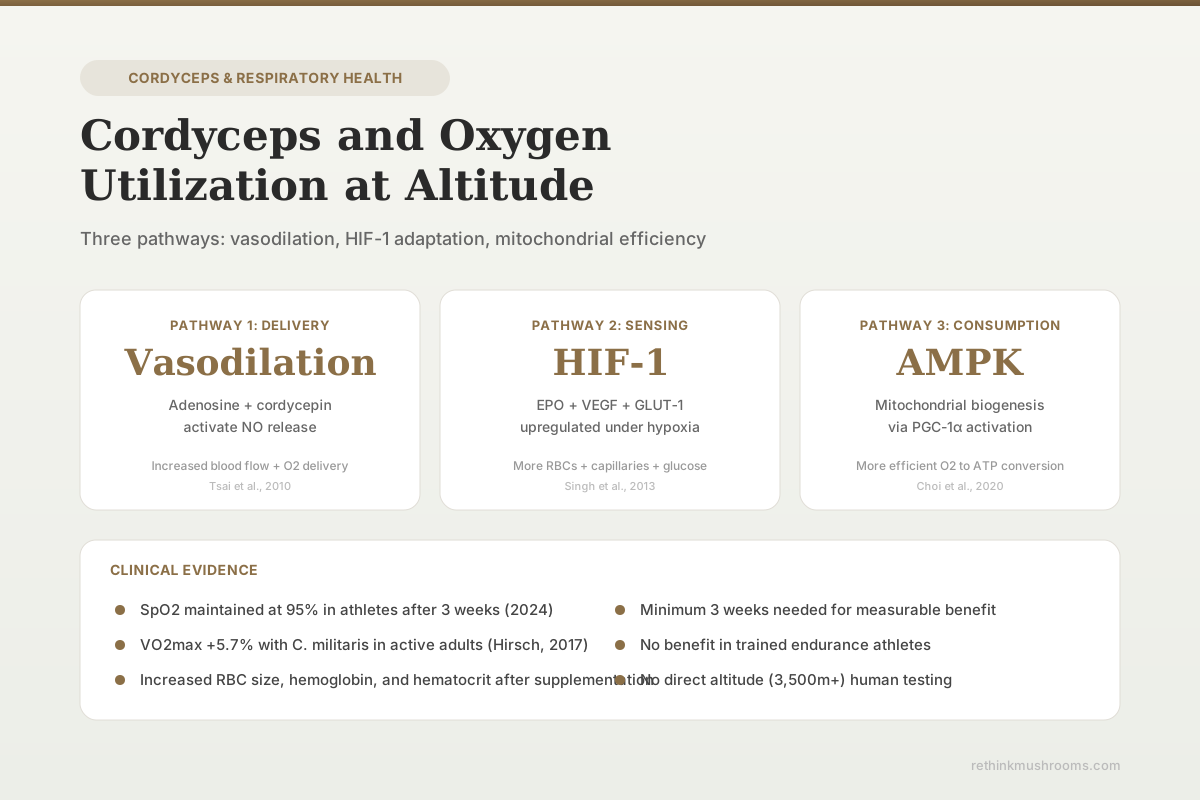
The question of how cordyceps affects oxygen utilization is distinct from whether it improves exercise performance. Performance trials measure composite outcomes (VO2max, time to exhaustion, threshold changes). Oxygen utilization research asks a narrower question: does cordyceps change how the body acquires, transports, or consumes oxygen at the cellular level? The answer involves three separate biological systems: vasodilation and blood flow (oxygen delivery), HIF-1-mediated adaptation (oxygen sensing), and mitochondrial efficiency (oxygen consumption). Each has supporting data, and each has limitations. For the broader performance trial evidence, see Cordyceps and high-altitude performance: the Tibetan tradition meets modern science. For airway-specific effects, see Cordyceps and asthma: anti-inflammatory airway effects.
Key Takeaways
- Cordyceps sinensis contains adenosine and cordycepin (3'-deoxyadenosine), both of which activate adenosine receptors that promote vasodilation and increase blood flow, with Tsai et al. (2010) characterizing their pharmacokinetic profiles showing rapid absorption and elimination
- Singh et al. (2013) showed Cordyceps sinensis extract upregulated HIF-1 and its downstream targets (erythropoietin, VEGF, GLUT-1) in human lung cells under hypoxic conditions, representing the three key oxygen adaptation responses: more red blood cells, more capillaries, and maintained glucose uptake
- Choi et al. (2020) demonstrated that Cordyceps militaris extract activated AMPK-mediated mitochondrial biogenesis in animal models, increasing the number and efficiency of mitochondria available for oxygen-dependent ATP production
- A 2024 athlete trial found Cordyceps militaris supplementation at 1 g/day for 3 weeks increased RBC size, hemoglobin, hematocrit, and maintained SpO2 at 95% with 2.5-fold fatigue reduction compared to controls
- Hirsch et al. (2017) showed 3 weeks of Cordyceps militaris increased VO2max by 5.7% in recreationally active adults, consistent with improved oxygen uptake, while 1 week showed no benefit
- All mechanistic data on oxygen pathways comes from cell culture and animal models; no human study has measured tissue-level oxygen consumption changes from cordyceps supplementation
Adenosine and Cordycepin: The Vasodilation Pathway
Oxygen delivery to tissues depends on blood flow, which depends on vascular diameter. Cordyceps sinensis and Cordyceps militaris both contain adenosine and cordycepin (3'-deoxyadenosine), compounds that activate adenosine receptors on blood vessel endothelial cells and smooth muscle. Adenosine receptor activation triggers nitric oxide release, which relaxes vascular smooth muscle and widens blood vessels.[1]
Tsai et al. (2010) characterized the pharmacokinetics of both compounds in rats. After intravenous administration, adenosine showed rapid distribution (half-life 0.27 minutes) and elimination (half-life 9.4 minutes). Cordycepin had a longer distribution phase (half-life 1.6 minutes) and elimination half-life of 21.6 minutes. Both compounds were rapidly cleared from circulation, with cordycepin showing wider tissue distribution. Oral bioavailability data were not reported.
The pharmacokinetic profile creates a paradox for altitude applications. If adenosine and cordycepin are cleared from circulation within minutes, how would a single daily dose of cordyceps maintain sustained vasodilation? Two possibilities exist. First, other Cordyceps constituents (polysaccharides, mannitol, proteins) may contribute to vascular effects through different mechanisms. Second, chronic supplementation may produce cumulative changes in vascular tone or endothelial function that persist beyond the clearance window of individual compounds. Neither hypothesis has been directly tested.
What is established: Cordyceps sinensis protein constituents contribute to hypotensive and vasorelaxant activity in isolated aortic rings, confirming that the vascular effects are not limited to adenosine and cordycepin alone. The bioactive profile is broader than any single compound. For the ATP production side of adenosine metabolism, see Cordyceps and ATP: how it boosts cellular energy.
HIF-1 Signaling: The Oxygen Sensor Response
When cells experience low oxygen (hypoxia), they activate hypoxia-inducible factor 1 (HIF-1), a transcription factor that orchestrates the body's adaptive response to reduced oxygen availability. HIF-1 upregulates three critical downstream targets: erythropoietin (EPO, which stimulates red blood cell production), vascular endothelial growth factor (VEGF, which promotes new capillary formation), and glucose transporter-1 (GLUT-1, which maintains glucose uptake when oxidative metabolism is compromised).
Singh et al. (2013) demonstrated that Cordyceps sinensis extract enhanced all three branches of this response in human lung epithelial cells (A549) exposed to hypoxic conditions.[2] Simultaneously, the extract activated Nrf2, upregulating heme oxygenase-1 (HO-1) and metallothionein (MT), which neutralize the reactive oxygen species (ROS) that accumulate during hypoxia.
The dual activation of HIF-1 (oxygen adaptation) and Nrf2 (oxidative stress defense) represents a coordinated cellular strategy: adapt to lower oxygen while preventing the damage that low oxygen causes. This is precisely what altitude acclimatization requires.
The clinical translation gap is substantial. A549 cells are a human lung adenocarcinoma cell line, not primary lung tissue. The extract was applied directly to cells in culture, bypassing absorption, metabolism, and tissue distribution. Whether oral cordyceps supplementation produces sufficient concentrations of bioactive compounds in lung tissue to activate HIF-1 signaling is unknown. The mechanism is biologically coherent; the delivery question remains open.
Mitochondrial Efficiency: Using Oxygen Better
Even if oxygen delivery and sensing are adequate, the final step is how efficiently mitochondria convert oxygen into ATP. Choi et al. (2020) investigated this in animal models using Cordyceps militaris ethyl acetate extract.[3]
The extract activated AMPK (AMP-activated protein kinase), a cellular energy sensor that triggers mitochondrial biogenesis when energy demand exceeds supply. Activated AMPK increases PGC-1α expression, which drives the creation of new mitochondria and improves the efficiency of existing ones. More mitochondria per cell means more capacity for oxidative phosphorylation, the oxygen-dependent process that generates ATP.
In exercise endurance tests, mice receiving Cordyceps militaris extract ran longer before exhaustion. The mechanistic data showed increased markers of mitochondrial biogenesis and enhanced cellular energy production through adenosine-mediated pathways.
This connects directly to altitude physiology. At altitude, the partial pressure of oxygen drops, reducing the oxygen gradient driving diffusion into mitochondria. If each mitochondrion is more efficient, or if there are simply more of them, the cell can maintain ATP production despite lower oxygen tension. This is the same adaptation that endurance training produces over months; the question is whether cordyceps supplementation can accelerate or augment it. For the detailed biochemistry, see Cordyceps and ATP: how it boosts cellular energy. For related creatine phosphate pathways, see Cordyceps and creatine phosphate: dual pathways to cellular energy.
SpO2 and Hematological Data in Athletes
A 2024 study published in the Asian Journal of Biological Sciences tested Cordyceps militaris supplementation in 48 athletes aged 16-35, divided into four groups, supplemented for 3 weeks.
The Cordyceps-supplemented groups maintained oxygen saturation (SpO2) at 95% with heart rate stabilized at 90 plus or minus 5 beats per minute. Running performance improved: 5 km time of 13.5 minutes and 200 m time of 25 seconds were both faster than control group times. Fatigue on a treadmill test decreased by 2.5-fold compared to controls.
The hematological mechanism was specific: RBC size increased in supplemented subjects, leading to higher hemoglobin content, higher hematocrit, increased oxygen-carrying capacity, and increased oxygen flow. This is consistent with EPO-mediated red blood cell changes, though the study did not measure EPO levels directly.
The 3-week supplementation timeline aligns with the Hirsch et al. (2017) finding that acute (1-week) Cordyceps militaris supplementation produced no benefit while chronic (3-week) supplementation improved VO2max by 5.7%.[4] Three weeks is also the minimum timeframe for new red blood cells to mature and enter circulation, suggesting the hematological changes may drive the performance improvements.
The study limitations include small group sizes (12 per group), lack of altitude-specific testing, and the absence of a standardized cordycepin/adenosine content analysis of the supplement used.
Rhodiola Plus Cordyceps at 2,100 Meters
The closest study to real-world altitude application comes from Chen et al. (2014), who tested a supplement combining Rhodiola crenulata and Cordyceps sinensis during 2 weeks of athletic training at 2,100 meters elevation.[5]
The supplement group showed improved aerobic exercise performance after the altitude training period, with alterations to autonomic nervous system activity and hematological profiles compared to placebo. This is the only published study testing a cordyceps-containing preparation during actual altitude exposure with exercise testing.
The combination design prevents isolating the cordyceps contribution. Rhodiola crenulata contains salidroside, which has its own evidence base for altitude adaptation through antioxidant and anti-fatigue mechanisms. The 2,100-meter elevation is moderate altitude, below the 3,500-meter threshold where hypoxic stress becomes clinically relevant. Whether the supplement would produce the same benefits at extreme altitudes (4,000-5,000 meters) where Ophiocordyceps sinensis naturally grows is a different, untested question. For related lung health research, see Cordyceps for lung health: what the research shows.
Pulmonary Vascular Effects
A separate line of research examines cordyceps in pulmonary hypertension, a condition where elevated pressure in the pulmonary arteries reduces oxygen exchange efficiency. Fermented Cordyceps powder attenuated pulmonary arteriolar remodeling by inhibiting p38 MAPK/NF-κB signaling in hypoxic pulmonary hypertension rat models.
Cordycepin reduced vascular inflammation, apoptosis, and oxidative stress in arterial smooth muscle cells while modulating VEGF pathways. These findings are relevant to altitude because hypoxic pulmonary vasoconstriction (HPV) is the primary driver of altitude-related pulmonary complications. If cordyceps compounds can blunt excessive pulmonary vasoconstriction while maintaining systemic vasodilation, they would address one of the most dangerous aspects of rapid altitude exposure. This remains preclinical and speculative but mechanistically grounded. For COPD-specific data, see Cordyceps and COPD: can it improve breathing.
Connecting the Pathways
The three oxygen utilization mechanisms that cordyceps research has identified are not independent. They form a cascade.
Adenosine and cordycepin promote vasodilation, increasing blood flow and oxygen delivery to tissues. HIF-1 activation triggers EPO production (more red blood cells to carry oxygen), VEGF expression (more capillaries for oxygen exchange), and GLUT-1 upregulation (maintained glucose metabolism when oxygen is scarce). AMPK activation increases mitochondrial number and efficiency, improving how much ATP each molecule of oxygen produces.
If all three pathways are active simultaneously, the net effect would be: more oxygen delivered (vasodilation), more oxygen carried (EPO), more exchange surfaces (VEGF), and more efficient oxygen use (mitochondrial biogenesis). This is a plausible model for altitude adaptation.
The evidence for each individual pathway is real but limited to cell culture or animal models. The clinical evidence (SpO2 maintenance, VO2max improvement, hematological changes) is consistent with these mechanisms operating in humans, but no study has simultaneously measured all three pathways in human subjects taking cordyceps at altitude. The mechanistic picture is coherent; the clinical validation is fragmentary.
The Bottom Line
Cordyceps contains compounds that affect three oxygen utilization pathways: adenosine-mediated vasodilation for oxygen delivery, HIF-1 activation for oxygen sensing and red blood cell production, and AMPK-driven mitochondrial biogenesis for oxygen consumption efficiency. Clinical data show improved SpO2, hematological parameters, and VO2max after 3+ weeks of supplementation, consistent with these mechanisms. No study has validated all three pathways simultaneously in humans at altitude.
Frequently Asked Questions
Sources & References
- 1RTHM-00199·Tsai, Yung-Jen et al. (2010). “Pharmacokinetics of adenosine and cordycepin, a bioactive constituent of Cordyceps sinensis in rat..” Journal of agricultural and food chemistry.Study breakdown →PubMed →↩
- 2RTHM-00305·Singh, Mrinalini et al. (2013). “Cordyceps sinensis increases hypoxia tolerance by inducing heme oxygenase-1 and metallothionein via Nrf2 activation in human lung epithelial cells..” BioMed research international.Study breakdown →PubMed →↩
- 3RTHM-00613·Choi, Eunhyun et al. (2020). “Beneficial Effect of Cordyceps militaris on Exercise Performance via Promoting Cellular Energy Production..” Mycobiology.Study breakdown →PubMed →↩
- 4RTHM-00473·Hirsch, Katie R et al. (2017). “Cordyceps militaris Improves Tolerance to High-Intensity Exercise After Acute and Chronic Supplementation..” Journal of dietary supplements.Study breakdown →PubMed →↩
- 5RTHM-00313·Chen, Chung-Yu et al. (2014). “Rhodiola crenulata- and Cordyceps sinensis-based supplement boosts aerobic exercise performance after short-term high altitude training..” High altitude medicine & biology.Study breakdown →PubMed →↩