Cordyceps (C. militaris & C. sinensis)
3 distinct organisms
What gets sold under the Cordyceps banner is actually three different organisms — wild Ophiocordyceps sinensis, CS-4 (Paecilomyces hepiali), and cultivated Cordyceps militaris. Each has its own compound profile and its own clinical evidence.
Lo et al., American Journal of Chinese Medicine, 2013
CS-4 ≠ wild O. sinensis
the dominant Cordyceps sinensis supplement uses Paecilomyces hepiali, a taxonomically distinct organism
Null in young athletes
CS-4 showed no endurance improvement in male endurance-trained cyclists (Parcell et al., 2004, n=22)
Threshold gains in older adults
CS-4 improved metabolic and ventilatory thresholds — but not VO2max — in healthy older adults (Chen et al., 2010, n=20)
Lo et al., American Journal of Chinese Medicine, 2013
 View as image ↗
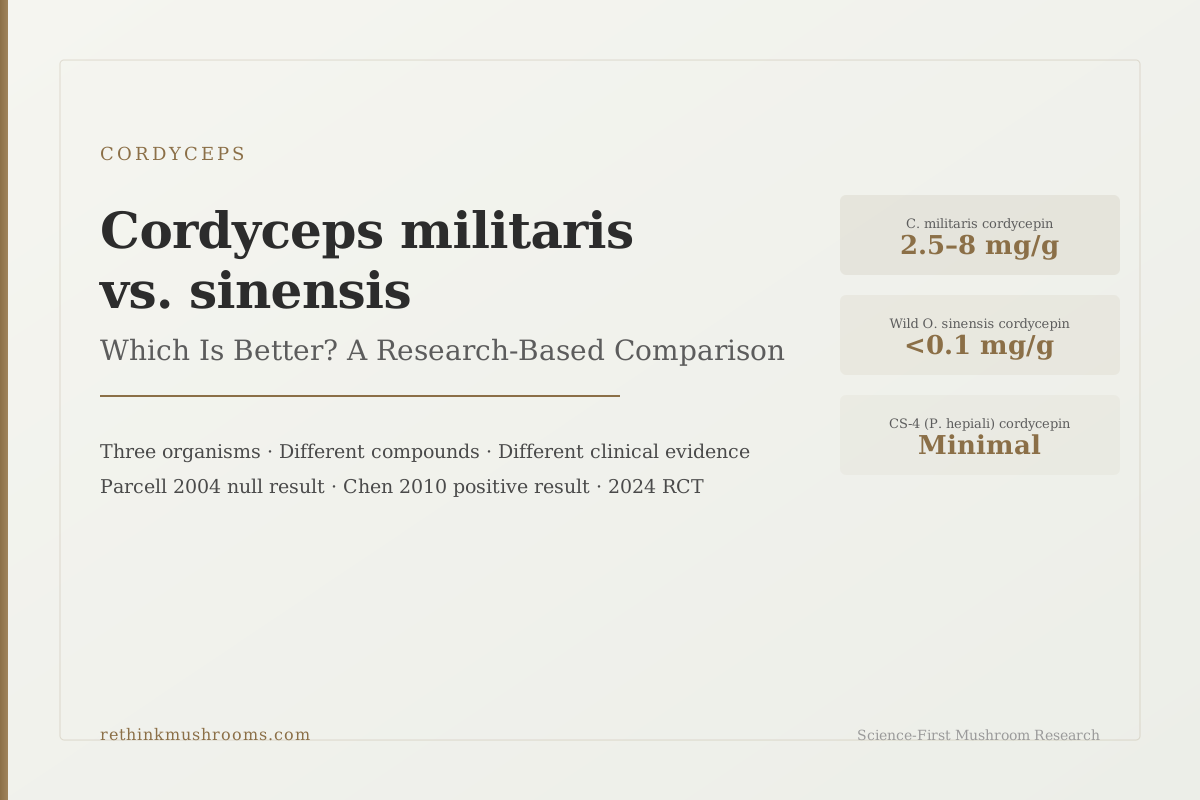
Most articles comparing cordyceps species treat this as a simple two-way choice: the premium wild version versus the affordable cultivated version. That framing misses the most important fact in this comparison. What gets sold as "cultivated Cordyceps sinensis" in most CS-4 supplements is not Cordyceps sinensis at all. It is a different organism called Paecilomyces hepiali, approved by China's drug authority in 1990 as an official substitute for wild Cordyceps sinensis but taxonomically distinct from it.[3]
The honest comparison of cordyceps militaris vs sinensis involves three organisms, not two. Wild Ophiocordyceps sinensis, the traditional Tibetan caterpillar fungus. CS-4, which is Paecilomyces hepiali fermented mycelium. And cultivated Cordyceps militaris, the species that now dominates supplement shelves globally. Each has a different compound profile, a different clinical evidence base, and different populations for whom it is most likely to work.
For an introduction to the Cordyceps genus broadly, see What Is Cordyceps? The Science Behind the Energy Mushroom.
Key Takeaways
- The "cordyceps militaris vs sinensis" comparison involves three distinct organisms — wild Ophiocordyceps sinensis, CS-4 (Paecilomyces hepiali fermented mycelium), and cultivated Cordyceps militaris — and they are not interchangeable[3]
- Cultivated C. militaris fruiting bodies can accumulate substantial cordycepin, but the actual content varies sharply by strain and substrate; in one comparative study, wheat with monosodium glutamate produced the highest cordycepin levels of the substrates tested[4]
- A landmark double-blind RCT in endurance-trained male cyclists (n=22, 3g/day for 5 weeks) found CS-4 produced no significant improvement in aerobic capacity or endurance performance (Parcell et al., 2004)[1]
- A separate double-blind, placebo-controlled trial in healthy older adults (n=20, 333 mg three times daily for 12 weeks) found CS-4 improved metabolic and ventilatory thresholds — but not VO2max — compared to placebo (Chen et al., 2010)[2]
- A 2013 systematic review of Ophiocordyceps sinensis concluded that the complex caterpillar-fungus organism cannot be fully replicated by any current cultivated or fermented product (Lo et al., 2013)[3]
- A 2026 review of Cordyceps militaris and a 2025 meta-analysis of fungal supplementation in athletes synthesize the broader evidence base, including the immunomodulatory and ergogenic claims most often made for the species[5][6]
Three Organisms, Not Two: Why This Comparison Is More Complex Than It Looks
Wild Ophiocordyceps sinensis (historically called Cordyceps sinensis) grows only on the Tibetan Plateau, parasitizing ghost moth caterpillars at altitudes above 3,500 meters. The organism produces a fruiting body from the mummified caterpillar host. This host-fungus complex is what traditional Tibetan and Chinese medicine used for centuries for lung, kidney, and energy conditions. Lo et al.'s 2013 systematic review walks through the taxonomy, traditional use, and chemistry of this complex in detail.[3]
Because wild O. sinensis cannot be successfully cultivated in the standard sense (the host-insect relationship is too complex to replicate at scale), researchers developed fermented mycelium alternatives. The most commercially successful is CS-4, a standardized fermentation of Paecilomyces hepiali developed in China in the 1980s and approved as an official substitute for wild O. sinensis in 1990. It is widely sold as "Cordyceps sinensis" but this is taxonomically incorrect.[3]
Cordyceps militaris is a separate species altogether, found globally on insect pupae but commercially cultivated on grain substrates. It does not require an insect host for cultivation and produces abundant fruiting bodies. It is the species most often associated with cordycepin, the nucleoside that drives much of the modern interest in Cordyceps supplementation.[5]
Why Cordycepin Content Is Not a Single Number
A common claim is that C. militaris contains "X times more cordycepin" than wild O. sinensis. The reality is that cordycepin content in C. militaris is highly variable and depends on cultivation parameters more than on species identity alone.
In Liang et al.'s 2014 substrate study, two strains of C. militaris were grown on multiple grain substrates with different nitrogen sources. The highest cordycepin contents — 25.07 mg/g (strain H) and 22.14 mg/g (strain L) — were obtained on wheat supplemented with monosodium glutamate. Other substrates produced markedly lower cordycepin levels in the same strains.[4]
The implication is practical: a label that says "Cordyceps militaris" guarantees the species, not the cordycepin content. Two C. militaris products can differ by an order of magnitude in cordycepin depending on strain, substrate, fruiting body vs. mycelium, harvest timing, and extraction method. Products that disclose a measured cordycepin percentage offer more assurance than unstandardized powders.
For the broader quality context around fruiting body vs. mycelium products and what substrate claims mean, see Fruiting Body vs. Mycelium: The Great Mushroom Supplement Debate and Mycelium on Grain: Why It's Controversial in the Supplement Industry.
CS-4 Clinical Evidence: A Null Result in Young Athletes, A Threshold Result in Older Adults
The CS-4 evidence base is more nuanced than most comparisons acknowledge. It does not simply work or fail. It worked in one specific older-adult population on threshold metrics and failed in young endurance-trained athletes, and understanding the difference matters more than the headline conclusion.
The null result. Parcell and colleagues (2004) ran a double-blind, placebo-controlled trial of 5 weeks of CordyMax Cs-4 supplementation at 3 g per day in 22 endurance-trained male cyclists. They found no effect on aerobic capacity or endurance exercise performance.[1] The study was well-designed and has held up in subsequent literature: in this fit, well-trained population, CS-4 did not improve performance.
The threshold result. Chen and colleagues (2010) ran a separate double-blind, placebo-controlled trial in 20 healthy older adults (age 50–75) at 333 mg of CS-4 three times daily for 12 weeks. After 12 weeks, the metabolic threshold improved by 10.5% (p < 0.02) and the ventilatory threshold by 8.5% in the CS-4 group. Importantly, the abstract explicitly notes that VO2max did not change in either group.[2] The improvement was in submaximal aerobic thresholds, not peak oxygen uptake.
The difference between the two trials is informative. In already-trained young athletes, CS-4 had no measurable effect on performance. In sedentary or moderately active older adults, CS-4 produced submaximal threshold gains — improvements in the workload at which the body shifts toward anaerobic metabolism — but did not raise the ceiling on aerobic capacity. The pattern is consistent with a small, population-specific effect, not a broad ergogenic one.
For a deeper examination of the CS-4 evidence and the P. hepiali taxonomy, see CS-4 Fermented Cordyceps: Is It Equivalent to Wild Cordyceps?.
C. militaris: A Growing but Still-Evolving Human Evidence Base
C. militaris has the most rapidly expanding human evidence base of the three organisms. A 2026 narrative review by Yang and colleagues synthesized in vitro, in vivo, and clinical work on C. militaris and its constituents, with particular attention to the immunomodulatory pathway.[5]
For ergogenic claims specifically, the most relevant recent synthesis is Shu et al.'s 2025 systematic review and meta-analysis of fungal supplementation in adult athletes, which examined endurance, immune function, and hematological outcomes across the trial literature.[6] Dewi et al.'s 2025 review specifically asked the question of whether Cordyceps works as an ergogenic aid and examined the available trials.[7]
The honest read of the current literature: the C. militaris–specific human trial base is smaller than the older CS-4 dataset and has not produced a result on the order of the Parcell or Chen studies for any specific endpoint. Recent reviews continue to describe the human evidence as preliminary.
For the broader cordycepin pharmacology, see Cordycepin (3'-Deoxyadenosine): The Multi-Target Mushroom Drug.
Which Cordyceps for Which Purpose
The evidence suggests that the right Cordyceps product depends heavily on what you are looking for, and the honest answer for any specific endpoint is more limited than the marketing language suggests.
For cordycepin specifically (AMPK activation, adenosine receptor effects): cultivated C. militaris fruiting body extract, ideally standardized to a measured cordycepin content. CS-4 (P. hepiali) and wild O. sinensis are not the right choice if cordycepin is the target compound, because neither accumulates it efficiently.[3]
For the specific populations where CS-4 has clinical evidence (older adults with declining aerobic capacity): CS-4 is the more studied option, with the Chen 2010 result on metabolic and ventilatory thresholds. It is not a VO2max booster and it has not been shown to help young, fit athletes.[2]
For wild O. sinensis traditional use: the wild organism is irreplaceable if the specific host-derived compounds unique to the caterpillar-fungus complex are the target. However, it is endangered, expensive, and has minimal modern clinical-trial evidence. It is not a practical recommendation for most supplement users.[3]
For general consumers: cultivated C. militaris fruiting body extract with a verified cordycepin content offers the most defensible combination of defined bioactives, accessible pricing, and a growing human evidence base — even if that base is still small relative to the marketing claims surrounding it.
The key practical detail from Liang 2014: ask for or look for a measured cordycepin content on the label, not just "Cordyceps militaris" as the ingredient. Products that disclose a specific cordycepin percentage have at minimum done the analysis to know what is in the bottle.[4]
The Bottom Line
Cordyceps militaris, wild Ophiocordyceps sinensis, and CS-4 (Paecilomyces hepiali) are three distinct organisms with meaningfully different compound profiles and clinical evidence bases. CS-4 has the only well-controlled human RCTs (Parcell 2004 null in young cyclists; Chen 2010 threshold gains but no VO2max change in older adults). C. militaris has a faster-growing recent literature, but the C. militaris–specific human trial base remains smaller than CS-4's. Cordycepin content varies sharply with strain, substrate, and processing rather than being a fixed property of the species. The right answer depends on which biological effect the buyer is actually trying to support.
Frequently Asked Questions
Sources & References
- 1RTHM-00075·Parcell, Allen C et al. (2004). “Cordyceps Sinensis (CordyMax Cs-4) supplementation does not improve endurance exercise performance..” International journal of sport nutrition and exercise metabolism.Study breakdown →PubMed →↩
- 2RTHM-00176·Chen, Steve et al. (2010). “Effect of Cs-4 (Cordyceps sinensis) on exercise performance in healthy older subjects: a double-blind, placebo-controlled trial..” Journal of alternative and complementary medicine (New York.Study breakdown →PubMed →↩
- 3RTHM-00542·Lo, Hui-Chen et al. (2013). “A Systematic Review of the Mysterious Caterpillar Fungus Ophiocordyceps sinensis in Dong-ChongXiaCao ( Dōng Chóng Xià Cǎo) and Related Bioactive Ingredients..” Journal of traditional and complementary medicine.Study breakdown →PubMed →↩
- 4RTHM-00617·Liang, Zeng-Chin et al. (2014). “Various grain substrates for the production of fruiting bodies and bioactive compounds of the medicinal caterpillar mushroom, Cordyceps militaris (Ascomycetes)..” International journal of medicinal mushrooms.Study breakdown →PubMed →↩
- 5RTHM-02247·Yang, Eun-Ju et al. (2026). “An Immunomodulatory Mushroom, Cordyceps militaris, and Its Constituents: A Review of In Vitro/In Vivo Studies and Clinical Trials..” Phytotherapy research : PTR.Study breakdown →PubMed →↩
- 6RTHM-00951·Shu, Meng-Yuan et al. (2025). “Effects of fungal supplementation on endurance, immune function, and hematological profiles in adult athletes: a systematic review and meta-analysis..” Frontiers in nutrition.Study breakdown →PubMed →↩
- 7RTHM-02074·Dewi, Luthfia et al. (2025). “Ergogenic Aid by Cordyceps: Does It Work??.” Current nutrition reports.Study breakdown →PubMed →↩