Cordyceps (C. militaris & C. sinensis)
100x the price
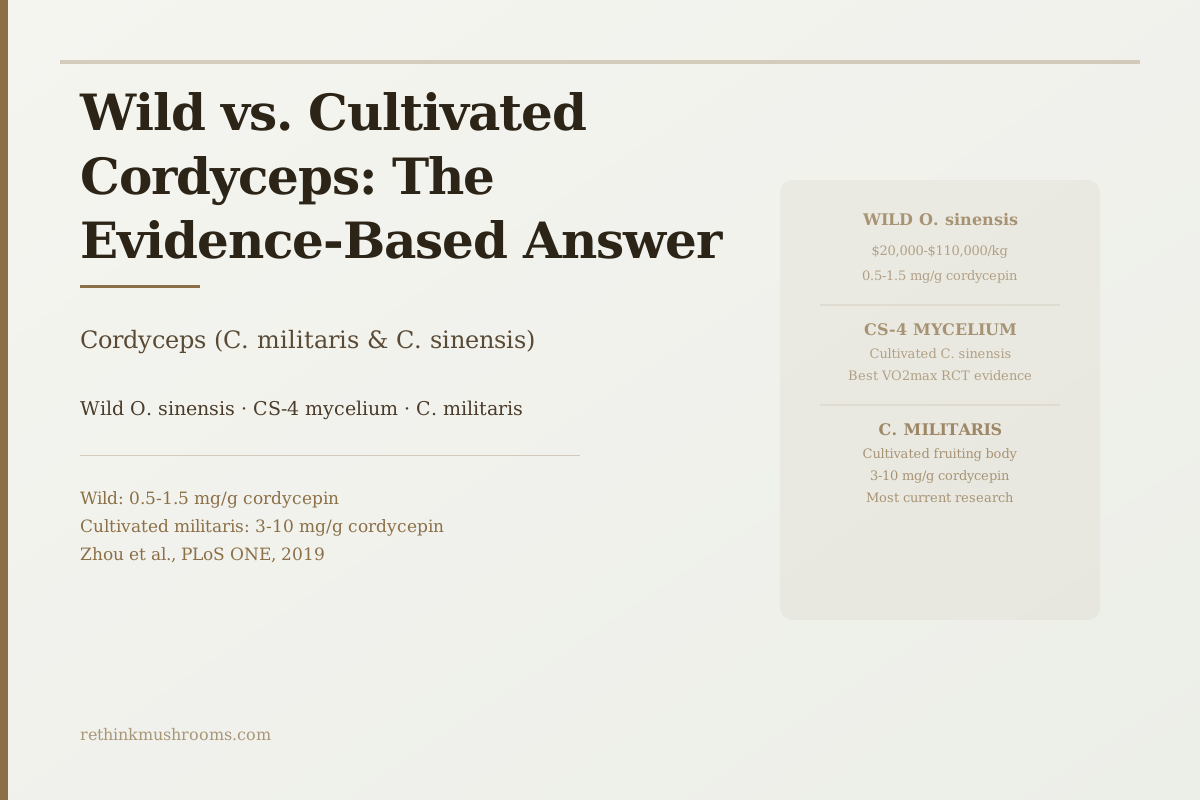
Wild Ophiocordyceps sinensis can cost $110,000 per kilogram. A 2019 composition study found cultivated Cordyceps sinensis had significantly higher cordycepin than wild-harvested samples, meaning the premium does not guarantee higher bioactive content.
Zhou et al., PLoS ONE, 2019
Higher cordycepin
in cultivated C. sinensis than wild-harvested O. sinensis per head-to-head composition study
VO2max improved
significantly in healthy older adults taking CS-4 (cultivated C. sinensis mycelium) vs. placebo in RCT
3 product types
sold as Cordyceps: wild O. sinensis, CS-4 mycelium, and cultivated C. militaris fruiting body
Zhou et al., PLoS ONE, 2019
 View as image ↗
Wild Cordyceps is expensive because it is rare, ecologically fragile, and culturally prestigious. Cultivated Cordyceps is affordable because it can be grown on grain in controlled facilities. Those facts are not in dispute. What is disputed, and what the research actually resolves, is whether paying the premium produces better biological outcomes. The answer requires separating three products that all get marketed under the single name "Cordyceps": wild Ophiocordyceps sinensis harvested from Tibetan plateaus, CS-4 (a cultivated O. sinensis mycelium grown in fermentation tanks), and cultivated Cordyceps militaris fruiting bodies grown on grain substrates in commercial facilities. These are not the same fungus, not the same part of the fungus, and not the same compound profile. For a broader introduction to Cordyceps and what it does in the body, see what is Cordyceps.
Key Takeaways
- Three distinct products are all sold as "Cordyceps": wild O. sinensis, CS-4 fermented mycelium, and cultivated C. militaris fruiting bodies; these have meaningfully different compound profiles and clinical evidence bases
- A 2019 PLoS ONE composition study (Zhou et al.) found cultivated C. sinensis had significantly higher cordycepin and adenosine than wild-harvested O. sinensis, directly contradicting the premise that wild is compositionally superior
- Cordycepin, the primary bioactive compound differentiating Cordyceps from other mushrooms, activates AMPK via two molecular mechanisms confirmed by Hawley et al. in Cell Chemical Biology (2020), explaining why cordycepin concentration matters for metabolic and energy effects
- Cultivated C. militaris fruiting body cordycepin content can be maximized through substrate selection (rice, wheat), light exposure (blue light triggers biosynthesis), and harvest timing (cordycepin peaks at late maturation)
- CS-4 is the only Cordyceps form with a double-blind RCT showing significant VO2max improvement in healthy older adults (Chen et al., 2010); cultivated C. militaris has the most recent comprehensive clinical trial evidence (Yang et al., 2026)
- For cordycepin-driven effects (energy, metabolic, anti-inflammatory), cultivated C. militaris fruiting body has the highest typical cordycepin concentration and the most current research; for traditional TCM kidney applications, wild or CS-4 preparations match the historical evidence base
Three Products Marketed as Cordyceps: Why They Are Not Interchangeable
The species biology matters here because it drives everything downstream.
Wild Ophiocordyceps sinensis (formerly classified as Cordyceps sinensis) is a parasitic fungus that requires a ghost moth caterpillar larva as its host. The larva is infected underground, the fungus colonizes and kills it, and a fruiting body emerges from the caterpillar's head. This lifecycle cannot be replicated in commercial settings: the ghost moth caterpillar's specific physiology, the high-altitude soil conditions (3,500 to 5,000 meters), and the precise timing all need to be present. Wild O. sinensis cannot be commercially cultivated. It is hand-harvested in Tibet and neighboring regions during a short seasonal window, which is why its price reaches $20,000 to $110,000 per kilogram.
CS-4 is not the same organism grown in a lab. It is a mycelium culture of Cordyceps sinensis grown in liquid or solid-state fermentation, producing mycelium (the root-like network) rather than fruiting bodies. The compounds it contains reflect mycelial metabolism, not fruiting-body metabolism. CS-4 is cheaper and replicable, and it forms the basis of most "Cordyceps sinensis" supplements outside of the premium market.
Cultivated Cordyceps militaris is a different species. It is closely related to O. sinensis but does not require a caterpillar host. C. militaris can be grown to full fruiting body on grain substrates (rice, wheat, sorghum) in controlled environments, at scale, with consistent quality control. It is the source of most mainstream Cordyceps supplements and the form with the most rapidly growing body of clinical research.
The supplement label may say "Cordyceps" in all three cases. The compound inside the capsule can be substantially different.
What the Composition Data Shows: Cordycepin, Adenosine, and Polysaccharides
The three key compound classes in Cordyceps products are cordycepin, adenosine, and polysaccharides. Their concentrations differ significantly across the three product types.
Cordycepin (3'-deoxyadenosine) is the signature bioactive unique to Cordyceps species. It is the compound behind the AMPK-activation mechanism, the anti-inflammatory effects, and the adenosine-receptor pharmacology that explains most of Cordyceps's modern clinical applications. Zhang and colleagues, reviewing cordycepin's pharmacology across cancers and metabolic diseases in Frontiers in Pharmacology in 2024, mapped its multi-target profile across AMPK, mTOR, NF-κB, and apoptosis pathways.[3]
Adenosine contributes cardiovascular and sleep-related effects through direct adenosine receptor binding.
Polysaccharides contribute immune modulation, antioxidant activity, and some of the broad systemic effects attributed to Cordyceps.
The relative concentrations of each compound vary by species, part of the fungus, and growth conditions. Here is how the three product types compare based on available analytical data:
| Product Type | Cordycepin | Adenosine | Polysaccharides | Cultivation? |
|---|---|---|---|---|
| Wild O. sinensis | 0.5-1.5 mg/g (variable) | Present | Present | No |
| CS-4 mycelium (cultivated sinensis) | Variable (often low) | Present | Present | Yes (mycelium) |
| C. militaris fruiting body (cultivated) | 3-10 mg/g (standardizable) | Present | Present | Yes (fruiting body) |
These ranges reflect the general analytical picture across the literature, with cultivation parameters being the primary driver of variation in cultivated forms.
The 2019 Study That Challenges the Wild Premium
The most relevant head-to-head composition data comes from Zhou and colleagues, who published a comparative analysis of wild-harvested O. sinensis, cultivated O. sinensis, and stiff worms (early-stage caterpillar mummies before fungal emergence) in PLoS ONE in 2019.[1]
Their finding directly challenges the premise that wild cordyceps is compositionally superior: cultivated C. sinensis had significantly higher mean adenosine and cordycepin concentrations than wild-harvested O. sinensis. Wild-harvested samples had higher mannitol and polysaccharide content. The researchers concluded that overall nutritional composition was effectively "identical" between wild and cultivated C. sinensis and that cultivated material "can serve as an effective substitute."
The implication for buyers is significant. If you are purchasing wild O. sinensis specifically for its cordycepin content, the evidence suggests cultivated C. sinensis at a fraction of the price provides the same or higher cordycepin concentration. The premium for wild O. sinensis may reflect cultural prestige, traditional medicine context, and supply scarcity, but it does not reliably reflect higher cordycepin content.
The comparison becomes even more pronounced when cultivated C. militaris enters the picture. C. militaris fruiting bodies, grown under optimized conditions, can reach cordycepin concentrations of 3 to 10 mg/g, substantially higher than the typical 0.5 to 1.5 mg/g range for wild O. sinensis.
For the detailed story of why wild cordyceps commands its extraordinary price and what the traditional evidence base actually supports, see the wild Cordyceps controversy: why it costs $20,000 per kilogram.
Why Cordycepin Concentration Determines Efficacy for Most Modern Applications
Hawley and colleagues published what is arguably the most mechanistically important Cordyceps paper of the last decade in Cell Chemical Biology in 2020: a rigorous analysis of exactly how cordycepin activates AMPK, the body's cellular energy sensor.[2]
AMPK (adenosine monophosphate-activated protein kinase) is the enzyme that cells use to detect energy status. When AMPK is activated, cells shift from energy-consuming processes to energy-generating ones. This is the metabolic basis for why Cordyceps is associated with endurance improvement, anti-fatigue effects, and metabolic support.
Hawley et al. found that cordycepin activates AMPK through two simultaneous mechanisms. First, cordycepin acts as a structural analog of AMP (adenosine monophosphate) and binds directly to AMPK's regulatory sites. Second, cordycepin inhibits an enzyme called AMP deaminase, which normally breaks down AMP. Blocking AMP deaminase raises intracellular AMP levels, which independently activates AMPK. The result is dual AMPK activation from a single compound.
This mechanism explains the dose-relevance of cordycepin concentration. The higher the cordycepin content in a product, the more molecular substrate is available for AMPK binding and AMP deaminase inhibition. Products with negligible cordycepin content, including some wild O. sinensis products and many mycelium-only products with no standardized cordycepin, provide little to no input to this pathway.
Yang and colleagues' 2026 review in Phytotherapy Research, the most comprehensive recent synthesis of C. militaris clinical trial evidence, confirmed that cordycepin and the polysaccharide compounds work through complementary pathways across immune modulation, anti-inflammatory, antitumor, and metabolic effects.[4] The clinical evidence for C. militaris spans both compound classes.
For a deeper look at cordycepin's multi-target pharmacology, see cordycepin (3'-deoxyadenosine): the multi-target compound behind Cordyceps' effects.
The Cultivation Science: Why Cultivated Militaris Can Be Standardized
Cordycepin concentration in cultivated C. militaris is not fixed. It is a product of cultivation decisions, and this is both a challenge and an opportunity.
Oh and colleagues, profiling the metabolomic changes during C. militaris fruiting body development in the Journal of Microbiology in 2019, found that cordycepin accumulates progressively as fruiting bodies mature and senesce (age).[5] Harvesting fruiting bodies at optimal maturation rather than early in the growth cycle maximizes cordycepin yield. This insight enables commercial producers to deliberately control cordycepin content through harvest timing, something impossible with wild O. sinensis.
Substrate selection also affects compound yield. Liang and colleagues tested multiple grain substrates for C. militaris cultivation in the International Journal of Medicinal Mushrooms in 2014, finding that different grain substrates (rice, wheat, sorghum) support different levels of fruiting body development and secondary metabolite production, including cordycepin.[6] Substrate optimization can meaningfully increase bioactive compound content before extraction begins.
Light conditions play a third role. Yang and colleagues identified a blue-light photoreceptor (CmWC-1) in C. militaris that mediates both fruiting body development and secondary metabolism, including cordycepin biosynthesis, in Applied Microbiology and Biotechnology in 2016.[7] Blue light exposure directly triggers the biosynthetic pathway that produces cordycepin. Commercial cultivators who manage light conditions can use this mechanism to increase yields.
The practical implication: a well-managed C. militaris cultivation facility can produce fruiting bodies with substantially higher and more consistent cordycepin content than wild O. sinensis, which is subject to environmental variability and has no controllable cultivation parameters at all.
Which Form Has Clinical Trial Support?
The clinical evidence base is uneven across the three product types, and this is worth knowing before choosing a supplement.
CS-4 (cultivated C. sinensis mycelium): The best-powered human RCT for Cordyceps in an exercise context used CS-4. Chen and colleagues ran a double-blind placebo-controlled trial in 20 healthy older adults, supplementing with CS-4 and measuring VO2max (a gold standard measure of aerobic capacity) in the Journal of Alternative and Complementary Medicine in 2010.[8] CS-4 supplementation produced significant improvement in VO2max compared to placebo. This remains one of the most methodologically clean human trials in the Cordyceps literature. CS-4 is also the form used in several kidney-function trials (Cochrane-reviewed) that support its traditional TCM kidney application.
Cultivated C. militaris: Yang et al.'s 2026 review is the most comprehensive recent synthesis of C. militaris human trial evidence, covering immune modulation, anti-inflammatory, antitumor, and metabolic effects across in vitro, animal, and human studies.[4] The review confirms significant clinical evidence for cordycepin-driven and polysaccharide-driven mechanisms. For an overview of its bioactive compounds across both classes, see Cordyceps bioactive compounds: cordycepin, adenosine, and polysaccharides.
Wild O. sinensis: The clinical trials that specifically used wild O. sinensis are primarily in TCM kidney-function and transplant contexts. Energy and athletic performance trials have generally used CS-4 or cultivated C. militaris. If you are buying wild O. sinensis for its energy or performance effects, you are extrapolating from trials that used different products.
Choosing Based on the Evidence: A Framework by Use Case
The evidence points in different directions depending on what you are trying to achieve.
If the goal is cordycepin-driven effects (energy metabolism, AMPK activation, anti-inflammatory action, or the cardiovascular effects explained in Cordyceps pharmacology), the form with the highest standardized cordycepin content is C. militaris fruiting body extract. Zhou 2019 shows cultivated C. sinensis already outperforms wild in cordycepin per gram. C. militaris fruiting body typically outperforms both, and its production can be deliberately optimized for cordycepin yield through substrate, light, and harvest timing.
If the goal is matching the TCM evidence base for kidney function or transplant support, the evidence is almost entirely in wild O. sinensis and CS-4 preparations. C. militaris has not been studied in kidney-function contexts to the same extent.
If the goal is immune modulation via polysaccharides, both cultivated C. militaris and CS-4 provide polysaccharide content, and the wild premium offers no documented advantage for this mechanism.
What the evidence does not support is paying the wild premium for cordycepin-driven benefits. Zhou 2019 specifically contradicts the premise that wild is compositionally superior for this compound. The premium reflects scarcity and tradition, not higher bioactive content for the applications most supplement buyers are seeking.
The Bottom Line
A 2019 composition study found cultivated Cordyceps sinensis had higher cordycepin and adenosine than wild-harvested O. sinensis, directly challenging the premise that wild is compositionally superior. Cultivated C. militaris fruiting bodies, whose cordycepin content can be optimized through substrate selection, light exposure, and harvest timing, typically contain 3 to 10 mg/g cordycepin vs. 0.5 to 1.5 mg/g in wild O. sinensis. For cordycepin-driven effects, cultivated C. militaris fruiting body has the strongest compound concentration and the most current clinical evidence. For traditional TCM kidney applications, wild O. sinensis and CS-4 preparations match the historical evidence base.
Frequently Asked Questions
Sources & References
- 1. Source details for this reference are not yet available.
- 2. Source details for this reference are not yet available.
- 3. Source details for this reference are not yet available.
- 4. Source details for this reference are not yet available.
- 5. Source details for this reference are not yet available.
- 6. Source details for this reference are not yet available.
- 7. Source details for this reference are not yet available.
- 8. Source details for this reference are not yet available.