Cordyceps (C. militaris & C. sinensis)
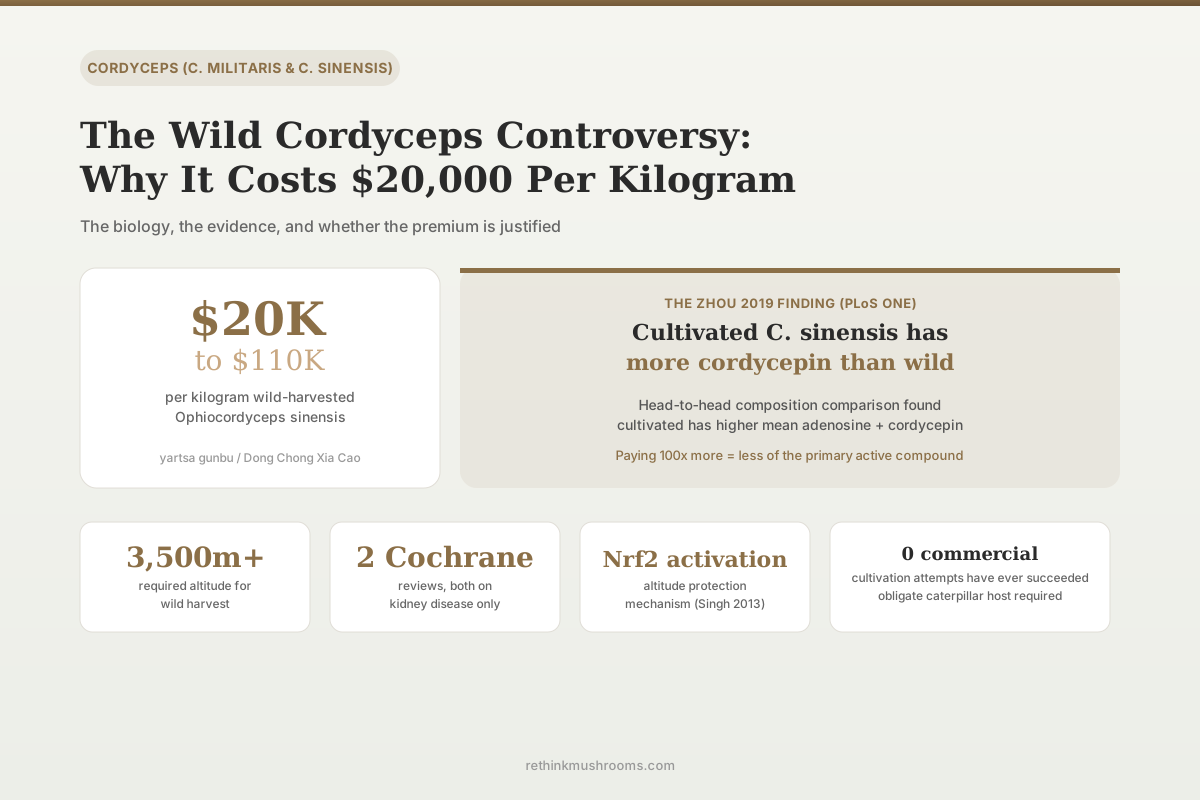
$20K–$110K/kg
Wild Ophiocordyceps sinensis is the world's most expensive fungal product. A 2019 head-to-head composition study found that cultivated Cordyceps actually has higher mean cordycepin content than the wild-harvested version.
Zhou et al., PLoS ONE, 2019
3,500m+
altitude required for wild harvest in Tibet and the Himalayas
2 Cochrane reviews
on wild O. sinensis both focus on kidney disease, not energy or immunity
0 cultivated
commercial cultivation of wild O. sinensis has never succeeded
Zhou et al., PLoS ONE, 2019
 View as image ↗
At the high-altitude grasslands of the Tibetan Plateau, between 3,500 and 5,000 meters above sea level, villagers spend weeks in May and June kneeling on the ground searching for a small, finger-shaped yellow-brown stalk protruding from the soil. What they are looking for is yartsa gunbu, one of the world's most expensive natural products, priced between $20,000 and $110,000 per kilogram. The object of that search is the fungus that is sold in western markets as wild Cordyceps sinensis, more correctly named Ophiocordyceps sinensis. Understanding why wild Cordyceps is so expensive requires understanding both the biology that makes it irreplaceable and the research that raises genuine questions about whether the price is justified. For an introduction to Cordyceps broadly, see What Is Cordyceps? The Science Behind the Energy Mushroom.
Key Takeaways
- Wild Ophiocordyceps sinensis costs $20,000-$110,000/kg because it grows only at 3,500-5,000m altitude in Tibet and the Himalayas, requires a ghost moth larva as host, cannot be commercially cultivated, and must be hand-harvested.
- Despite decades of attempts, commercial cultivation of O. sinensis has failed because the fungus requires its specific host caterpillar (Thitarodes species) to complete its lifecycle; cultivated products sold as "wild cordyceps" are different organisms.
- A 2019 head-to-head composition study (Zhou et al., PLoS ONE) found that cultivated C. sinensis actually has higher mean cordycepin and adenosine content than wild-harvested O. sinensis, directly challenging the premium's justification.
- The published clinical evidence base for wild O. sinensis consists almost entirely of kidney disease and transplant studies (two Cochrane reviews, one meta-analysis), focused on kidney disease rather than energy, immunity, or athletic performance.
- Singh et al. (2013) demonstrated a real molecular mechanism behind the traditional altitude use: O. sinensis extract activates the Nrf2 cytoprotective pathway, increasing cellular resistance to oxygen deprivation.
- For cordycepin-driven benefits (energy, AMPK activation, anti-inflammatory effects), cultivated C. militaris fruiting body has higher compound concentrations and more modern research than wild O. sinensis.
The Biology Behind the Price: Why This Fungus Cannot Be Farmed
The reason wild O. sinensis costs more per kilogram than gold has nothing to do with market manipulation or cultural mythology. It has to do with an extremely inconvenient biological fact: this fungus can only complete its lifecycle inside the living body of a specific moth larva.
The host is a ghost moth caterpillar belonging to the genus Thitarodes. The fungus infects the larva while it is underground, gradually consuming its tissue and eventually filling the caterpillar's body with fungal mycelium. The larva dies. The following spring, a yellow-brown fruiting body erupts from the dead caterpillar's head and grows upward through the soil. The visible structure (about 3-5 centimeters long) is the combination of the mummified caterpillar body and the fungal stalk emerging from it.
Every attempt to cultivate this process commercially has failed. The ghost moth larvae cannot be raised at scale in captivity (they eat plant roots and require specific soil environments). The caterpillar-fungus relationship is an obligate one, meaning the fungus cannot skip the host and complete its reproductive cycle on a substrate. The altitude matters too: O. sinensis grows only above 3,500 meters in Tibet, Bhutan, Nepal, and northern India, in cold grasslands that support the right caterpillar populations. Each fruiting body must be found by hand and picked before the spores disperse.
The result: all supply is wild-harvested, all harvesting is labor-intensive, supply is geographically constrained to remote high-altitude regions, and demand from Chinese herbal medicine markets (plus growing western supplement interest) has increased continuously for decades.
What is sold in western markets as "cultivated wild cordyceps" is either cultivated Cordyceps sinensis mycelium (a different preparation method, not the same as wild), CS-4 (a lab-fermented mycelium product), or cultivated Cordyceps militaris (a different species entirely). None of these are the same organism as the wild-harvested Tibetan product. For the full comparison of these preparations, see The Wild vs. Cultivated Cordyceps Debate: Does Origin Affect Efficacy?.
Yartsa Gunbu: 2,000 Years of Traditional Use at High Altitude
"Yartsa gunbu" is Tibetan for "summer grass, winter worm," a description of the visible form the fungus takes as the seasons change. In Chinese, it is called "Dong Chong Xia Cao," meaning exactly the same thing. The earliest documented use appears in Tibetan medicine texts from the 15th century, where it was described as a tonic for kidney deficiency, sexual function, and vitality. In traditional Chinese medicine, it entered formal pharmacopoeias later.
The economic significance to high-altitude Himalayan communities is substantial. For Tibetan and Nepali villagers, wild O. sinensis can constitute 50-80% of annual cash income during the short spring harvesting window. The harvest season is governed by official policies in different jurisdictions, and over-harvesting has become a conservation concern as population pressure and demand have increased together.
In traditional therapeutic use, the primary applications were: supporting kidney function, promoting lung health (particularly relevant at altitude where oxygen is scarce), building vitality and endurance, and, historically, treating high-altitude sickness. These are not random historical claims. Some of them have a documented biological mechanism.
The Nrf2 Mechanism: Why Traditional Altitude Medicine Has a Real Scientific Basis
The traditional use of wild O. sinensis for high-altitude conditions turns out to have a credible molecular explanation.
Singh and colleagues tested O. sinensis extract in human lung cells and found that it activated a cellular defense pathway controlled by a protein called Nrf2 (Nuclear factor erythroid 2-related factor 2).[6] Nrf2 is sometimes called the "master regulator of cellular defense" because when it is activated, it triggers the production of protective enzymes that defend cells from oxidative damage and oxygen deprivation. Two specific protective proteins were upregulated in Singh's experiment: heme oxygenase-1 (an enzyme that helps cells manage oxidative stress) and metallothionein (a protein that captures and neutralizes harmful reactive compounds).
Cover "heme oxygenase-1" with your thumb and the sentence still makes sense: the fungus activated enzymes that protect cells from oxygen deprivation. The technical details add precision for those who want them.
This Nrf2 pathway activation is biologically meaningful at altitude, where lower oxygen levels push cells into a stressed state. Singh's experiment directly demonstrates a molecular mechanism for why O. sinensis might help with altitude conditions: it activates the cell's own defense system against hypoxic stress. The experiment used cell cultures, not living organisms, but Rakhee and colleagues later demonstrated protective effects against high-altitude-induced hypoxia and oxidative stress in rodent models using an O. sinensis formulation.[5]
The Tibetan traditional use for altitude and lung health has a genuine biological plausibility, backed by mechanistic data, even if the clinical trial evidence is limited. Liu and colleagues' comprehensive compound review of C. sinensis noted the anti-hypoxic activity as one of the species' documented pharmacological properties, mapped to specific bioactive constituents.[7]
What the Clinical Evidence for Wild O. sinensis Actually Shows
Here is the part that most coverage leaves out: the clinical evidence base for wild O. sinensis is narrow and focused on a specific indication that is not what most western supplement buyers are purchasing it for.
Two Cochrane systematic reviews have been published on O. sinensis. Both cover kidney applications.
The first, by Zhang and colleagues, reviewed C. sinensis for chronic kidney disease (CKD) and found some evidence of benefit for kidney function, but concluded that the overall quality of evidence was low: small trials, high risk of bias, inconsistent outcome measures.[4]
The second, by Hong and colleagues, reviewed C. sinensis as an adjunct for kidney transplant recipients and found possible benefit for kidney function biomarkers, again with low overall evidence quality.[3] A meta-analysis by Ong and Aziz pooled the available transplant data and found modest benefits for creatinine levels (a waste product that kidneys filter from the blood, with lower levels indicating better kidney function), but noted that all included trials used O. sinensis or CS-4 preparations, not cultivated C. militaris.[2]
The clinical picture: what evidence exists for wild O. sinensis is concentrated in kidney disease and transplant contexts. There are no blinded RCTs demonstrating that wild O. sinensis improves athletic endurance, energy levels, or immunity in healthy adults. Those outcomes have been studied in cultivated Cordyceps militaris (Kang 2015 immune RCT) and CS-4 (Chen 2010 VO2max RCT), not in wild O. sinensis.
For a deeper look at the kidney application history, see Cordyceps sinensis and Kidney Transplant: Traditional Use.
The Zhou 2019 Finding: What a Head-to-Head Composition Study Actually Showed
The most important piece of data for evaluating the wild O. sinensis premium comes from a 2019 study that compared the chemical composition of wild-harvested O. sinensis against cultivated samples across multiple collection years.
Zhou and colleagues analyzed the major bioactive constituents in both wild and cultivated C. sinensis preparations and reached a conclusion that inverts the standard premium narrative: cultivated C. sinensis had significantly higher mean adenosine and cordycepin content than wild-harvested O. sinensis.[1] Wild samples had higher mannitol and polysaccharide content. The authors concluded that cultivated C. sinensis can serve as an effective substitute, and that its overall nutritional composition, while different in some compounds, is broadly equivalent.
Cordycepin is the compound most frequently cited as responsible for Cordyceps' modern pharmacological effects: AMPK activation, anti-inflammatory NF-κB suppression, adenosine receptor signaling. If you are buying wild O. sinensis for cordycepin-mediated benefits, Zhou 2019 is an inconvenient result: you are paying 100 times more for less of the primary active compound.
Wild O. sinensis does have higher polysaccharide content, which matters for immune applications, and it has higher mannitol, a compound with established benefits for acute kidney applications. The traditional kidney use, then, is the application most consistent with wild O. sinensis's actual compound profile. The energy and performance applications are not.
For readers interested in cordycepin specifically, see Cordycepin (3'-Deoxyadenosine): The Multi-Target Compound Behind Cordyceps' Effects.
When Does the Wild Cordyceps Premium Actually Make Sense?
Not often, by the standards of current evidence. Here is the honest breakdown:
If your interest is athletic performance or energy: Cultivated C. militaris fruiting body has substantially higher cordycepin content, a modern evidence base that includes blinded RCTs, and costs a fraction of wild O. sinensis. The premium is not justified.
If your interest is immune support: The Kang 2015 RCT demonstrating immune enhancement used cultivated C. militaris, not wild O. sinensis. The immune polysaccharides are present in both, but cultivated is both cheaper and better-studied for this application.
If your interest is kidney support following TCM principles: This is the application most consistent with the actual evidence base and the actual compound profile of wild O. sinensis. Both Cochrane reviews and the meta-analysis used O. sinensis preparations. The polysaccharide and mannitol composition matches the kidney application historically. This is the context where the traditional preparation most closely aligns with the research.
If your interest is altitude adaptation: The Nrf2 mechanism is documented. The traditional context is real. But the evidence is preclinical, and cultivated alternatives have not been comparatively tested for this specific application.
If you are buying for cultural or traditional medicine reasons: Wild yartsa gunbu has 2,000 years of documented use in Tibetan and Chinese medicine, and the communities that harvest it depend on its economic value. That context has meaning independent of pharmacological optimization.
What the premium does not represent is access to a superior scientific product for the most common reasons western consumers buy Cordyceps supplements.
The Bottom Line
Wild Ophiocordyceps sinensis costs $20,000-$110,000/kg because biological constraints make commercial cultivation impossible. It requires a specific ghost moth larva host, grows only at extreme altitude, and must be hand-harvested. The clinical evidence base is real but narrow: two Cochrane reviews and a meta-analysis support its use specifically for kidney disease and transplant outcomes. The bombshell from Zhou et al. (2019) is that cultivated Cordyceps has higher cordycepin and adenosine content than wild, meaning buyers paying the premium for cordycepin-driven benefits are receiving less of those compounds per dollar than they would with cultivated alternatives. The premium makes the most sense for traditional kidney applications matching the research evidence, and the least sense for energy or performance goals.
Frequently Asked Questions
Sources & References
- 1. Source details for this reference are not yet available.
- 2. Source details for this reference are not yet available.
- 3. Source details for this reference are not yet available.
- 4. Source details for this reference are not yet available.
- 5. Source details for this reference are not yet available.
- 6. Source details for this reference are not yet available.
- 7. Source details for this reference are not yet available.