Cordycepin Pharmacology
3'-dA structural analogue of adenosine
Cordycepin is 3'-deoxyadenosine, a nucleoside analogue that is phosphorylated intracellularly to 3'-dATP and disrupts RNA polyadenylation. It also activates AMPK, modulates adenosine receptor signalling, and is rapidly inactivated by adenosine deaminase (ADA).
Ashraf et al., Molecules, 2020; Thomadaki et al., 2008
Polyadenylation Inhibitor
truncates poly(A) tail, destabilises mRNA
AMPK Activator
central metabolic-energy pathway
ADA Substrate
rapid deamination limits oral bioavailability
Ashraf et al., Molecules, 2020; Thomadaki et al., 2008
 View as image ↗
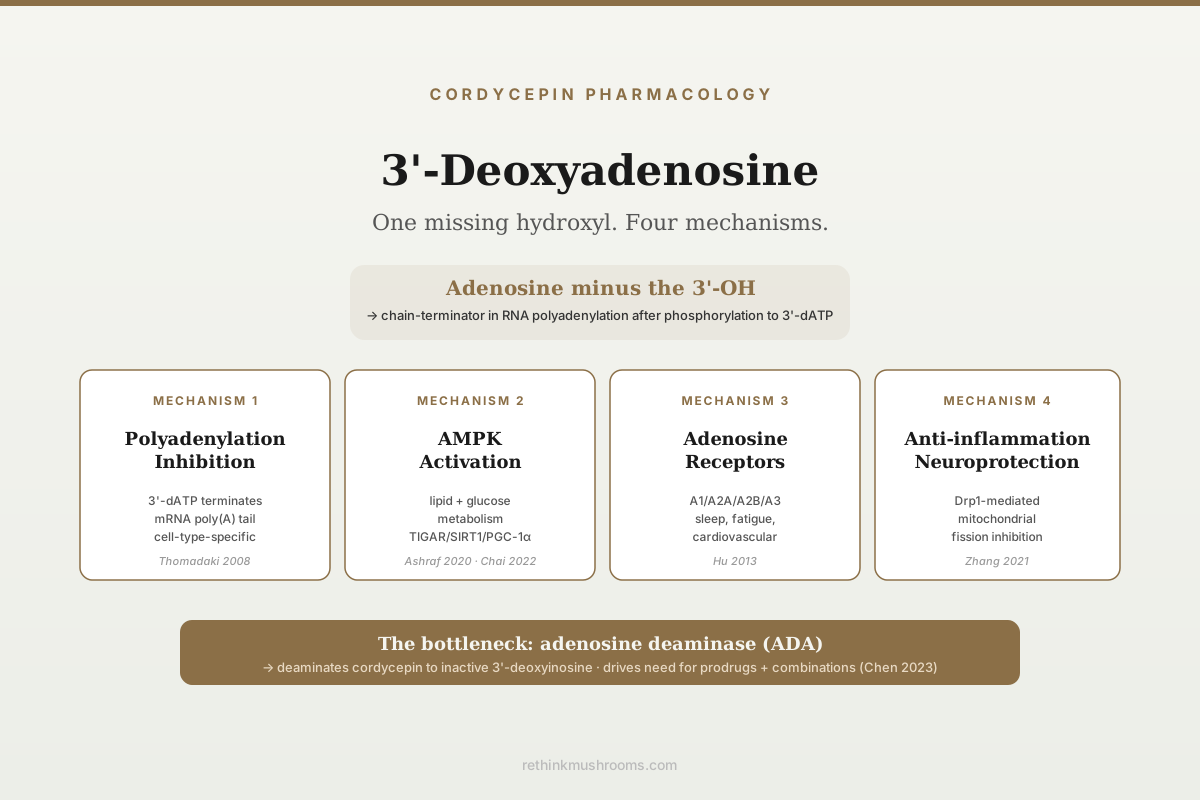
Cordycepin, chemically 3'-deoxyadenosine, is the single compound that most of the Cordyceps pharmacology literature traces back to. It is a nucleoside analogue of adenosine with one defining structural difference: the 3' hydroxyl group on the ribose sugar is missing, replaced by a hydrogen. That single-atom difference is the basis for everything else. The missing hydroxyl lets cordycepin insert into RNA but blocks chain elongation beyond that position, which disrupts polyadenylation and destabilises mRNA. The close structural resemblance to adenosine also makes cordycepin a substrate for adenosine-handling enzymes, a ligand at adenosine receptors, and a substrate for rapid deamination by adenosine deaminase (ADA). Ashraf and colleagues (2020) provide the most complete recent overview of the compound's pharmacology, and Zhang and colleagues (2024) extend it with a structural and pharmacological review focused on neoplasms and metabolic disorders.[1] [2]
For deeper dives on specific aspects see how cordycepin works: mechanisms of action across diseases, cordycepin and adenosine signaling: the energy connection and cordycepin as a pharmaceutical: current development status.
Key Takeaways
- Cordycepin (3'-deoxyadenosine) differs from adenosine by a single hydroxyl; that missing 3'-OH is the basis for polyadenylation inhibition after phosphorylation to 3'-dATP
- Thomadaki et al. (2008) detailed cordycepin's role in cancer as a polyadenylation inhibitor, with cell-type-specific effects that can either induce or suppress apoptosis
- Ashraf et al. (2020) and Zhang et al. (2024) reviewed cordycepin's AMPK-dependent regulation of lipid and glucose metabolism, the second major mechanism beyond RNA effects
- Adenosine deaminase (ADA) rapidly deaminates cordycepin to inactive 3'-deoxyinosine, which limits bioavailability and drove the development of ADA-resistant prodrugs and ADA-inhibitor co-administration strategies (Chen et al., 2023)
- Hu et al. (2013) showed oral cordycepin increases non-rapid-eye-movement (NREM) sleep and theta-wave power in rats and raises hypothalamic A1, A2A, and A2B adenosine receptor levels, the authors' proposed third mechanistic arm
- Zhang et al. (2021) showed cordycepin has anti-inflammatory and neuroprotective effects in rotenone-induced Parkinson's disease models via Drp1-mediated mitochondrial fission
The Molecule: Adenosine Minus One Hydroxyl
Cordycepin is 9-(3-deoxy-β-D-ribofuranosyl)-adenine. Adenosine carries a ribose sugar with hydroxyls at the 2', 3' and 5' positions. Cordycepin has hydroxyls only at the 2' and 5' positions. The missing 3' hydroxyl, replaced by a hydrogen, is the entire structural distinction. That distinction is why cordycepin is both biologically active in multiple distinct ways and challenging to translate from laboratory to clinic.
Inside a cell, cordycepin is phosphorylated by adenosine kinase to cordycepin monophosphate, diphosphate, and then triphosphate. The 3'-dATP metabolite is the active form for most downstream effects. Ashraf 2020 catalogued the phosphorylation cascade and the downstream intracellular consequences.[1] Sharma and colleagues (2022) provided a further detailed review of cordycepin as a metabolite with pharmacological potential.[3]
The ADA Problem
The most clinically important metabolic feature of cordycepin is its rapid deamination. Adenosine deaminase, the same enzyme that deaminates adenosine to inosine, also deaminates cordycepin to 3'-deoxyinosine. The deaminated product is largely inactive. In the bloodstream, where ADA activity is high, cordycepin has a very short half-life. Oral cordycepin therefore faces two sequential barriers: first-pass hepatic metabolism and rapid plasma deamination.
The pharmacological solution has been to either co-administer an ADA inhibitor such as pentostatin, or to develop ADA-resistant cordycepin analogues and prodrugs. Chen and colleagues (2023) reviewed the strategies to improve cordycepin bioavailability and efficacy, covering prodrug chemistry, liposomal delivery, nanoparticle encapsulation and ADA-inhibitor combinations.[4] This is the single largest obstacle between the preclinical activity of cordycepin and its translation to human therapeutics. A consumer-grade Cordyceps militaris supplement providing cordycepin orally faces the same ADA barrier without the benefit of formulation chemistry.
Mechanism 1: Polyadenylation Inhibition
The first and historically best-characterised mechanism of cordycepin is inhibition of RNA polyadenylation. Most eukaryotic mRNAs carry a 3'-terminal poly(A) tail that stabilises the mRNA, enables nuclear export and licenses translation. Polyadenylation requires successive addition of adenosine nucleotides, each of which forms a 5'-3' phosphodiester bond with the previous adenosine. A 3'-deoxyadenosine incorporated into this chain lacks the 3'-OH needed for the next linkage, and chain extension terminates.
Thomadaki and colleagues (2008) tested cordycepin in five leukemia and lymphoma cell lines (U937, K562, HL-60, Daudi, Molt-4) alongside the chemotherapeutic etoposide and showed that the apoptotic outcome is cell-type specific.[5] In HL-60 cells, cordycepin induced apoptosis. In U937 and K562, it suppressed apoptotic processes. Daudi and Molt-4 used alternative apoptotic pathways and did not respond to polyadenylation inhibition the same way. This cell-type specificity is a feature of nucleoside analogue pharmacology generally, and it complicates the "cordycepin kills cancer cells" simplification that appears in some non-technical sources. The biology is more nuanced than that, with the specific outcome depending on the baseline polyadenylation machinery of the target cell and the cell's reliance on specific poly(A)-dependent mRNAs.
Zhang 2024 extended the polyadenylation story to a systems-pharmacology view of cordycepin's effects on growth factor signalling.[2] The polyadenylation effect is not uniform across the transcriptome; inflammatory and growth-factor-induced genes, which tend to have short poly(A) tails and rapid turnover, are disproportionately affected. That selectivity gives cordycepin a broader anti-inflammatory and anti-proliferative signature than a general transcriptional inhibitor would.
Mechanism 2: AMPK And Metabolic Control
The second major mechanism is activation of AMP-activated protein kinase (AMPK). AMPK is the master energy sensor in eukaryotic cells, activated when cellular AMP rises relative to ATP, and signalling broadly to restore energy balance by upregulating catabolism (fatty acid oxidation, glucose uptake) and downregulating anabolism (fatty acid synthesis, gluconeogenesis, protein synthesis). Cordycepin activates AMPK, and this is the accepted basis for its effects on lipid and glucose metabolism.
Ashraf 2020 summarised the AMPK-centric metabolic story, reporting effects on hepatic lipid metabolism, insulin sensitisation, adipocyte differentiation and glucose handling.[1] Zhang 2024 extended this to metabolic disorders broadly, covering dyslipidaemia, hyperglycaemia, non-alcoholic fatty liver disease and obesity.[2]
Chai and colleagues (2022) identified a specific AMPK-adjacent axis relevant to cordycepin's anti-fatigue effect: activation of the TIGAR/SIRT1/PGC-1α signalling pathway, which governs mitochondrial biogenesis and energy metabolism.[6] That study is mechanistic in rodent models, but the pathway it identifies is reasonably specific and consistent with the broader AMPK activation narrative. The practical prediction is that cordycepin's effects on energy, endurance and metabolic health are all mediated by AMPK-coupled pathways, not by separate mechanisms.
The Cordyceps exercise literature is consistent with this mechanistic account. Choi and colleagues (2020) reported beneficial effects of Cordyceps militaris on exercise performance via promotion of cellular energy production.[7] Song and colleagues (2015) characterised antifatigue activity of Cordyceps militaris fruit body extract, providing additional preclinical support for the energy-metabolism mechanism.[8]
Mechanism 3: Adenosine Receptor Signalling
A third distinct mechanism runs through adenosine receptors. Adenosine itself is a ligand for four G-protein-coupled receptors (A1, A2A, A2B, A3), which mediate effects including vasodilation, cardiac rate modulation, sleep regulation, analgesia and immune modulation. Cordycepin, as a structural analogue of adenosine, has activity at these receptors, and some of its pharmacological effects are attributable to direct receptor engagement rather than polyadenylation or AMPK.
Hu and colleagues (2013) reported that oral cordycepin increased non-rapid-eye-movement (NREM) sleep and theta-wave power density in rats while raising A1, A2A, and A2B adenosine receptor protein levels in the hypothalamus, the authors' proposed mechanism being nonspecific adenosine receptor signalling.[9] This is the same adenosine system that caffeine antagonises, and the sleep-promoting effect of cordycepin is mechanistically consistent with that pharmacology, though the abstract reports an associative receptor-density signal rather than an antagonist-blocking experiment.
The adenosine-receptor arm also contributes to the exercise and fatigue phenotypes. Adenosine accumulates during exercise as ATP is metabolised and signals at adenosine receptors to modulate perceived exertion and cardiovascular response. A compound that modulates adenosine receptor signalling plausibly affects exercise tolerance through this route in addition to mitochondrial effects.
Mechanism 4: Anti-Inflammatory And Neuroprotective Activity
Cordycepin has a documented anti-inflammatory and neuroprotective signature that is partly a downstream consequence of polyadenylation effects on inflammatory gene expression and partly attributable to direct pathway effects.
Zhang and colleagues (2021) demonstrated anti-inflammatory and neuroprotective effects of natural cordycepin in rotenone-induced Parkinson's disease models, via inhibition of Drp1-mediated mitochondrial fission.[10] Drp1 is a mitochondrial fission protein, and its inhibition preserves mitochondrial network integrity under oxidative stress, which is protective in dopaminergic neurons relevant to Parkinson's pathology. This is a mechanism-specific preclinical signal rather than a clinical result.
Lin and colleagues (2021) reported antidepressant-like effects of Cordyceps militaris water extract in a chronic unpredictable mild stress rodent model, via modulation of the ROCK2/PTEN/Akt signalling pathway.[11] The pathway is distinct from the pure-cordycepin neuroprotection mechanism in Zhang 2021 and suggests that intact Cordyceps extracts contain additional bioactive fractions beyond cordycepin alone.
Phull and colleagues (2022) provided a broader review of Cordyceps militaris as a bio-functional food with anti-inflammatory actions and related molecular mechanisms, integrating the various mechanistic arms into a unified pharmacological picture.[12]
Clinical Translation: The Bioavailability Gap
The multiplicity of mechanisms is a reason for interest in cordycepin as a pharmacological lead, but clinical translation has been difficult. The ADA deamination problem limits intact cordycepin bioavailability after oral dosing. The polyadenylation mechanism, while pharmacologically interesting, acts broadly on cellular gene expression and produces cell-type-specific effects that are hard to target cleanly in human disease.
Chen 2023 reviewed the strategies to address this gap: prodrug chemistry (structurally masking cordycepin so that it survives ADA and is released at the target site), co-administration with ADA inhibitors (pentostatin), liposomal and nanoparticle delivery systems, and structural analogues that retain activity while resisting deamination.[4] Each of these strategies has shown preclinical activity but none has yet produced an approved cordycepin-based therapeutic in any clinical indication.
In the consumer-supplement context, the cordycepin content of Cordyceps militaris products varies by cultivation method. Zheng and colleagues (2015) identified the genes involved in fruiting body production and cordycepin formation in Cordyceps militaris, establishing the genetic basis for variability in cordycepin yield across strains and cultivation conditions.[13] A supplement label that does not specify cordycepin content should be interpreted with the same caution as any other undefined extract: actual cordycepin dosing may be substantially lower than expected.
Other Activity Profiles
Bibi and colleagues (2022) used cheminformatic docking and molecular dynamics simulation to flag cordycepin as a potential inhibitor of SARS-CoV-2 RNA-dependent RNA polymerase (RdRp), which extended the conceptual indication space to antiviral applications.[14] This is an in-silico study, not a preclinical assay or clinical trial, but it illustrates the breadth of the mechanism space accessible to a nucleoside analogue of this structural class.
Hirsch and colleagues (2017) tested a Cordyceps militaris-centred mushroom blend in 28 humans over 1 week, then in a smaller 10-volunteer 3-week extension.[15] The 1-week comparison was null across VO2max, ventilatory threshold, time to exhaustion, peak power, average power, and percent power drop. Only the 3-week extension showed an intervention-arm VO2max increase of 4.8 mL/kg/min versus 0.9 mL/kg/min in placebo, on a small follow-on sample. This is one of the better-designed human trials on the genus, but it tests a multi-mushroom blend rather than isolated cordycepin and the chronic signal rests on n = 10.
Limits Of The Evidence
Several boundaries on the cordycepin evidence base should be stated plainly.
Most of the polyadenylation, AMPK and Drp1 mechanism work is preclinical (cell culture, rodent models). Direct human pharmacokinetic and pharmacodynamic data on isolated cordycepin are limited, largely because of the ADA bioavailability problem.
Consumer supplements rarely quantify cordycepin content on the label, and when they do, the assay method is often unspecified. Product-to-product variability in cordycepin concentration is substantial.
The whole-Cordyceps extract literature and the isolated-cordycepin literature are not fully overlapping. Effects demonstrated for Cordyceps militaris extracts (antifatigue, exercise performance, antidepressant) cannot be automatically attributed to cordycepin without isolation experiments, and several of the published effects may be attributable to other compounds in the extract (polysaccharides, ergosterol-related compounds, amino acids).
The cell-type-specific effects on apoptosis (inducing in some, suppressing in others) complicate the translation from "cordycepin has anticancer activity in vitro" to clinical utility. Broader claims based on single cell-line experiments are weak extrapolations.
ADA-resistant analogues and prodrugs are pharmaceutical development projects, not consumer supplements. The enthusiasm for cordycepin as a future drug class does not carry over to claims about current Cordyceps militaris supplements.
The Bottom Line
Cordycepin is 3'-deoxyadenosine, a structural analogue of adenosine whose single missing hydroxyl is the basis for multiple distinct pharmacological activities: RNA polyadenylation inhibition (with cell-type-specific apoptotic effects), AMPK activation driving metabolic and energy effects, adenosine receptor agonism underlying sleep and fatigue effects, and anti-inflammatory/neuroprotective activity. The compound is rapidly inactivated by adenosine deaminase (ADA), which is the main obstacle to clinical translation and the reason prodrug and combination strategies have been developed. Ashraf 2020, Zhang 2024, Thomadaki 2008, Chen 2023 and Hu 2013 provide the core mechanistic references.
Frequently Asked Questions
Sources & References
- 1RTHM-00605·Ashraf, Syed Amir et al. (2020). “Cordycepin for Health and Wellbeing: A Potent Bioactive Metabolite of an Entomopathogenic Cordyceps Medicinal Fungus and Its Nutraceutical and Therapeutic Potential..” Molecules (Basel.Study breakdown →PubMed →↩
- 2RTHM-00918·Zhang, Jinming et al. (2024). “Structural and pharmacological insights into cordycepin for neoplasms and metabolic disorders..” Frontiers in pharmacology.Study breakdown →PubMed →↩
- 3RTHM-00795·Sharma, Shivani et al. (2022). “Cordycepin as a Metabolite with Pharmacological Potential: A Review..” International journal of medicinal mushrooms.Study breakdown →PubMed →↩
- 4RTHM-00817·Chen, Min et al. (2023). “Cordycepin: A review of strategies to improve the bioavailability and efficacy..” Phytotherapy research : PTR.Study breakdown →PubMed →↩
- 5RTHM-00147·Thomadaki, Hellinida et al. (2008). “The role of cordycepin in cancer treatment via induction or inhibition of apoptosis: implication of polyadenylation in a cell type specific manner..” Cancer chemotherapy and pharmacology.Study breakdown →PubMed →↩
- 6RTHM-00749·Chai, Xiaoming et al. (2022). “Cordycepin exhibits anti-fatigue effect via activating TIGAR/SIRT1/PGC-1α signaling pathway..” Biochemical and biophysical research communications.Study breakdown →PubMed →↩
- 7RTHM-00613·Choi, Eunhyun et al. (2020). “Beneficial Effect of Cordyceps militaris on Exercise Performance via Promoting Cellular Energy Production..” Mycobiology.Study breakdown →PubMed →↩
- 8RTHM-00401·Song, Jingjing et al. (2015). “Studies on the Antifatigue Activities of Cordyceps militaris Fruit Body Extract in Mouse Model..” Evidence-based complementary and alternative medicine : eCAM.Study breakdown →PubMed →↩
- 9RTHM-00288·Hu, Zhenzhen et al. (2013). “Cordycepin Increases Nonrapid Eye Movement Sleep via Adenosine Receptors in Rats..” Evidence-based complementary and alternative medicine : eCAM.Study breakdown →PubMed →↩
- 10RTHM-00735·Zhang, Xiao-Ling et al. (2021). “Anti-inflammatory and neuroprotective effects of natural cordycepin in rotenone-induced PD models through inhibiting Drp1-mediated mitochondrial fission..” Neurotoxicology.Study breakdown →PubMed →↩
- 11RTHM-00700·Lin, Yu-En et al. (2021). “Antidepressant-like effects of water extract of Cordyceps militaris (Linn.) Link by modulation of ROCK2/PTEN/Akt signaling in an unpredictable chronic mild stress-induced animal model..” Journal of ethnopharmacology.Study breakdown →PubMed →↩
- 12RTHM-00790·Phull, Abdul-Rehman et al. (2022). “Cordyceps militaris as a Bio Functional Food Source: Pharmacological Potential, Anti-Inflammatory Actions and Related Molecular Mechanisms..” Microorganisms.Study breakdown →PubMed →↩
- 13RTHM-00413·Zheng, Zhuang-Li et al. (2015). “Identification of the Genes Involved in the Fruiting Body Production and Cordycepin Formation of Cordyceps militaris Fungus..” Mycobiology.Study breakdown →PubMed →↩
- 14RTHM-00745·Bibi, Shabana et al. (2022). “Cordycepin as a Promising Inhibitor of SARS-CoV-2 RNA Dependent RNA Polymerase (RdRp)..” Current medicinal chemistry.Study breakdown →PubMed →↩
- 15RTHM-00473·Hirsch, Katie R et al. (2017). “Cordyceps militaris Improves Tolerance to High-Intensity Exercise After Acute and Chronic Supplementation..” Journal of dietary supplements.Study breakdown →PubMed →↩