Cordycepin Science
1.6 Minutes
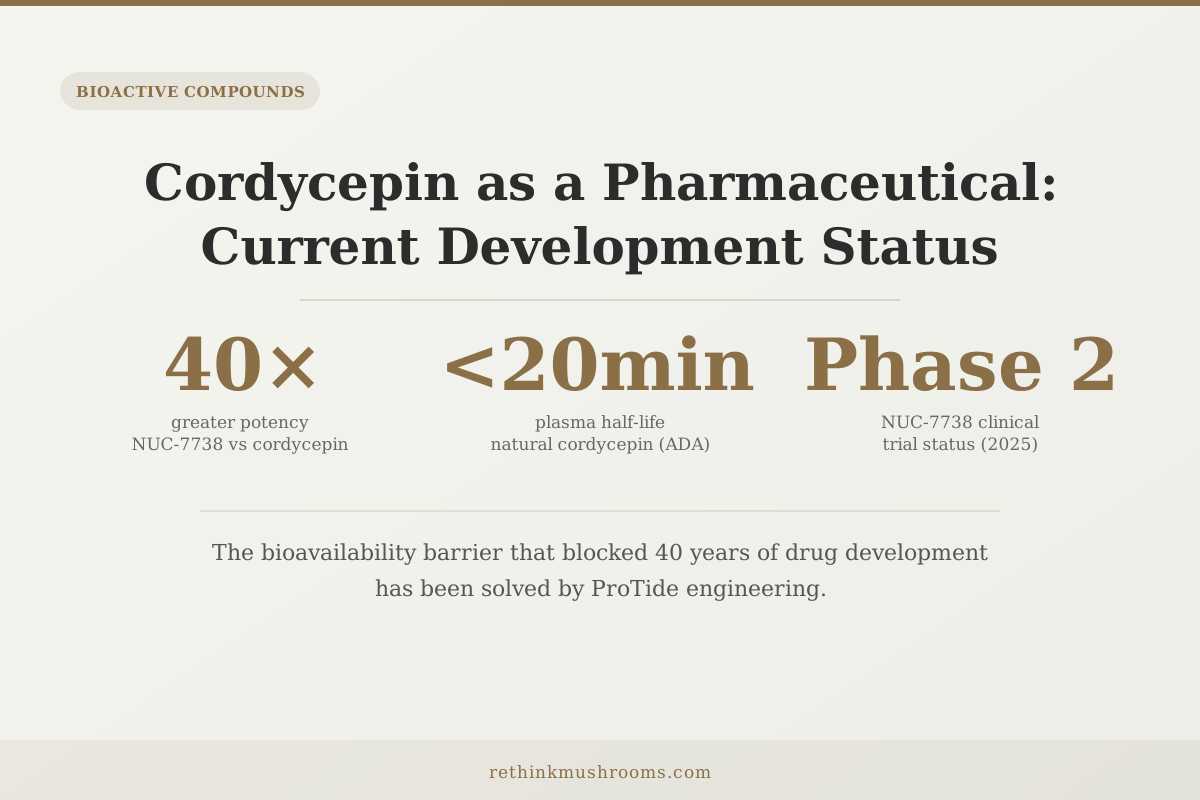
Cordycepin's plasma half-life in rats is approximately 1.6 minutes because adenosine deaminase converts it to inactive 3'-deoxyinosine; the short half-life is the central obstacle every drug-development program must solve.
Tsai et al., Journal of Agricultural and Food Chemistry, 2010
1950
year of discovery
Phase 1/2
current clinical stage (NUC-7738)
ADA1
the enzyme that inactivates it
Tsai et al., Journal of Agricultural and Food Chemistry, 2010
 View as image ↗
Cordycepin (3'-deoxyadenosine) is a nucleoside analog produced by Cordyceps militaris and related fungi. It has been studied as a chemotherapeutic since 1950, when it was first isolated, and has appeared in hundreds of preclinical papers showing anticancer, antiviral, antidiabetic, and anti-inflammatory activity. The obvious question is why it is not yet a drug. The answer is a single enzyme, adenosine deaminase, and a pharmacokinetic problem that took seven decades to engineer around. This article tracks where cordycepin stands as a pharmaceutical candidate in 2026: what the molecule does, why it disappears so quickly from the body, what prodrug strategies are being tested, and what the most advanced clinical program has shown so far. For the broader mechanism story, see how cordycepin works: mechanisms of action across diseases. For the adenosine signaling context, see cordycepin and adenosine signaling. For a plain-language compound overview, see cordycepin (3'-deoxyadenosine): the multi-target mushroom drug.
Key Takeaways
- Cordycepin is metabolized by adenosine deaminase (ADA) to inactive 3'-deoxyinosine, giving it a plasma half-life of roughly 1.6 minutes in rats and a short half-life in humans; this is the central pharmacokinetic barrier (Tsai et al., 2010)
- The ProTide prodrug NUC-7738 bypasses the nucleoside-transporter and activation bottlenecks that limit native cordycepin and has shown activity in a first-in-human Phase 1 trial in advanced solid tumors and lymphoma
- Molecular dynamics modeling of human ADA1 has mapped cordycepin, adenosine, and 2'-deoxyadenosine binding modes, providing a structural basis for designing cordycepin analogs that resist deamination (Niramitranon et al., 2020)
- Cordycepin shows activity in preclinical cancer models via apoptosis induction and polyadenylation inhibition in a cell-type-specific manner, with stronger effects in leukemia and lymphoma lines (Thomadaki et al., 2008)
- Computational docking identifies cordycepin as a potential inhibitor of SARS-CoV-2 RNA-dependent RNA polymerase, though no clinical antiviral program has advanced to randomized trials (Bibi et al., 2022)
- Natural cordycepin production in C. militaris is low relative to pharmaceutical demand, driving research into CRISPR-based metabolic engineering and optimized fermentation approaches (Sharma et al., 2022)
- A 2024 randomized controlled trial in healthy adults tested a submerged-fermentation C. militaris beverage and measured immune response outcomes, representing a small but growing human evidence base (Ontawong et al., 2024)
What Cordycepin Is and Why It Was a Drug Target
Cordycepin differs from adenosine by a single atom: the 3'-hydroxyl of ribose is replaced by hydrogen. That one change is enough to break the molecule's function when it is incorporated into RNA, because without the 3'-OH the growing RNA chain cannot be extended. Cells treated with cordycepin therefore make truncated RNA, fail to complete mRNA polyadenylation, and trigger apoptosis or cell-cycle arrest depending on cell type. Thomadaki et al. (2008) demonstrated this in leukemia and lymphoma cell lines (U937, K562, HL-60, Daudi, Molt-4), showing that cordycepin both synergized with and modified the activity of etoposide in a manner tied to poly(A) polymerase (PAP) activity and isoform expression.[1] The effect on apoptosis was cell-type-specific, consistent with cordycepin's downstream targeting of transcriptional and post-transcriptional machinery rather than a single receptor.
Zhang et al. (2024) extended the chemistry-to-disease picture across oncology and metabolism.[2] The review documents direct tumor-suppressive effects (biosynthesis inhibition, apoptosis and autophagy induction, cell-cycle regulation, invasion and metastasis suppression, tumor microenvironment immune modulation) alongside therapeutic activity in hyperlipidemia and glucose regulation. The structure-activity relationship for cordycepin and its analogs is mapped in the review, as are pharmacokinetic properties and the strategies under development to enhance bioavailability.
The Adenosine Deaminase Problem
Cordycepin's pharmacokinetic fate explains why six decades of preclinical promise produced no approved drug. Tsai et al. (2010) used HPLC with photodiode-array detection coupled to microdialysis sampling to track cordycepin and adenosine simultaneously in rat blood and liver after dosing.[3] Cordycepin was cleared extremely rapidly, with plasma levels declining to near-baseline within minutes. The metabolic pathway paralleled that of adenosine: adenosine deaminase (ADA) deaminated cordycepin to 3'-deoxyinosine, a pharmacologically inactive species. The authors could rescue cordycepin levels by co-dosing with erythro-9-(2-hydroxy-3-nonyl)adenine (EHNA), a potent ADA inhibitor, confirming ADA as the responsible enzyme.
Chen et al. (2023) reviewed the downstream consequences.[4] Because ADA deaminates cordycepin rapidly in vivo, the effective half-life is short and systemic bioavailability after oral dosing is negligible without intervention. Oral cordycepin, at doses reasonably achievable in food or supplement form, does not reach the systemic circulation at levels matching in vitro active concentrations. The review catalogs the strategies being tested: ADA inhibitor co-administration, structural analogs that resist deamination, prodrug approaches that bypass the transporter and activation steps required for the native nucleoside, encapsulation to extend plasma residence, and targeted delivery to lower the systemic exposure needed for on-tumor activity.
Niramitranon et al. (2020) provided a structural foundation for analog design.[5] Using the first published crystal structure of human ADA1 in complex with 2'-deoxyadenosine, they ran molecular dynamics simulations to predict the binding modes of cordycepin, adenosine, and 2'-deoxyadenosine in ADA1. The simulations identified the specific residues that contact the 3'-hydroxyl (in adenosine and 2'-deoxyadenosine) and the 3'-H (in cordycepin), and showed how cordycepin still fits productively into the active site despite the missing 3'-OH. This map supports rational design of cordycepin analogs that sit in the active site without being productively deaminated, a standard approach in nucleoside analog chemistry.
Prodrug Strategy: ProTides and NUC-7738
The most advanced pharmaceutical development program for cordycepin uses the ProTide chemistry platform pioneered by Professor Chris McGuigan, which has already produced approved drugs including sofosbuvir (hepatitis C) and remdesivir (COVID-19). A ProTide is a masked monophosphate of a nucleoside analog, delivered as a membrane-permeable prodrug that bypasses the cellular transporters and kinase activation step. Once inside the cell, the mask is removed and the active nucleoside monophosphate is released directly, bypassing both the ADA-driven degradation in plasma and the first phosphorylation step that is often rate-limiting for nucleoside analogs.
The cordycepin ProTide NUC-7738 (developed by NuCana plc with the Oxford Target Discovery Institute) entered Phase 1 clinical testing in patients with advanced solid tumors and lymphoma under the trial name NuTide:701 (ClinicalTrials.gov NCT03829254). Preclinical data demonstrated that NUC-7738 had substantially higher potency than native cordycepin in cancer cell lines and was effective in resistant lines. Clinical pharmacokinetic and tumor samples from the first-in-human trial validated the in vitro findings and showed proapoptotic activity in patient cells with effects on the NF-κB pathway. Publication of the initial Phase 1 results appeared in Clinical Cancer Research in late 2021. A Phase 2 expansion in selected tumor types followed. Readers tracking real-time status should consult ClinicalTrials.gov NCT03829254 and the NuCana pipeline, because the trial is ongoing and readout timelines shift.
The Enzyme That Blocked 70 Years of Development
One Molecule, Two Fates: Why the Prodrug Works
Native cordycepin and the ProTide prodrug NUC-7738 start from the same active nucleoside. What separates a failed drug candidate from one in human trials is a single enzyme, adenosine deaminase, and whether the molecule ever has to face it.
Native cordycepin
oral supplement or IV dose
- Enters bloodstream
- Adenosine deaminase (ADA) removes an amino group
- Becomes 3′-deoxyinosine — pharmacologically inactive
Activity lost before reaching most tissues
Plasma half-life ≈ 1.6 min in rats; systemic oral bioavailability negligible [3, 4]
NUC-7738 (ProTide prodrug)
masked cordycepin monophosphate
- Membrane-permeable prodrug enters the cell intact
- Intracellular esterases remove the mask → cordycepin monophosphate
- Phosphorylated to cordycepin triphosphate (COR-TP), the active form
Reaches the active metabolite inside cells
Bypasses ADA in plasma and the rate-limiting first phosphorylation step; higher potency than native cordycepin in preclinical and Phase 1 work
NUC-7738 is an investigational drug in clinical trials, not an approved medicine, and this diagram describes a delivery mechanism rather than a proven clinical benefit. Native cordycepin from Cordyceps supplements follows the top path; it does not reliably deliver active drug to the circulation.
Mechanism synthesis from Tsai 2010 [3], Chen 2023 [4] & Niramitranon 2020 [5]
The NUC-7738 program is the first cordycepin-derived candidate to reach human cancer patients. It is not yet approved and not yet definitive, but its existence demonstrates that the ADA and transporter problems are tractable with modern medicinal chemistry rather than intractable physiological blocks.
Seventy Years From Discovery to the Clinic
The Cordycepin Development Timeline
Cordycepin has been a drug candidate since 1950, but the pharmacokinetic barrier kept it out of the clinic for decades. The breakthrough was not a new discovery about what it does — it was an engineering fix for how to deliver it.
Cordycepin (3′-deoxyadenosine) identified in Cordyceps militaris; among the earliest studied nucleoside analogs.
Cell-type-specific apoptosis and polyadenylation effects mapped in leukemia and lymphoma lines (Thomadaki [1]).
Plasma half-life ≈ 1.6 min in rats; adenosine deaminase identified as the cause and rescued by an ADA inhibitor (Tsai [3]).
Molecular dynamics maps cordycepin in the human ADA1 active site, guiding deamination-resistant analog design (Niramitranon [5]).
NUC-7738 ProTide reaches patients — Phase 1 NuTide:701 (NCT03829254) results published in Clinical Cancer Research.
Phase 2 expansion ongoing in advanced solid tumors and lymphoma. No cordycepin-derived drug approved anywhere; no Phase 3 initiated.
Clinical-trial status changes; for real-time status consult ClinicalTrials.gov (NCT03829254) and the NuCana pipeline. No cordycepin-derived pharmaceutical is approved in any jurisdiction as of 2026.
Milestones from Thomadaki 2008 [1], Tsai 2010 [3], Niramitranon 2020 [5] & the NUC-7738 program
Non-Oncology Indications Under Investigation
Oncology is the dominant theme in cordycepin drug development, but other indications have active preclinical programs.
Metabolic disease. Zhang et al. (2024) and Ashraf et al. (2020) both document cordycepin's effects on hyperlipidemia and glucose metabolism.[2][6] Ashraf identified anti-diabetic and anti-hyperlipidemic activity alongside immunomodulatory, antioxidant, anti-aging, and hepatoprotective effects in preclinical and early translational studies. The metabolic signals are consistent but have not advanced to a dedicated late-stage cardiometabolic trial.
Viral disease. Bibi et al. (2022) performed a drug-repositioning computational study investigating cordycepin against SARS-CoV-2 RNA-dependent RNA polymerase (RdRp, PDB 6M71) by molecular docking.[7] Cordycepin showed favorable binding in silico. No randomized clinical antiviral trial has advanced; the COVID-19 treatment landscape pivoted to other agents. The study is notable for illustrating how the pharmaceutical industry evaluates nucleoside analogs in parallel against viral polymerases, which is one reason the chemistry platform used by NUC-7738 (ProTide) has antiviral precedent (sofosbuvir, remdesivir).
Immune function. Ontawong et al. (2024) published a randomized controlled clinical trial of a functional beverage made from submerged fermentation of C. militaris (FCM) in healthy male and female volunteers, measuring immune response parameters.[8] The study is a functional food trial rather than a purified cordycepin pharmaceutical trial, and the beverage contains polysaccharides, adenosine, cordycepin, cordycepic acid, amino acids, ergosterol, and beta-sitosterol together. It cannot be read as evidence for cordycepin specifically. It does represent a small, growing body of human randomized data involving C. militaris products, which is relevant context for regulatory pathways that might include a botanical or nutraceutical route alongside a conventional small-molecule route.
The Supply Problem
A separate development issue is supply. Natural cordycepin yields from wild or cultivated Cordyceps are modest relative to pharmaceutical demand; fermentation yields from standard cultivation are also modest. Sharma et al. (2022) reviewed metabolic engineering approaches for overproduction.[9] CRISPR-based genome editing now replaces older tools for targeted pathway modification. A second approach called POPCORN optimizes carbon-to-nitrogen ratios to tune the biosynthetic shunt toward cordycepin production. These biotechnological methods are needed because a commercially successful cordycepin-derived drug would require a robust, cost-effective supply chain; wild harvest of Ophiocordyceps sinensis is neither sustainable nor scalable. For a candidate like NUC-7738, the supply question is less acute because the synthesis starts from a nucleoside precursor rather than native Cordyceps biomass; for broader cordycepin-based products, supply is a real gating factor.
What Has Been Ruled Out and What Is Still Open
- Cell & computational studiescompleted
Apoptosis and polyadenylation inhibition in leukemia/lymphoma lines (Thomadaki 2008 [1]); ADA1 binding modes modeled for analog design (Niramitranon 2020 [5]); SARS-CoV-2 RdRp docking (Bibi 2022 [7])
- Animal models & pharmacokineticscompleted
Rat PK pinning the ADA barrier (Tsai 2010 [3]); preclinical anticancer, metabolic and other activity reviewed (Zhang 2024 [2]; Ashraf 2020 [6])
- First human trialscurrent
NUC-7738 ProTide Phase 1 (NuTide:701, NCT03829254) in advanced solid tumors and lymphoma; a small functional-food RCT of a fermented C. militaris beverage (Ontawong 2024 [8]) — a whole extract, not purified cordycepin
- Large / replicated RCTmissing
No large or replicated randomized trial of purified cordycepin or its prodrug; Phase 2 of NUC-7738 is ongoing, no Phase 3 initiated
- Meta-analysismissing
Too few human trials to pool
The preclinical and pharmacokinetic case is mature and internally consistent: the mechanism is mapped, the barrier is understood, and the engineering fix (a ProTide prodrug) has reached human patients. But human efficacy evidence rests on a single first-in-human Phase 1 program plus a small functional-food trial of whole extract. No cordycepin-derived drug is approved as of 2026.
Synthesis of references [1]–[9] cited in this article plus the published NUC-7738 Phase 1 program (NuTide:701)
Ruled out (or effectively ruled out). Oral native cordycepin at food-supplement doses does not achieve systemic pharmacokinetic levels that reproduce the in vitro activities reported in preclinical studies. This follows directly from the Tsai (2010) PK and the Chen (2023) bioavailability review.[3][4] Claims that eating Cordyceps militaris supplies pharmacologically active cordycepin in the circulation are not supported by the available pharmacokinetic evidence.
Still open. Whether NUC-7738 or a successor ProTide will achieve the safety, efficacy, and durability needed for regulatory approval in a cancer indication is still open; the Phase 2 data will determine this. Whether an ADA-resistant structural analog of cordycepin could be developed with an oral bioavailability profile suitable for chronic dosing in cardiometabolic disease is still open. Whether local or targeted delivery of cordycepin (intratumoral, pulmonary, topical) could establish niches where systemic PK is less limiting is also open. All three are active research directions with published rationale but no late-stage clinical data.
Not yet tested. No Phase 3 cordycepin program in any indication has been initiated as of 2026. No regulatory approval of any cordycepin-based drug exists. Claims to the contrary are not accurate as of this writing.
Where This Leaves the Consumer Question
A reader asking whether they should take a Cordyceps supplement for cancer, diabetes, or any other serious condition on the strength of cordycepin research is asking about a different question than pharmaceutical development. The supplement question is dominated by C. militaris fruiting body or mycelial biomass, which is a mixture of polysaccharides (including galactomannan), adenosine, cordycepin, cordycepic acid, ergosterol, beta-sitosterol, amino acids, and minerals. The evidence base for the whole extract in humans is small; the evidence base for purified cordycepin in humans is essentially the NUC-7738 Phase 1 trial and a small number of functional-food-style studies like Ontawong (2024).[8] This is not sufficient evidence for a purified-cordycepin treatment claim in any non-oncology human indication as of 2026. The pharmaceutical pipeline is real and advancing; the consumer implications are not ready to follow.
Supplements vs. the drug
ModerateA Cordyceps supplement is not a cordycepin medicine
Concern
Oral cordycepin from supplements is rapidly deaminated by adenosine deaminase and does not reach the bloodstream at the concentrations that produced effects in laboratory studies. No cordycepin-derived drug is approved anywhere, and NUC-7738 is an investigational prodrug available only through clinical trials.
What the research says
The pharmaceutical evidence for NUC-7738 does not transfer to over-the-counter Cordyceps products, which are whole extracts studied only in small functional-food trials. Treat supplement claims and pharmaceutical claims as separate questions.
Particularly relevant for: Anyone considering Cordyceps for cancer, diabetes, or another serious condition
What to do
Do not substitute a supplement for evidence-based treatment or delay care. Discuss any supplement with your oncologist or physician, especially during active cancer treatment where interactions and immune effects matter.
Tsai et al., 2010; Chen et al., 2023
The Bottom Line
Cordycepin is a legitimate pharmaceutical candidate with a central pharmacokinetic problem (rapid adenosine deaminase degradation) that modern medicinal chemistry is now engineering around. The most advanced candidate, NUC-7738, is a ProTide prodrug in Phase 1/2 cancer trials and represents the first cordycepin-derived molecule to reach human patients at efficacious exposures. Preclinical signals in metabolic disease, viral disease, and immune function are consistent but have not advanced to late-stage human trials. No cordycepin-derived drug is approved as of 2026.
Frequently Asked Questions
Sources & References
- 1RTHM-00147·Thomadaki, Hellinida et al. (2008). “The role of cordycepin in cancer treatment via induction or inhibition of apoptosis: implication of polyadenylation in a cell type specific manner..” Cancer chemotherapy and pharmacology.Study breakdown →PubMed →↩
- 2RTHM-00918·Zhang, Jinming et al. (2024). “Structural and pharmacological insights into cordycepin for neoplasms and metabolic disorders..” Frontiers in pharmacology.Study breakdown →PubMed →↩
- 3RTHM-00199·Tsai, Yung-Jen et al. (2010). “Pharmacokinetics of adenosine and cordycepin, a bioactive constituent of Cordyceps sinensis in rat..” Journal of agricultural and food chemistry.Study breakdown →PubMed →↩
- 4RTHM-00817·Chen, Min et al. (2023). “Cordycepin: A review of strategies to improve the bioavailability and efficacy..” Phytotherapy research : PTR.Study breakdown →PubMed →↩
- 5RTHM-00647·Niramitranon, Jitti et al. (2020). “Exploring the binding modes of cordycepin to human adenosine deaminase 1 (ADA1) compared to adenosine and 2'-deoxyadenosine..” Journal of molecular modeling.Study breakdown →PubMed →↩
- 6RTHM-00605·Ashraf, Syed Amir et al. (2020). “Cordycepin for Health and Wellbeing: A Potent Bioactive Metabolite of an Entomopathogenic Cordyceps Medicinal Fungus and Its Nutraceutical and Therapeutic Potential..” Molecules (Basel.Study breakdown →PubMed →↩
- 7RTHM-00745·Bibi, Shabana et al. (2022). “Cordycepin as a Promising Inhibitor of SARS-CoV-2 RNA Dependent RNA Polymerase (RdRp)..” Current medicinal chemistry.Study breakdown →PubMed →↩
- 8RTHM-00899·Ontawong, Atcharaporn et al. (2024). “A randomized controlled clinical trial examining the effects of Cordyceps militaris beverage on the immune response in healthy adults..” Scientific reports.Study breakdown →PubMed →↩
- 9RTHM-00795·Sharma, Shivani et al. (2022). “Cordycepin as a Metabolite with Pharmacological Potential: A Review..” International journal of medicinal mushrooms.Study breakdown →PubMed →↩