Cordycepin Research
791 papers systematically reviewed
Cordycepin (3'-deoxyadenosine) from Cordyceps militaris engages adenosine receptors, the NLRP3 inflammasome, the TIGAR/SIRT1/PGC-1α energy axis, PI3K/AKT/mTOR growth signalling, and RNA polyadenylation across preclinical models. A 2021 systematic review of 791 papers found the effects real and reproducible — at a median cell-study IC50 of 135 µM, in a molecule that adenosine deaminase destroys within minutes of absorption.
Radhi et al., Molecules, 2021; Chen et al., Phytotherapy Research, 2023
135 µM
median IC50 across 192 cell-survival papers — a high concentration that no oral dose has been shown to reach in human plasma (Radhi et al., 2021)
ADA deamination
adenosine deaminase inactivates cordycepin rapidly in vivo, making bioavailability the central drug development problem (Chen et al., 2023)
0 human trials
of isolated cordycepin at a defined dose; the one RCT tested a whole Cordyceps militaris beverage (Ontawong et al., 2024)
Radhi et al., Molecules, 2021; Chen et al., Phytotherapy Research, 2023
 View as image ↗
Cordycepin is the single compound most often invoked when researchers talk about the pharmacology of Cordyceps militaris. It is a naturally occurring nucleoside analogue differing from adenosine by a single hydroxyl group at the 3' position, and this structural similarity is both why cordycepin has broad biological activity and why it fails to survive intact through the gut and liver in humans. The preclinical literature is unusually large for a mushroom compound: a 2021 systematic review screened 1,204 publications and read 791 of them after applying exclusion criteria, extracting data across cell survival, inflammation, signal transduction, and animal models.[1] That review is the closest thing the field has to a map, and it is the backbone of this article.
The five documented pathway categories are adenosine receptor signalling, NLRP3 inflammasome-mediated neuroinflammation, the TIGAR/SIRT1/PGC-1α energy axis, PI3K/AKT/mTOR growth signalling, and RNA polyadenylation. What the evidence map also shows is a gap: the potency required in cell studies is high, the molecule is deaminated within minutes of absorption,[2] and the human trial evidence amounts to a single RCT of a C. militaris beverage — not of isolated cordycepin.[3] For the pathway deep-dive, see how cordycepin works: mechanisms of action across diseases, and for the pharmaceutical development status see cordycepin as a pharmaceutical: current development status.
Key Takeaways
- Radhi et al. (2021) systematically reviewed 791 cordycepin papers and calculated a median inhibitory concentration (IC50) of 135 µM across 192 cell-survival studies — a high concentration that anchors every mechanism claim below in a potency reality check
- Chen et al. (2023) reviewed cordycepin pharmacology in Phytotherapy Research and documented rapid deamination by adenosine deaminase (ADA) as the primary barrier to clinical translation; proposed strategies include ADA inhibitor co-administration, structural modification, and nano-formulation delivery
- Hu et al. (2013) showed cordycepin increases non-rapid eye movement (NREM) sleep in rats via adenosine receptor engagement, with A1, A2A, and A2B receptor protein levels elevated in the rat hypothalamus after cordycepin administration
- Zhang et al. (2021) demonstrated cordycepin protects against rotenone-induced Parkinson's disease pathology in vitro and in vivo by increasing AMPK phosphorylation, reversing Drp1-mediated mitochondrial fission, and inhibiting NLRP3 inflammasome activation
- Chai et al. (2022) established an anti-fatigue mechanism for cordycepin via activation of the TIGAR/SIRT1/PGC-1α signalling pathway, linking the compound to mitochondrial biogenesis and energy metabolism
- The active-metabolite question is genuinely unsettled: Hawley et al. (2020) identified cordycepin monophosphate as an AMP mimic that activates AMPK, while Lawrence et al. (2025) reported that cordycepin triphosphate represses PI3K/AKT/mTOR and MEK/ERK signalling in six cell lines without requiring AMPK activation
- Ontawong et al. (2024) conducted a randomised controlled clinical trial of a Cordyceps militaris beverage in healthy adults and reported changes in immune response markers; this is the closest-to-human evidence, and it tests a beverage rather than isolated cordycepin
What Cordycepin Is and Why the Structure Matters
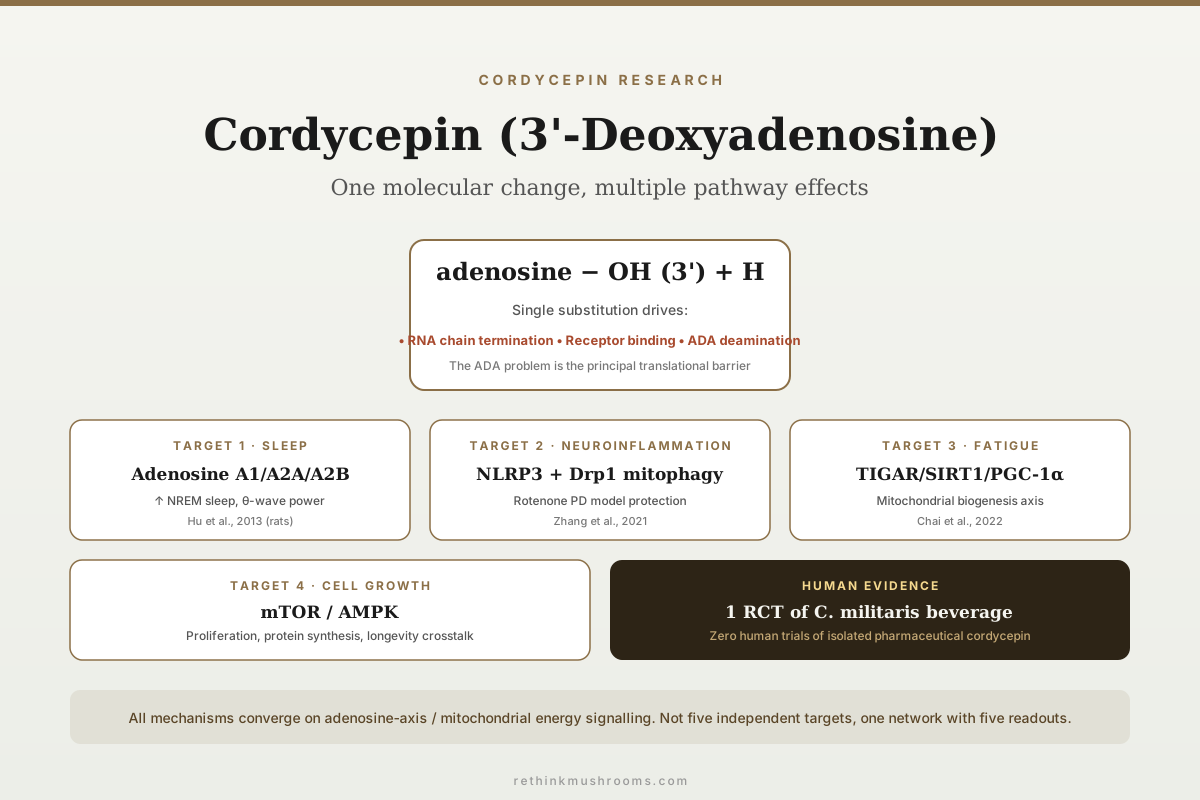
Cordycepin is 3'-deoxyadenosine. The parent molecule, adenosine, has a hydroxyl group at the 3' position of the ribose ring. Cordycepin replaces that hydroxyl with a hydrogen. This single substitution has three biological consequences that together explain the entire pharmacology story.
First, cordycepin engages adenosine receptors. Because the rest of the molecule is structurally nearly identical to adenosine, cordycepin can bind the A1, A2A, A2B, and A3 adenosine receptor subtypes that adenosine normally binds. This receptor engagement drives effects in the central nervous system (sleep, pain modulation, neuroprotection), cardiovascular system (coronary vasodilation, antiplatelet activity), and immune system (broad immunomodulation).[4] The receptor-binding profile is not identical to adenosine's, which is why cordycepin is not simply a long-acting adenosine substitute.
Second, cordycepin interferes with RNA synthesis. During RNA synthesis, RNA polymerase adds nucleotides to the growing RNA strand by forming a bond to the 3'-hydroxyl of the previous nucleotide. Cordycepin lacks that 3'-hydroxyl. When a cell incorporates cordycepin into a growing RNA strand, the next nucleotide cannot be added, and elongation stops. The best-characterised expression of this is inhibition of polyadenylation — the addition of the poly(A) tail that mRNA molecules need for stability and translation. Cordycepin has been used as a polyadenylation-specific inhibitor in cancer cell work since at least the 2000s,[5] and more recent work has carried that mechanism into whole-animal disease models.[6]
Third, cordycepin is rapidly deaminated by adenosine deaminase (ADA). ADA is a ubiquitous mammalian enzyme that converts adenosine to inosine, removing the amino group at the 6 position of the purine ring. Molecular dynamics simulations of human adenosine deaminase 1 (ADA1) confirm that cordycepin occupies the same binding pocket as adenosine and 2'-deoxyadenosine, with a binding affinity ranking of adenosine > cordycepin > 2'-deoxyadenosine — cordycepin is a genuine ADA1 substrate, not merely a structural lookalike.[7] Deamination converts cordycepin to 3'-deoxyinosine, which has much weaker biological activity. ADA is present in blood, intestinal mucosa, and virtually all tissues. Oral cordycepin is therefore rapidly inactivated on absorption, producing a short plasma half-life and poor oral bioavailability.[2]
The interaction of these three features shapes everything downstream. The mechanism diversity is real and reproducible in vitro. The clinical translation gap is directly attributable to the ADA problem. Solving that problem — through co-administered ADA inhibitors, through structural analogues that are not ADA substrates, or through nanoparticle delivery that bypasses first-pass metabolism — is the central pharmaceutical development challenge.[2]
The Potency Number That Frames Everything
Before walking the individual targets, one number deserves to sit in front of them. Radhi et al. (2021) extracted concentration data from 192 papers on cordycepin's effects on cell survival and proliferation and calculated a median IC50 of 135 µM.[1]
The same review found the direction of effect strikingly consistent where it mattered: cordycepin repressed cell migration across 26 papers and cellular inflammation across 53 papers, and analysis of 76 signal transduction papers showed consistently reduced PI3K/mTOR/AKT and ERK signalling alongside AMPK activation.[1] Not everything was consistent. Effects on the p38 and Jun kinases varied between studies, as did effects on cell cycle arrest across 53 papers, which the authors interpreted as cell-specific rather than universal responses.[1] That distinction — consistent core signalling, variable peripheral effects — is a more honest description of cordycepin than "multi-target compound."
Radhi et al. (2021) · Molecules
- Population
- 1,204 publications screened; 791 retained after exclusion criteria (cut-off 1 February 2021)
- Intervention
- Systematic extraction of cell survival, migration, inflammation, signal transduction, and animal model data
- Finding
- Median IC50 of 135 µM across 192 cell-survival papers. Consistent repression of cell migration (26 papers) and inflammation (53 papers). Across 76 signal transduction papers: consistently reduced PI3K/mTOR/AKT and ERK signalling with AMPK activation. Effects on p38/Jun kinases and cell cycle arrest were variable and cell-specific. 150 animal studies covered tumour growth (37), pain and inflammation (9), brain function (11), cardiac (19), respiratory (8), and metabolic disorders (8).
mixed The largest and most rigorous synthesis of cordycepin research available. It validates the mechanism breadth and simultaneously establishes why translation has stalled: the effective concentrations are high and the human data is absent.
Radhi et al. (2021), Molecules 26(19)
The Documented Target Landscape
Target 1: Adenosine receptors and sleep regulation
Hu et al. (2013) investigated cordycepin's central nervous system effects in rats using electroencephalographic (EEG) sleep recording after oral cordycepin administration.[4] Cordycepin reduced sleep-wake cycles, increased NREM sleep duration, and increased theta-wave power density during NREM sleep. Adenosine receptor subtype protein levels (A1, A2A, A2B) were elevated in the hypothalamus, a brain region central to sleep regulation. The authors framed cordycepin as acting through non-specific adenosine receptor engagement in the hypothalamus, distinguishable from single-subtype agonists by its broad-spectrum receptor profile.
Target 2: NLRP3 inflammasome and neuroinflammation
Zhang et al. (2021) tested cordycepin in rotenone-induced Parkinson's disease models, in vitro and in vivo, reporting anti-inflammatory and neuroprotective effects.[8] Rotenone is a mitochondrial complex I inhibitor used to model PD pathology; it drives dopaminergic neuron death via oxidative stress, mitochondrial dysfunction, and NLRP3 inflammasome activation.
Cordycepin ameliorated rotenone-induced motor dysfunction and dopaminergic neuron loss. Mechanistically, it increased AMPK phosphorylation, reversed Drp1-mediated mitochondrial fragmentation, raised ATP content and mitochondrial membrane potential, reduced mitochondrial ROS, and inhibited NLRP3 inflammasome expression.[8] NLRP3 is a multi-protein inflammatory sensor that, once assembled, cleaves pro-caspase-1 into active caspase-1, which in turn cleaves pro-IL-1β into active IL-1β. Inhibiting NLRP3 assembly upstream blunts downstream IL-1β release, which is neuroprotective in models where neuroinflammation drives neuron loss. The AMPK step in this chain matters for the argument later in this article: it is the same node that appears in the energy and growth-signalling targets.
Target 3: TIGAR/SIRT1/PGC-1α energy axis and fatigue
Chai et al. (2022) investigated cordycepin's anti-fatigue effect in mice and demonstrated activation of the TIGAR/SIRT1/PGC-1α signalling pathway.[9] TIGAR (TP53-induced glycolysis and apoptosis regulator) modulates glucose flux between glycolysis and the pentose phosphate pathway, balancing energy production against antioxidant capacity. SIRT1 is a NAD+-dependent deacetylase that activates PGC-1α, the master transcriptional coactivator for mitochondrial biogenesis. Activation of this axis increases mitochondrial number, ATP production, and oxidative capacity in skeletal muscle.
The pathway framing connects cordycepin to the broader mitochondrial-biogenesis-as-therapy paradigm that also encompasses caloric restriction mimetics, AMPK activators, and exercise-mimetic compounds. The exact upstream trigger in the Chai model was not fully dissected, which is worth stating plainly rather than filling in with a plausible-sounding mechanism.
Target 4: AMPK and PI3K/AKT/mTOR — the contested centre
This is where cordycepin research is genuinely unresolved, and where most popular summaries overstate the consensus.
Hawley et al. (2020) worked out how cordycepin activates AMPK, and the answer was not adenosine receptors.[10] Cordycepin enters cells through adenosine transporters and is then phosphorylated by cellular metabolism into mono-, di-, and triphosphates. AMPK activation correlated specifically with the content of cordycepin monophosphate and not with other cordycepin or adenine nucleotides. In cell-free assays, cordycepin monophosphate mimicked all three regulatory effects of AMP on AMPK, and activation in intact cells was blocked by a γ-subunit mutation that prevents activation by AMP. Genetic knockout of AMPK made cells more sensitive to cordycepin's cytotoxic effects. The authors' conclusion was that cordycepin is a pro-drug: it does its AMPK work only after the cell converts it into an AMP analogue.
Lawrence et al. (2025) then complicated that picture.[11] Studying growth factor signalling across six cell lines with bioinformatics, quantitative PCR, and western blotting, they concluded that cordycepin triphosphate is likely the active metabolite for that effect, that cordycepin consistently represses growth factor-induced gene expression by blocking PI3K/AKT/mTOR and/or MEK/ERK, and — critically — that AMPK activation is not required for it. Effects on translation via mTOR repression were detectable within 30 minutes, indicating a rapid process rather than a downstream transcriptional consequence. They proposed a single universal mechanism acting through cordycepin triphosphate on an as-yet-unidentified target in growth factor signalling.
These two results are not a simple contradiction — they concern different readouts, and both come from work that takes the pro-drug framing seriously. But they do disagree about which phosphorylated form matters and whether AMPK is on the causal path. Radhi et al. (2021), reviewing 76 signal transduction papers, found both AMPK activation and PI3K/mTOR/AKT inhibition to be consistent findings,[1] which is compatible with either model. Anyone claiming cordycepin's anti-cancer activity is settled science on the AMPK pathway is ahead of the literature.
Contested Mechanism · Which Metabolite Is Active
One Pro-Drug, Two Active Forms, Two Conclusions
Both groups agree cordycepin only works after the cell phosphorylates it. They disagree about which phosphorylated form does the work and whether AMPK sits on the causal path. Popular summaries usually report only the first result.
Agreed by both
- Enters cells via adenosine transporters, not adenosine receptors
- Phosphorylated by cellular metabolism into mono-, di-, and triphosphate forms
- Therefore a pro-drug — the parent molecule is not the active species
Cordycepin monophosphate
Ref 10Hawley et al., 2020 · Cell Chemical Biology
AMPK is the target
- Correlation: AMPK activation tracked cordycepin monophosphate content specifically — not other cordycepin or adenine nucleotides
- Cell-free assay: Cordycepin monophosphate mimicked all three regulatory effects of AMP on AMPK
- Genetic test: A γ-subunit mutation that blocks AMP activation also blocked cordycepin activation in intact cells
- Knockout: Deleting AMPK made cells more sensitive to cordycepin cytotoxicity
AMPK activation runs through an AMP mimic
Cordycepin triphosphate
Ref 11Lawrence et al., 2025 · FEBS Letters
AMPK is not required
- Breadth: Growth factor-induced gene expression consistently repressed across six cell lines
- Pathways: PI3K/AKT/mTOR and/or MEK/ERK blocked, confirmed by bioinformatics, qPCR, and western blotting
- Speed: mTOR-linked translation effects detectable within 30 minutes — too fast for a downstream transcriptional consequence
- Dependency: AMPK activation explicitly not required for the effect
A single universal mechanism on an unidentified target
A 2021 systematic review of 76 signal transduction papers found both AMPK activation and PI3K/mTOR/AKT inhibition to be consistent findings, which is compatible with either model and does not settle the question.
Hawley et al. (2020), Cell Chemical Biology; Lawrence et al. (2025), FEBS Letters; Radhi et al. (2021), Molecules
Target 5: RNA polyadenylation and transcription
Cordycepin's oldest and most biochemically direct action is interference with RNA processing. Thomadaki et al. (2008) used cordycepin as a polyadenylation-specific inhibitor across five leukaemia and lymphoma cell lines (U937, K562, HL-60, Daudi, Molt-4), measuring poly(A) polymerase activity alongside apoptosis markers.[5] Their finding was pointedly cell-type dependent: cordycepin could induce or inhibit apoptosis depending on the line and the co-treatment, which is an early and underappreciated warning against treating cordycepin as uniformly pro-apoptotic.
Ashraf et al. (2019) carried polyadenylation from cell culture into whole-animal disease models.[6] Working in rodent osteoarthritis models — monosodium iodoacetate injection in rats and surgical destabilisation of the medial meniscus in mice — they showed cordycepin reduced pain behaviour, inflammation, and joint pathology. In human monocyte-derived macrophages and a mouse macrophage line, cordycepin affected nuclear localisation of NF-κB and of the polyadenylation factors WDR33 and CPSF4, connecting the RNA-processing mechanism to the inflammatory readout rather than leaving them as separate observations.
This target is the most mechanistically secure of the five, because it follows directly from the missing 3'-hydroxyl rather than requiring a receptor or a signalling intermediate.
The Bioavailability Problem in Detail
Chen et al. (2023) systematically reviewed bioavailability-improvement strategies for cordycepin in Phytotherapy Research, the most comprehensive framing of the translational challenge in recent literature.[2] The strategies span four categories.
Chemical derivatisation. Prodrugs that protect the cordycepin molecule from ADA until it reaches target tissue. Fluorinated analogues and modified linkages have been explored.
ADA inhibitor co-administration. Pentostatin (deoxycoformycin) is an FDA-approved ADA inhibitor used clinically for hairy cell leukaemia. The pharmacological logic is direct, and it is demonstrable: in rat pharmacokinetic work, Tsai et al. (2010) tracked cordycepin and adenosine in blood and liver by microdialysis coupled to HPLC and found both nucleosides declined rapidly, within roughly 30 minutes of administration — with the ADA inhibitor EHNA used specifically to interrupt that metabolic clearance.[12] Blocking ADA extends exposure. It also adds the toxicity of a second cytotoxic drug, which is why this approach has not moved into routine use.
Nanoparticle and liposomal delivery. Encapsulation protects the molecule during absorption and can target specific tissues. Multiple academic groups have reported enhanced pharmacokinetics with such formulations, though clinical translation has been slow.
Structural analogues that retain activity without ADA substrate recognition. Several analogues have been synthesised with partial activity, though finding one that retains the multi-target profile without the ADA problem has been challenging.
No cordycepin-based pharmaceutical has yet achieved FDA approval for any indication, which reflects both the bioavailability challenge and the general difficulty of translating multi-target natural products into regulatory-pathway-compatible drug candidates.
What the Human Evidence Actually Shows
Ontawong et al. (2024) published the first randomised controlled clinical trial of a Cordyceps militaris beverage on immune response in healthy adults.[3] The trial examined a C. militaris extract beverage containing cordycepin, adenosine, polysaccharides, and additional Cordyceps bioactives, with immune markers measured in pre-post and between-group comparisons. It is important as the first human RCT in this space, and its design used a whole-mushroom extract rather than isolated cordycepin — which means the results apply to the beverage formulation and cannot be cleanly attributed to cordycepin versus other C. militaris constituents.
Song (2020) developed a Cordyceps coffee formulation containing cordycepin and β-glucan by treating green coffee beans with mixed extracts from C. militaris, Phellinus linteus, and chaga.[13] The finished product had higher total polyphenol content (37.34 mg gallic acid equivalents per gram) than control coffee (27.00 mg GAE/g). This is functional food development rather than pharmaceutical development, but it illustrates a parallel translation track that does not require solving the ADA bioavailability problem, because the target outcomes are general antioxidant and consumer-acceptable functional ingredient status rather than discrete clinical endpoints.
No published human trial has tested isolated pharmaceutical-grade cordycepin at a specified dose for a specific clinical endpoint. This is the single largest gap in the cordycepin evidence base.
Evidence Volume · Preclinical Depth vs Human Data
791 Papers, 150 Animal Studies, Zero Trials of the Compound
The mechanism literature is genuinely large. The human literature is a single randomised trial — and it tested a mushroom beverage, not cordycepin. This gap, not any individual mechanism, is the honest headline.
Papers read in systematic review
791
From 1,204 publications screened to the cut-off of 1 February 2021, after exclusion criteria
Animal studies among them
150
Purified cordycepin evaluated across tumour, cardiac, neurological, respiratory, and metabolic models
Human RCTs of a Cordyceps beverage
1
A C. militaris extract beverage containing cordycepin plus adenosine, polysaccharides, and other bioactives
Human RCTs of isolated cordycepin
0
No published trial has tested pharmaceutical-grade cordycepin at a defined dose for a clinical endpoint
What the 150 animal studies covered
37
Tumour growth
19
Cardiac
11
Brain function
9
Pain & inflammation
8
Respiratory
8
Metabolic disorders
Counts are papers, not participants. Every one is an animal model — none is evidence of an effect in people.
Radhi et al. (2021), Molecules 26(19); Ontawong et al. (2024), Scientific Reports 14(1)
- Cell & Lab Studiescompleted
The bulk of the field. 192 cell-survival papers (median IC50 135 µM), 53 inflammation papers, 76 signal transduction papers (Radhi et al., 2021)
- Animal Studiescompleted
150 animal studies reviewed — tumour growth (37), cardiac (19), brain function (11), pain and inflammation (9), respiratory (8), metabolic (8)
- Case Reportsmissing
No meaningful case-report literature for isolated cordycepin as a therapeutic
- Small Human Trialscurrent
One RCT — and of a Cordyceps militaris beverage containing cordycepin plus other bioactives, not isolated cordycepin (Ontawong et al., 2024)
- Large Randomized Trial (200+)missing
None. No trial of isolated pharmaceutical-grade cordycepin at a defined dose for any clinical endpoint
- Meta-Analysismissing
Impossible — there are no human trials of the isolated compound to pool
Cordycepin has one of the deepest preclinical evidence bases of any mushroom compound and almost no human evidence. The 791-paper systematic review establishes that the mechanisms are real and reproducible in cells and animals. It also establishes the ceiling: high effective concentrations, rapid deamination, and a single human RCT that tested a beverage rather than the compound.
Radhi et al. (2021); Ontawong et al. (2024); Chen et al. (2023)
Where the Mechanism Categories Overlap
Several of the five target categories converge on mitochondrial and energy signalling: the TIGAR/SIRT1/PGC-1α axis, the NLRP3 inflammasome (which is activated by mitochondrial dysfunction), and the AMPK node that appears in both the Parkinson's model[8] and the pro-drug mechanism work.[10] This convergence is not accidental. Adenosine analogues interact with cellular energy metabolism at multiple levels because adenosine itself is the nucleoside backbone of ATP, ADP, AMP, cAMP, and NAD+, and the adenosine signalling network is tightly integrated with energy sensing.
The practical implication is that cordycepin may be better understood not as a multi-target compound hitting five independent pathways, but as a single-point intervention in the adenosine/energy signalling network with several downstream readouts. The Hawley pro-drug result supports that reading directly: the cell converts cordycepin into a nucleotide that the energy-sensing machinery already knows how to read.[10] The Lawrence result is the honest caveat — at least one major readout appears to run through a different phosphorylated form and to bypass AMPK entirely.[11]
Either way, the framing has implications for clinical development: combination therapies, dose-response relationships, and biomarker selection should be designed around upstream nucleotide-level engagement rather than around any single downstream pathway.
For the adenosine signalling deep-dive see cordycepin and adenosine signaling: the energy connection.
Before You Read This as a Recommendation
ModerateThis is mechanism research, not a protocol
Concern
Nearly all cordycepin evidence is cell culture and animal work, much of it at concentrations around a median IC50 of 135 µM that no oral dose has been shown to achieve in human plasma. Cordycepin is a nucleoside analogue in the same broad chemical family as several chemotherapy drugs, it has documented antiplatelet activity in preclinical work, and the main strategy for extending its half-life is co-administration with pentostatin — an FDA-approved cytotoxic ADA inhibitor with its own toxicity profile.
What the research says
Nothing here is a recommendation to treat, prevent, or cure any condition, and no dose can be inferred from this evidence. Supplement Cordyceps products are regulated as foods, not drugs, and their cordycepin content varies widely between products and species.
Particularly relevant for: People on anticoagulants, antiplatelet drugs, immunosuppressants, or chemotherapy; people preparing for surgery; people who are pregnant or breastfeeding
What to do
Talk to a qualified healthcare provider before using any Cordyceps or cordycepin product, particularly alongside prescription medication or active cancer treatment.
Radhi et al. (2021); Chen et al. (2023)
The Bottom Line
Cordycepin (3'-deoxyadenosine), the signature compound of Cordyceps militaris, is a nucleoside analogue with documented preclinical activity across adenosine receptor signalling, NLRP3 inflammasome-mediated neuroinflammation (Zhang et al., 2021), the TIGAR/SIRT1/PGC-1α energy metabolism axis (Chai et al., 2022), PI3K/AKT/mTOR growth signalling, and RNA polyadenylation (Ashraf et al., 2019; Thomadaki et al., 2008). The single structural difference from adenosine — the missing 3'-hydroxyl — drives both the biological activity and the central translational problem: rapid deamination by adenosine deaminase, confirmed at the molecular level by ADA1 binding simulations (Niramitranon et al., 2020) and visible in rat pharmacokinetics as a decline within roughly 30 minutes (Tsai et al., 2010). The largest synthesis available, a systematic review of 791 papers, calculated a median cell-study IC50 of 135 µM and found consistent repression of migration, inflammation, and PI3K/mTOR/AKT signalling alongside variable, cell-specific effects on p38, Jun kinases, and cell cycle arrest (Radhi et al., 2021). The active metabolite remains contested: Hawley et al. (2020) identified cordycepin monophosphate as an AMP mimic driving AMPK activation, while Lawrence et al. (2025) found cordycepin triphosphate represses growth factor signalling in six cell lines without requiring AMPK. Human evidence is limited to a single RCT of a C. militaris beverage (Ontawong et al., 2024) and functional food development work (Song, 2020); no published human trial has tested isolated pharmaceutical-grade cordycepin at a defined dose for a specific clinical endpoint.
Frequently Asked Questions
Sources & References
- 1RTHM-01420·Radhi, Masar et al. (2021). “A Systematic Review of the Biological Effects of Cordycepin..” Molecules (Basel.Study breakdown →PubMed →↩
- 2RTHM-00817·Chen, Min et al. (2023). “Cordycepin: A review of strategies to improve the bioavailability and efficacy..” Phytotherapy research : PTR.Study breakdown →PubMed →↩
- 3RTHM-00899·Ontawong, Atcharaporn et al. (2024). “A randomized controlled clinical trial examining the effects of Cordyceps militaris beverage on the immune response in healthy adults..” Scientific reports.Study breakdown →PubMed →↩
- 4RTHM-00288·Hu, Zhenzhen et al. (2013). “Cordycepin Increases Nonrapid Eye Movement Sleep via Adenosine Receptors in Rats..” Evidence-based complementary and alternative medicine : eCAM.Study breakdown →PubMed →↩
- 5RTHM-00147·Thomadaki, Hellinida et al. (2008). “The role of cordycepin in cancer treatment via induction or inhibition of apoptosis: implication of polyadenylation in a cell type specific manner..” Cancer chemotherapy and pharmacology.Study breakdown →PubMed →↩
- 6RTHM-00543·Ashraf, Sadaf et al. (2019). “The polyadenylation inhibitor cordycepin reduces pain, inflammation and joint pathology in rodent models of osteoarthritis..” Scientific reports.Study breakdown →PubMed →↩
- 7RTHM-00647·Niramitranon, Jitti et al. (2020). “Exploring the binding modes of cordycepin to human adenosine deaminase 1 (ADA1) compared to adenosine and 2'-deoxyadenosine..” Journal of molecular modeling.Study breakdown →PubMed →↩
- 8RTHM-00735·Zhang, Xiao-Ling et al. (2021). “Anti-inflammatory and neuroprotective effects of natural cordycepin in rotenone-induced PD models through inhibiting Drp1-mediated mitochondrial fission..” Neurotoxicology.Study breakdown →PubMed →↩
- 9RTHM-00749·Chai, Xiaoming et al. (2022). “Cordycepin exhibits anti-fatigue effect via activating TIGAR/SIRT1/PGC-1α signaling pathway..” Biochemical and biophysical research communications.Study breakdown →PubMed →↩
- 10RTHM-00618·Hawley, Simon A et al. (2020). “Mechanism of Activation of AMPK by Cordycepin..” Cell chemical biology.Study breakdown →PubMed →↩
- 11RTHM-02124·Lawrence, Steven et al. (2025). “Cordycepin generally inhibits growth factor signal transduction in a systems pharmacology study..” FEBS letters.Study breakdown →PubMed →↩
- 12RTHM-00199·Tsai, Yung-Jen et al. (2010). “Pharmacokinetics of adenosine and cordycepin, a bioactive constituent of Cordyceps sinensis in rat..” Journal of agricultural and food chemistry.Study breakdown →PubMed →↩
- 13RTHM-00656·Song, Hyo-Nam (2020). “Functional Cordyceps Coffee Containing Cordycepin and β-Glucan..” Preventive nutrition and food science.Study breakdown →PubMed →↩