Cordycepin
3'-deoxy vs adenosine
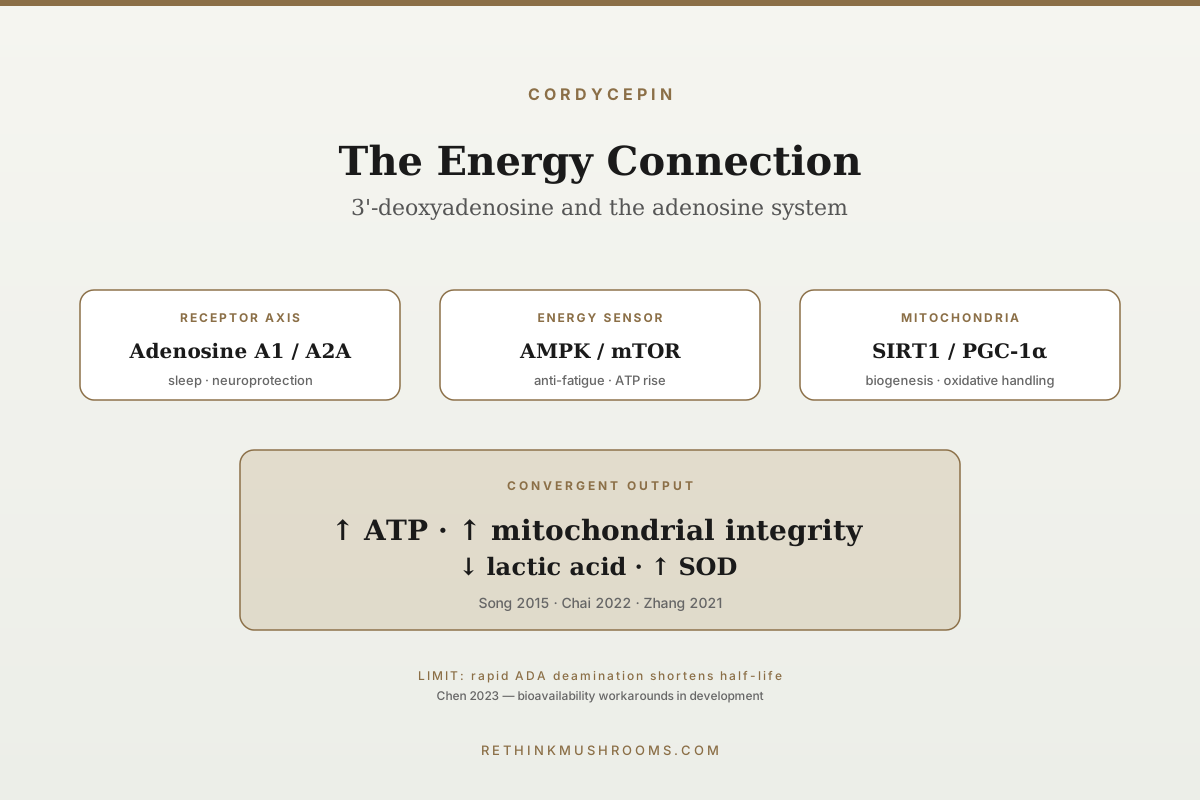
Cordycepin is 3'-deoxyadenosine, structurally identical to adenosine except for a missing 3'-hydroxyl on the ribose. That single structural change turns a core cellular-energy nucleoside into a compound that binds adenosine receptors, inhibits polyadenylation, activates AMPK and raises ATP, with rapid deamination by adenosine deaminase as the principal pharmacokinetic limit.
Ashraf et al., 2020; Chen et al., 2023; Zhang et al., 2024
Adenosine receptors
non-specific A1/A2A/A2B engagement linked to NREM sleep in rats (Hu 2013)
AMPK / mTOR
energy-sensor activation links to anti-fatigue effects
ADA deamination
rapid in vivo degradation shortens half-life
Ashraf et al., 2020; Chen et al., 2023; Zhang et al., 2024
 View as image ↗
Cordycepin is the signature bioactive alkaloid of Cordyceps militaris and Ophiocordyceps sinensis, and its chemistry is almost unreasonably simple. It is adenosine with a single hydroxyl group removed from the 3' position of the ribose. Because adenosine is one of the central molecules of cellular energy metabolism, neurotransmission and receptor signalling, cordycepin's structural near-identity gives it access to adenosine-system biology in ways that almost no other mushroom metabolite has. This article maps the connection between cordycepin's chemistry, its receptor and pathway engagement, and the "energy" effects (anti-fatigue, sleep regulation, mitochondrial protection, ATP support) that have made it a focus of preclinical and translational research.
For related angles, see cordycepin (3'-deoxyadenosine): the multi-target compound behind cordyceps' effects, cordycepin (3'-deoxyadenosine): the multi-target mushroom drug, how cordycepin works: mechanisms of action across diseases, and cordycepin as a pharmaceutical: current development status.
Key Takeaways
- Cordycepin is 3'-deoxyadenosine: adenosine with a single 3'-hydroxyl removed, the entire structural distinction from the parent nucleoside (Ashraf et al., 2020; Sharma et al., 2022)
- Cordycepin binds adenosine receptors and exerts CNS effects; Hu et al. (2013) showed cordycepin increased NREM sleep and theta-wave power density in rats, with elevated hypothalamic protein levels of A1, A2A, and A2B subtypes and an authors' conclusion of action via non-specific adenosine receptors
- Cordycepin activates AMPK and modulates the mTOR pathway; Song et al. (2015) demonstrated this signalling axis is central to the anti-fatigue activity of Cordyceps militaris fruit body extracts in mice
- Chai et al. (2022) identified TIGAR/SIRT1/PGC-1α as an additional cordycepin-activated pathway driving anti-fatigue effects, with reductions in lactic acid and MDA and increases in SOD
- Zhang et al. (2021) showed cordycepin raised intracellular ATP and maintained mitochondrial morphology via AMPK phosphorylation in a rotenone-induced Parkinson's disease model
- Thomadaki et al. (2008) demonstrated cordycepin inhibits polyadenylation through poly(A) polymerase modulation, an RNA-level mechanism distinct from its receptor and kinase effects
- Chen et al. (2023) reviewed the principal pharmacokinetic limitation: rapid deamination by adenosine deaminase (ADA) in vivo gives cordycepin a very short half-life; co-administration with ADA inhibitors or prodrug strategies are the active workarounds
- The "energy connection" is the intersection of adenosine-receptor signalling, AMPK-mediated cellular energy sensing, mitochondrial ATP production, and the polyadenylation-level control of protein synthesis
Cordycepin's Structure And Its Consequences
Adenosine consists of adenine linked to ribose through an N-glycosidic bond. The ribose carries hydroxyl groups at the 2' and 3' positions. Cordycepin is adenosine missing the 3'-hydroxyl: 3'-deoxyadenosine. Everything else is identical.
This single-atom difference has two principal biochemical consequences. First, the 3'-deoxy modification prevents cordycepin from being extended in RNA chains the way adenosine can, because the 3'-hydroxyl is what the next nucleotide attaches to during RNA synthesis. When cordycepin monophosphate is incorporated into a growing RNA strand it acts as a chain terminator, which is the basis for its polyadenylation-inhibitor activity. Second, the structural similarity to adenosine means cordycepin retains the ability to bind adenosine receptors and interact with adenosine-metabolising enzymes, though with different affinities and kinetics than adenosine itself. Ashraf and colleagues (2020) emphasised that the adenosine-analogue framing captures the compound's pharmacology better than any single organ-system-based classification.[1]
The trade-off at the heart of cordycepin pharmacology flows directly from the adenosine mimicry. Adenosine deaminase (ADA) is an enzyme whose function is to convert adenosine to inosine in vivo, and ADA acts on cordycepin too, converting it rapidly to 3'-deoxyinosine, a much less active metabolite. Chen and colleagues (2023) reviewed the practical consequences of this rapid degradation: cordycepin's oral bioavailability is poor, its systemic half-life is short, and active-drug exposure at target tissues is limited without pharmaceutical intervention.[2]
Adenosine Receptor Engagement
Four adenosine receptor subtypes are recognised in mammalian biology (A1, A2A, A2B, A3), each with distinct tissue distribution, coupling and physiological role. Adenosine itself is a key signalling molecule in sleep-wake regulation, cardiovascular tone, immune function and neuronal excitability. Cordycepin's near-identical chemistry allows it to engage these receptors, though the specific affinity profile differs from adenosine and differs again across cordycepin derivatives and metabolites.
Hu and colleagues (2013) provided the clearest functional demonstration of cordycepin-adenosine-receptor engagement in the sleep domain. Oral cordycepin in rats increased non-rapid-eye-movement (NREM) sleep measured by EEG over four hours and increased theta-wave power density during NREM sleep.[3] Hypothalamic protein levels of three adenosine receptor subtypes (A1, A2A, and A2B) were elevated after cordycepin administration, and the authors framed the mechanism as acting via non-specific adenosine receptors rather than a single subtype. This is a mechanistic bridge between cordycepin's structural mimicry of adenosine and the downstream physiology of adenosine accumulation (which is what drives sleep pressure during waking).
The adenosine-receptor engagement pathway also underpins several of cordycepin's cardiovascular and neuroprotective effects in preclinical models, because adenosine receptors modulate cerebral blood flow, inflammation and neuronal survival in ways that cordycepin appears to partially recapitulate. Sharma and colleagues (2022) summarised the receptor-level pharmacology as "broadly adenosine-like with distinctive kinetics", emphasising that cordycepin is not a clean selective agonist of any one receptor subtype.[4]
AMPK, mTOR And The Cellular Energy Sensor
The second principal axis of cordycepin's energy pharmacology is AMP-activated protein kinase (AMPK). AMPK is the master cellular energy sensor: it is activated when intracellular AMP:ATP ratios rise (signalling low energy state), and its activation triggers catabolic ATP-producing pathways while inhibiting anabolic ATP-consuming ones. AMPK and mTOR are reciprocally regulated, with AMPK activation tending to suppress mTOR and shift cells toward energy conservation and autophagy.
Song and colleagues (2015) demonstrated that a Cordyceps militaris fruit body aqueous extract reduced fatigue in multiple mouse models (rotating rod, forced swimming, forced running), raised ATP content and antioxidant enzyme activity, and reduced lactic acid and reactive oxygen species. The mechanism mapped to AMPK phosphorylation and AKT/mTOR pathway activity.[5] The tested extract was polysaccharide-dominant (29.1% polysaccharides, 0.4% cordycepin), so the AMPK/mTOR effect cannot be cleanly attributed to cordycepin alone — Chai 2022 (below) is the cleaner cordycepin-specific evidence for this axis.
Chai and colleagues (2022) identified an additional, complementary pathway. Cordycepin at 20 and 40 mg/kg activated the TIGAR/SIRT1/PGC-1α axis in mouse weight-loaded swimming models, prolonging swimming time while reducing lactic acid, blood uric nitrogen and malondialdehyde and increasing superoxide dismutase.[6] PGC-1α is a master regulator of mitochondrial biogenesis; SIRT1 is an energy-status-sensitive deacetylase; TIGAR links p53 to metabolic reprogramming. The convergence of these three targets on mitochondrial capacity and oxidative stress handling provides a coherent mechanism for the anti-fatigue phenotype.
Zhang and colleagues (2021) extended the energy-sensing picture into mitochondrial dynamics specifically. In rotenone-induced Parkinson's disease models, cordycepin attenuated motor dysfunction and dopaminergic neuron loss, reversed Drp1-mediated mitochondrial fragmentation, raised ATP content and increased AMPK phosphorylation.[7] Drp1 (dynamin-related protein 1) is the principal driver of mitochondrial fission; blocking excessive fission preserves mitochondrial networks and their capacity for ATP synthesis. Cordycepin's effect here converges with AMPK activation, indicating that the energy-sensing and mitochondrial-morphology effects are intertwined.
Polyadenylation Inhibition And RNA Biology
The third mechanistic axis operates at the RNA level rather than at the receptor or kinase level. Because cordycepin monophosphate acts as a chain terminator in RNA synthesis when incorporated, it interferes with polyadenylation, the post-transcriptional step that adds poly(A) tails to mRNA transcripts in preparation for export and translation. Thomadaki and colleagues (2008) characterised this activity in leukemia and lymphoma cell lines and showed that cordycepin altered poly(A) polymerase (PAP) activity and PAP isoform expression in cell-type-specific patterns.[8] The practical consequence was differential induction or inhibition of apoptosis depending on the cell line, consistent with polyadenylation being an indirect lever on programmed cell death.
Polyadenylation inhibition is more relevant to cordycepin's anticancer activity than to its energy-metabolism phenotype, but it is still part of the overall pharmacological footprint. The distinction worth drawing is that cordycepin's energy effects (sleep regulation, anti-fatigue, mitochondrial support) are mediated primarily through receptor and kinase engagement, while its anticancer and certain cytotoxic effects are mediated primarily through RNA-level interference with polyadenylation and related nucleotide-metabolism pathways. Zhang and colleagues (2024) synthesised the dual-pathway picture for neoplastic and metabolic disorders and emphasised the compound's multiplicity of targets as both an opportunity and a drug-development challenge.[9]
The Bioavailability Problem
The most significant translational limitation of cordycepin is pharmacokinetic. Adenosine deaminase (ADA) is expressed throughout human tissues and circulates at high activity in serum. Cordycepin is a substrate for ADA, and once deaminated to 3'-deoxyinosine, it loses most of its pharmacological activity. Chen and colleagues (2023) reviewed the degradation kinetics in detail and documented the oral-bioavailability consequences: even substantial cordycepin doses produce relatively short systemic exposure and modest target-tissue concentrations.[2]
Three strategies are under active exploration to address this. First, co-administration with ADA inhibitors (such as pentostatin, itself a clinically-used drug) slows cordycepin deamination and raises systemic exposure. This is the approach used in some oncology research protocols but introduces its own pharmacology and potential toxicity. Second, structural analogue development produces cordycepin-like molecules that retain pharmacological activity but resist ADA. This is an active medicinal-chemistry programme. Third, formulation and delivery approaches (nanoparticles, liposomes, prodrugs that are gradually converted to cordycepin in vivo) extend effective exposure without changing the parent molecule.
None of these has yet produced an approved drug based on cordycepin. The pharmacokinetic challenge is the single biggest reason cordycepin remains a preclinical and mechanistic molecule rather than a clinical drug despite several decades of interest. Sharma and colleagues (2022) framed it directly: the therapeutic potential is real, the pharmacokinetic ceiling is real, and bridging the gap is the next phase.[4]
Human Exercise Studies
One human study sits at the translational edge of cordycepin's energy pharmacology. Hirsch and colleagues (2017) conducted a randomised, double-blind, placebo-controlled trial of PeakO2, a 4 g/day multi-mushroom blend that pairs Cordyceps militaris with Ganoderma lucidum, Pleurotus eryngii, Lentinula edodes, Hericium erinaceus, and Trametes versicolor.[10] Twenty-eight participants completed the 1-week phase, which was null across VO2max, ventilatory threshold, time to exhaustion, and peak power. Ten of those participants opted into a 3-week extension; in that smaller cohort the intervention arm gained roughly 4.8 mL/kg/min in VO2max versus 0.9 mL/kg/min in placebo, with within-group gains in time to exhaustion and ventilatory threshold.
This is a multi-mushroom blend rather than a pure cordycepin study, the chronic-phase n is 10, and the active-component attribution to cordycepin specifically is inferential. The trial nonetheless suggests that the preclinical AMPK/mTOR/mitochondrial findings translate in at least a partial way to human endurance phenotypes after chronic supplementation.
Anti-Fatigue Models And Mechanism Convergence
Bringing the pathways together, the "energy connection" of cordycepin resolves into a set of interacting mechanisms that converge on mitochondrial capacity and energy-sensor signalling.
- Adenosine-receptor engagement (non-specific across A1, A2A, and A2B as Hu 2013 framed it) mediates sleep regulation, neuroprotection and some cardiovascular effects
- AMPK activation drives ATP-producing catabolism, inhibits mTOR, and triggers autophagy in energy-stressed cells (Song 2015; Zhang 2021)
- SIRT1, PGC-1α and TIGAR activation shifts metabolism toward mitochondrial biogenesis and oxidative-stress handling (Chai 2022)
- Drp1-mediated mitochondrial fission is attenuated, preserving mitochondrial network integrity and ATP synthesis capacity (Zhang 2021)
- ATP levels rise, lactic acid falls, and antioxidant enzyme activity increases in skeletal muscle and CNS tissues under cordycepin exposure (Song 2015; Chai 2022; Zhang 2021)
These effects are logically coherent: a molecule that mimics adenosine structurally, activates the body's primary cellular energy sensor, supports mitochondrial integrity and promotes oxidative-stress resilience will present clinically as an "energy" compound in vivo. The framing as adaptogen, anti-fatigue agent or metabolic-resilience molecule reflects the same underlying biology from different observational angles.
Other Energy-Related Mechanisms
Three additional mechanisms are worth noting for completeness, even though they are less central to the energy-connection framing.
Antioxidant enzyme upregulation. SOD, catalase and glutathione-related enzyme increases under cordycepin are consistent across multiple studies. Mitochondrial oxidative stress is a principal driver of fatigue biology, and cordycepin's antioxidant-support effects intersect with its direct mitochondrial mechanisms.
SARS-CoV-2 polymerase interaction. Bibi and colleagues (2022) reported in silico evidence that cordycepin binds SARS-CoV-2 RNA-dependent RNA polymerase (RdRp), consistent with its general ability to interfere with RNA chain extension.[11] The clinical relevance is unconfirmed, but the finding illustrates that the polyadenylation-terminator chemistry has broader effects than mammalian mRNA processing.
Cell-cycle and apoptosis regulation. Cordycepin affects cell-cycle progression and induces apoptosis in multiple cancer cell lines, with effects that vary by cell type. This is relevant to the oncology-oriented research programme around cordycepin but not to the energy-metabolism story.
Limitations Of The Evidence
Most of the cordycepin mechanism evidence is preclinical (cell culture, mouse, pig models). Direct human-tissue or human-subject mechanistic studies are sparse. The exercise-performance literature is the principal human foothold but typically uses mushroom extracts rather than pure cordycepin, complicating attribution.
Dose translation is uncertain. The effective doses in mouse models (20–40 mg/kg range) do not straightforwardly translate to human doses, and ADA activity varies between species in ways that affect systemic exposure. Human equivalent doses have not been established with confidence for most endpoints.
The pharmacokinetic limitation is systemic. Without an ADA-inhibitor co-administration, a resistant analogue, or a specialised delivery system, oral cordycepin is unlikely to reach mechanism-relevant systemic concentrations in humans for most of the effects described in cellular and preclinical studies.
Mushroom-extract formulations vary. Cordyceps militaris fruit-body and mycelial extracts can contain substantially different cordycepin concentrations, alongside other bioactive components (polysaccharides, adenosine itself, other nucleosides, ergosterol derivatives). A supplement labelled "cordyceps" rarely discloses the actual cordycepin concentration in sufficient detail for a consumer to interpret dose.
What The Evidence Establishes
The cordycepin-and-adenosine evidence base supports a precise set of claims:
- Cordycepin is 3'-deoxyadenosine, structurally identical to adenosine except for a missing 3'-hydroxyl, with receptor-level and chain-terminator consequences downstream (Ashraf 2020; Sharma 2022)
- Cordycepin elevated hypothalamic A1, A2A, and A2B receptor protein levels and increased NREM sleep and theta-wave power density in rats, with the mechanism framed as acting via non-specific adenosine receptors (Hu 2013)
- Cordycepin activates AMPK and modulates mTOR, with anti-fatigue effects in mouse models linked to this pathway (Song 2015)
- Additional energy-linked pathways include TIGAR/SIRT1/PGC-1α (Chai 2022) and AMPK-Drp1-mediated mitochondrial morphology preservation (Zhang 2021)
- ATP content rises, mitochondrial integrity is preserved and antioxidant enzymes are upregulated under cordycepin exposure across multiple preclinical models
- Cordycepin inhibits polyadenylation through poly(A) polymerase modulation, a mechanism more relevant to its anticancer than to its energy pharmacology (Thomadaki 2008)
- Rapid deamination by ADA is the principal pharmacokinetic limitation; ADA inhibitors, resistant analogues and specialised delivery are active workarounds under investigation (Chen 2023)
The Bottom Line
Cordycepin is 3'-deoxyadenosine, an adenosine analogue whose energy-connection pharmacology operates through three convergent axes: adenosine receptor engagement (driving sleep and neuroprotection, per Hu 2013), AMPK and mTOR signalling (driving anti-fatigue and mitochondrial support, per Song 2015 and Zhang 2021), and TIGAR/SIRT1/PGC-1α activation (driving mitochondrial biogenesis and oxidative-stress handling, per Chai 2022). Rapid deamination by adenosine deaminase is the principal pharmacokinetic ceiling (Chen 2023) and the main reason cordycepin remains a preclinical mechanistic molecule rather than an approved drug.
Frequently Asked Questions
Sources & References
- 1RTHM-00605·Ashraf, Syed Amir et al. (2020). “Cordycepin for Health and Wellbeing: A Potent Bioactive Metabolite of an Entomopathogenic Cordyceps Medicinal Fungus and Its Nutraceutical and Therapeutic Potential..” Molecules (Basel.Study breakdown →PubMed →↩
- 2RTHM-00817·Chen, Min et al. (2023). “Cordycepin: A review of strategies to improve the bioavailability and efficacy..” Phytotherapy research : PTR.Study breakdown →PubMed →↩
- 3RTHM-00288·Hu, Zhenzhen et al. (2013). “Cordycepin Increases Nonrapid Eye Movement Sleep via Adenosine Receptors in Rats..” Evidence-based complementary and alternative medicine : eCAM.Study breakdown →PubMed →↩
- 4RTHM-00795·Sharma, Shivani et al. (2022). “Cordycepin as a Metabolite with Pharmacological Potential: A Review..” International journal of medicinal mushrooms.Study breakdown →PubMed →↩
- 5RTHM-00401·Song, Jingjing et al. (2015). “Studies on the Antifatigue Activities of Cordyceps militaris Fruit Body Extract in Mouse Model..” Evidence-based complementary and alternative medicine : eCAM.Study breakdown →PubMed →↩
- 6RTHM-00749·Chai, Xiaoming et al. (2022). “Cordycepin exhibits anti-fatigue effect via activating TIGAR/SIRT1/PGC-1α signaling pathway..” Biochemical and biophysical research communications.Study breakdown →PubMed →↩
- 7RTHM-00735·Zhang, Xiao-Ling et al. (2021). “Anti-inflammatory and neuroprotective effects of natural cordycepin in rotenone-induced PD models through inhibiting Drp1-mediated mitochondrial fission..” Neurotoxicology.Study breakdown →PubMed →↩
- 8RTHM-00147·Thomadaki, Hellinida et al. (2008). “The role of cordycepin in cancer treatment via induction or inhibition of apoptosis: implication of polyadenylation in a cell type specific manner..” Cancer chemotherapy and pharmacology.Study breakdown →PubMed →↩
- 9RTHM-00918·Zhang, Jinming et al. (2024). “Structural and pharmacological insights into cordycepin for neoplasms and metabolic disorders..” Frontiers in pharmacology.Study breakdown →PubMed →↩
- 10RTHM-00473·Hirsch, Katie R et al. (2017). “Cordyceps militaris Improves Tolerance to High-Intensity Exercise After Acute and Chronic Supplementation..” Journal of dietary supplements.Study breakdown →PubMed →↩
- 11RTHM-00745·Bibi, Shabana et al. (2022). “Cordycepin as a Promising Inhibitor of SARS-CoV-2 RNA Dependent RNA Polymerase (RdRp)..” Current medicinal chemistry.Study breakdown →PubMed →↩