Cordyceps militaris vs. sinensis & CS-4 Equivalence
P. hepiali
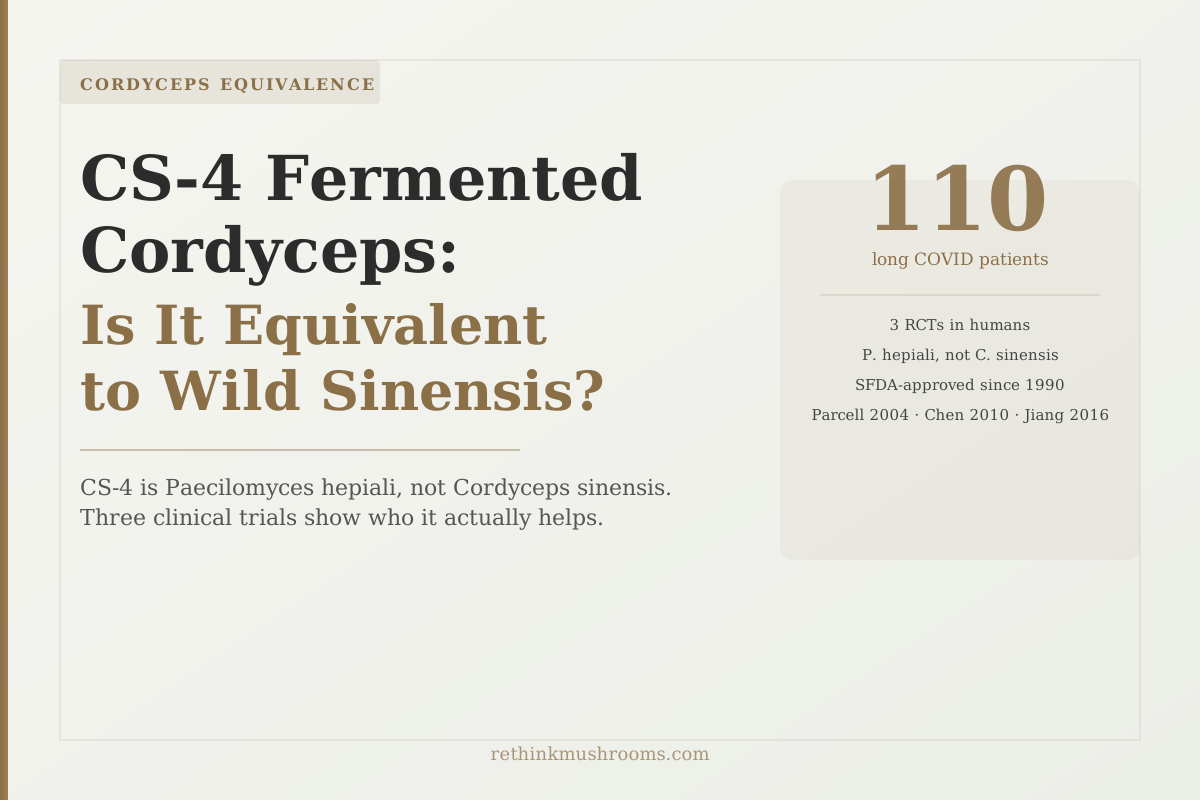
CS-4 is a fermented mycelium product made from Paecilomyces hepiali, not from Ophiocordyceps sinensis. The label is taxonomically wrong, but the human trial evidence — null in young athletes, positive on submaximal thresholds in older adults, and population-specific in kidney disease — has more nuance than either side of the debate usually concedes.
Lo et al., American Journal of Chinese Medicine, 2013
Null in young athletes
no aerobic or endurance gains in endurance-trained male cyclists (Parcell et al., 2004)
Threshold gains, not VO2max
metabolic and ventilatory thresholds improved in older adults — VO2max did not change in either arm (Chen et al., 2010)
1990
approved as Ophiocordyceps sinensis substitute by China's SFDA
Lo et al., American Journal of Chinese Medicine, 2013
 View as image ↗
Most products sold as "Cordyceps sinensis" do not contain Cordyceps sinensis. They contain Paecilomyces hepiali, the organism used to make CS-4, a fermented mycelium product developed in Chinese labs in the 1980s when wild caterpillar fungus became too scarce and too expensive to meet pharmaceutical demand. China's State Food and Drug Administration approved CS-4 as an official substitute for wild Ophiocordyceps sinensis in 1990, and the sinensis name stuck on the label. But the biology and the chemistry tell a different story.[1]
For a broader introduction to the cordyceps research landscape, see What Is Cordyceps? The Science Behind the Energy Mushroom.
Key Takeaways
- CS-4 is Paecilomyces hepiali fermented mycelium, not Ophiocordyceps sinensis. China's SFDA approved it as an official pharmaceutical substitute in 1990, which is why "Cordyceps sinensis" still appears on CS-4 labels — a regulatory artifact, not a species claim[1]
- A 2013 systematic review concluded that the wild caterpillar-fungus complex contains compounds and ecological context that no current cultivated or fermented product fully replicates (Lo et al., 2013)[1]
- Parcell et al. (2004) found 5 weeks of CordyMax CS-4 at 3 g/day produced no improvement in aerobic capacity or endurance performance in 22 endurance-trained male cyclists — a clean null in the population most often imagined as the customer[2]
- Chen et al. (2010) found CS-4 (333 mg three times daily for 12 weeks) improved metabolic threshold by 10.5% (p < 0.02) and ventilatory threshold by 8.5% in 20 healthy older adults — but the abstract explicitly states VO2max did not change in either group[3]
- A Cochrane review of Cordyceps sinensis (CS-4 and related products) for chronic kidney disease found benefits in some surrogate outcomes but flagged the underlying trials as low quality, and a separate Cochrane review for kidney transplant patients reached a similar overall verdict[4][5]
- A 2019 randomized double-blind RCT of a related Paecilomyces hepiali mycelium product (CBG-CS-2) found significant increases in NK cell activity in healthy adults, supporting the biological plausibility of a polysaccharide-mediated immune effect for this class of fermented mycelium extracts[6]
CS-4 Is Paecilomyces hepiali. The Label Is Historically Wrong
Paecilomyces hepiali Chen is a distinct fungal species. It is not a cultivated strain of Ophiocordyceps sinensis, the wild caterpillar fungus prized in Traditional Chinese Medicine. It is not the same organism as Cordyceps militaris. The three organisms share some chemical similarities, but they are different species with different compound profiles and different clinical research bases.[1]
The regulatory history explains the naming confusion. Wild O. sinensis grows only in high-altitude grasslands in Tibet and the Himalayas, where it parasitizes ghost moth caterpillars. Collection is difficult and supply is limited. By the 1980s, overharvesting had made pharmaceutical-grade wild sinensis unaffordable for routine medical use. Chinese researchers developed CS-4 as a fermented mycelium substitute, and when it received official SFDA approval in 1990, it inherited the Cordyceps sinensis regulatory classification. That classification has stayed on product labels ever since.
The consequence is a pervasive misnaming in the supplement industry. "CS-4 Cordyceps sinensis" on a label is a historical regulatory artifact, not an accurate species description. Knowing this changes how you read the evidence on both sides of the debate: the claim that CS-4 is genuine Cordyceps sinensis is wrong, and so is the claim that CS-4 must be fake or ineffective because it is not truly sinensis.
Why No Lab Can Fully Replicate Wild Sinensis Chemistry
Wild Ophiocordyceps sinensis is not simply a mushroom growing on organic material. It is a fungal-insect complex: the fungus infects a ghost moth caterpillar larva, colonizes and mummifies the body, and produces a fruiting body that emerges from the insect's head. The resulting organism contains compounds derived from both the fungal biology and the decomposed insect host. No fermentation process working with fungal mycelium alone can include the insect-derived fraction.[1]
Lo et al.'s 2013 systematic review of the O. sinensis literature documented this limitation in detail. The review compiled the historical Chinese medical record alongside modern chemical analyses and concluded that the full compound complexity of the wild caterpillar-fungus complex has not been replicated by any cultivated alternative. This applies to CS-4 specifically, but also to every other product claiming to be cultivated Cordyceps sinensis.[1]
What this means in practice: the claim that CS-4 is "equivalent to wild sinensis" is chemically false. What remains open is whether CS-4 produces its own clinically meaningful effects in humans. The human trial evidence addresses that question directly.
Three Trial Populations, Three Different Answers
CS-4 has been tested in published controlled human trials across distinct populations. The results are only interpretable when you keep track of who was in each trial.
Healthy Endurance-Trained Cyclists: Zero Benefit
Parcell et al. (2004) is the trial that gets cited most often by CS-4 critics, and it deserves the attention.[2] The researchers ran a double-blind, placebo-controlled study in 22 endurance-trained male cyclists. Subjects received CordyMax CS-4 at 3 g per day or placebo for five weeks. The endpoints were aerobic capacity (VO2max), lactate threshold, and time-to-exhaustion.
The result: no statistically significant improvement on any endpoint compared to placebo. The published conclusion is unambiguous — five weeks of CordyMax CS-4 supplementation has no effect on aerobic capacity or endurance exercise performance in this population.[2]
This is a solid null result from a well-designed trial. But notice who was enrolled: endurance-trained young men. These are people whose aerobic systems are already operating near their natural ceiling. Parcell's finding is that CS-4 cannot push already-optimized aerobic performance higher. It is not a finding about what CS-4 does in populations with more physiological room to recover.
Healthy Older Adults: Threshold Gains, Not VO2max
Chen et al. (2010) took the same question to a different population.[3] The trial enrolled 20 healthy older adults (age 50–75) in a double-blind, placebo-controlled design. Subjects took CS-4 at 333 mg three times daily, totaling approximately 1 g per day, for 12 weeks. The endpoints were VO2max, metabolic threshold, and ventilatory threshold.
After 12 weeks, the metabolic threshold improved by 10.5% (p < 0.02) and the ventilatory threshold by 8.5% in the CS-4 group, with no comparable change in placebo. The honest read of this trial is that it did not show a VO2max effect — the abstract explicitly notes that VO2max did not change in either group. What improved were the submaximal aerobic thresholds, which is a different and more modest claim than "boosted aerobic capacity."[3]
The two cardiopulmonary trials read together do not contradict each other. Both are consistent with a small, population-specific effect on submaximal aerobic metrics — and not a broad ergogenic effect.
Kidney Disease Populations: Cochrane-Reviewed but Low-Quality Evidence
Two Cochrane systematic reviews have synthesized the Cordyceps sinensis (largely CS-4 and related fermented mycelium products) evidence in renal medicine.
Zhang et al. (2014) reviewed Cordyceps sinensis as a complementary treatment for chronic kidney disease. The review identified multiple small Chinese trials suggesting benefits on surrogate outcomes such as serum creatinine and 24-hour urinary protein, but noted that the underlying trial quality was low — small samples, unclear blinding, and inconsistent outcome reporting were common. The reviewers' overall verdict was that the available evidence is suggestive but not strong enough to support a confident recommendation.[4]
Hong et al. (2015) ran the parallel Cochrane review for kidney transplant recipients, reaching a similar conclusion: some small trials reported reductions in adverse drug effects and infections when Cordyceps sinensis preparations were added to standard immunosuppression, but the certainty of evidence was rated low.[5]
A representative example of the kind of clinical work these Cochrane reviews aggregated is Li et al.'s 2009 paper on the clinical application of Cordyceps sinensis in renal transplantation, which described its use as part of immunosuppressive therapy.[7] The kidney-medicine literature on CS-4 is the area where its clinical use is most defensible — but it is not the same thing as a clean, large, blinded RCT proving efficacy on hard endpoints.
A 2024 Long-COVID Trial: Real Signal, Limited Indexing
A 2024 randomized waitlist-controlled trial published in Acta Materia Medica reported on 110 long-COVID patients in Hong Kong who received either a Cordyceps sinensis mycelium culture extract (CS-4-class) or were waitlisted for 12 weeks, with significant improvements in fatigue, insomnia, and respiratory symptoms in the active arm. This is a recent and clinically relevant signal — but the paper is not yet indexed in PubMed and is not currently part of this site's verified study corpus. Treat it as preliminary evidence pending further indexing and replication, not as a settled result.
What CS-4 Probably Does at the Mechanism Level
CS-4 is produced through liquid fermentation of Paecilomyces hepiali mycelium. The primary bioactive compounds in the extract are polysaccharides, adenosine, and small amounts of cordycepin.[1]
A 2019 randomized double-blind clinical trial by Jung et al. tested CBG-CS-2, a related Paecilomyces hepiali mycelium product, and found a significant increase in NK cell activity in healthy adults compared to placebo (P < 0.019).[6] CBG-CS-2 is a different commercial product than CS-4, but both are P. hepiali fermented mycelium extracts, so the immune-activation mechanism it documents is biologically relevant to the CS-4 class. That mechanism appears to work through the polysaccharide fraction rather than through cordycepin levels — which matters when comparing CS-4 (low cordycepin, polysaccharide-active) to Cordyceps militaris (the species best characterized for cordycepin accumulation).
For a direct comparison of C. militaris and the various "C. sinensis" products across the full range of evidence, see Cordyceps militaris vs. sinensis: Which Is Better?. For a full breakdown of cordycepin concentrations specifically, see Cordycepin Content Comparison: Militaris vs. Sinensis. For context on how extraction method affects what compounds actually survive into the final supplement product, see Fruiting Body vs. Mycelium: The Great Mushroom Supplement Debate.
A related quality consideration: because CS-4 is a fermented mycelium product rather than a fruiting body, it shares some of the quality concerns common to other mycelium-based supplements. The broader controversy around this category of products is covered in Mycelium on Grain: Why It's Controversial in the Supplement Industry. CS-4's liquid fermentation process is different from the grain-based mycelium production used for most mushroom supplements, but the distinction between mycelium and fruiting body extracts is still relevant for understanding what you are buying.
The Verdict: Chemically Different, Clinically Useful in the Right Context
CS-4 is not equivalent to wild Ophiocordyceps sinensis. The chemical case for that is settled. Wild O. sinensis is a fungal-insect complex with compounds that no fermentation process can fully replicate.[1]
But not equivalent is not the same as not useful.
Across the controlled human trials, the pattern is consistent: CS-4 produces no measurable effect in already-fit young athletes (Parcell 2004), produces submaximal threshold gains — but not VO2max gains — in healthy older adults (Chen 2010), and has Cochrane-reviewed, low-certainty evidence of benefit in kidney disease and post-transplant populations (Zhang 2014; Hong 2015). The unifying thread is small, population-specific effects in groups with physiological deficits or higher baseline turnover, not performance enhancement in healthy young people.
The biggest practical problem with CS-4 is that the label is taxonomically wrong and the marketing often targets the one population — healthy young adults seeking performance enhancement — where the controlled-trial evidence most clearly shows it does not work. Parcell's null result in that population should be read for what it is: CS-4 is the wrong tool for that specific application. For the populations where CS-4 has actually been studied with positive signals, the evidence base is real but modest in size and certainty.
The related question of whether CS-4's fermentation process specifically can produce effects comparable to wild sinensis is explored in more technical depth in CS-4 Fermentation: Is Lab-Grown Cordyceps as Effective as Wild?.
The Bottom Line
CS-4 is Paecilomyces hepiali, not Ophiocordyceps sinensis, and a 2013 systematic review confirms that no cultivated or fermented product reproduces the full chemistry of the wild caterpillar-fungus complex. The clinical picture is population-dependent: CS-4 failed to improve endurance in 22 endurance-trained young cyclists (Parcell, 2004); produced submaximal metabolic and ventilatory threshold gains — but not VO2max gains — in 20 healthy older adults (Chen, 2010); and has Cochrane-reviewed but low-certainty evidence of benefit in chronic kidney disease (Zhang, 2014) and kidney transplant recipients (Hong, 2015). A related Paecilomyces hepiali mycelium product (CBG-CS-2) showed NK cell activation in a 2019 RCT (Jung et al.). Not equivalent to wild sinensis, but with a small, real, population-specific human evidence base.
Frequently Asked Questions
Sources & References
- 1RTHM-00542·Lo, Hui-Chen et al. (2013). “A Systematic Review of the Mysterious Caterpillar Fungus Ophiocordyceps sinensis in Dong-ChongXiaCao ( Dōng Chóng Xià Cǎo) and Related Bioactive Ingredients..” Journal of traditional and complementary medicine.Study breakdown →PubMed →↩
- 2RTHM-00075·Parcell, Allen C et al. (2004). “Cordyceps Sinensis (CordyMax Cs-4) supplementation does not improve endurance exercise performance..” International journal of sport nutrition and exercise metabolism.Study breakdown →PubMed →↩
- 3RTHM-00176·Chen, Steve et al. (2010). “Effect of Cs-4 (Cordyceps sinensis) on exercise performance in healthy older subjects: a double-blind, placebo-controlled trial..” Journal of alternative and complementary medicine (New York.Study breakdown →PubMed →↩
- 4RTHM-00360·Zhang, Hong Wei et al. (2014). “Cordyceps sinensis (a traditional Chinese medicine) for treating chronic kidney disease..” The Cochrane database of systematic reviews.Study breakdown →PubMed →↩
- 5RTHM-00375·Hong, Tao et al. (2015). “Cordyceps sinensis (a traditional Chinese medicine) for kidney transplant recipients..” The Cochrane database of systematic reviews.Study breakdown →PubMed →↩
- 6RTHM-00563·Jung, Su-Jin et al. (2019). “Immunomodulatory effects of a mycelium extract of Cordyceps (Paecilomyces hepiali; CBG-CS-2): a randomized and double-blind clinical trial..” BMC complementary and alternative medicine.Study breakdown →PubMed →↩
- 7RTHM-00161·Li, Y et al. (2009). “Clinical application of Cordyceps sinensis on immunosuppressive therapy in renal transplantation..” Transplantation proceedings.Study breakdown →PubMed →↩