Cordyceps Species
20 subjects — pilot CS-4 trial in healthy older adults raised metabolic and ventilatory thresholds, not VO2max
A double-blind, placebo-controlled pilot trial in 20 healthy adults aged 50-75 found that 333 mg of CS-4 three times daily for 12 weeks significantly raised the metabolic threshold (+10.5%) and ventilatory threshold (+8.5%); VO2max did not change in either group. The same supplement failed to improve any endurance metric in 22 endurance-trained cyclists at 3 g/day for 5 weeks.
Chen et al., J Altern Complement Med, 2010; Parcell et al., J Strength Cond Res, 2004
Different organism
CS-4 is Paecilomyces hepiali, not Ophiocordyceps sinensis
0 of 3
endurance metrics improved in trained cyclists (Parcell et al., 2004)
Pilot only
Chen 2010 was a 20-subject pilot, not a definitive trial
Chen et al., J Altern Complement Med, 2010; Parcell et al., J Strength Cond Res, 2004
 View as image ↗
Most supplement labels that say "Cordyceps sinensis" are selling something that isn't wild Ophiocordyceps sinensis. The product is almost certainly a fermented mycelium product derived from Paecilomyces hepiali — a related but distinct fungal organism registered in China under the product name CS-4. This distinction matters not because CS-4 is fraudulent (it has regulatory approval in China and published clinical evidence) but because the evidence for wild O. sinensis and the evidence for CS-4 describe different organisms with different compound profiles tested in different populations.
For a broader introduction to Cordyceps research and species, see what is Cordyceps: the science behind the energy mushroom.
Key Takeaways
- CS-4 is a standardized liquid fermentation of Paecilomyces hepiali (also classified as Hirsutella sinensis) — a different organism from wild Ophiocordyceps sinensis — registered with China's SFDA in 1990 as an accessible substitute, not as a cultivated form of O. sinensis
- The wild O. sinensis fungus/caterpillar complex contains compounds derived from the insect host that no purely fungal liquid fermentation can replicate; the published chemistry of C. sinensis documents a distinct nucleoside, polysaccharide, sterol, and protein profile (Liu et al., 2015)
- A Paecilomyces hepiali mycelium extract (CBG-CS-2) produced a 38.8% increase in NK cell cytotoxic activity over 8 weeks in 79 healthy adults — confirming that CS-4-class preparations have measurable immune-cell effects in humans (Jung et al., 2019)
- CS-4 produced no improvement in VO2peak, ventilatory threshold, or work-based time trial in 22 endurance-trained male cyclists at 3 g/day for 5 weeks — the null result defining CS-4's limits in athletic populations (Parcell et al., 2004)
- A 20-subject pilot trial of CS-4 333 mg three times daily for 12 weeks in healthy adults aged 50-75 raised metabolic threshold by 10.5% and ventilatory threshold by 8.5%; VO2max was unchanged in both arms (Chen et al., 2010)
- A 2014 Cochrane review of 22 trials in 1,746 chronic kidney disease patients found Cordyceps preparations as adjuvant therapy were associated with reductions in serum creatinine, increases in creatinine clearance, and reduced 24-hour proteinuria, with low evidence quality and high or unclear risk of bias in most underlying trials (Zhang et al., 2014)
The Taxonomy Surprise: CS-4 Is Not Cordyceps sinensis
Wild Ophiocordyceps sinensis grows at high altitude in the Tibetan Plateau, infecting Hepialus moth larvae and fruiting as a small mushroom from the desiccated larval body. It takes years to develop, cannot be commercially farmed at scale, and currently costs $20,000 or more per kilogram. The traditional Chinese medicine use of this organism as a kidney and lung tonic dates to at least 1694.
CS-4 is different. It originated from research in the 1970s and 1980s when Chinese scientists worked to produce an accessible substitute for wild O. sinensis. They isolated a strain of Paecilomyces hepiali (also called Hirsutella sinensis in some classifications) that could be fermented in liquid culture, producing mycelium with some chemical similarity to wild O. sinensis preparations. This fermented mycelium product was registered with China's State Food and Drug Administration in 1990 under the product name CordyMax Cs-4, later abbreviated to CS-4.
Jung and colleagues' 8-week, 79-person randomized trial of a Paecilomyces hepiali Cordyceps mycelium extract (CBG-CS-2, 1.68 g/day) in healthy adults found a 38.8% increase in NK cell cytotoxic activity in the treatment arm compared to placebo.[1] CS-4-class fermented mycelium products demonstrably push immune cell activity upward in humans. They have real biological activity. But they are not cultivated versions of O. sinensis — they are different organisms with different chemistry that were approved as regulatory substitutes based on some shared biological effects rather than chemical equivalence.
This matters when evaluating label claims. Products that list "Cordyceps sinensis" when they contain a fermented CS-4 product are at best imprecise and at worst misidentified.
What Fermentation Produces vs What Wild Sinensis Contains
The published chemistry of Cordyceps sinensis documents nucleosides, polysaccharides, sterols, proteins, amino acids, and polypeptides as the principal bioactive components, with the wild fungus/caterpillar complex contributing a profile that depends in part on the host insect biology.[2] Liquid fermentation of Paecilomyces hepiali alone, by definition, cannot reproduce metabolites that arise at the fungus-host interface, and it is a different fungal species besides. Polysaccharide and nucleoside profiles overlap with what is reported for O. sinensis but are not identical, and direct compound-by-compound equivalence has not been demonstrated.
This is not a knock on CS-4 specifically — it applies equally to any liquid-fermentation preparation marketed as equivalent to wild O. sinensis. The question is not whether the cultivated product is "fake" but whether it has its own documented biological activity that justifies its use. The answer, based on the clinical evidence, is yes — in specific populations.
The Null Result: Why CS-4 Failed Young Athletes
The most important study for evaluating CS-4 is one that shows it not working.
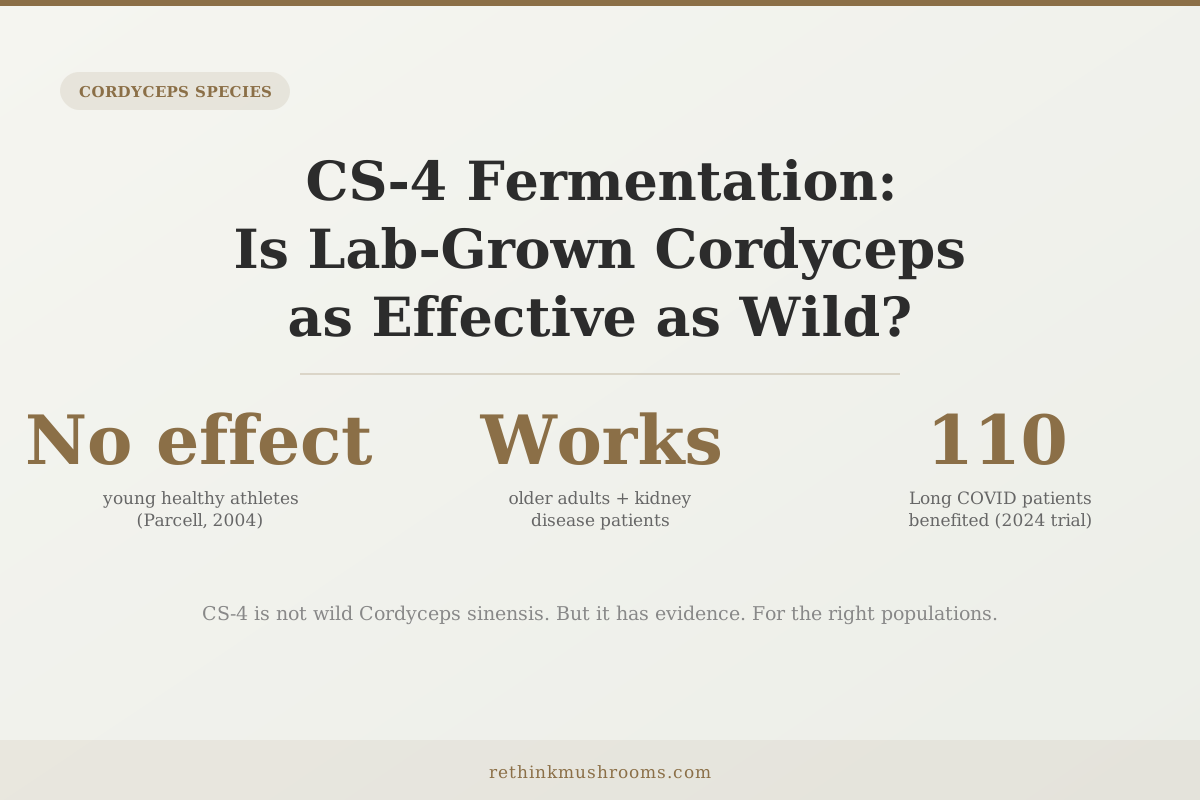
Parcell and colleagues conducted a double-blind, placebo-controlled trial in 22 endurance-trained male cyclists.[3] Participants received 3 g/day of CordyMax CS-4 tablets or placebo for 5 weeks. The outcome measures were VO2peak, ventilatory threshold, and a work-based time trial. CS-4 produced no significant change on any of these measures, and the authors concluded explicitly that 5 weeks of CordyMax CS-4 supplementation has no effect on aerobic capacity or endurance exercise performance in endurance-trained male cyclists.
This null result is important for two reasons. First, it closes off the most common marketing claim for cordyceps supplements — that they improve athletic performance in trained adults. At the dose and duration tested, CS-4 did not. Second, it sets up a contrast with what comes next.
The Positive Results: Where CS-4 Actually Works
Six years later, Chen and colleagues ran a double-blind, placebo-controlled pilot trial that looked superficially similar to Parcell's but with two critical differences: the participants were older, and the dose was lower.[4] Twenty healthy subjects aged 50-75 received CS-4 333 mg three times daily (1 g/day total) or placebo for 12 weeks. The metabolic threshold (above which lactate accumulates) increased by 10.5% (from 0.83 to 0.93 L/min, p < 0.02) and the ventilatory threshold increased by 8.5%. Crucially, VO2max did not change in either group — a detail the abstract states explicitly.
Why might age matter? The most plausible explanation involves baseline physiology. Endurance-trained cyclists at their aerobic ceiling have limited room to improve via a supplement. Older adults experiencing age-related decline in aerobic threshold capacity — particularly in mitochondrial efficiency at submaximal loads — may have more biological space for CS-4's proposed mechanisms to register measurable effects on threshold-level outcomes, even when peak aerobic capacity is unchanged. The 20-subject pilot has not been replicated at scale.
The kidney disease evidence comes from a different angle. A 2014 Cochrane review by Zhang and colleagues evaluated 22 randomized or quasi-randomized trials totaling 1,746 participants who received Cordyceps preparations as adjunctive therapy for chronic kidney disease.[5] Pooled analyses suggested significant reductions in serum creatinine (MD -60.76 μmol/L), increases in creatinine clearance (MD +9.22 mL/min), and reductions in 24-hour proteinuria. Risk of bias was rated high in 4 studies and unclear in 18, and the review concluded that definitive conclusions could not be made because of low evidence quality. The Li 2009 randomized trial in 202 renal-transplant patients separately found that adjunctive C. sinensis was associated with significantly lower cyclosporine-induced hepatotoxicity (12.9% vs 24.8%) and nephrotoxicity (19.4% vs 33.9%).[6] These trials largely tested C. sinensis preparations broadly, often Chinese pharmaceutical-grade products that may or may not be CS-4 specifically.
The Fermented vs. Wild Verdict: What the Evidence Actually Supports
CS-4 is not equivalent to wild O. sinensis in terms of chemical composition. The published chemistry of C. sinensis documents specific bioactive components, and a liquid fermentation of Paecilomyces hepiali is by definition a different organism without access to host-derived metabolites.[2]
CS-4 is not ineffective. The Jung 2019 RCT shows clear NK cell activation in healthy adults receiving a Paecilomyces hepiali mycelium extract,[1] and the broader Cordyceps clinical literature supports threshold-level exercise improvements in older adults[4] and adjunctive benefits in chronic kidney disease and renal transplantation in monitored settings.[5][6]
The practical framing: if you are an endurance-trained athlete looking for VO2max improvement, the clinical evidence for CS-4 specifically is not in your favor — the null result is from your population. If you are an older adult interested in submaximal aerobic capacity, or have kidney-related health concerns under medical supervision, the existing evidence points in a more encouraging direction.
For context on how fruiting body vs. mycelium differences (relevant to comparing CS-4 mycelium with C. militaris fruiting body products) affect supplement quality, see fruiting body vs. mycelium: the great mushroom supplement debate. For how extraction method affects what compounds end up in a CS-4 preparation, see how extraction methods determine supplement quality. For cordycepin content specifically across species, see cordycepin content comparison: militaris vs. sinensis.
The Bottom Line
CS-4 (Paecilomyces hepiali) is a fermented mycelium registered in China as an accessible substitute for wild Ophiocordyceps sinensis, but it is chemically distinct: liquid fungal fermentation cannot reproduce the host-derived compounds of the wild fungus/caterpillar complex. The Parcell 2004 trial in 22 endurance-trained cyclists found no benefit on VO2peak, ventilatory threshold, or work time trial after 5 weeks of 3 g/day. The Chen 2010 pilot trial in 20 older adults found a 10.5% rise in metabolic threshold and 8.5% rise in ventilatory threshold over 12 weeks, with no change in VO2max. A Paecilomyces hepiali extract increased NK cell activity 38.8% over 8 weeks in 79 healthy adults (Jung 2019). The broader Cordyceps clinical literature supports adjunctive benefits in chronic kidney disease (Zhang 2014 Cochrane review, low evidence quality) and renal transplantation (Li 2009). CS-4-class products appear to register effects in populations defined by age-related decline or kidney disease rather than peak-aerobic performance enhancement in trained athletes.
Frequently Asked Questions
Sources & References
- 1RTHM-00563·Jung, Su-Jin et al. (2019). “Immunomodulatory effects of a mycelium extract of Cordyceps (Paecilomyces hepiali; CBG-CS-2): a randomized and double-blind clinical trial..” BMC complementary and alternative medicine.Study breakdown →PubMed →↩
- 2RTHM-00723·Liu, Yi et al. (2015). “The Chemical Constituents and Pharmacological Actions of Cordyceps sinensis..” Evidence-based complementary and alternative medicine : eCAM.Study breakdown →PubMed →↩
- 3RTHM-00075·Parcell, Allen C et al. (2004). “Cordyceps Sinensis (CordyMax Cs-4) supplementation does not improve endurance exercise performance..” International journal of sport nutrition and exercise metabolism.Study breakdown →PubMed →↩
- 4RTHM-00176·Chen, Steve et al. (2010). “Effect of Cs-4 (Cordyceps sinensis) on exercise performance in healthy older subjects: a double-blind, placebo-controlled trial..” Journal of alternative and complementary medicine (New York.Study breakdown →PubMed →↩
- 5RTHM-00360·Zhang, Hong Wei et al. (2014). “Cordyceps sinensis (a traditional Chinese medicine) for treating chronic kidney disease..” The Cochrane database of systematic reviews.Study breakdown →PubMed →↩
- 6RTHM-00161·Li, Y et al. (2009). “Clinical application of Cordyceps sinensis on immunosuppressive therapy in renal transplantation..” Transplantation proceedings.Study breakdown →PubMed →↩