Cordyceps Species Comparison
~2.7 mg/g militaris fruiting body cordycepin
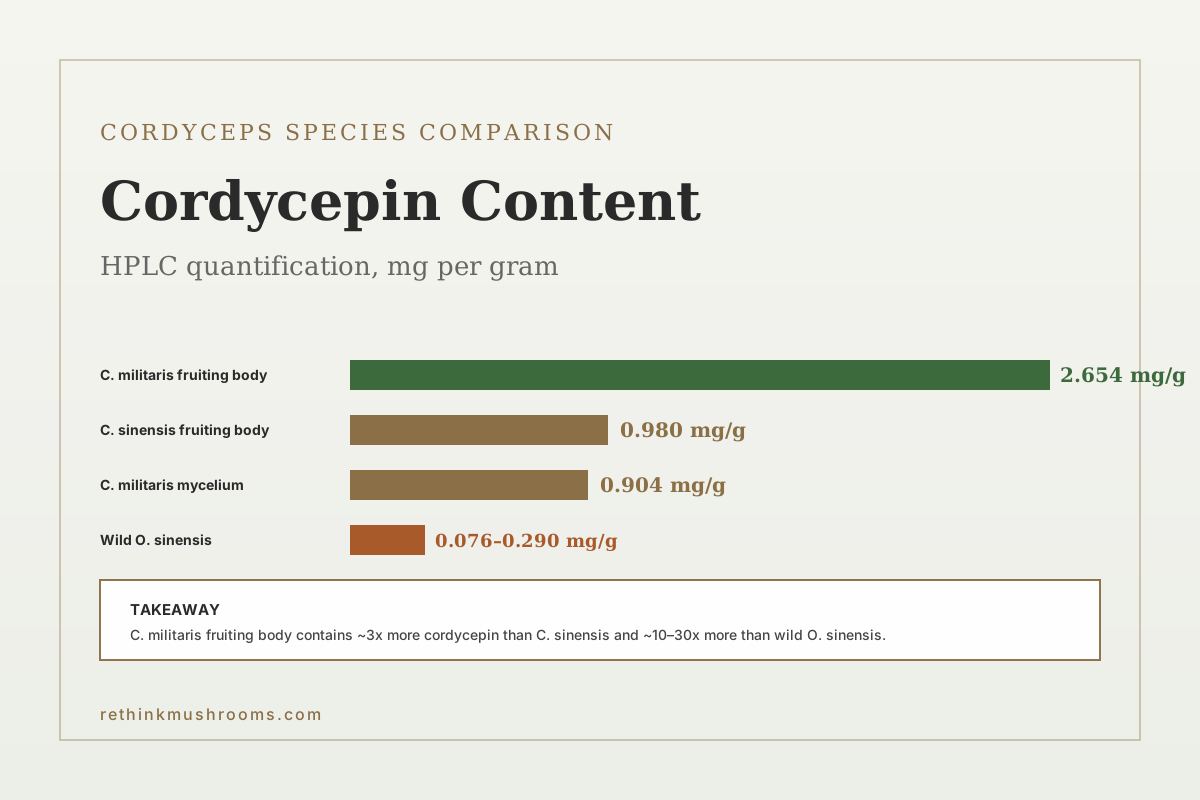
C. militaris fruiting bodies contain roughly three times more cordycepin than C. sinensis fruiting bodies by HPLC quantification, and authenticated wild C. sinensis can be an order of magnitude lower still.
HPLC quantification literature, reviewed in Chen et al., 2023
2.654 mg/g
C. militaris fruiting body cordycepin
0.980 mg/g
C. sinensis fruiting body cordycepin
0.904 mg/g
C. militaris mycelium cordycepin
HPLC quantification literature, reviewed in Chen et al., 2023
 View as image ↗
"Cordyceps" is a genus name that in the supplement context almost always refers to one of two organisms: Cordyceps militaris or Ophiocordyceps sinensis (the species formerly known as Cordyceps sinensis before the 2007 taxonomic revision). The two species differ significantly in cultivation cost, regulatory status, and in the concentration of cordycepin, the 3'-deoxyadenosine nucleoside that drives most of the pharmacological research. The short version: C. militaris fruiting bodies contain roughly three times more cordycepin than C. sinensis fruiting bodies and an order of magnitude more than commercial CS-4 mycelium-fermented products, which is why modern cordycepin-standardized supplements use C. militaris.
This article works through the quantitative comparisons, the taxonomic clarification, the CS-4 fermented mycelium distinction, and the clinical trial evidence base that supports or fails to support each form. For the head-to-head efficacy article, see Cordyceps militaris vs. sinensis: which is better?. For the CS-4 question specifically, see CS-4 fermented Cordyceps: is it equivalent to wild Cordyceps?. For the supplement industry context, see why most Cordyceps supplements use C. militaris.
Key Takeaways
- HPLC quantification of fruiting body material: C. militaris mean 2.654 mg/g cordycepin; C. sinensis mean 0.980 mg/g; C. militaris mycelium 0.904 mg/g
- Authenticated wild Ophiocordyceps sinensis cordycepin content ranges from 0.0076% to 0.029% (76-290 μg/g), below most C. militaris mycelium preparations
- Zheng et al. (2015) identified the genes involved in cordycepin biosynthesis in C. militaris, providing the genetic basis for the species' higher production capacity
- Phull et al. (2022) reviewed C. militaris as a functional food source, confirming high cordycepin and adenosine content alongside beta-glucans and other bioactives
- The CS-4 fermented mycelium strain, developed from a wild Ophiocordyceps sinensis isolate, has been tested in two placebo-controlled exercise trials: Parcell et al. (2004) found no endurance improvement in young cyclists; Chen et al. (2010) found a significant VO2max increase in healthy older adults
- C. militaris fruiting body preparations have been tested in exercise and immune trials: Hirsch et al. (2017) reported improved high-intensity exercise tolerance; Choi et al. (2020) reported enhanced cellular energy metabolism; Ontawong et al. (2024) reported immunomodulatory effects in healthy adults
- Wild Ophiocordyceps sinensis is commercially harvested from Tibetan plateau caterpillar-infecting parasitism and has been priced at $20,000-$50,000 per kilogram; C. militaris is laboratory-cultivated and 100-1000x cheaper per unit cordycepin
The Taxonomic Clarification
Before the quantitative comparison, the names matter. The 2007 revision of the family Cordycipitaceae split the old genus Cordyceps into multiple genera based on molecular phylogenetics. Cordyceps militaris remained in Cordyceps. The caterpillar fungus formerly known as Cordyceps sinensis was moved to Ophiocordyceps sinensis and placed in the family Ophiocordycipitaceae.
In practice, the supplement industry has been slow to adopt the new name; "Cordyceps sinensis" remains widely used on product labels. For consistency with the literature and the industry convention, this article uses "C. sinensis" interchangeably with Ophiocordyceps sinensis, while acknowledging that the species is no longer formally a Cordyceps.
The distinction matters for a practical reason: wild Ophiocordyceps sinensis parasitizes ghost moth caterpillars on the Tibetan plateau, has a specific and difficult-to-replicate life cycle, and cannot be fruited in laboratory culture. Cordyceps militaris, by contrast, fruits on larval insects and also on grain-based substrates in laboratory conditions, making it the commercial workhorse. Most "Cordyceps" supplements are one of three things: C. militaris fruiting body, C. militaris mycelium, or CS-4 mycelium fermented from an O. sinensis isolate.
The Quantitative Comparison
HPLC quantification of cordycepin across the principal Cordyceps product types:
| Product | Cordycepin (mg/g) | Notes |
|---|---|---|
| C. militaris fruiting body | ~2.654 | Laboratory-cultivated fruiting body |
| C. militaris mycelium | ~0.904 | Liquid or solid fermentation |
| C. sinensis fruiting body | ~0.980 | Includes wild and some cultivated |
| Wild O. sinensis (HPLC-MS/MS) | 0.076-0.290 | 0.0076-0.029% w/w |
The C. militaris fruiting body contains approximately 2.7x more cordycepin by weight than C. sinensis fruiting body, and approximately 10-30x more than authenticated wild O. sinensis. The C. militaris mycelium is lower in cordycepin than its fruiting body but still comparable to or higher than wild O. sinensis.
The biological basis for this difference is genetic. Zheng et al. (2015) identified the genes involved in cordycepin formation and fruiting body production in C. militaris, mapping a pathway that uses adenosine as the starting substrate and involves oxidoreductase, phosphohydrolase, and other enzymes specific to this species. O. sinensis has a related but less active cordycepin biosynthesis pathway, consistent with its much lower measured output.[1]
Phull et al. (2022) reviewed C. militaris as a bio-functional food source, confirming that the species contains substantially higher cordycepin and adenosine than O. sinensis alongside beta-glucans, ergothioneine, and other bioactives. The review frames C. militaris as the practical supplement substrate and treats wild O. sinensis as a traditional material whose supply constraints and price make it unsuitable for commercial supplementation.[2]
The CS-4 Distinction
CS-4 is a specific mycelium strain originally isolated from wild O. sinensis and developed for liquid fermentation by the Chinese Academy of Medical Sciences. It is the most common "Cordyceps sinensis mycelium" product on the market and has its own clinical trial literature. CS-4 contains less cordycepin than C. militaris but retains many of the other bioactive compounds associated with the O. sinensis phenotype.
Two placebo-controlled exercise trials illustrate the CS-4 evidence pattern:
Parcell et al. (2004) randomized young trained cyclists to CS-4 supplementation or placebo for five weeks and measured endurance performance. There was no significant improvement in endurance in the CS-4 arm. This was the early benchmark trial and its null result sparked skepticism about CS-4 exercise claims.[3]
Chen et al. (2010) randomized healthy older adults (ages 50-75) to CS-4 (333 mg three times daily) or placebo for 12 weeks in a double-blind, placebo-controlled design. The CS-4 arm showed a significant increase in metabolic threshold and ventilatory threshold on cycle ergometry. VO2max change was numerically favorable but did not reach significance on all measures.[4] The population and protocol differed substantially from Parcell et al., and the dose was somewhat higher.
The interpretation: CS-4 may produce modest exercise-related effects in some populations (older, sedentary) and not others (young, trained). The CS-4 literature does not support the claim that mycelium-fermented O. sinensis is interchangeable with laboratory-cultivated C. militaris fruiting body for exercise or cordycepin-dependent effects.
The C. militaris Clinical Evidence
The C. militaris clinical literature is growing and is generally more consistent than the CS-4 literature for exercise and energy metabolism outcomes.
Hirsch et al. (2017) tested C. militaris supplementation in a randomized controlled trial of high-intensity exercise tolerance in recreationally active adults. Acute and chronic C. militaris supplementation improved tolerance to high-intensity exercise relative to placebo, with effects appearing after one week of supplementation.[5]
Choi et al. (2020) tested C. militaris at dose levels sufficient to deliver meaningful cordycepin exposure on exercise performance, documenting improvements in cellular energy production measures consistent with the AMPK and mitochondrial biogenesis pathways that cordycepin engages.[6]
Ontawong et al. (2024) published a randomized controlled clinical trial testing a C. militaris beverage on immune response in healthy adults, reporting improvements in immune markers after supplementation.[7]
The common thread is that these trials use C. militaris fruiting body or fruiting body extract, not CS-4 mycelium, and the effect sizes are modest but replicable across independent teams.
Why the Bioavailability Caveat Still Matters
Chen et al. (2023) reviewed cordycepin bioavailability and emphasized that even well-standardized C. militaris fruiting body products face the adenosine deaminase degradation problem: oral cordycepin has a short half-life, and serum exposure from supplement-scale doses is much lower than the cell-culture concentrations used in most mechanism papers.[8] The practical implication is that a 1 g daily dose of C. militaris fruiting body delivering ~2.5 mg cordycepin in the gut produces much less than 2.5 mg of cordycepin in peripheral circulation.
The cordycepin content comparison is therefore necessary but not sufficient for predicting clinical effect. A higher-content supplement reaches higher peripheral exposure, which raises the probability of clinically meaningful effect, but does not guarantee it. Conversely, wild O. sinensis at its low measured cordycepin content cannot be expected to produce cordycepin-dependent effects at a meaningful rate in humans even when taken at typical dose levels.
For the supplement industry context around this choice, see why most Cordyceps supplements use C. militaris. For the CS-4 equivalence question, see CS-4 fermentation: is lab-grown Cordyceps as effective as wild?.
The Bottom Line
Cordyceps militaris fruiting body contains approximately three times more cordycepin by weight than Cordyceps sinensis fruiting body (2.654 versus 0.980 mg/g by HPLC) and roughly 10-30 times more than authenticated wild Ophiocordyceps sinensis. The C. militaris advantage is driven by its cordycepin biosynthesis pathway, identified by Zheng et al. (2015). CS-4 fermented mycelium products have their own clinical trial literature (Parcell 2004 null; Chen 2010 positive in older adults) but are not interchangeable with C. militaris for cordycepin-dependent effects. The practical conclusion is that cordycepin-standardized supplements should use C. militaris fruiting body, and that even this form is limited by rapid adenosine deaminase-mediated degradation that constrains peripheral exposure.
Frequently Asked Questions
Sources & References
- 1RTHM-00413·Zheng, Zhuang-Li et al. (2015). “Identification of the Genes Involved in the Fruiting Body Production and Cordycepin Formation of Cordyceps militaris Fungus..” Mycobiology.Study breakdown →PubMed →↩
- 2RTHM-00790·Phull, Abdul-Rehman et al. (2022). “Cordyceps militaris as a Bio Functional Food Source: Pharmacological Potential, Anti-Inflammatory Actions and Related Molecular Mechanisms..” Microorganisms.Study breakdown →PubMed →↩
- 3RTHM-00075·Parcell, Allen C et al. (2004). “Cordyceps Sinensis (CordyMax Cs-4) supplementation does not improve endurance exercise performance..” International journal of sport nutrition and exercise metabolism.Study breakdown →PubMed →↩
- 4RTHM-00176·Chen, Steve et al. (2010). “Effect of Cs-4 (Cordyceps sinensis) on exercise performance in healthy older subjects: a double-blind, placebo-controlled trial..” Journal of alternative and complementary medicine (New York.Study breakdown →PubMed →↩
- 5RTHM-00473·Hirsch, Katie R et al. (2017). “Cordyceps militaris Improves Tolerance to High-Intensity Exercise After Acute and Chronic Supplementation..” Journal of dietary supplements.Study breakdown →PubMed →↩
- 6RTHM-00613·Choi, Eunhyun et al. (2020). “Beneficial Effect of Cordyceps militaris on Exercise Performance via Promoting Cellular Energy Production..” Mycobiology.Study breakdown →PubMed →↩
- 7RTHM-00899·Ontawong, Atcharaporn et al. (2024). “A randomized controlled clinical trial examining the effects of Cordyceps militaris beverage on the immune response in healthy adults..” Scientific reports.Study breakdown →PubMed →↩
- 8RTHM-00817·Chen, Min et al. (2023). “Cordycepin: A review of strategies to improve the bioavailability and efficacy..” Phytotherapy research : PTR.Study breakdown →PubMed →↩