Mushroom Extraction Methods
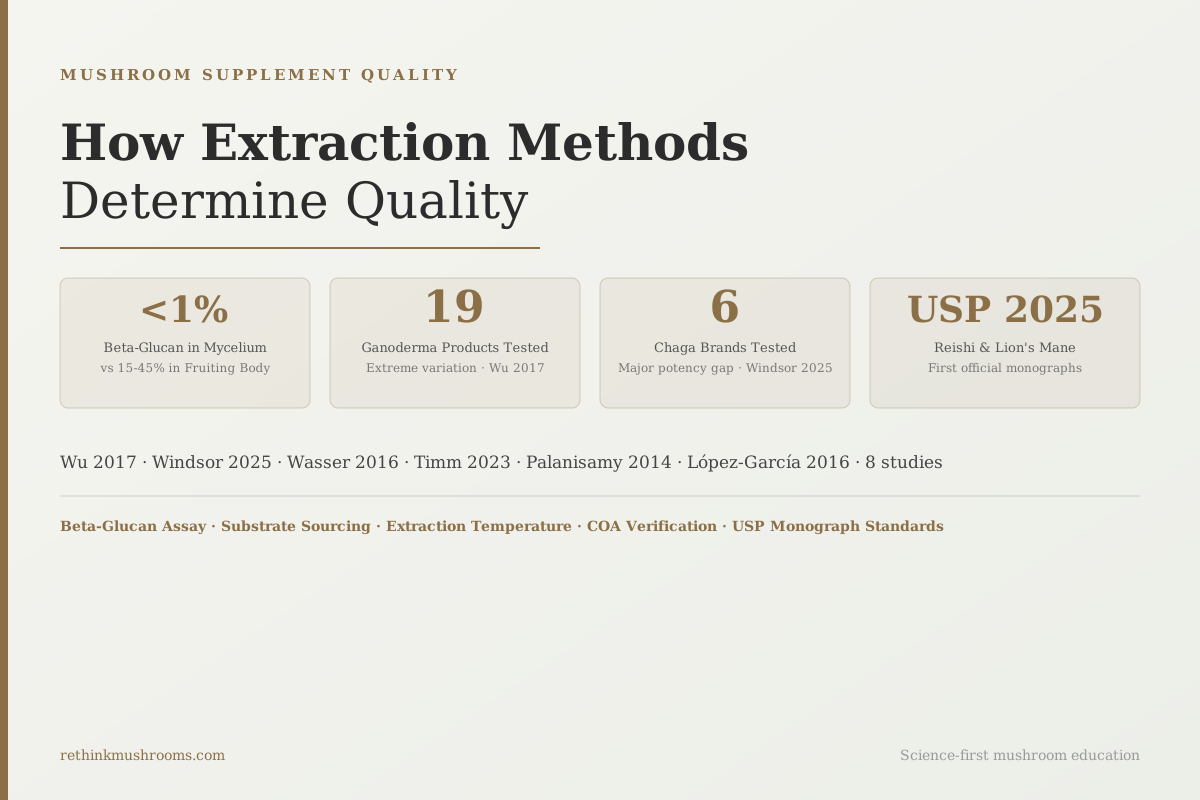
<1% β-glucan
Mycelium-on-grain mushroom supplements frequently test below 1% beta-glucan, compared to 15–45% in fruiting body hot water extracts — from the same labeled species, at the same price.
Wasser et al., Int J Med Mushrooms, 2016
19
US Ganoderma supplements tested — some with no detectable active compounds (Wu 2017)
6
Chaga supplement brands tested — major potency variation across all key biomarkers (Windsor 2025)
2025
Year USP published official monographs for Reishi and Lion's Mane potency verification
Wasser et al., Int J Med Mushrooms, 2016
 View as image ↗
Nineteen Ganoderma lucidum supplements were purchased from the US market, tested by independent researchers, and evaluated for polysaccharide and triterpene content. Some high-priced products had no detectable active compounds at all.[1]
This was not a fringe finding. The researchers directly linked the variation to differences in extraction method, source material, and lack of standardized manufacturing. Two products making nearly identical label claims about potency had entirely different compound profiles under laboratory analysis.
Extraction method is the single largest determinant of what a mushroom supplement actually contains. Two products made from the same species, with identical label claims, can deliver completely different compounds depending on how they were processed. Understanding this is the practical foundation for evaluating any mushroom supplement. The full biology of how extraction methods work explains the underlying chemistry. This article focuses on how those differences translate to quality variation in real products on the market.
Key Takeaways
- Wu et al. tested 19 Ganoderma supplements from the US market and found extreme variation in polysaccharide and triterpene content — some high-priced products had no detectable active compounds.[1]
- Windsor et al. (2025) tested 6 Chaga supplement brands and found major variation in inotodiol, betulin, betulinic acid, and polysaccharide content across products with identical label claims.[2]
- Mycelium-on-grain mushroom products frequently test below 1% beta-glucan, while fruiting body hot water extracts typically show 15–45%, using the same validated enzymatic assay on the same labeled species.[3]
- Hot water extraction temperature is not neutral: excessive heat degrades high-molecular-weight beta-glucan chains that are more immunostimulatory, meaning crude yield can increase while immunological potency decreases.[6]
- Even the same extraction method applied to the same species produces different polysaccharide molecular weight profiles depending on parameters — making products that claim identical potency on labels fundamentally different compounds.[8]
- The 2025 United States Pharmacopeia (USP) published official monographs for Reishi and Lion's Mane — the first standardized benchmarks for identity, purity, and potency verification in these species.
The 19-Supplement Finding That Should Change How You Buy Mushroom Products
In 2017, Wu and colleagues published an analysis of 19 Ganoderma lucidum dietary supplements purchased from retailers and online channels in the United States. The study tested each product for polysaccharide content and triterpene content, the two primary bioactive compound classes in reishi.[1]
The results showed extreme variation. Some products claiming high potency had no detectable polysaccharides. Others had detectable polysaccharides but no measurable triterpenes. Still others had both, in varying concentrations that bore no clear relationship to price or label claims.
The researchers attributed the variation to three main factors: differences in extraction method, differences in source material (fruiting body versus mycelium versus mycelium-on-grain), and the absence of standardized manufacturing requirements for mushroom supplements.
For consumers, this finding has a direct implication. When two Ganoderma products make similar label claims and one sells for $20 and one for $60, price is not a reliable guide to compound content. The extraction method, stated on the label, is a more meaningful differentiator than price, brand size, or marketing language.
The Wu 2017 study was conducted on Ganoderma, but its conclusion applies broadly to the supplement category. Polysaccharide and triterpene content in mushroom supplements varies significantly based on how they were made, not just what species was used.
2025 Chaga Testing: Major Potency Variation Across Six Brands
The Wu 2017 Ganoderma data was not a one-species anomaly. A 2025 analytical study by Windsor and colleagues tested six commercial Chaga supplement brands using three complementary techniques: nuclear magnetic resonance (NMR) spectroscopy, high-performance liquid chromatography (HPLC), and Fourier-transform infrared spectroscopy (FTIR).[2]
The authors found major variation across the six brands in inotodiol, betulin, and betulinic acid — three of Chaga's signature bioactive compounds — and in polysaccharide content. Products with comparable label claims showed dramatically different compound profiles under analysis.
The conclusion pointed directly to extraction method and sourcing. Products derived from wild-harvested Chaga and processed with appropriate extraction showed notably different profiles than products using cultivated or mycelium-sourced material. The method of extraction used, whether hot water, alcohol, or a combination, also significantly influenced which compound classes were present.
This 2025 data matters because Chaga is one of the most marketed mushroom supplements in the Western market. The brand-to-brand variation in Windsor 2025 means that consumers selecting a Chaga supplement based on label claims and price are navigating information that does not reliably reflect what the product contains.
For context on what hot water and alcohol extraction each capture differently in species like Chaga, where betulin and inotodiol require different solvent approaches than beta-glucans, the compound-specific extraction article covers that distinction in detail.
The Substrate Problem: Why Mycelium on Grain Produces Near-Zero Beta-Glucan
Extraction method is one determinant of supplement quality. The material being extracted is another, and the two interact.
In 2016, Wasser and colleagues published a validated enzymatic assay for measuring actual beta-glucan content, as distinct from total polysaccharide content, in mushroom products and mycelial preparations.[3] The results showed a stark difference: mycelium-on-grain preparations frequently tested below 1% beta-glucan, while fruiting body hot water extracts typically showed 15–45% beta-glucan from the same species.
This difference matters because beta-glucan content is the primary functional marker for the immune-modulating activity that most mushroom supplements are marketed around. A product with 1% beta-glucan and a product with 30% beta-glucan are not delivering similar doses of the primary active compound, even if both claim to be "mushroom supplements" from the same species.
The reason mycelium-on-grain products test so low is structural. When mushroom mycelium is grown on grain substrates like oats or rice, the grain starch becomes part of the final product. Crude polysaccharide assays — which measure all polysaccharides including starch — can show high numbers that look impressive on labels but do not distinguish grain-derived starch from mushroom-derived beta-glucan. The Megazyme enzymatic assay specifically measures fungal beta-glucan, and that is where the gap becomes visible.
The substrate question also extends to species-level variation. A 2020 analysis of 20 Polish wild mushroom species by Mirończuk-Chodakowska and Witkowska found beta-glucan concentration varied widely across species, confirming that efficient hot water extraction must be calibrated per species to achieve meaningful compound concentrations in the final product.[4] A hot water extraction protocol optimized for Lion's Mane may not produce the same beta-glucan yield when applied to Chaga or Turkey Tail at identical parameters.
The fruiting body vs. mycelium debate covers the substrate question in more depth, including how the grain residue problem affects label accuracy across species.
The Temperature Trap: When More Heat Means Less Potency
Even among products using genuine hot water extraction from fruiting body material, extraction quality varies based on one often-overlooked parameter: temperature.
A 2023 review by Timm and colleagues examined the structure-activity relationships of mushroom beta-glucans and the role of extraction parameters in determining their properties.[6] The review confirmed that higher-molecular-weight beta-1,3-1,6-glucans are more immunostimulatory than lower-molecular-weight fractions. It also confirmed that excessive extraction heat degrades these high-molecular-weight chains.
This creates a counterintuitive situation: increasing extraction temperature above an optimal range increases crude beta-glucan yield while simultaneously reducing the proportion of high-molecular-weight chains. A manufacturer who prioritizes yield may inadvertently produce a product with lower immunostimulatory potency than one optimized at lower temperatures, even if both products test at similar total beta-glucan percentages.
A 2014 study by Palanisamy and colleagues established this temperature window experimentally using pressurized hot water extraction of edible mushrooms. Extraction at 100–160°C showed increasing beta-glucan yield up to an optimal point, after which polysaccharide degradation accelerated.[7] The optimal window exists, and it is species-dependent.
A related finding comes from research on processing method variability. Liu and colleagues compared wild fruiting body extract, liquid-state fermentation, and solid-state culture of the same mushroom species and found that the processing approach fundamentally altered the bioactive compound profile, with wild fruiting body extract showing highest activity and solid-state culture showing the weakest.[5] Extraction method, in other words, is not just a downstream variable. It interacts with the entire upstream production process.
The practical implication: two products claiming identical beta-glucan percentages can have different immunostimulatory profiles depending on the molecular weight distribution of their beta-glucans, which is determined by extraction temperature. This variable is not currently disclosed on most supplement labels.
5 Things a Quality Mushroom Supplement Label Should State
The analytical research points toward a practical reading guide. The following five elements distinguish supplements where extraction quality is verifiable from those where it is not.
1. Extraction method explicitly stated. The label should specify hot water extract, alcohol extract, or dual extract. If the label says only "mushroom powder" or "whole mushroom," the product has likely not been extracted at all. The compound classes that drive the documented biological activity of most medicinal mushrooms are not bioavailable from raw powder because the chitin cell wall prevents human digestion from accessing them.
2. Beta-glucan percentage verified by enzymatic assay. For hot water extracts from fruiting bodies, a quality product typically states 15–40% beta-glucan. Critically, this should be verified by the Megazyme enzymatic assay or equivalent, which specifically measures fungal beta-glucan rather than total polysaccharides. A product stating "30% polysaccharides" without specifying beta-glucan content may be measuring grain starch.
3. Fruiting body stated as the source. Look for "fruiting body extract" rather than "mycelium" or "full spectrum." As the Wasser 2016 enzymatic data demonstrates, fruiting body hot water extracts reliably show higher beta-glucan content than mycelium-on-grain preparations.[3]
4. Certificate of Analysis (COA) from a third-party laboratory available. The COA should specify the test methods used. Beta-glucan by enzymatic assay, heavy metals by ICP-MS, and microbial limits should each appear with numerical values. A COA that lists only "polysaccharides" without specifying the assay method or listing beta-glucan specifically is less informative.
5. USP verification or equivalent quality standard cited. The United States Pharmacopeia published official monographs for Reishi (Ganoderma lucidum) and Lion's Mane (Hericium erinaceus) in 2025 — the first standardized benchmarks for identity, purity, and potency for these species. Products that reference USP monograph compliance have cleared a specific bar for compound identification and absence of adulterants.
López-García and colleagues demonstrated in 2016 that MALDI-TOF mass spectrometry analysis of five commercial mushroom supplement brands revealed significant differences in polysaccharide molecular weight profiles between products.[8] The technology exists to detect these differences. COAs using more sophisticated analytical methods are beginning to appear in the premium segment of the market.
What Independent Testing and USP Monographs Actually Verify
Third-party testing closes the gap between label claims and actual compound content, but not all third-party testing is equivalent.
The most informative COAs specify the test method for each assay. For beta-glucan: the Megazyme mixed linkage beta-glucan assay is the validated method specifically measuring fungal beta-glucan. For triterpenes in Reishi: UV-Vis spectrophotometry measuring total ganoderic acid equivalents. For heavy metals: ICP-MS (inductively coupled plasma mass spectrometry), which meets regulatory thresholds for arsenic, cadmium, lead, and mercury. For identity: HPLC or HPTLC comparing the product's chemical fingerprint against a reference standard.
The 2025 USP monographs for Reishi and Lion's Mane formalize these standards. A monograph specifies the acceptable range for each assay — beta-glucan content, identity markers, absence of specific adulterants — and a manufacturer claiming USP monograph compliance is claiming the product meets those ranges across all tests.
For consumers, USP monograph compliance or equivalent independent verification is the closest available proxy for what the Wu 2017 and Windsor 2025 studies suggest is absent from much of the market: evidence that the product actually contains what it claims, at the concentration it claims, from the source it claims.
Heavy metal testing is the companion quality check for mushrooms specifically. Mushrooms bioaccumulate heavy metals from their growth substrate, making heavy metal testing in mushroom supplements a relevant quality marker alongside beta-glucan content. A product with excellent beta-glucan numbers grown in contaminated substrate may fail heavy metal limits.
When Does Lower-Quality Extraction Still Provide Value?
The evidence-based hierarchy is clear: extracted fruiting body products show higher functional compound concentrations than raw powder or mycelium-on-grain products. That hierarchy is not a condemnation of every non-extracted product for every use case.
Raw mushroom powder, for dietary and culinary applications, delivers fiber, ergothioneine, and nutritional value. Ergothioneine is relatively heat-stable and water-soluble enough to survive cooking and basic processing. For consumers using mushroom supplements as a daily dietary addition rather than a therapeutic intervention, raw powder provides some of the compounds associated with the category.
The evidence gap between raw powder and proper hot water extraction is most consequential for the immunological and cognitive applications that have been studied in clinical trials. Those trials virtually without exception use standardized extracts. When the research on Lion's Mane shows nerve growth factor (NGF) stimulation, it is typically using hot water extract with a defined beta-glucan or hericenone content. The extraction question matters most when consumers are targeting a specific outcome that has been studied.
Beta-glucan bioavailability is the question that follows from extraction quality: once the beta-glucan is liberated from the cell wall, how much of it is actually absorbed? The extraction step creates the pool of available compounds; absorption determines what reaches systemic circulation. Both questions matter for understanding the full gap between label claims and physiological effect.
The Bottom Line
Laboratory testing has consistently found extreme quality variation in commercial mushroom supplements, linked directly to differences in extraction method and source material. Mycelium-on-grain products frequently contain near-zero beta-glucan compared to fruiting body hot water extracts. Even among properly extracted products, temperature parameters during extraction determine the molecular weight distribution of beta-glucans — and therefore their immunostimulatory potency — in ways that label claims do not currently capture. The 2025 USP monographs for Reishi and Lion's Mane, combined with third-party COAs using validated assay methods, provide the best available framework for verifying that a product contains what it claims.
Frequently Asked Questions
Sources & References
- 1RTHM-00499·Wu, Ding-Tao et al. (2017). “Evaluation on quality consistency of Ganoderma lucidum dietary supplements collected in the United States..” Scientific reports.Study breakdown →PubMed →↩
- 2RTHM-02209·Windsor, Coleton et al. (2025). “What This 2025 Chaga Supplement Authentication Study Actually Found.” International journal of molecular sciences.Study breakdown →PubMed →↩
- 3. Source details for this reference are not yet available.
- 4RTHM-00637·Mirończuk-Chodakowska, Iwona et al. (2020). “Evaluation of Polish wild Mushrooms as Beta-Glucan Sources..” International journal of environmental research and public health.Study breakdown →PubMed →↩
- 5RTHM-00119·Liu, Der-Zen et al. (2007). “Comparative anti-inflammatory characterization of wild fruiting body, liquid-state fermentation, and solid-state culture of Taiwanofungus camphoratus in microglia and the mechanism of its action..” Journal of ethnopharmacology.Study breakdown →PubMed →↩
- 6RTHM-00854·Timm, Thaynã Gonçalves et al. (2023). “Mushroom β-glucans: application and innovation for food industry and immunotherapy..” Applied microbiology and biotechnology.Study breakdown →PubMed →↩
- 7RTHM-00342·Palanisamy, Marimuthu et al. (2014). “Pressurized water extraction of β-glucan enriched fractions with bile acids-binding capacities obtained from edible mushrooms..” Biotechnology progress.Study breakdown →PubMed →↩
- 8RTHM-00437·López-García, Marta et al. (2016). “MALDI-TOF to compare polysaccharide profiles from commercial health supplements of different mushroom species..” Food chemistry.Study breakdown →PubMed →↩