Mushroom Supplement Testing & Certification
<1 μg/g heavy metals in US cultivated mushrooms
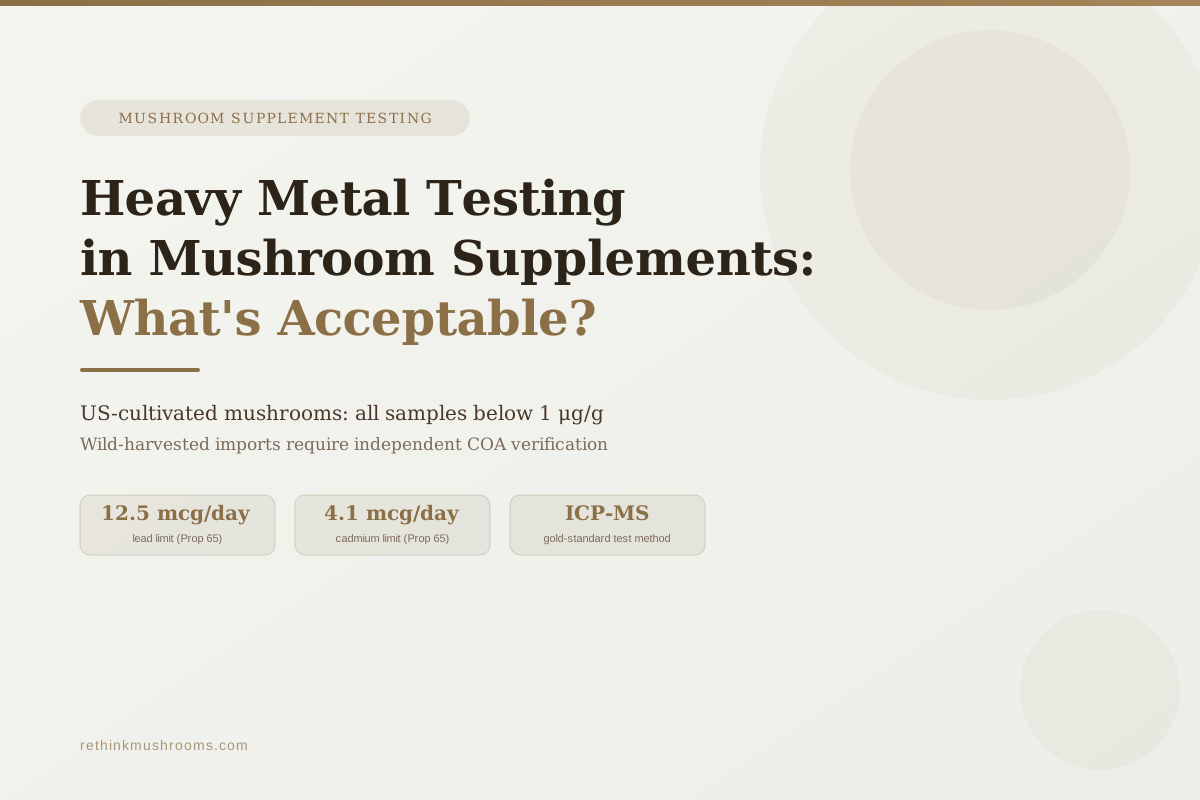
All 40 commercially cultivated US mushroom samples analyzed by Seyfferth and colleagues came in below 1 μg/g for arsenic, lead, and cadmium, but supplement form concentrates raw material, and sourcing matters.
Seyfferth et al., Environ Sci Technol, 2016
610 samples
mushrooms tested from Jilin Province, China (Zhang 2021)
4 metals
routinely tested: Pb, Cd, Hg, As
ICP-MS
the gold-standard heavy metal testing method
Seyfferth et al., Environ Sci Technol, 2016
 View as image ↗
The concern is understandable. Heavy metals in mushroom supplements get flagged regularly in consumer alerts, and fungi are known to absorb minerals from whatever substrate they grow on. If you're taking a mushroom supplement daily, the question of what heavy metals mushroom supplements contain is a reasonable one.
The honest answer is that it depends heavily on where the mushrooms were grown and how. Commercially cultivated mushrooms from regulated markets come in at low levels by research standards. Wild-harvested products from industrially contaminated growing regions are a different story. And because supplement production concentrates raw mushroom material, the quality of what goes in determines the quality of what comes out.
This article covers what the research actually shows about heavy metal levels in mushrooms and supplements, what acceptable limits look like from regulatory and certification bodies, and how to evaluate a product's heavy metal testing data.
For the broader picture on supplement quality, the mushroom supplement buyer's guide covers the full evaluation framework.
Key Takeaways
- All 40 US commercially cultivated mushroom samples analyzed by Seyfferth and colleagues came in below 1 μg/g dry weight for arsenic, lead, and cadmium (Seyfferth et al., 2016)
- Wild mushrooms from contaminated soils can exceed WHO/FAO food safety thresholds; some species in Yunnan Province exceeded safe limits in primary research (Yang et al., 2015)
- A 2021 analysis of 610 mushroom samples from Jilin Province, China found some exceeded national safety standards for lead, cadmium, mercury, and arsenic (Zhang et al., 2021)
- Only 26.3% of US Ganoderma supplements passed quality evaluation in a peer-reviewed analysis, suggesting heavy metal testing is among the checks most supplement brands skip (Wu et al., 2017)
- The main risk factors are geographic origin, cultivation vs. wild-harvest, and substrate contamination history
- Acceptable daily exposure limits are set by California Prop 65: lead at 12.5 mcg/day for adults, cadmium at 4.1 mcg/day, inorganic arsenic at 10 mcg/day, methylmercury at 0.3 mcg/day
The Short Answer: US-Grown Mushrooms Test Clean; Imports Are Less Predictable
In 2016, Seyfferth and colleagues published an analysis of 40 samples spanning 12 types of commercially cultivated US mushrooms, measuring arsenic, lead, and cadmium content in each.[2] Every sample came in below 1 μg/g dry weight for all three metals.
That is a reassuring baseline. In practical terms, it means that commercially grown mushrooms available at US grocery stores, and supplements made from domestically sourced mushroom material, are unlikely to present meaningful heavy metal exposure under normal consumption patterns.
The nuance comes with three factors: where the raw material was grown, whether it was cultivated or wild-harvested, and what the substrate was. Mushrooms are efficient bioaccumulators; they pull minerals from their growing medium more readily than most plant species. A mushroom grown in clean, controlled substrate produces clean product. A mushroom pulled from contaminated forest soil may carry metals that the substrate absorbed over years of industrial or agricultural activity.
Supplement production adds another variable: concentration. Where fresh mushrooms are consumed in 100g servings, a supplement capsule may represent the equivalent of a much larger mass of mushroom material in concentrated form. Even if fresh mushroom heavy metal levels are low, consistent supplementation with concentrated product could increase exposure over time if testing is not part of the quality process.
Why Fungi Accumulate Heavy Metals at All
Fungi are not plants and do not photosynthesize. They acquire minerals directly from their substrate through hyphal networks. This biological mechanism, which evolved to efficiently extract nutrients from decaying organic matter, works equally well on mineral contaminants. Cadmium, lead, arsenic, and mercury are absorbed through the same pathways as essential minerals.
Species vary considerably in how much they concentrate specific metals. Some wild Agaricus species are known cadmium hyperaccumulators. Certain Boletus species have been documented with arsenic levels that would raise concern if consumed regularly. Reishi (Ganoderma lucidum), one of the most commonly supplemented species, is not among the highest accumulators, but it is also typically sourced internationally, where substrate and geographic variation creates more variability.
The substrate matters as much as the species. A portobello grown on pasteurized straw in a controlled indoor environment carries minimal contamination risk. A wild chanterelle pulled from soil adjacent to a mining operation or industrial agricultural zone is a different product entirely.
When Geography Determines Safety: Evidence From Wild Mushrooms
Yang and colleagues analyzed wild edible mushrooms from Yunnan Province, China, a major source of internationally traded wild mushroom products.[1] The results showed highly variable heavy metal concentrations across species and collection sites. Mushrooms from areas with agricultural or industrial activity accumulated cadmium, arsenic, and lead at levels that exceeded WHO/FAO food safety thresholds in some samples. The primary determinant of contamination level was not the mushroom species but the soil from which it was harvested.
Zhang and colleagues conducted a larger-scale analysis in 2021, testing 610 edible mushroom samples from Jilin Province, China.[4] Some samples exceeded China's national food safety standards for lead, cadmium, mercury, and arsenic. Fresh mushrooms generally had lower contamination levels than dried, suggesting that drying and concentration processes amplify whatever contamination exists in the raw material. The study explicitly noted that imported mushroom products destined for supplement use could exceed safety thresholds if sourcing is unverified.
These studies document a risk that is real in specific contexts: wild-harvested mushroom material from regions with contaminated soils, processed into concentrated supplement form, and sold without independent heavy metal verification. The risk is not inherent to mushrooms, it is a sourcing and quality control failure.
The contrast with Seyfferth's US cultivated data is stark. Clean substrate, controlled environment, regulated market: all samples below 1 μg/g. Contaminated soil, wild harvest, unverified origin: significant variability and in some cases, exceedances of safety standards.
What "Acceptable" Actually Means: The Numbers Consumers Can Use
Several reference frameworks establish what acceptable daily exposure to heavy metals looks like. The most commonly cited for dietary supplements in the US are California Proposition 65 limits, which set Maximum Allowable Dose Levels (MADLs), the thresholds above which a product requires a warning label.
Heavy Metal Acceptable Daily Exposure Limits (Reference Values)
| Metal | California Prop 65 Limit | Notes |
|---|---|---|
| Lead (Pb) | 12.5 mcg/day | Reproductive toxicant limit for adults |
| Cadmium (Cd) | 4.1 mcg/day | Based on ConsumerLab/California standard |
| Inorganic Arsenic (As) | 10 mcg/day | California OEHHA limit |
| Methylmercury (Hg) | 0.3 mcg/day | Neurological toxicant limit |
Reference: California Office of Environmental Health Hazard Assessment (OEHHA), Prop 65 standards; these are daily exposure limits, not per-serving limits.
A few things to understand about these numbers.
First, they are daily totals across all exposures, not just supplements. If you eat fish, certain grains, and tap water from older infrastructure, some heavy metal exposure is already occurring before you add a supplement.
Second, they are risk-management thresholds, not absolute safe-versus-unsafe lines. Exposure below these limits does not guarantee zero risk, and exceeding them does not guarantee harm. They represent the regulatory bodies' assessment of where the risk-benefit calculation tips toward requiring a warning.
Third, a concentrated mushroom supplement taken daily at large doses could approach these limits if the raw material is not tested. A product using 2g of mushroom extract per serving, from material containing 1 μg/g lead (Seyfferth's upper bound for US cultivated mushrooms), would deliver 2 mcg lead per serving. Three servings of such a product across a day = 6 mcg, nearly half the Prop 65 limit, from the supplement alone. This illustrates why testing matters even when individual serving sizes seem modest.
How Heavy Metal Testing Works: ICP-MS and What to Look for on a COA
The gold-standard method for heavy metal analysis in food and supplement products is inductively coupled plasma mass spectrometry (ICP-MS). The name sounds complex, but the core concept is straightforward: samples are vaporized in a plasma flame, elements are separated by mass-to-charge ratio, and concentrations of specific metals are measured with high precision down to parts per trillion.
ICP-MS gives precise, element-specific readings across all four metals of concern (Pb, Cd, Hg, As) simultaneously. It is the method required by USP for pharmaceutical-grade testing and is used by NSF and ConsumerLab in their verification panels.
A Certificate of Analysis (COA) for heavy metals should include:
- The specific metals tested (Pb, Cd, Hg, As at minimum)
- The test method used (ICP-MS preferred; ICP-OES is also acceptable)
- The result for each metal, either as a measured value or as "below X μg/g" (the detection limit)
- The testing laboratory (should be an accredited third-party lab, not the brand's own facility)
- A lot number linking the COA to the specific batch
"Below detection limit" (BDL) or "not detected" (ND) is an acceptable and often desirable result: it means the testing equipment found no measurable amount. However, the detection limit itself matters: BDL at a detection limit of 10 μg/g is far less informative than BDL at 0.01 μg/g.
The quality problem across the supplement industry is that heavy metal COAs, when they exist at all, often come from the raw material supplier rather than from independent batch testing. Wu and colleagues found that only 26.3% of US Ganoderma supplements passed comprehensive quality evaluation in a peer-reviewed analysis.[3] If species authentication fails at that rate, it is reasonable to assume that contaminant testing rates are no better.
For a broader look at how quality failures happen across the mushroom supplement industry, the mushroom supplement quality crisis article covers the full scope of what peer-reviewed audits have found.
Which Certifications Require Heavy Metal Testing
Not all supplement certifications are equal on contaminant screening.
USDA Organic covers farming practices, pesticide use, and substrate. It does not test for heavy metals in the finished product and does not verify heavy metal content of the raw mushroom material. An organic certification is meaningful for what it covers (pesticide residues and synthetic inputs) but does not substitute for heavy metal verification.
NSF Contents Certified and NSF Certified for Sport both include contaminant screening that covers heavy metals. For a mushroom supplement brand, NSF Contents Certified is the more practical certification since it adds GMP facility audits and label accuracy verification alongside contaminant testing.
USP Verified requires purity testing to pharmaceutical-grade standards, which includes heavy metal content verification using methods consistent with USP monographs. This is the most rigorous pharmaceutical-standard approach available for dietary supplements.
ConsumerLab tests commercial products for contaminants including heavy metals as part of its independent review process. Results are published in their database, which is subscription-based but widely cited as the most independent source of supplement test data.
For a full comparison of what each certification tests and what it means for mushroom supplement buyers, the mushroom supplement certifications guide covers each program in depth. The third-party testing overview explains the regulatory context for why these programs exist.
Practical Risk Assessment: Who Should Be Most Concerned
For most consumers taking commercially produced mushroom supplements from established US or European brands using domestically cultivated material, heavy metal exposure from the supplement is unlikely to represent meaningful risk based on available evidence. Seyfferth's data on US-cultivated mushrooms provides a reasonable baseline.
The risk profile shifts for:
Wild-harvested mushroom products. Particularly chaga, which grows on birch trees and can accumulate minerals from contaminated forest environments. Products marketed as "wild-harvested" or "forest-grown" from regions with limited environmental monitoring carry more uncertainty.
Products from unverified Chinese supply chains. Zhang's 2021 data and Yang's Yunnan findings demonstrate that some Chinese-sourced mushroom material exceeds safety standards. This does not mean all Chinese mushroom products are contaminated, but it does mean independent third-party COA verification becomes essential rather than optional.
High-dose, long-term users. At therapeutic supplement doses taken consistently over months or years, even low-level contamination compounds. The daily exposure calculation matters more for consistent high-dose users than for occasional consumers.
Children and pregnant individuals. Lead and mercury thresholds are more protective for these groups. California Prop 65 reproductive toxicant limits apply specifically here.
For anyone in these higher-concern categories, the practical action is to look for a COA from an independent accredited lab covering Pb, Cd, Hg, and As, with actual measured values (not just supplier-issued certificates), or to choose products with NSF, USP, or ConsumerLab verification.
The mushroom supplement label guide explains how to find and interpret this information on product packaging and brand websites.
The Bottom Line
Heavy metal contamination in mushroom supplements is a real but context-dependent concern. US commercially cultivated mushrooms consistently test below 1 μg/g for lead, cadmium, and arsenic, suggesting low baseline risk for products using domestic material. Wild-harvested products and imports from regions with industrial contamination show more variability, with some samples exceeding national safety standards in peer-reviewed analyses. Supplement concentration amplifies whatever contamination exists in raw material, and most supplement brands do not conduct independent batch-level heavy metal testing. ICP-MS testing against a COA from an accredited third-party lab is the standard for verification; NSF, USP, and ConsumerLab certifications all include contaminant screening.
Frequently Asked Questions
Sources & References
- 1. Source details for this reference are not yet available.
- 2. Source details for this reference are not yet available.
- 3. Source details for this reference are not yet available.
- 4. Source details for this reference are not yet available.