Mushroom Supplement Testing & Certification
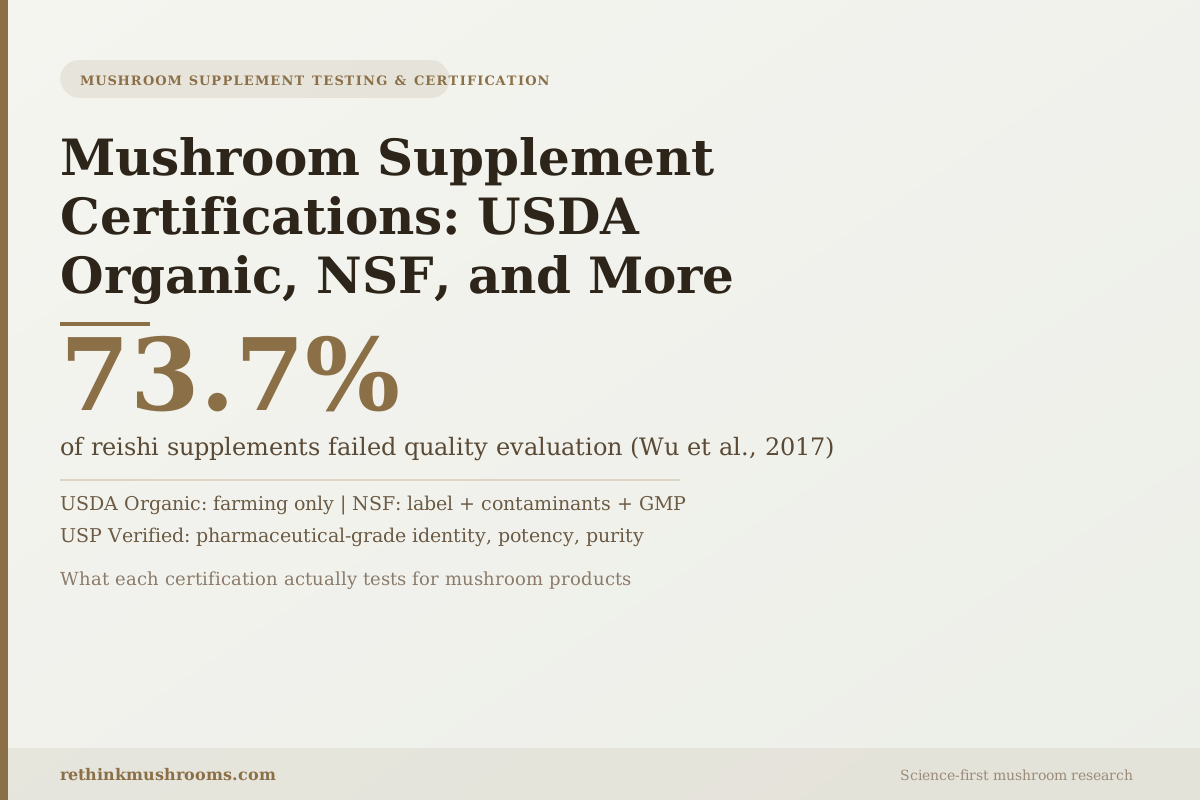
73.7% failed
A 2017 analysis of commercially sold Ganoderma (reishi) supplements in the US found that 73.7% failed species authentication, label accuracy, or expected bioactive content, leaving only 26.3% that passed quality evaluation.
Wu et al., PLoS One, 2017
USDA Organic
certifies farming practices, not beta-glucan content or heavy metals
NSF Certified
tests label accuracy, contaminants, and performs GMP factory audits
USP Verified
pharmaceutical-grade identity, potency, and purity testing
Wu et al., PLoS One, 2017
 View as image ↗
The most common misconception about mushroom supplement quality is that USDA Organic certification means the product has been verified for what it claims to contain. It does not. USDA Organic certifies that the mushrooms were grown without synthetic pesticides or fertilizers. It says nothing about whether the supplement contains the beta-glucans on the label, whether the species is correctly identified, or whether the product is free of heavy metals above safety thresholds.
A 2017 analysis published in PLoS One examined Ganoderma lucidum (reishi) supplements commercially available in the United States. Only 26.3% passed quality evaluation for species authentication, label accuracy, and expected bioactive compound content. The remaining 73.7% failed on at least one of those criteria.[2]
Understanding what each certification actually tests for mushroom supplements specifically is the only way to use certification as a reliable quality signal. This article covers each of the major certification programs, what they verify, and what they do not. For the broader guide to choosing a mushroom supplement, see the complete mushroom supplement buyer's guide.
Key Takeaways
- USDA Organic certification verifies farming practices only; it does not test beta-glucan content, species identity, or heavy metal levels in the finished supplement
- 73.7% of commercially sold Ganoderma supplements in the US failed quality evaluation in Wu et al. (2017), establishing the need for testing that goes beyond organic status
- NSF Contents Certified is the most relevant certification for mushroom supplement quality: it tests label accuracy, screens for contaminants including heavy metals, and requires GMP factory audits
- NSF Certified for Sport adds a 300+ banned substance screen and is appropriate for competitive athletes but unnecessary for most mushroom supplement users
- USP Verified applies pharmaceutical-grade identity, potency, and purity standards; it is less common in mushroom supplements but carries the strongest quality credential
- A 2020 review found that FDA regulations under DSHEA do not require pre-market approval for supplements; manufacturers self-certify safety, making third-party certification the consumer's primary protection
Why Supplement Certifications Exist: The Gap in US Regulation
The US dietary supplement regulatory framework, established by the Dietary Supplement Health and Education Act (DSHEA) in 1994, regulates supplements as food rather than drugs. Under DSHEA, a supplement manufacturer does not need to prove efficacy or safety to a regulatory body before bringing a product to market. They must follow Good Manufacturing Practice (GMP) guidelines, but FDA inspection and enforcement are reactive rather than preventive.
Bailey and colleagues' 2020 review of regulatory guidelines for dietary supplements in the US confirmed this structure: DSHEA places the burden of safety documentation on manufacturers, while FDA acts primarily after problems are detected and reported.[3]
Starr and colleagues' 2015 analysis of the supplement regulatory framework was more pointed, describing the current system as "too little, too late," noting that millions of Americans use supplements for which no independent safety or quality verification exists, and that the FDA's reactive enforcement capacity is insufficient to monitor an industry with tens of thousands of products.[1]
Third-party certification programs emerged to fill this gap. They are voluntary, paid for by the supplement brand, and independently verify quality claims before a product reaches market. Not all certifications are equal, and for mushroom supplements specifically, some are significantly more meaningful than others.
USDA Organic: What It Certifies and Why It Is Not Enough Alone
USDA Organic certification verifies that the mushrooms were cultivated according to National Organic Program standards: no synthetic pesticides, no synthetic fertilizers, no prohibited substances used in growing. For agricultural products where pesticide residue is the primary concern, organic certification is meaningful.
For mushroom supplements, it addresses only one corner of the quality picture.
USDA Organic does not verify:
- Whether beta-glucan content matches label claims
- Whether the product contains the species listed on the label
- Whether heavy metals from the growing substrate are below safety limits
- Whether the extraction method used preserves active compounds
- Whether potency is consistent batch to batch
An organic mushroom supplement can still fail species verification, label accuracy testing, or heavy metal screening. The Wu 2017 analysis showed that failures in the mushroom supplement market are not about pesticide residues; they are about species fraud, label inaccuracy, and bioactive content shortfalls.[2]
Organic certification is therefore a baseline input standard, not a quality verification for the supplement itself. A product can have both USDA Organic AND NSF certification. In that combination, organic speaks to farming; NSF speaks to product quality. Organic alone does not substitute for product-level testing.
NSF Contents Certified: The Most Relevant Standard for Mushroom Supplements
NSF International's Contents Certified program is the most broadly applicable third-party certification for mushroom supplement quality. It covers three areas that directly address the failure modes documented in the research literature:
Label accuracy: NSF tests that the product actually contains what the label states, at the stated amounts. For mushroom supplements, this is the most critical failure mode, because fraudulent label claims about beta-glucan content and species identity are common.
Contaminant screening: NSF tests for heavy metals, microbial contaminants, pesticide residues, and other substances. Heavy metal testing specifically addresses the risk from mushroom substrates and growing environments. Mushrooms are known bioaccumulators: they concentrate elements from their growing substrate, which means the substrate source and geographic origin directly affect contamination risk in the finished product. For a full treatment of heavy metal thresholds and testing standards for mushroom supplements, see Heavy Metal Testing in Mushroom Supplements: What's Acceptable?.
GMP factory audit: NSF conducts on-site audits of the manufacturing facility to verify that Good Manufacturing Practices are being followed consistently. The audit component is meaningful because GMP compliance affects batch-to-batch consistency, which chemical testing of a single lot cannot capture.
NSF Contents Certified does not specifically mandate beta-glucan testing by the Megazyme AOAC method, though products subject to label accuracy testing must substantiate any bioactive claims on their label. For a full breakdown of what beta-glucan testing involves, see How Beta-Glucan Testing Works: Megazyme and Other Methods.
NSF Certified for Sport: When It Applies and When It Is Overkill
NSF Certified for Sport builds on the Contents Certified program with an additional requirement: testing for more than 300 substances prohibited by major sports regulatory bodies including WADA, NFL, MLB, NBA, and the NCAA. Each lot must be tested before release to market.
This certification is designed for competitive athletes who are subject to drug testing and need verified assurance that a supplement contains no banned substances. For mushroom supplements specifically, the banned substance concern is minimal: functional mushrooms do not naturally contain performance-enhancing drugs or stimulants in meaningful amounts.
For a typical consumer buying reishi for sleep support or lion's mane for cognitive focus, NSF Certified for Sport provides no additional relevant protection compared to NSF Contents Certified. It is substantially more expensive for brands to pursue and maintain, which may explain why relatively few mushroom supplement brands carry it.
For competitive athletes, especially those in tested sports, NSF Certified for Sport is a reasonable requirement, not because of any mushroom-specific banned substance risk, but because the per-lot testing process provides the strongest available assurance of batch consistency.
USP Verified: Pharmaceutical-Grade Quality for Supplements
USP Verified is the certification program from the United States Pharmacopeia, the same organization that sets quality standards for pharmaceutical drugs. The program applies pharmaceutical-grade testing standards to dietary supplements.
What USP Verified tests:
- Identity: the supplement contains the declared ingredients, verified by appropriate analytical methods
- Potency: the ingredients are present at the declared amounts (not more, not less, within defined tolerances)
- Purity: the product is free of contaminants including heavy metals, microbial impurities, and prohibited substances
- Dissolution: the supplement disintegrates and releases its ingredients appropriately (relevant for capsules and tablets)
USP Verified carries significant credibility because the organization is the same body whose standards govern pharmaceutical drug quality in the US. It is more common in mainstream supplement categories (vitamins, minerals) than in mushroom supplements, and relatively few mushroom supplement brands carry it. When a mushroom supplement does carry USP Verified status, it represents one of the strongest available quality indicators.
Bailey and colleagues' review noted that USP and NSF certification programs explicitly exist to provide consumer protections beyond what DSHEA mandates.[3]
ConsumerLab: Independent Testing Without Brand Involvement
ConsumerLab is structurally different from the certification programs above. It does not certify products at the brand's request. Instead, ConsumerLab independently purchases supplements from retail channels and conducts its own laboratory testing, then publishes the results.
This matters for a specific reason: certifications like NSF and USP are applied to specific lots submitted by the brand under controlled conditions. ConsumerLab tests products as consumers actually receive them, off shelves. This approach can detect batch-to-batch inconsistency that certification of submitted samples might miss.
ConsumerLab's results for mushroom supplements have historically found label inaccuracies, heavy metal issues in some products, and beta-glucan content that did not match label claims. Their database is the most useful independent resource for comparing specific brands, but it requires a paid subscription to access results.
The limitation of ConsumerLab is that it tests a snapshot. A product that passed ConsumerLab review in one year may have changed formulation or manufacturing partners since then. ConsumerLab does periodic re-reviews, but their coverage is not comprehensive across all mushroom supplement brands.
What Each Certification Actually Verifies: A Summary
| Certification | Label accuracy | Beta-glucan tested | Heavy metals | GMP audit | Banned substance screen |
|---|---|---|---|---|---|
| USDA Organic | No | No | No | Partial (farm only) | No |
| NSF Contents Certified | Yes | If claimed on label | Yes | Yes | No |
| NSF Certified for Sport | Yes | If claimed on label | Yes | Yes | Yes (300+) |
| USP Verified | Yes | If claimed on label | Yes | Yes | No |
| ConsumerLab | Yes | Varies by product | Sometimes | No | No |
No single certification perfectly addresses every quality concern for mushroom supplements. The closest to comprehensive coverage is NSF Contents Certified (which handles the most critical failure modes) combined with a COA (Certificate of Analysis) that specifically reports beta-glucan content tested by the AOAC enzymatic method.
For the consumer's decision-making framework on which certification to prioritize, see Third-Party Testing for Mushroom Supplements: USP, NSF, and What Certifications Mean.
The Global Picture: Quality Problems Are Not Limited to the US
A 2023 Italian review of mushroom-based supplements in the European market described the situation as "Pandora's Box," finding significant quality concerns across the EU market despite Europe's generally more stringent regulatory framework for supplements compared to the US.[4] Supplements frequently failed label accuracy, species verification, and active compound content testing.
You and colleagues' 2024 review of label compliance and ingredient verification approaches noted that while modern analytical techniques including DNA barcoding and mass spectrometry have substantially improved the ability to verify supplement contents, enforcement gaps and industry compliance failures persist globally.[5] The technical capability to verify quality has improved faster than the industry's adoption of those verification methods.
The practical implication: certifications issued in the US (NSF, USP) do not cover products manufactured and sold primarily in other markets. For imported mushroom supplement products, looking for one of these recognized certification marks provides the strongest available independent verification that a product meets quality standards, regardless of where it was manufactured.
For a comprehensive look at the quality issues in the mushroom supplement market broadly, see The Mushroom Supplement Quality Crisis: Why Most Products Fail and What to Look for on a Mushroom Supplement Label. For the specific question of fruiting body vs. mycelium products, see Fruiting Body vs. Mycelium on Grain: The Debate That Defines Mushroom Supplement Quality.
Also in this cluster: Third-Party Testing for Mushroom Supplements: Why It Matters and Heavy Metal Testing in Mushroom Supplements: What's Acceptable?.
The Bottom Line
The five major supplement certification programs differ significantly in what they verify for mushroom products. USDA Organic certifies farming practices, not product quality or bioactive content. NSF Contents Certified is the most directly relevant: it tests label accuracy, screens for heavy metal and microbial contaminants, and audits GMP compliance. NSF Certified for Sport adds a banned substance screen relevant for competitive athletes but unnecessary for most buyers. USP Verified applies pharmaceutical-grade identity, potency, and purity standards and carries strong credibility. ConsumerLab provides independent off-the-shelf testing with publicly searchable results. Given that 73.7% of Ganoderma supplements failed quality evaluation in a 2017 peer-reviewed analysis, having at least one of these certifications, with preference for NSF Contents Certified or USP Verified, is the practical minimum for quality assurance.
Frequently Asked Questions
Sources & References
- 1. Source details for this reference are not yet available.
- 2. Source details for this reference are not yet available.
- 3. Source details for this reference are not yet available.
- 4. Source details for this reference are not yet available.
- 5. Source details for this reference are not yet available.