Mushroom Supplement Testing
73.7%
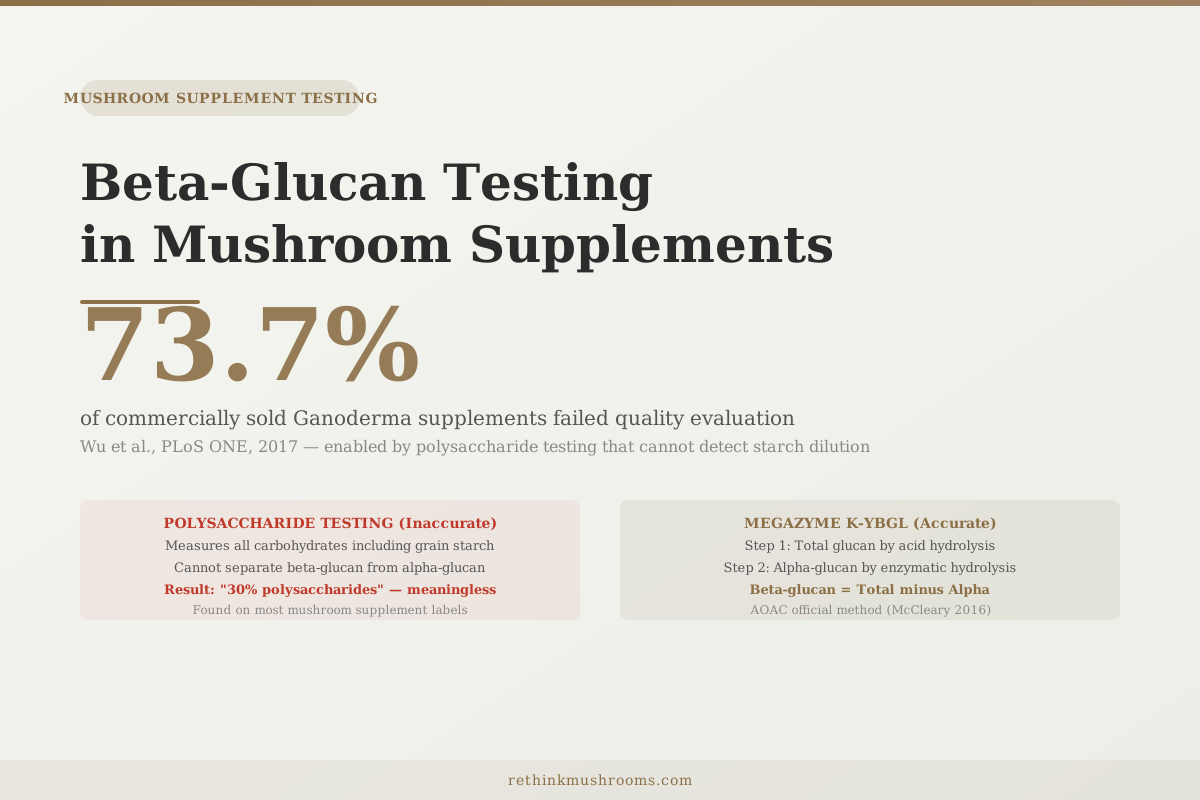
Of commercially available Ganoderma supplements tested in the US failed quality evaluation in 2017, with polysaccharide testing unable to detect the problem because it cannot distinguish medicinal beta-glucans from dietary starch.
Wu et al. PLoS ONE. 2017
26.3%
of US Ganoderma supplements passed species and quality verification
2016
year the Megazyme AOAC enzymatic method was peer-reviewed and standardized
2 steps
required to isolate true beta-glucan from starch contamination in the assay
Wu et al. PLoS ONE. 2017
 View as image ↗
Pick up a mushroom supplement and look at the label. If it says "30% polysaccharides," you have been given a number that tells you almost nothing about the mushroom's actual medicinal value.
Polysaccharides are a broad category of complex carbohydrates that includes both beta-glucans (the compounds with documented immune-supporting and health-relevant activity) and alpha-glucans, which are the starch-type sugars in grain. A product made by growing mushroom mycelium on oats and then drying the whole thing, grain and all, will test high in polysaccharides because it is mostly starch. It will test low in beta-glucans if it's tested correctly.
The critical word is "correctly." Most polysaccharide measurements use a colorimetric method that cannot distinguish between these two types of sugar. The Megazyme K-YBGL method can. This article explains what the difference is, how the accurate test works, and what to look for on a label and a Certificate of Analysis.
For the background on why the quality problem in mushroom supplements exists structurally, see Third-Party Testing for Mushroom Supplements: Why It Matters. For the larger discussion of what fruiting body vs. mycelium-on-grain means for supplement quality, see Fruiting Body vs. Mycelium on Grain. For an overview of what to look for on supplement labels generally, see How to Choose a Mushroom Supplement: The Science-Based Buyer's Guide.
Key Takeaways
- "Polysaccharide percentage" on a mushroom label is not a reliable indicator of beta-glucan content. Polysaccharides include both medicinal beta-glucans and dietary starch (alpha-glucans)
- The Megazyme K-YBGL method, published as an AOAC standard by McCleary and Draga in 2016, is the peer-reviewed reference method for accurate beta-glucan measurement in mushrooms
- The method works in two steps: acid hydrolysis measures total glucan (all sugars), then enzymatic hydrolysis measures alpha-glucan; subtracting alpha-glucan from total glucan isolates the beta-glucan content
- A 2017 PLoS ONE study found only 26.3% of US Ganoderma supplements passed quality evaluation. Polysaccharide testing allowed the other 73.7% to carry unsubstantiated label claims
- Labels that say "beta-glucans: X%, tested by Megazyme K-YBGL" or "AOAC method" provide verifiable, specific data; "polysaccharides: X%" does not
- DNA barcoding and mass spectrometry are complementary modern verification tools that confirm species identity separately from compound content
The Problem with Polysaccharide Labels
To understand why polysaccharide testing fails for mushroom supplements, a brief chemistry primer is necessary.
Glucans are polysaccharides built from chains of glucose molecules. The crucial distinction is how those glucose units are linked together. Alpha-glucans have a specific type of chemical bond (alpha-glycosidic linkage) that is the same bond found in starch and glycogen. Beta-glucans have a different bond type (beta-glycosidic linkage) that the human body does not readily digest with its own enzymes. This difference in bond type is why beta-glucans behave differently in the body: they resist digestion in the small intestine and interact with immune receptors, particularly the Dectin-1 receptor on immune cells.
Mycelium grown on grain substrates (oats, rye, brown rice) contains both types. The mushroom mycelium produces beta-glucans. The grain itself produces starch, which is alpha-glucan. If a manufacturer dries and powders the whole mass without separating the mycelium from the grain, the product is a blend of medicinal beta-glucans and dietary starch.
Standard colorimetric polysaccharide testing cannot distinguish between them. The test measures total carbohydrate content and produces a single percentage. A product that is 30% starch and 5% beta-glucan will test at 35% polysaccharides. A pure mushroom fruiting body extract with 30% beta-glucan will also test at approximately 30% polysaccharides. The label numbers look similar; the products are not.
This is not a fringe concern. It is the structural vulnerability that allowed most of the market's quality problems to persist without detection.
What Beta-Glucans Are in Mushrooms Specifically
In medicinal mushrooms, the primary therapeutic beta-glucans are 1,3-1,6-beta-D-glucans, named for the positions of the glucose connections in their three-dimensional structure. These are the compounds studied in immunology research for their effects on macrophage activation, NK cell function, and cytokine modulation. They are concentrated in the cell walls of mushroom fruiting bodies.
Different mushroom species have different beta-glucan profiles and concentrations. Reishi, shiitake (lentinan), maitake, and lion's mane all produce 1,3-1,6-beta-glucans as a major component of their cell walls. The research on biological activity has been conducted using preparations standardized to these specific glucans.
Alpha-glucans, which are present in grain and also in some amounts in mushroom storage compounds (glycogen), have no documented equivalent activity. They are not the active compounds referenced in mushroom research. When a label reports "polysaccharides" without specifying "beta-glucans," the number reflects the sum of both types, making it impossible to determine how much of the documented active fraction is actually present.
The Megazyme Method: How the AOAC Standard Works
The accurate measurement of beta-glucan in mushrooms requires a method that separates the two glucan types. McCleary and Draga published the peer-reviewed solution in the Journal of AOAC International in 2016, where it was accepted as an official AOAC method for mushroom and mycelial products.[1]
The AOAC designation (from the Association of Official Analytical Collaboration, the body that sets food and agricultural testing standards) means the method has been validated for reproducibility, accuracy, and specificity across multiple laboratories. It is commercially available as the Megazyme K-YBGL kit.
The method works in two sequential steps:
Step 1: Measure total glucan. The sample is treated with a strong acid (usually hydrochloric acid), which breaks apart all sugar chain linkages regardless of bond type. This releases individual glucose units from both alpha-glucans and beta-glucans. The free glucose is then quantified using a glucose oxidase/peroxidase reaction, which produces a color signal proportional to the amount of glucose present. The result is total glucan as a percentage.
Step 2: Measure alpha-glucan. A separate portion of the sample is treated with amyloglucosidase and invertase, enzymes that specifically break only alpha-glycosidic bonds while leaving beta-glycosidic bonds intact. This selectively frees glucose from starch and glycogen only. The same glucose detection reaction measures the alpha-glucan fraction.
The result: beta-glucan = total glucan minus alpha-glucan. By measuring both fractions and subtracting, the method isolates the beta-glucan content specifically. The subtraction step is what makes this test accurate for mushroom products where starch contamination is a real concern.[1]
This approach was validated by Nguyen and colleagues in 2020, who used an artificial neural network model to cross-validate beta-glucan quantification methods across multiple mushroom species and found the enzymatic subtraction approach to be the reliable reference technique against which other methods should be benchmarked.[3]
Why the Distinction Matters: The Quality Data
The reason accurate beta-glucan testing matters is quantified by a 2017 PLoS ONE study by Wu and colleagues, which examined commercially available Ganoderma lucidum (reishi) dietary supplements sold in the United States.[2]
Wu's team evaluated supplements for species authentication, label accuracy, and expected bioactive compound content. The result: only 26.3% of tested products passed all quality evaluation criteria. The other 73.7% failed on one or more measures: misidentified species, inaccurate label claims, or bioactive content that did not match label representations.
A significant portion of the failures would not have been detectable using standard polysaccharide testing. Products with low beta-glucan content but high starch content from grain-based manufacturing could report high polysaccharide numbers and appear compliant with label claims under non-specific assays. Only when the correct, specific method is applied does the discrepancy become visible.
This is why the distinction between "polysaccharides" and "beta-glucans tested by AOAC method" on a label matters beyond semantics. They are different claims. The first is broad and easily inflated; the second requires a specific validated method to produce.[2]
For how to identify mycelium-on-grain products from label information before a COA is available, see How to Spot a Mycelium-on-Grain Supplement: Label Red Flags.
DNA Barcoding and What It Adds Beyond Beta-Glucan Testing
Beta-glucan content measurement tells you how much of the active compound is present. It does not tell you whether the material is actually the species it claims to be.
Species verification is a separate analytical question, and it has become significantly more tractable with modern molecular methods. You and colleagues, in a 2024 review in the Journal of AOAC International, documented the current state of label compliance verification across botanical dietary supplements.[4] DNA barcoding, which sequences a short standardized region of the organism's genome and matches it against reference databases, provides definitive species identification that cannot be substituted or faked with filler materials. Mass spectrometry approaches, which identify chemical fingerprints of specific compounds, complement DNA testing by confirming the chemical profile expected from the declared species.
These molecular and chemical fingerprinting approaches are increasingly integrated into high-quality testing panels. A comprehensive supplement quality assessment now typically combines: (1) beta-glucan content by enzymatic AOAC method; (2) species identity by DNA barcoding; and (3) contaminant screening for heavy metals, pesticides, and microbiological load.
For a mushroom supplement to make a credible quality claim, ideally all three categories are covered. Beta-glucan testing alone confirms potency but not identity. DNA barcoding alone confirms identity but not potency. Both together, plus contaminants, constitute a complete quality picture.[4]
What Specific Numbers to Look For
If you can find beta-glucan test results for a product, either on the label, in a Certificate of Analysis, or through a third-party testing database, what numbers indicate quality?
The answer varies by species, extraction method, and concentration. General benchmarks from the research literature and industry practice:
For hot-water extracted mushroom products:
- Reishi fruiting body extract: 25-35% beta-glucans is typical for quality material
- Lion's mane fruiting body extract: 15-25% beta-glucans
- Turkey tail fruiting body extract: 30-40% beta-glucans
- Chaga extract: 5-15% beta-glucans (chaga is naturally lower; high beta-glucan claims from chaga products warrant scrutiny)
Warning signs:
- Any product claiming very high beta-glucan content (40%+) from mycelium-based material warrants verification, as mycelium-on-grain products rarely achieve these levels even under favorable manufacturing conditions
- Products listing only "polysaccharides" without specifying "beta-glucans tested by AOAC/Megazyme" should be treated with caution
- Extremely high polysaccharide claims (60-80%) from mushroom powder (not extract) products are almost always inflated by starch content
These benchmarks are guidelines drawn from published research and industry practice, not regulatory limits. Individual products may legitimately fall outside these ranges based on species, batch, and processing.
How to Read a Certificate of Analysis for Beta-Glucan Results
A Certificate of Analysis (COA) is the document a manufacturer or testing laboratory produces to verify a product's specifications. For beta-glucan testing, a high-quality COA should include:
-
Test method identified. Look for "AOAC Method 995.16" or "Megazyme K-YBGL" or "enzymatic method." Generic "polysaccharides by colorimetric method" or no method specified is a red flag.
-
Beta-glucan value, not just polysaccharide value. The result should be explicitly labeled "beta-glucan" or "1,3/1,6 beta-glucan," not just "polysaccharide."
-
Independent laboratory. The COA should name the testing laboratory. Internal manufacturer testing is not third-party verified. Reputable independent labs include Covance, Eurofins, NSF International, and USP.
-
Lot number specific. A COA should be tied to a specific product lot, not a generic certificate that applies to all production. Each batch can vary.
-
Date. Beta-glucan content can degrade over time, particularly in improperly stored products. COA results should be recent (within 1-2 years of the lot's production).
If a brand cannot provide a COA with this level of specificity for beta-glucan content, that itself is informative about their quality verification practices.
The Consumer Takeaway
A label saying "30% polysaccharides" is marketing language. A label saying "30% beta-glucans, tested by AOAC enzymatic method (Megazyme K-YBGL)" is verifiable science. Both numbers can appear on mushroom supplements sold side by side. Only one of them tells you what is actually in the capsule.
The Megazyme method's importance comes from its specificity: it measures beta-glucan, the compound with documented activity, by subtracting the starch fraction that would otherwise inflate the number. McCleary and Draga's 2016 AOAC paper established this as the reference standard; it remains the most reliable publicly validated method for mushroom products.[1]
For the companion article on heavy metal testing standards and what acceptable limits look like for mushroom supplements, see Heavy Metal Testing in Mushroom Supplements: What's Acceptable?.
The Bottom Line
Beta-glucan testing in mushroom supplements requires a method that separates the medicinal beta-glucan fraction from the dietary starch (alpha-glucan) fraction, because standard polysaccharide testing cannot make this distinction. The McCleary and Draga 2016 AOAC method, commercialized as the Megazyme K-YBGL kit, uses a two-step enzymatic subtraction to isolate true beta-glucan content. Wu et al. (2017) found only 26.3% of US Ganoderma supplements passed quality evaluation, with the failure partly enabled by polysaccharide testing that cannot detect starch dilution. A label specifying "beta-glucans, tested by AOAC enzymatic method" provides verifiable data; a label showing only "polysaccharides" does not.
Frequently Asked Questions
Sources & References
- 1. Source details for this reference are not yet available.
- 2. Source details for this reference are not yet available.
- 3. Source details for this reference are not yet available.
- 4. Source details for this reference are not yet available.