Mushroom Supplement Quality & Sourcing
73.7% failed label check
In a peer-reviewed analysis of 19 US reishi supplements, the measured ingredients matched the label in only five products.
Wu et al., Scientific Reports, 2017
6 of 19
Italian supplements whose DNA matched their labelled species (Risoli et al., 2023)
12
peer-reviewed studies used in this guide
5-step
framework for evaluating any mushroom supplement
Wu et al., Scientific Reports, 2017
 View as image ↗
In 2017, Wu and colleagues bought 19 batches of reishi (Ganoderma lucidum) supplements on the US market and measured the compounds their labels advertised, using chromatography and saccharide mapping to quantify triterpenes and polysaccharides. The measured ingredients matched the label in 5 of the 19 products — 26.3%.[1] The other 73.7% did not.
That number isn't a reason to avoid mushroom supplements. It's a reason to know how to choose one.
This guide covers five concrete checks to run before buying any mushroom supplement. None require a laboratory. All are grounded in published research on what actually predicts product quality — and, just as importantly, on where that research shows the checks stop working.
The Five Checks in Sequence
What Each Step Rules Out — and Where It Stops
The checks are not interchangeable. Each closes a different failure mode, and each is blind to the ones the others catch — which is why the list is five items long rather than one. The badges mark how far a buyer can actually get without the manufacturer’s cooperation.
Source
Readable on the boxWhich part of the fungus is in the capsule?
Pass signal: "Fruiting body" — or, for lion's mane erinacines specifically, mycelium from liquid culture rather than myceliated grain.
Rules out: Undisclosed grain substrate riding along as filler.
Blind to: Says nothing about how much active compound is present.
Beta-glucan number
Readable on the boxIs a specific beta-glucan percentage given, or only "total polysaccharides"?
Pass signal: A stated beta-glucan percentage, with the assay named.
Rules out: Starch inflating an umbrella "polysaccharide" figure.
Blind to: Numbers from different assays are not comparable to each other.
Extraction
Readable on the boxHas anything been done to get compounds out of the cell walls?
Pass signal: "Hot water extract", "aqueous extract", or "dual extract".
Rules out: Raw powder whose bioactives stay locked in indigestible chitin.
Blind to: An extract ratio like 10:1 describes concentration, not method.
Certificate of analysis
Needs the COADoes an independent lab confirm the label for this lot?
Pass signal: ISO 17025 lab, matching lot number, alpha- AND beta-glucan columns, method named, heavy-metals panel.
Rules out: Label claims no one ever measured; contaminant load.
Blind to: A compound assay cannot tell you which organism was tested.
Species authentication
Rarely publishedDid the material come from the organism named on the label?
Pass signal: ITS DNA barcoding reported alongside the compound data.
Rules out: The right chemistry from the wrong mushroom.
Blind to: Confirms identity only — not potency or purity.
Why the sequence matters: the gates are independent, so a product can clear four and fail the fifth. Windsor and colleagues applied several complementary analytical techniques to the same chaga products and found stark compositional deviations between them — performing well on one marker did not predict performing well on another. Three checks cost nothing but attention; the last two depend entirely on whether a company chooses to publish.
Framework is a decision aid, not a study finding. The failure modes each gate closes are drawn from: Wu DT, et al. Sci Rep 2017;7:7792. Loyd AL, et al. Front Microbiol 2018;9:1557. Risoli S, et al. Nutrients 2023;15(3):776. McCleary BV, Draga A. J AOAC Int 2016;99(2):364–73. Windsor C, et al. Int J Mol Sci 2025;26(7):2970 — five of six authors employed by Nammex, a fruiting-body supplier; conflict disclosed in the paper.
Key Takeaways
- Wu et al. (2017) analysed 19 batches of US reishi supplements by chromatography and saccharide mapping; the measured triterpene and polysaccharide content matched the label in only 5 of them (26.3%)
- Risoli et al. (2023) sequenced 19 mushroom supplements sold in Italy and matched only 6 to the species named on the label; products labelled G. lucidum returned sequences matching G. resinaceum and G. sichuanense instead
- Loyd et al. (2018) found that none of 20 manufactured reishi products contained G. lucidum in the strict sense — 93% were G. lingzhi, which is the taxon most medicinal reishi research has actually been done on, making this more a taxonomic naming problem than proof of a worthless product
- Lion's mane is the documented exception to "fruiting body is better": hericenones occur in the fruiting body and erinacines in the mycelium, and both stimulate nerve growth factor synthesis (Wang et al., 2025)
- "Total polysaccharides" is a weaker label metric than a stated beta-glucan percentage, because alpha-glucans — starch and glycogen, including grain substrate residue — are counted inside the polysaccharide total; the McCleary method measures alpha-glucan separately and reports beta-glucan by difference (McCleary & Draga, 2016)
- A beta-glucan percentage is a property of the mushroom and the assay: two accepted methods run on the same 21 species disagreed not just on magnitude but on which species ranked highest (Mirończuk-Chodakowska & Witkowska, 2020)
- Under DSHEA, the FDA does not require pre-market proof of safety or efficacy for dietary supplements, and enforcement challenges leave oversight incomplete — which is why voluntary third-party testing carries so much weight (Starr, 2015)
The Market Data That Makes a Buying Guide Necessary
Before getting to what to look for, it helps to understand what the research says about what's already on shelves.
Wu and colleagues published their US reishi market analysis in Scientific Reports in 2017. They assessed 19 batches of commercially sold G. lucidum supplements against their own label claims, using chromatographic methods and saccharide mapping to measure the bioactive components — triterpenes and polysaccharides — those labels advertised. Five products (26.3%) were in accordance with their labels.[1] Note what this study did and did not do: it is a chemical audit. It did not test which species was in the bottle. That is a separate question, answered by a separate test, and it is Step 5 of this guide.
Risoli and colleagues ran the complementary analysis in Italy, published in Nutrients in 2023. They took 19 mushroom-based supplements sold as single-ingredient products on the Italian market and identified them genetically, comparing sequences against those deposited in GenBank. Only 6 of the 19 matched the species stated on the label: four Lentinula edodes products and two Ganoderma lucidum products. The remaining reishi-labelled samples returned sequences with 100% and 99% homology to G. resinaceum and G. sichuanense — different species from the one on the box. The researchers also screened the products for ergosterol, aflatoxins, heavy metals, nicotine and total glucan.[2]
Risoli et al. (2023) · Nutrients
- Population
- 19 single-ingredient mushroom-based dietary supplements sold in Italy
- Intervention
- ITS sequence comparison against GenBank deposits, plus assays for ergosterol, aflatoxins, heavy metals, nicotine and total glucan
- Finding
- Only 6 of 19 products matched the species named on their label. Samples marketed as Ganoderma lucidum returned sequences matching G. resinaceum and G. sichuanense at 99-100% homology.
narrow-scope A single-market snapshot of products sold as monotherapy. It establishes that mislabelling occurs at a high rate in this sample, not a global prevalence figure.
Risoli S, et al. Nutrients. 2023;15(3):776.
Two audits, two continents, two different analytical questions — one chemical, one genetic — and both found that the label was an unreliable description of the contents.
Before Dose, Identity
Two Audits of What Is Actually in US Reishi Products
Dose arithmetic assumes the label is describing the right organism in the right amount. Two independent groups tested that assumption on the same product category using different tools.
Chemical audit
Wu et al., 2017
26.3%
matched their own label
5 of 19 · 19 batches of US reishi supplements
Method: Chromatography and saccharide mapping of labelled triterpenes and polysaccharides
The authors concluded quality consistency in the US market was poor and warranted investigation.
Genetic audit
Loyd et al., 2018
0 of 20
contained G. lucidum sensu stricto
0 of 20 · 20 manufactured reishi products
Method: DNA extraction with ITS and tef1α sequencing, plus Illumina MiSeq of the ITS1 region
93% were identified as Ganoderma lingzhi — the taxon actually cultivated and studied in Asia — with G. applanatum, G. australe, G. gibbosum, G. sessile and G. sinense also detected.
What this does and does not show: both audits sampled reishi specifically, and neither tested gummies or chocolate. They do not establish a failure rate for the edible category. What they establish is that in the one product category where this has been checked carefully, label fidelity was the weak link before dose was ever considered — and reishi is one of the most common ingredients in edible mushroom blends.
Sources: Wu D-T, Deng Y, Chen L-X, Zhao J, Bzhelyansky A, Li S-P. Sci Rep 2017;7(1):7792. Loyd AL, Richter BS, Jusino MA, et al. Assessing the Ganoderma species composition in commercial reishi products, 2018.
The regulatory structure explains how this persists. Under DSHEA, the 1994 Dietary Supplement Health and Education Act, dietary supplements reach the market without the pre-market demonstration of safety and efficacy required of drugs. Starr's 2015 analysis in the American Journal of Public Health described the consequence: the FDA regulates supplement quality, safety and labelling and the FTC monitors marketing claims, yet vast enforcement challenges remain and optimal governmental oversight has not been achieved. Starr's further point is the one that matters most for a buyer: if the composition and quality of ingredients cannot be reliably ensured, then even the research literature on supplements rests on uncertain ground.[7]
The result is a market where quality testing is largely voluntary. The five steps below address what that means in practice.
For a detailed look at why this quality failure is so widespread, including the economics of mycelium-on-grain production and global market survey data, see The Mushroom Supplement Quality Crisis: Why Most Products Fail.
Step 1: Fruiting Body vs. Mycelium on Grain (The Source Question)
The first thing to establish about a mushroom supplement is which part of the fungus it uses.
Most people picture the cap-and-stem structure above ground. That's the fruiting body. Many supplements use mycelium instead — the thread-like network the fungus grows through its substrate. Mycelium is a legitimate part of the organism and does contain mushroom compounds. The complication is how commercial mycelium supplements are typically manufactured.
Most commercial mycelium is cultivated on grain substrates, usually oats, rice or wheat. After the mycelium colonises the grain, the entire mixture is dried and milled into powder. The finished product contains both mycelium and residual grain starch, in proportions that vary by manufacturer and batch.
That residue is chemically detectable. Windsor and colleagues, analysing chaga products in 2025, used iodine-starch assays alongside beta-glucan quantification and confirmed a starch-rich composition in mycelium-fermented grain products, and its absence in authentic wildcrafted chaga canker.[6] That study warrants a disclosure: five of its six authors are employed by Nammex, a company that produces and sells fruiting-body material, and the sixth works at a testing laboratory Nammex contracts. The conflict is disclosed in the paper. The analytical finding is replicable in principle by anyone with the same instruments, but a reader should weigh the source of a result that happens to favour the authors' product category.
What the mycelium-versus-fruiting-body comparison actually shows. Berger and colleagues published a systematic metabolite comparison of mycelia and fruiting bodies in Microorganisms in 2022, covering Agaricus bisporus, Pleurotus ostreatus, Lentinula edodes and close relatives. Their conclusion is more nuanced than the marketing on either side. Large effects of substrate chemistry, strain, developmental stage and ecological interactions produce wide variation in metabolite concentrations in both mycelial cells and fruiting bodies.[3] In other words, which part of the organism you use is one variable among several, and it does not by itself fix the compound content. This is a good reason to want a measured number on the label rather than a category claim — which is Step 2.
The lion's mane exception. There is one well-documented case where the fruiting body and the mycelium are not interchangeable at all, because they make chemically different compounds. Kawagishi's group, reviewing and extending their own work in the Journal of Natural Products in 2025, describe hericenones C–H as compounds of the fruiting body and erinacines A–I as compounds of the mycelium, with both classes stimulating nerve growth factor synthesis in vitro and in vivo.[10] For lion's mane specifically, a fruiting body product does not contain erinacines, and a mycelium product does not contain hericenones.
Source Claims
Is mycelium always the inferior option?
The claim
“Mycelium supplements are fake mushrooms — always avoid them.”
A reasonable reaction to mycelium-on-grain products sold at fruiting-body prices, generalised into a rule about mycelium itself.
What research shows
Context DependentThe documented problem is grain substrate carried into the finished powder, which shows up as starch and inflates 'polysaccharide' claims. That is a manufacturing issue, not a property of mycelium.
Berger et al. found metabolite concentrations vary widely in both mycelia and fruiting bodies depending on substrate, strain and developmental stage. And for lion's mane, erinacines exist only in the mycelium — so a blanket rule would rule out the only source of that compound class.
Berger et al., Microorganisms 2022; Wang et al., J Nat Prod 2025; Windsor et al., Int J Mol Sci 2025.
What to look for on a label:
"Fruiting body" or "fruit body" signals the above-ground structure with no grain substrate. "Mycelium biomass", "myceliated oats" or "myceliated rice" signal the grain-grown mixture. "Full spectrum" typically includes mycelium and warrants checking whether grain content is disclosed.
For the full scientific comparison of these two source materials and why the distinction matters, see Fruiting Body vs. Mycelium on Grain: The Debate That Defines Mushroom Supplement Quality.
Step 2: Find the Beta-Glucan Number (Not Just "Total Polysaccharides")
After establishing the source, the most informative number on a mushroom supplement label is the beta-glucan percentage. It is different from, and more specific than, the total polysaccharide percentage many labels report instead.
Because alpha-glucans count toward the polysaccharide total, a supplement made from mycelium grown on grain can accurately claim a high polysaccharide percentage while most of that number is substrate residue. A product listing 40% polysaccharides with 35% alpha-glucan is mostly starch — and nothing on that label is false.
What the Umbrella Term Hides
“Total Polysaccharides” vs. Beta-Glucan
A schematic of category membership. Segment sizes are illustrative — no published figure exists for the market-wide split, which is exactly why the umbrella number cannot be converted into a beta-glucan figure.
Counted as “total polysaccharides”
↑ the only part a beta-glucan claim measures
Alpha-glucaninflates the number
starch, glycogen — includes grain substrate residue
Chitininflates the number
structural cell-wall polymer
Mannansinflates the number
other cell-wall carbohydrate
Beta-glucanimmune-active fraction
the fraction with documented immune-modulating activity
The grain problem: when mycelium is grown on grain, the starch from that grain cannot be fully separated at harvest, so it lands inside the alpha-glucan segment and pushes the umbrella number up. A 2025 analysis using iodine-starch assays alongside beta-glucan quantification confirmed a starch-rich composition in mycelium-fermented grain products and its absence in authentic wildcrafted chaga canker.
The fix: the McCleary method measures alpha-glucan separately and subtracts it, reporting beta-glucan by difference. A label that reports a beta-glucan percentage from that assay has done the subtraction. A label reporting only “polysaccharides” has not.
Sources: McCleary BV, Draga A. J AOAC Int 2016;99(2):364–73. Windsor C, et al. Int J Mol Sci 2025;26(7):2970 — authors affiliated with a supplier of fruiting-body material; conflict disclosed in the paper.
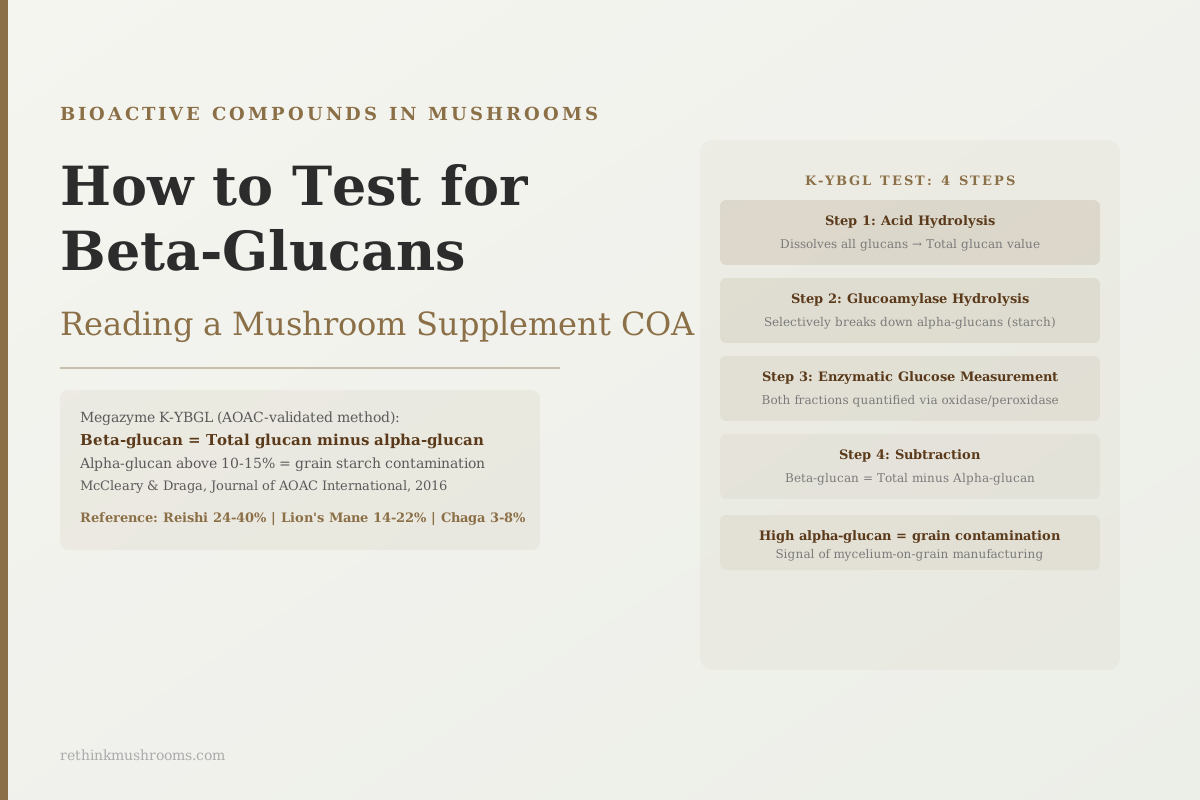
McCleary and Draga published the enzymatic procedure that separates the two fractions in the Journal of AOAC International in 2016. It works in three moves: total glucan is released by controlled acid hydrolysis with sulphuric acid and the liberated glucose measured with glucose oxidase/peroxidase reagent; alpha-glucan is measured separately after hydrolysing starch and glycogen with glucoamylase (and sucrose with invertase); beta-glucan is then obtained by difference.[4] A laboratory running this procedure produces a Certificate of Analysis showing both beta-glucan and alpha-glucan values, which is what makes starch content visible rather than inferred.
The same paper contains a caution that matters for reading any COA. McCleary and Draga compared several acid and enzyme-based hydrolysis routes and found that assays based entirely on enzymatic hydrolysis generally yielded much lower values than the sulphuric acid procedure, and that for certain species — Ganoderma lucidum and Poria cocos among them — the sulphuric acid route returned significantly higher values than hydrochloric acid.[4] The measured beta-glucan content of a reishi product is therefore partly a function of the chemistry the lab chose.
That method-dependence is not a small effect. Mirończuk-Chodakowska and Witkowska assayed 18 wild and three commercial mushroom species by both the Megazyme enzymatic procedure and the Congo red method. The two did not merely differ in magnitude — they disagreed about which species ranked highest: Megazyme put Tricholoma portentosum top at 34.97 g/100 g dry matter, while Congo red put Lactarius deliciosus top at 17.11 g/100 g, with Suillus grevillei close behind at 16.97 g/100 g.[12] Two credible labs using two accepted methods can rank the same products in a different order.
Why Two Labels Can’t Be Compared
The Beta-Glucan Number Depends on the Assay
A beta-glucan percentage is a property of the mushroom and the method used to measure it. Two accepted assays run across the same panel of mushrooms did not agree on the magnitude — or even on which species came out on top.
Same 21-species panel, two methods, two different “highest”
Megazyme method
34.97 g/100 g DMTop-ranked species: Tricholoma portentosum (Sooty head)Enzymatic / acid hydrolysis, glucose measured by GOPOD
Congo red method
17.11 g/100 g DMTop-ranked species: Lactarius deliciosus (Saffron milk cap)Dye-binding assay, different analytical procedure entirely
The two methods did not disagree by a fixed, correctable offset. Congo red values ran generally higher than Megazyme values in wild mushrooms, while Megazyme values for wild mushrooms were comparable to commercial ones — so the size and direction of the gap shift by species.
And the chemistry inside one method changes it again
H₂SO₄ hydrolysis
The procedure McCleary & Draga selected as the best option. For Ganoderma lucidum and Poria cocos specifically, it returned significantly higher values than the alternative acid.
Fully enzymatic hydrolysis
Yielded "much lower values" in general than the H₂SO₄ procedure — on the same class of material.
Trifluoroacetic acid, 120 °C
Much less effective than either of the other two acids evaluated.
What to do with this: a beta-glucan percentage is only interpretable alongside the method that produced it. A Certificate of Analysis that states a number but not the analytical method has given you a figure you cannot compare against any other product — and comparing two brands’ percentages without checking both methods is not a valid comparison.
Sources: Mironczuk-Chodakowska & Witkowska, 2020 [4] — Megazyme vs. Congo red across 18 wild and 3 commercial mushroom species. McCleary & Draga, 2016 [2] — hydrolysis chemistry comparison within the mushroom and mycelial beta-glucan procedure.
A third method adds to the same picture. Kanno and colleagues developed an assay using a recombinant beta-glucan-binding protein and benchmarked it against an existing antibody-based beta-glucan assay, reporting differences in reactivity across glucan types and extraction fractions.[9] The practical conclusion across all three papers is the same: a beta-glucan percentage means little without the method attached to it.
What good looks like: a specific beta-glucan percentage, backed by a COA from an accredited lab showing both alpha-glucan and beta-glucan values, with the analytical method named. What's less informative: a total polysaccharide figure with no breakdown, or a beta-glucan number with no method.
For a complete guide to mushroom supplement label terminology, see What to Look for on a Mushroom Supplement Label. For an explanation of what specific beta-glucan percentages mean across different mushroom species, see Beta-Glucan Percentages on Labels: What the Numbers Mean.
Step 3: Check the Extraction Method (Raw Powder and Extract Are Not the Same Thing)
Source and compound percentage matter. So does extraction, because it determines whether what's in the powder is available to you.
Hot water extraction is the standard answer to that problem: heating dried mushroom material in water at elevated temperature disrupts the cell walls and brings the water-soluble beta-glucan and polysaccharide fractions into solution. This is why dried whole powder and hot water extract made from the same starting material are not equivalent products, even at identical weight.
Dual extraction adds an alcohol step. Alcohol recovers fat-soluble compounds that water does not reach. For reishi, the most studied of those are the triterpenes — the bitter fraction, and the same fraction Wu and colleagues found so often failed to match label claims. For species whose principal bioactives are water-soluble, such as turkey tail or maitake, hot water extraction alone is generally sufficient.
Label signals to know:
"Hot water extract" or "aqueous extract" signals that cell walls have been disrupted and water-soluble fractions liberated. "Dual extract" indicates coverage of both water-soluble and alcohol-soluble fractions. "Raw mushroom powder" or "whole mushroom powder" indicates no extraction step. "10:1 extract" describes a concentration ratio, not an extraction type, and does not on its own tell you which process was used. For a full explanation of what concentration ratios mean on labels, see 10:1 Extract Ratios: What They Mean (and What They Don't).
Step 4: Find the Certificate of Analysis and Read the Alpha-Glucan Column
Most buyer's guides stop at label reading. A Certificate of Analysis is where verification actually happens.
A COA is a document issued by a laboratory reporting what a specific production lot contains, based on testing of that lot. A company committed to transparency publishes COAs accessibly — searchable by lot number on the website, or reachable via a QR code on the pack. If a COA is only available on request, or cannot be tied to a lot number, that is itself information.
Six things to check on a COA:
1. Lab accreditation. The laboratory should hold ISO 17025 accreditation, meaning its testing methods have been independently assessed for competence and reproducibility. Accreditation status can be checked on the accrediting body's public register.
2. Alpha-glucan AND beta-glucan columns. This is the single most diagnostic pair of numbers for identifying grain-grown mycelium. Labs running the McCleary procedure report both.[4] A high alpha-glucan value relative to total glucan indicates substantial starch. A COA reporting only total polysaccharides leaves the question open.
How to Read a COA
The K-YBGL Subtraction, and What the Alpha-Glucan Column Reveals
Reading the alpha-glucan value
Fruiting body or cleanly processed mycelium
Wood substrates contain no digestible starch; endogenous mushroom glycogen is low.
Meaningful grain starch present
Indicates a mycelium-on-grain product where substrate was not fully separated.
Substantial substrate contamination
Most of the reported "glucan" is starch regardless of the beta-glucan figure shown alongside it.
A COA that reports only "polysaccharides %" or a single "beta-glucan %" without the alpha-glucan breakdown cannot tell you how much of that number is active compound versus grain starch.
Method: McCleary & Draga (2016), J. AOAC International — Megazyme K-YBGL assay
 View as image ↗
3. Testing method stated explicitly. Given that Megazyme and Congo red can reverse the rank order of the same samples,[12] and that enzymatic-only hydrolysis reads lower than the sulphuric acid procedure,[4] a COA that does not name its method cannot be compared against any other COA.
4. Heavy metals panel. Mushrooms are efficient bioaccumulators. Liu and colleagues sampled wild edible mushrooms from 16 locations in Yunnan Province, China, and found concentrations of arsenic, lead and cadmium above Chinese national standards in most cases; bio-concentration factors indicated arsenic and cadmium accumulate more readily than lead, and a health risk assessment identified those two as the principal risks.[5] Qin and colleagues reached a convergent conclusion in a 2024 survey of nine edible mushrooms measured by ICP-MS: cadmium, arsenic, lead and mercury concentrations exceeded Chinese maximum standards by 22.95%, 8.20%, 1.64% and 3.28% respectively, and hazard index calculations put cadmium and arsenic far ahead of the rest as the primary contributors to health risk.[11] A complete COA should cover at minimum lead, arsenic, cadmium and mercury.
Contaminants
ModerateHeavy metal accumulation is a real, measured risk — and it is species and origin dependent
Concern
Mushrooms concentrate metals from their substrate. Across surveys of Chinese edible mushrooms, arsenic and cadmium consistently exceed national limits more often than lead or mercury, and consistently dominate calculated health risk.
What the research says
A heavy metals panel on a lot-specific COA is the only way to know what a given batch contains. Cultivated mushrooms on controlled substrate are generally lower risk than wild-harvested material, but neither is exempt from testing.
Particularly relevant for: Relevant to anyone taking a mushroom supplement daily over months, where cumulative exposure matters more than any single dose.
What to do
Check that the COA reports lead, arsenic, cadmium and mercury, and that the figures are given in concentration units you can convert against your actual serving size.
Liu B, et al. Food Chem. 2015;188:294-300. Qin G, et al. Sci Rep. 2024;14(1):26960.
Reading The Document
What to Check on a Heavy Metal Certificate of Analysis
Four metals, four reference points, and one unit conversion that most readings get wrong.
Prop 65 MADL — reproductive toxicity
The strictest of the commonly cited consumer benchmarks. A separate cancer figure (15 µg/day) is far looser; the 0.5 µg/day number is the one to hold a product to.
Prop 65 safe-harbour list — oral route
Use the oral figure. The 0.05 µg/day cadmium number that also appears on the Prop 65 list is for inhalation and has nothing to do with a capsule or powder.
Prop 65 safe-harbour list — inorganic arsenic, non-inhalation
The limit is for inorganic arsenic. CoAs usually report total arsenic, which also counts far less toxic organic forms — so a total-arsenic reading held to this limit is a conservative test, not a lenient one.
Listed for reproductive toxicity; oral figure not verified here
Require that the CoA reports a measured mercury value rather than "complies". We are not printing a threshold we could not confirm against a primary regulatory source.
The unit trap
The limits above are per day. Certificates of Analysis almost always report concentration — µg/g, or equivalently mg/kg or ppm. Those are not the same quantity, and comparing one against the other directly is the most common way a CoA gets misread. You need the serving size to convert:
Worked example: a CoA reporting 2 µg/g of lead in a product with a 1 g daily serving delivers 2 µg of lead per day — four times the 0.5 µg/day reference, even though 2 µg/g sounds small. Halve the serving and you halve the dose. This is ordinary unit arithmetic, not a research finding, but it is the step that decides whether a number on a CoA is reassuring or not.
Reference values: California Office of Environmental Health Hazard Assessment, Proposition 65 safe harbour levels (No Significant Risk Levels and Maximum Allowable Dose Levels). Proposition 65 figures are California warning thresholds, not federal supplement limits and not a medical safety line — they are used here because they are the most accessible published reference point a US consumer can check a product against.
5. Lot number match. The COA should reference the lot printed on your bottle. A COA from a different batch does not characterise what you bought.
6. Test date. Re-testing per production lot is the standard the checks above assume. An old COA may not represent current production.
One caution about over-trusting any single figure on a COA. Windsor and colleagues applied several complementary analytical techniques to chaga supplements — HPTLC, liquid chromatography with several detectors, mass spectrometry, NMR, UV-Vis spectrophotometry and iodine-starch assays — evaluating triterpenoids, polysaccharides and melanin. Whole chaga canker contained triterpenoids such as inotodiol and trametenolic acid, and melanin absorbance at 500 nm distinguished it from fermented grain products, while NMR fingerprinting and mass spectrometry showed stark compositional deviations between wildcrafted canker, I. obliquus mycelium and fermented grain products.[6] No single marker separated the categories on its own — which is the argument for reading a COA as a panel rather than hunting for one reassuring number. The authors' Nammex affiliation, noted above, applies to this conclusion too.
For a full step-by-step walkthrough of how to locate a COA and interpret each section, see Independent Lab Test Results: How to Find and Read Them.
Step 5: Species Authentication Is a Separate Test (and Most Products Skip It)
Compound testing tells you what is in the capsule. Species authentication tells you which organism it came from. These are different questions, and a compound assay cannot answer the second one — it identifies molecules, not the fungus that made them.
Loyd and colleagues made the point unusually concretely in a 2018 Frontiers in Microbiology study. They sequenced the ITS region and translation elongation factor 1-alpha from 20 manufactured reishi products and 17 grow-your-own kits sold as Ganoderma lucidum. None of the manufactured products contained G. lucidum in the strict sense; it was detected in a single grow-your-own kit. The great majority — 93% of manufactured products — were Ganoderma lingzhi.[8]
That result needs careful reading, because the obvious interpretation is not quite the right one. G. lingzhi is native to Asia and is, as the authors note, the most widely cultivated and most studied taxon used medicinally. The name G. lucidum was historically applied to most shiny Ganoderma species, while true G. lucidum has a limited native range in Europe and parts of China. So a bottle labelled G. lucidum containing G. lingzhi is, in most cases, a taxonomic naming lag rather than a substitution of worthless material — it may well contain the species the research was actually done on. The genuine warning sits elsewhere: Loyd's team noted that medicinally relevant chemistry likely differs between Ganoderma species, and Risoli's Italian samples returned G. resinaceum and G. sichuanense,[2] which are not the well-studied taxon by any naming convention.
The practical implication is narrower than "your reishi is fake" and more useful: without a DNA test, you cannot tell which of those two situations you are in. Most COAs will not tell you. Brands that publish ITS authentication alongside compound data are offering a level of verification that remains uncommon in this market.
For a consolidated look at what quality failure signals to check for before buying, see 7 Red Flags in Mushroom Supplements: What to Avoid.
Why the Regulatory Gap Makes These Five Steps Necessary
The quality problem in this market is structural rather than a matter of a few bad actors.
Under DSHEA, dietary supplements are not required to demonstrate safety or efficacy before sale in the way drugs are. The FDA regulates supplement quality, safety and labelling and the FTC monitors advertising, but Starr's analysis concluded that substantial enforcement challenges remain and that optimal governmental oversight has not been achieved.[7]
The consequence is that third-party verification is largely voluntary and largely uncompensated by the market. A manufacturer paying for ISO 17025 testing, DNA authentication and public COAs carries costs a competitor can simply decline. Price competition does not automatically reward the more rigorous product. The five checks in this guide are the consumer-level substitute for a pre-market review that the regulatory structure does not perform.
How to Choose a Mushroom Supplement: The 5-Minute Checklist
Before buying any mushroom supplement, these five checks take under five minutes:
- Source. Does the label say "fruiting body"? (For lion's mane erinacines specifically, look instead for mycelium grown in liquid culture rather than on grain.)
- Beta-glucan percentage. Is a specific beta-glucan figure given rather than only total polysaccharides?
- Extraction method. Does it specify hot water or dual extract rather than raw powder?
- Certificate of Analysis. Is a COA publicly available, tied to your lot number, from an ISO 17025-accredited lab — showing both alpha-glucan and beta-glucan with the method named?
- Heavy metals. Does that COA include lead, arsenic, cadmium and mercury?
A product clearing all five operates at a meaningfully higher standard than most of what is on shelves. The Wu, Risoli and Loyd data show what the distribution looks like when these checks are not made.
This guide is about evaluating product quality, not about treating any condition. Nothing here is medical advice; if you take prescription medication or have a health condition, talk to a qualified clinician before adding a supplement.
The Bottom Line
Peer-reviewed market surveys establish that mushroom supplement labels are frequently unverified rather than merely optimistic. Wu et al. (2017) found measured triterpene and polysaccharide content matched the label in only 5 of 19 US reishi products. Risoli et al. (2023) genetically matched only 6 of 19 Italian supplements to their labelled species. Loyd et al. (2018) found no manufactured reishi product containing G. lucidum in the strict sense, though most contained G. lingzhi, the taxon the research literature actually rests on. The five-step framework here — source, beta-glucan percentage, extraction method, COA verification and species authentication — addresses a different failure mode at each step, because the studies show these checks are independent: performing well on one analytical marker does not predict performing well on another.
Frequently Asked Questions
Sources & References
- 1RTHM-00499·Wu, Ding-Tao et al. (2017). “Evaluation on quality consistency of Ganoderma lucidum dietary supplements collected in the United States..” Scientific reports.Study breakdown →PubMed →↩
- 2RTHM-01778·Risoli, Samuele et al. (2023). “Mushroom-Based Supplements in Italy: Let's Open Pandora's Box..” Nutrients.Study breakdown →PubMed →↩
- 3RTHM-00743·Berger, Ralf G et al. (2022). “Mycelium vs. Fruiting Bodies of Edible Fungi-A Comparison of Metabolites..” Microorganisms.Study breakdown →PubMed →↩
- 4RTHM-00438·McCleary, Barry V et al. (2016). “Measurement of β-Glucan in Mushrooms and Mycelial Products..” Journal of AOAC International.Study breakdown →PubMed →↩
- 5RTHM-00394·Liu, Borui et al. (2015). “Study of heavy metal concentrations in wild edible mushrooms in Yunnan Province, China..” Food chemistry.Study breakdown →PubMed →↩
- 6RTHM-02209·Windsor, Coleton et al. (2025). “What This 2025 Chaga Supplement Authentication Study Actually Found.” International journal of molecular sciences.Study breakdown →PubMed →↩
- 7RTHM-00735·Starr, Ranjani R (2015). “Too little, too late: ineffective regulation of dietary supplements in the United States..” American journal of public health.Study breakdown →PubMed →↩
- 8RTHM-00981·Loyd, Andrew L et al. (2018). “Identifying the "Mushroom of Immortality": Assessing the Ganoderma Species Composition in Commercial Reishi Products..” Frontiers in microbiology.Study breakdown →PubMed →↩
- 9RTHM-00625·Kanno, Takashi et al. (2020). “Quantification of β-Glucan from Culinary-Medicinal Mushrooms Using Novel Artificial β-Glucan Recognition Protein..” International journal of medicinal mushrooms.Study breakdown →PubMed →↩
- 10RTHM-02204·Wang, Junhong et al. (2025). “Uncovering Hericenones from the Fruiting Bodies of Hericium erinaceus through Interdisciplinary Collaboration..” Journal of natural products.Study breakdown →PubMed →↩
- 11RTHM-01969·Qin, Guofu et al. (2024). “Analysis of heavy metal characteristics and health risks of edible mushrooms in the mid-western region of China..” Scientific reports.Study breakdown →PubMed →↩
- 12RTHM-00637·Mirończuk-Chodakowska, Iwona et al. (2020). “Evaluation of Polish wild Mushrooms as Beta-Glucan Sources..” International journal of environmental research and public health.Study breakdown →PubMed →↩