Mushroom Pharmacology & Bioavailability
19 reishi supplements tested — with extreme potency variation
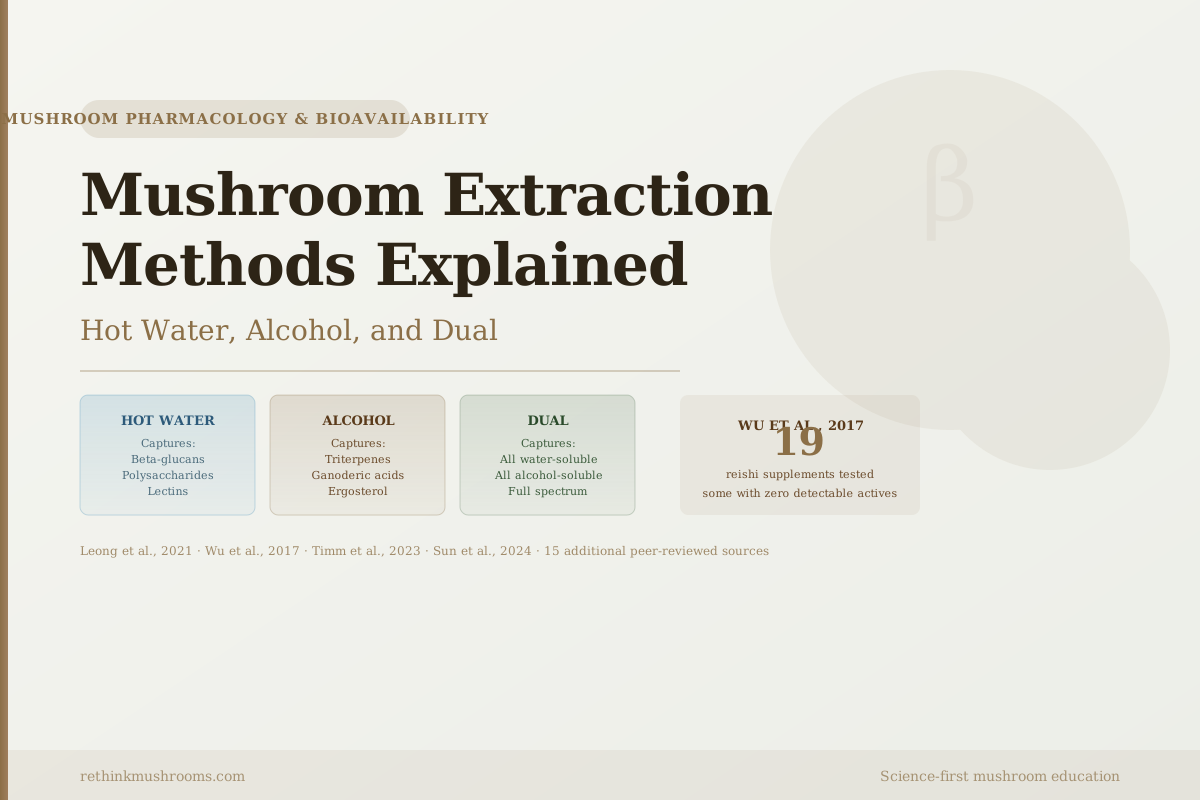
Wu et al. analyzed 19 Ganoderma lucidum supplements sold in US stores and found extreme variation in polysaccharide and triterpene content. Some products with premium label claims had no detectable active compounds — a direct result of inferior extraction methods.
Wu et al., Scientific Reports, 2017
30-70% higher
Polysaccharide yield from ultrasonic and enzyme-assisted extraction vs. conventional hot water (Leong 2021)
0%
Ganoderic acid content in hot-water-only reishi extracts — these compounds are entirely alcohol-soluble (Dudhgaonkar 2009)
<1% vs. 15-45%
Beta-glucan content in mycelium-on-grain vs. fruiting body hot water extracts, measured by validated enzymatic assay (McCleary & Draga 2016)
Wu et al., Scientific Reports, 2017
 View as image ↗
The chitin cell wall that gives mushrooms their structural integrity is also why eating raw mushroom powder delivers most of the bioactive compounds into the toilet. Human digestive enzymes cannot break down chitin, the same material that forms insect exoskeletons and crustacean shells. Without extraction, using solvents to dissolve compounds out of the cell matrix before consumption, most of what makes medicinal mushrooms medicinal passes through the body intact.
Mushroom extraction methods solve this problem. The three you will encounter on supplement labels are hot water extraction, which captures polysaccharides like beta-glucans; alcohol extraction, which captures triterpenes, sterols, and fat-soluble compounds; and dual extraction, which applies both solvents. A 2021 comprehensive review by Leong and colleagues in Carbohydrate Polymers confirmed that chitin is the central bottleneck across all extraction approaches, and that conventional hot water extraction yields measurably lower compound recovery than newer methods using physical or enzymatic cell wall disruption.[1]
What no competitor guide covers: not all hot water extraction is equal, excessive heat actively degrades the most immunostimulatory fraction of beta-glucans, and alcohol captures an entirely different compound class that hot water leaves behind entirely. This guide explains what each method does and does not capture, which species need which methods, and what the research says about the quality of mushroom supplements currently on the market.
Key Takeaways
- Mushroom cell walls are made of chitin, which human digestive enzymes cannot break down; extraction is required to make bioactive compounds biologically available (Leong et al., 2021, Carbohydrate Polymers).
- Hot water extraction captures polysaccharides (beta-glucans); alcohol extraction captures triterpenes and sterols. A 2007 head-to-head study showed these two solvents produce functionally non-overlapping bioactive profiles from the same mushroom (Faccin et al., Letters in Applied Microbiology).
- Ganoderic acids A, B, C, and D — the most-studied anti-inflammatory compounds in reishi — are entirely absent from hot-water-only extracts; they dissolve only in alcohol (Dudhgaonkar et al., 2009).
- Excessive heat during hot water extraction degrades high-molecular-weight beta-glucan chains that are the most immunostimulatory fraction, reducing biological activity even while increasing crude polysaccharide yield (Timm et al., 2023).
- Of 19 US-market Ganoderma supplements analyzed, some with high-potency label claims contained no detectable active compounds; extreme potency variation was directly linked to extraction method and sourcing (Wu et al., 2017).
- Ultrasonic extraction achieves 20-40% higher polysaccharide yield than conventional hot water extraction while operating at lower temperatures that preserve heat-sensitive compounds (Sun et al., 2024).
Why Mushroom Extraction Methods Exist: The Cell Wall Problem
Every bioactive compound in medicinal mushrooms — the beta-glucans, triterpenes, ergothioneine, hericenones — sits inside cells bounded by a chitin wall. Chitin is resistant to the range of digestive enzymes the human gut deploys. Plant cell walls, made of cellulose, can be partially broken down by some gut bacteria and digestive processes. Chitin cannot. When whole mushroom powder passes through the digestive tract, the cells largely remain intact.
The 2021 review by Leong and colleagues catalogued conventional and emerging extraction technologies specifically for this bottleneck.[1] The review confirmed that getting through the chitin wall requires one of three approaches: dissolving compounds through the wall using heat and water, dissolving fat-soluble compounds by disrupting the cell membrane using alcohol, or physically rupturing the wall using mechanical energy (which is how ultrasonic extraction works). Each approach captures a different fraction of the total bioactive content.
Raw powder versus extract: Raw mushroom powder (dried and ground fruiting body or mycelium) contains every compound the mushroom produced, including all its fiber. Some compounds that naturally leach from cellular material during digestion are absorbed. But without extraction, the primary bioactive fractions, polysaccharides, triterpenes, and other cell-wall-bound compounds, are largely unavailable.
Mushroom extract has had its bioactive compounds dissolved out of the chitin matrix using one or more solvents, then concentrated. An extraction ratio on a label (such as "10:1") means 10 parts raw mushroom produced 1 part extract by weight. It does not indicate compound concentration without supporting data on beta-glucan or triterpene percentages. A 10:1 extraction ratio from poor-quality material with inadequate extraction conditions can deliver less bioactivity than a 4:1 ratio from properly processed, high-quality fruiting body.
For what to look for on a label, see How Extraction Methods Determine Supplement Quality.
Hot Water Extraction: What It Captures and the Heat Problem Most Guides Miss
Hot water extraction is the most widely used method for medicinal mushrooms and the appropriate choice for the compound class most associated with immune modulation: polysaccharides, particularly beta-glucans.
Beta-glucans are water-soluble molecules with a branched structure (beta-1,3-1,6-glucan in most medicinal species) that gives them their immunostimulatory activity. When heated water circulates through mushroom material, beta-glucans dissolve into the solvent and are captured in the resulting extract. Hot water also captures other polar compounds: lectins, water-soluble phenolics, and some amino acid-conjugated compounds.
Temperature matters more than most labels indicate. A 2014 study by Palanisamy and colleagues, published in Biotechnology Progress, applied pressurized hot water extraction at temperatures ranging from 100°C to 160°C to edible mushrooms.[3] Beta-glucan yield increased with temperature up to an optimal point, above which polysaccharide degradation set in. Work by Cai and colleagues (2015) in the International Journal of Medicinal Mushrooms found the same pattern: extraction temperature and duration significantly affected both the yield and bioactivity of polysaccharides from Auricularia mushrooms, with certain parameters producing measurably different outcomes from the same starting material.[4]
The counterintuitive finding that no competitor covers:
A 2023 systematic review by Timm and colleagues, published in Applied Microbiology and Biotechnology, examined beta-glucan structure-activity relationships across mushroom species and extraction approaches.[5] Their central finding: higher-molecular-weight beta-1,3-1,6-glucan chains are more immunostimulatory than lower-molecular-weight fragments. And excessive heat during hot water extraction degrades those high-molecular-weight chains. The result is that pushing extraction temperature too high increases the crude polysaccharide percentage on paper while simultaneously reducing the immunological activity of what is actually recovered.
This is why crude polysaccharide percentage is not a sufficient quality metric. A supplement showing 40% crude polysaccharides extracted at excessive temperature may deliver lower immune activity than one showing 25% extracted within the optimal temperature window. The molecular weight distribution of extracted beta-glucans determines how much of the extract is biologically active in the immune context.
What hot water extraction misses:
Water is a polar solvent. It dissolves polar, water-soluble molecules. It cannot dissolve non-polar, fat-soluble compounds. Triterpenes (including ganoderic acids in reishi), sterols (ergosterol, a vitamin D2 precursor found in most mushrooms), and many phenolic compounds are fat-soluble. They are not recovered from hot-water-only extracts, regardless of extraction temperature, duration, or pressure.
For a compound-by-compound breakdown with measured yield data from head-to-head studies, see Hot Water vs. Alcohol Extraction: Which Compounds Each Captures.
Alcohol Extraction: The Compound Class That Water Cannot Reach
Ethanol-based extraction uses 40-95% ethanol as the primary solvent. Ethanol is less polar than water, which means it dissolves a different class of compounds: triterpenes, sterols, some phenolics, and other fat-soluble molecules that form a substantial part of medicinal mushroom bioactivity.
The reishi case is the clearest proof of why this matters. A 2009 study by Dudhgaonkar and colleagues, published in International Immunopharmacology, examined four specific triterpenes from reishi: ganoderic acids A, B, C, and D.[6] These four compounds significantly suppressed TNF-alpha, IL-1beta, and NF-kB signaling in vitro. They represent the most studied anti-inflammatory compounds in the entire reishi research literature. They are insoluble in water. A hot-water-only reishi supplement, regardless of its beta-glucan content or extraction ratio, contains zero ganoderic acids. The polysaccharides are there. The triterpenes are not.
Ergosterol is a second concrete example. Ergosterol is the primary sterol in most edible and medicinal mushrooms and serves as the precursor to vitamin D2 when exposed to UV light. A 2018 study by Corrêa and colleagues, published in Food and Function, optimized ergosterol extraction from Agaricus blazei.[7] Ultrasound-assisted ethanol extraction achieved the highest ergosterol recovery. The finding confirmed what the chemistry predicts: ergosterol is an alcohol-soluble compound. Hot water extraction recovers it at negligible concentrations regardless of how the extraction is run.
The non-overlapping profiles problem: A 2014 study by Petrović and colleagues, published in Food and Function, compared aqueous, ethanolic, and n-hexane extracts of the same mushroom species (Laetiporus sulphureus) across antimicrobial and antioxidant assays.[8] Ethanolic extracts showed superior antimicrobial activity while aqueous extracts had distinct polysaccharide-driven activity. The two solvents produced non-overlapping bioactive profiles from the same raw material. No single solvent captured the full spectrum.
What alcohol extraction misses:
Ethanol does not dissolve polysaccharides well. Beta-glucans — the primary immune-modulating compounds in most medicinal mushrooms — are insoluble in high-concentration ethanol. An alcohol-only extract captures triterpenes and sterols while largely missing the beta-glucan fraction. For most mushroom species, alcohol-only extraction is not appropriate as a standalone method unless the specific target compounds are confirmed to be alcohol-soluble.
Dual Extraction: What the Research Actually Shows
Dual extraction combines hot water and alcohol extraction, either sequentially (water extract followed by separate ethanol extraction of the same material) or in a combined approach. The goal is to capture the bioactive profiles that neither solvent accesses alone.
Solvent Capture Map
Which Extraction Method Captures Which Compound Class
Hot Water
Alcohol
Dual
Beta-glucans (polysaccharides)
Water-soluble immune-modulating compounds
Triterpenes (ganoderic acids A–D)
Alcohol-soluble anti-inflammatory compounds
Sterols (ergosterol / vitamin D2 precursor)
Fat-soluble; negligible recovery in water
Full antimicrobial + antioxidant profile
Non-overlapping across solvents
Water and alcohol dissolve non-overlapping compound classes from the same mushroom. Only dual extraction captures both the water-soluble beta-glucans and the alcohol-soluble triterpenes and sterols — which is why a hot-water-only reishi extract contains zero ganoderic acids.
Source: Faccin et al. (2007), Letters in Applied Microbiology; Dudhgaonkar et al. (2009), International Immunopharmacology; Corrêa et al. (2018), Food & Function; Petrović et al. (2014), Food & Function.
A 2007 study by Faccin and colleagues, published in Letters in Applied Microbiology, put this to a direct test using Agaricus brasiliensis against poliovirus.[2] The aqueous extract's polysaccharide fraction drove immunological effects that the ethanol fraction did not replicate. The ethanol fraction showed distinct antiviral mechanisms absent from the aqueous extract. Neither fraction alone captured the full activity profile. This is the foundational evidence for why dual extraction exists as a category: the solvents are not interchangeable or redundant. They are accessing different compound classes with different biological activities.
A multi-solvent fractionation study by Reza and colleagues (2011), published in Toxicological Research, took this further.[9] They separated Auricularia auricula-judae extract into five solvent fractions (n-hexane, chloroform, ethyl acetate, n-butanol, and water) and tested each fraction's antitumor activity. Each fraction showed distinct activity profiles. No single fraction captured all antitumor potential. The finding supports the principle that comprehensive bioactive extraction from a single species requires a multi-solvent approach.
Liu and colleagues (2007), in the Journal of Ethnopharmacology, added a layer to this picture: even within "hot water" processing, fermentation and decoction of the same mushroom species produced measurably different compound profiles and anti-inflammatory activities.[11] Extraction method is not simply the solvent used. Processing approach at every stage shapes the final product.
Which species need dual extraction:
The answer depends on what you are trying to capture from each species.
Reishi (Ganoderma lucidum): Yes. Reishi has two well-characterized bioactive compound classes with non-overlapping solubility. Beta-glucans (water-soluble) drive immune-modulating effects. Ganoderic acids A, B, C, and D (alcohol-soluble) are the most studied anti-inflammatory triterpenes, documented by Dudhgaonkar et al. to be entirely absent from hot-water-only extracts.[6] Dual extraction is the minimum standard for a full-spectrum reishi product.
Chaga (Inonotus obliquus): Yes, and the evidence suggests conventional dual extraction may not be enough. A 2024 study by Lazić and colleagues in the Journal of Fungi compared green extraction methods (ultrasonic, microwave, subcritical water) head-to-head with traditional hot water decoction for Chaga.[10] Green methods preserved significantly more phenolic compounds and betulin while achieving comparable or superior polysaccharide yields. Traditional hot water decoction, even as part of a dual extraction, degraded heat-sensitive phenolics that are central to Chaga's distinctive activity. For Chaga, "dual extraction" using conventional high-heat methods may miss the most valuable part of the mushroom.
Lion's Mane (Hericium erinaceus): Primarily hot water. The hericenones in the fruiting body are predominantly water-soluble, and hot water extraction is the standard approach in published research. Alcohol extraction adds some phenolic recovery but is not necessary for the core active fraction.
Turkey Tail (Trametes versicolor): Primarily hot water. PSK and PSP, the polysaccharide compounds with a clinical trial history, are water-soluble. Alcohol extraction does not add substantially to the primary bioactive profile.
Cordyceps: Primarily hot water for cordycepin and adenosine, which are the main studied compounds. Some sterols require alcohol, but these are secondary targets.
For a species-by-species breakdown with the evidence behind each recommendation, see Dual Extraction: Why It Matters for Full-Spectrum Mushroom Products.
The Quality Problem: What the Supplement Studies Actually Found
Knowing the correct extraction method for a given species tells you what should be in the product. What is actually in the bottle is a separate question, and the research on it is sobering.
In 2017, Wu and colleagues published an analysis of 19 Ganoderma lucidum dietary supplements purchased from the US market, in Scientific Reports.[12] The study found extreme variation in polysaccharide and triterpene content across products. Some products with high-potency label claims had no detectable polysaccharides or triterpenes. The authors linked this variation directly to differences in extraction method, source material, and manufacturing standards.
A 2025 analysis by Windsor and colleagues, published in the International Journal of Molecular Sciences, examined six commercial Chaga supplement brands using NMR, HPLC, and FTIR.[13] The study found major variation in inotodiol, betulin, betulinic acid, and polysaccharide content across brands with identical label claims. The authors concluded that extraction method and sourcing (wild harvest versus cultivated) were the primary determinants of quality variation.
The mycelium-on-grain problem: A critical context for interpreting beta-glucan claims on supplement labels comes from the validated assay work of McCleary & Draga (2016), published in the Journal of AOAC International.[14] Their method — the basis of the widely used Megazyme mushroom beta-glucan assay — specifically distinguishes mushroom beta-glucan from the alpha-glucan (starch and glycogen) that grain substrate contributes, measuring each fraction separately and reporting beta-glucan by difference. Applied to real products, this distinction is decisive: mycelium-on-grain preparations consistently test very low in actual beta-glucan, often below 1%, because most of their measured "polysaccharide" is grain starch. Fruiting body hot water extracts, by contrast, commonly test far higher — in the 15-45% range reported across the beta-glucan literature.
The reason is structural. Mycelium grown on grain substrate incorporates grain starch into the product. Crude polysaccharide assays cannot distinguish between mushroom beta-glucans and grain alpha-glucans. A product testing at 40% "polysaccharides" by a crude assay, while grown on grain, may contain almost no actual beta-glucans. The McCleary & Draga method separately quantifies the alpha-glucan (starch) fraction and reports only the true beta-glucan content.
Polysaccharide profile variation in commercial products: A 2016 study by López-García and colleagues, published in Food Chemistry, used MALDI-TOF mass spectrometry to compare polysaccharide molecular weight profiles across five commercially available mushroom supplement species.[15] The study found significant differences in polysaccharide profiles between products from the same species, confirming that extraction method is a key determinant of the polysaccharide composition consumers actually receive. Products with the same species label, same claimed extraction method, and similar polysaccharide percentages had meaningfully different compound profiles at the molecular level.
Species-level beta-glucan variation also matters: Mirończuk-Chodakowska and Witkowska (2020), publishing in the International Journal of Environmental Research and Public Health, measured beta-glucan content across 20 wild Polish mushroom species and found wide variation by species.[16] This means that hot water extraction efficiency must be calibrated to the specific species being processed. An extraction protocol optimized for one species may under-extract another even under identical conditions.
What to look for on a label:
Based on the research above, five practical indicators distinguish higher-quality from lower-quality mushroom supplements:
-
Extraction method stated explicitly. If the label says "mushroom powder" or lists no extraction method, it is likely raw powder with minimal bioavailable content. "Hot water extract" or "dual extract" should be stated.
-
Beta-glucan percentage from a specific assay. Look for "% beta-glucans" confirmed by the Megazyme enzymatic assay. Crude "% polysaccharides" is not equivalent and can include grain starches.
-
Fruiting body as the source. Mycelium-on-grain products can pass crude polysaccharide tests while containing below 1% actual beta-glucans (McCleary & Draga 2016). "Fruiting body" should be specified on the label.
-
Certificate of Analysis (COA) available. A reputable manufacturer provides a COA showing beta-glucan content (and triterpene content for reishi) from a third-party analytical lab.
-
For reishi: triterpene percentage stated. A dual-extracted reishi product should list both beta-glucan and triterpene (ganoderic acid) percentages. Listing only polysaccharides on a reishi product suggests the alcohol-extraction step is absent.
For a cross-link to the substrate quality issue, the Fruiting Body vs. Mycelium: The Great Mushroom Supplement Debate article covers how the source material decision affects what extraction can recover.
Next-Generation Extraction: What Research Unlocks Beyond Dual
The three standard extraction methods cover most of what supplement manufacturers currently produce. The research community has moved further, and the gap between what is achievable and what is commercially widespread is significant.
Ultrasonic extraction (UAE): Ultrasound passes high-frequency waves through an extraction liquid, creating microscopic bubbles that collapse violently, physically rupturing chitin cell walls through a process called acoustic cavitation. This physical disruption is solvent-agnostic: it breaches the cell wall regardless of whether the solvent is water or ethanol, and it does so without requiring high temperatures.
A 2024 systematic review by Sun and colleagues in Ultrasonics Sonochemistry synthesized the evidence for UAE applied to edible mushroom processing.[18] The key finding: UAE increases polysaccharide yield 20-40% over conventional hot water extraction, reduces extraction time from hours to minutes, and preserves compound integrity better than thermal methods by eliminating the high-temperature exposure that Timm et al. (2023) showed degrades high-molecular-weight beta-glucan chains.[5]
Specific optimization data for Ganoderma come from Zheng and colleagues (2020), published in PLoS One.[17] Optimized UAE conditions for reishi — 46°C, 47 minutes, 60% ultrasonic amplitude — significantly outperformed conventional hot water extraction for polysaccharide yield while simultaneously extracting triterpenoids. The approach achieved comparable results to dual extraction in a single step by combining water solvent with acoustic cavitation rather than sequential high-heat water and alcohol steps.
Enzyme-assisted extraction (EAE): Enzyme-assisted extraction uses cellulases, hemicellulases, and occasionally chitinases (enzymes that break down chitin specifically) to digest the cell wall before or during extraction. This approach works at low temperatures (35-60°C) because enzymes function best well below the boiling point of water.
A 2024 review by Sirohi and colleagues, in the Journal of Food Science and Technology, documented that EAE achieves 40-80% higher yields compared to conventional extraction methods while using less solvent and lower temperatures.[19] The low-temperature operation is particularly valuable for terpenoids, which are sensitive to heat degradation at the temperatures used in conventional hot water and dual extraction. The Leong (2021) review confirmed that enzyme-assisted plus ultrasonic in sequence achieves synergistic gains, with the enzyme step degrading the chitin wall followed by ultrasound maximizing compound release into the solvent.[1]
The commercial availability caveat: UAE and EAE equipment is not yet widely deployed in consumer supplement manufacturing. The majority of mushroom supplements on the market today are produced by conventional hot water extraction, conventional alcohol extraction, or traditional dual extraction. The research describes what is possible and what the best industrial manufacturers have access to. For the typical consumer, the practical question is whether a product clearly labels hot water or dual extraction and provides a COA with verified beta-glucan content. The next-gen methods are the horizon; the present question is whether conventional extraction was done correctly.
For a full breakdown of ultrasonic, enzyme-assisted, microwave, and subcritical water extraction, see Ultrasonic and Enzyme-Assisted Extraction: Next-Gen Methods.
What the Research Means for Bioavailability
Extraction determines what compounds are in the product. Bioavailability determines what compounds actually reach the bloodstream after consumption.
Beta-glucans extracted by hot water methods have documented immune system interactions, primarily through gut-associated lymphoid tissue (GALT) and receptors like Dectin-1 on immune cells. Whether extracted beta-glucans with intact high-molecular-weight structure interact with these receptors more effectively than degraded, lower-molecular-weight fractions is what the Timm (2023) molecular weight data predicts, though this chain from extraction quality to in vivo bioavailability is still being quantified in human studies.
For the downstream question of how absorbed mushroom compounds behave in the body, see Beta-Glucan Bioavailability: Can Your Gut Actually Absorb Them? and How Well Does Your Body Absorb Mushroom Compounds?.
The Bottom Line
Mushroom extraction exists because chitin cell walls block digestive access to bioactive compounds. Hot water extraction captures beta-glucans but misses triterpenes and sterols; alcohol extraction captures triterpenes and sterols but misses beta-glucans. Dual extraction is the minimum standard for full-spectrum species like reishi, where the most studied anti-inflammatory compounds are entirely absent from hot-water-only products. The market reality, documented by Wu et al. (2017) and Windsor et al. (2025), is that substantial variation in supplement quality exists, and some products with premium label claims contain no detectable active compounds. Ultrasonic and enzyme-assisted extraction represent the next generation of methods that outperform conventional dual extraction in yield and compound preservation, but are not yet widespread in consumer products. The practical consumer decision centers on whether extraction method is stated, whether beta-glucan content is verified by species-specific assay, and whether fruiting body is confirmed as the source.
Frequently Asked Questions
Sources & References
- 1RTHM-01383·Leong, Yoong Kit et al. (2021). “Extraction of polysaccharides from edible mushrooms: Emerging technologies and recent advances..” Carbohydrate polymers.Study breakdown →PubMed →↩
- 2RTHM-00112·Faccin, L C et al. (2007). “Antiviral activity of aqueous and ethanol extracts and of an isolated polysaccharide from Agaricus brasiliensis against poliovirus type 1..” Letters in applied microbiology.Study breakdown →PubMed →↩
- 3RTHM-00342·Palanisamy, Marimuthu et al. (2014). “Pressurized water extraction of β-glucan enriched fractions with bile acids-binding capacities obtained from edible mushrooms..” Biotechnology progress.Study breakdown →PubMed →↩
- 4RTHM-00364·Cai, Ming et al. (2015). “Extraction, Antimicrobial, and Antioxidant Activities of Crude Polysaccharides from the Wood Ear Medicinal Mushroom Auricularia auricula-judae (Higher Basidiomycetes)..” International journal of medicinal mushrooms.Study breakdown →PubMed →↩
- 5RTHM-00854·Timm, Thaynã Gonçalves et al. (2023). “Mushroom β-glucans: application and innovation for food industry and immunotherapy..” Applied microbiology and biotechnology.Study breakdown →PubMed →↩
- 6RTHM-00152·Dudhgaonkar, Shailesh et al. (2009). “Suppression of the inflammatory response by triterpenes isolated from the mushroom Ganoderma lucidum..” International immunopharmacology.Study breakdown →PubMed →↩
- 7RTHM-00506·Corrêa, Rúbia C G et al. (2018). “A natural food ingredient based on ergosterol: optimization of the extraction from Agaricus blazei, evaluation of bioactive properties and incorporation in yogurts..” Food & function.Study breakdown →PubMed →↩
- 8RTHM-00346·Petrović, Jovana et al. (2014). “Different extraction methodologies and their influence on the bioactivity of the wild edible mushroom Laetiporus sulphureus (Bull.) Murrill..” Food & function.Study breakdown →PubMed →↩
- 9RTHM-00232·Reza, Ahsanur et al. (2011). “Comparative Antitumor Activity of Different Solvent Fractions from an Auricularia auricula-judae Ethanol Extract in P388D1 and Sarcoma 180 Cells..” Toxicological research.Study breakdown →PubMed →↩
- 10RTHM-00888·Lazić, Vesna et al. (2024). “The Effect of Green Extraction Technologies on the Chemical Composition of Medicinal Chaga Mushroom Extracts..” Journal of fungi (Basel.Study breakdown →PubMed →↩
- 11RTHM-00119·Liu, Der-Zen et al. (2007). “Comparative anti-inflammatory characterization of wild fruiting body, liquid-state fermentation, and solid-state culture of Taiwanofungus camphoratus in microglia and the mechanism of its action..” Journal of ethnopharmacology.Study breakdown →PubMed →↩
- 12RTHM-00499·Wu, Ding-Tao et al. (2017). “Evaluation on quality consistency of Ganoderma lucidum dietary supplements collected in the United States..” Scientific reports.Study breakdown →PubMed →↩
- 13RTHM-02209·Windsor, Coleton et al. (2025). “What This 2025 Chaga Supplement Authentication Study Actually Found.” International journal of molecular sciences.Study breakdown →PubMed →↩
- 14RTHM-00438·McCleary, Barry V et al. (2016). “Measurement of β-Glucan in Mushrooms and Mycelial Products..” Journal of AOAC International.Study breakdown →PubMed →↩
- 15RTHM-00437·López-García, Marta et al. (2016). “MALDI-TOF to compare polysaccharide profiles from commercial health supplements of different mushroom species..” Food chemistry.Study breakdown →PubMed →↩
- 16RTHM-00637·Mirończuk-Chodakowska, Iwona et al. (2020). “Evaluation of Polish wild Mushrooms as Beta-Glucan Sources..” International journal of environmental research and public health.Study breakdown →PubMed →↩
- 17RTHM-00668·Zheng, Shizhong et al. (2020). “Optimization of ultrasonic-assisted extraction of polysaccharides and triterpenoids from the medicinal mushroom Ganoderma lucidum and evaluation of their in vitro antioxidant capacities..” PloS one.Study breakdown →PubMed →↩
- 18RTHM-01998·Sun, Mianli et al. (2024). “A comprehensive review of the application of ultrasonication in the production and processing of edible mushrooms: Drying, extraction of bioactive compounds, and post-harvest preservation..” Ultrasonics sonochemistry.Study breakdown →PubMed →↩
- 19RTHM-01993·Sirohi, Ranjna et al. (2024). “Emerging technologies for the extraction of bioactives from mushroom waste..” Journal of food science and technology.Study breakdown →PubMed →↩