Mushroom Pharmacology & Bioavailability
Two solvents needed for non-overlapping fractions
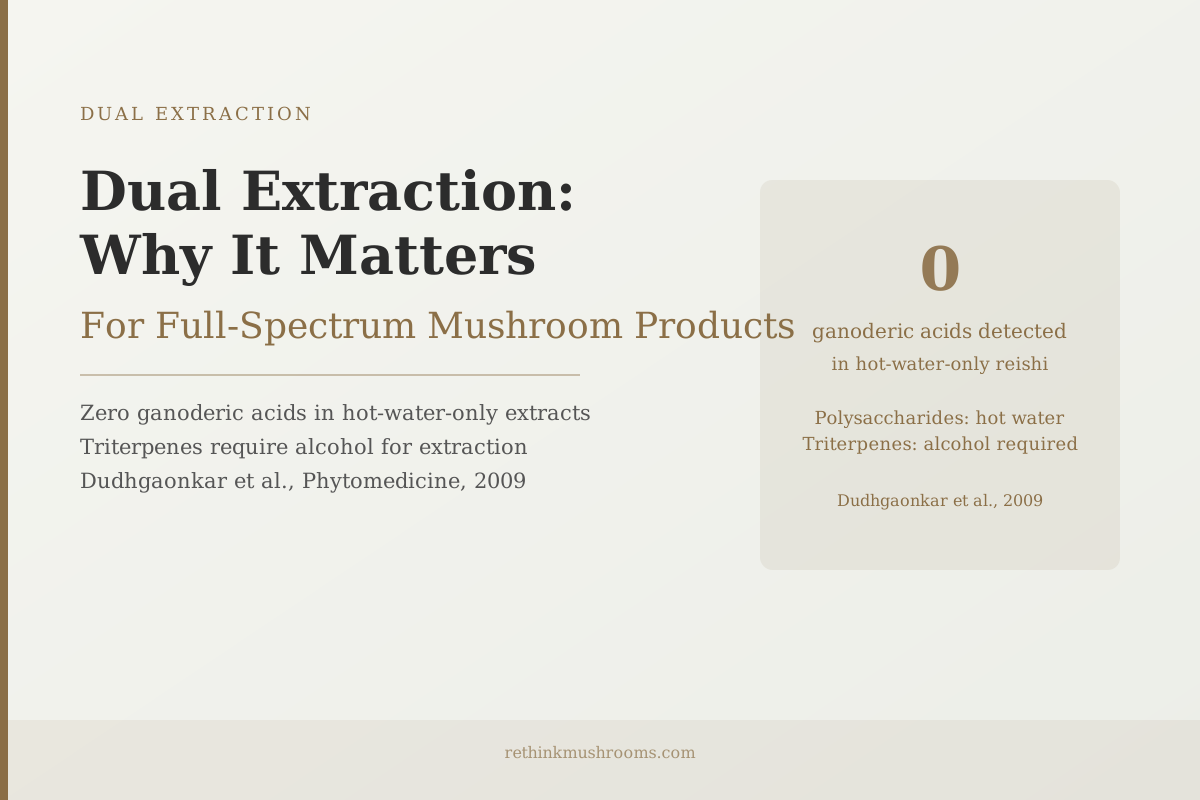
A triterpene extract from Ganoderma lucidum suppressed TNF-α, IL-6, NO, PGE₂, iNOS, COX-2, and NF-κB in LPS-stimulated macrophages — and that triterpene fraction sits in the alcohol-soluble compound class, separate from water-extractable beta-glucan polysaccharides. Single-solvent extraction recovers one fraction or the other, not both.
Dudhgaonkar et al., International Immunopharmacology, 2009
Two solvents
hot water (polysaccharides) and alcohol (triterpenes + sterols) — with non-overlapping compound classes in each
Reishi
the clearest case for dual extraction — ganoderic acids require alcohol; beta-glucans require water
Chaga
a species where green extraction methods (UAE, subcritical water) may outperform traditional dual for heat-sensitive phenolics (Lazić, 2024)
Dudhgaonkar et al., International Immunopharmacology, 2009
 View as image ↗
Dual extraction means extracting a mushroom twice: once with hot water to capture water-soluble compounds (primarily beta-glucan polysaccharides), and once with alcohol to capture fat-soluble compounds (primarily triterpenes and sterols). The two extracts are then combined into a finished product. The result is a full-spectrum extract — one that contains the biologically active fractions from both extraction phases.
The reason dual extraction exists is that mushrooms contain compound classes with fundamentally different solubility. Water-soluble compounds dissolve readily in hot water but are poorly extracted by alcohol. Fat-soluble compounds dissolve in alcohol but are essentially invisible to water as a solvent. A single-solvent extract, regardless of how well-optimized, captures one group while leaving the other behind.
This article covers what dual extraction actually captures and what it doesn't, which mushroom species are most likely to benefit from it, what "full spectrum" actually means on a label, and where the dual extraction model itself has limitations.
For a broader overview of extraction methods including hot water, alcohol, and emerging technologies, see Mushroom Extraction Methods Explained: Hot Water, Alcohol, and Dual.
Key Takeaways
- Dual extraction combines hot water (for beta-glucan polysaccharides) and alcohol (for triterpenes and sterols) to capture compound classes that have non-overlapping solubility
- A triterpene extract from Ganoderma lucidum (GLT) suppressed TNF-α, IL-6, NO, PGE₂, iNOS, COX-2, and NF-κB activity in LPS-stimulated macrophages — establishing the alcohol-extracted triterpene fraction of reishi as a distinct anti-inflammatory mechanism that water-extracted polysaccharides do not replicate (Dudhgaonkar et al., 2009)
- Ergosterol (the precursor to Vitamin D2) is a fungal sterol recovered by alcohol-based extraction; a 2018 study used Soxhlet technology with ethanol to extract ergosterol from Agaricus blazei fruiting bodies (about 12% yield, 58.53 ± 1.72 µg per 100 g dry mushroom in the optimal cycle) for use as a sterol-enriched food fortifier (Corrêa et al., 2018)
- The two extraction phases are not interchangeable: a 2014 study of Laetiporus sulphureus comparing aqueous methanolic, water, and ethanolic extracts found water-based extracts had higher total phenolic content and stronger antioxidant capacity than the ethanolic extract, while antimicrobial activity was comparable across solvents (Petrović et al., 2014)
- Reishi and chaga are the clearest candidates for dual extraction; lion's mane and turkey tail have fewer fat-soluble compounds and derive most bioactivity from water-soluble fractions
- For chaga specifically, a 2024 green extraction study compared subcritical water (SWE), microwave-assisted (MW), and ultrasonic-assisted (VAE) extraction across solvents; SWE produced the highest yield and total polysaccharide / glucan content (especially at 200 °C), while MW with 50% ethanol produced the highest total phenols. The authors recommend SWE as the most efficient method for chaga's commercially important compounds (Lazić et al., 2024)
What Single Extraction Misses: The Evidence
The strongest direct evidence that aqueous and alcohol extractions capture different, non-overlapping compound classes comes from a 2007 study by Faccin and colleagues comparing the two fractions from the same mushroom species side by side.[1] They found that the aqueous extract and the ethanol extract showed distinct antiviral mechanisms — the polysaccharide fraction of the aqueous extract drove one set of biological effects that the ethanol fraction did not replicate, and vice versa. Using only one solvent did not capture what the other solvent found.
The reishi case makes this concrete. A 2009 study by Dudhgaonkar and colleagues evaluated a triterpene extract from Ganoderma lucidum (GLT) in LPS-stimulated RAW264.7 macrophages.[3] GLT markedly suppressed TNF-α, IL-6, nitric oxide, and prostaglandin E₂ secretion, downregulated iNOS and COX-2 expression, and inhibited NF-κB activation. These are well-characterized anti-inflammatory mechanisms. The critical point for extraction policy: this triterpene-fraction activity sits in the alcohol-soluble compound class. Ganoderic acids and related G. lucidum triterpenes are largely fat-soluble; a hot-water-only "reishi extract" recovers very little of the triterpene fraction the GLT study tested.
A 2014 study by Petrović and colleagues compared aqueous methanolic, water, and ethanolic extracts of the wild mushroom Laetiporus sulphureus.[4] Both the aqueous methanolic and water extracts contained higher total phenolic content and stronger antioxidant capacity than the ethanolic extract, while antimicrobial activity was broadly comparable across solvents. The point for the dual-extraction question is not that one solvent always wins, but that different solvents recover different fractions and the correct comparison is fraction-by-fraction rather than "ethanol vs water" in the abstract.
A 2021 comparison of water, ethanol, and methanol extracts of two edible mushroom species by Fogarasi and colleagues confirmed the same pattern: methanol and ethanol yielded higher polyphenol concentrations, while water captured distinct polysaccharide-rich fractions — no single solvent captured the full antioxidant potential of either species.[6]
The Ergosterol Angle: A Third Compound Class That Needs Alcohol
Beyond triterpenes, there is a third category of fat-soluble compounds that hot water extraction misses entirely: sterols, particularly ergosterol.
Ergosterol is the primary sterol in fungal cell membranes and the biological precursor to Vitamin D2. When mushrooms are exposed to UV light (sunlight or artificial UV), ergosterol converts to ergocalciferol — Vitamin D2. Ergosterol is also the target of antifungal drugs like fluconazole, which work by disrupting fungal membrane integrity.
A 2018 study by Corrêa and colleagues used Soxhlet technology with ethanol to extract ergosterol from Agaricus blazei fruiting bodies for use as a sterol-enriched food ingredient.[5] The optimal Soxhlet cycle (the 5th) produced 58.53 ± 1.72 µg of ergosterol per 100 g of mushroom dry weight, with a yield of approximately 12%. The ergosterol-rich extract showed antioxidant and antimicrobial activity without hepatotoxicity in the screened assays. The point for extraction policy is that ergosterol recovery requires an alcohol-based solvent system; mushroom products marketed for ergosterol or Vitamin D2 content that use only hot water are unlikely to deliver meaningful amounts of either.
Which Mushrooms Need Dual Extraction — and Which Don't
Dual extraction is not equally relevant for all medicinal mushroom species. The decision depends on whether a species has meaningful fat-soluble bioactive compounds alongside its water-soluble ones.
Reishi (Ganoderma lucidum / G. lingzhi): The strongest case for dual extraction. Reishi's therapeutic literature rests on two distinct compound classes with separate mechanisms: beta-glucan polysaccharides (immune activation via TLR pathways) and the triterpene fraction including ganoderic acids (the anti-inflammatory NF-κB / iNOS / COX-2 suppression demonstrated in Dudhgaonkar 2009). Neither class covers the other's function. A hot-water-only reishi extract is essentially a polysaccharide-only product, missing the compound class behind reishi's bitter taste and the alcohol-extracted anti-inflammatory mechanism.
Chaga (Inonotus obliquus): Also a clear candidate, but with an important nuance. Chaga's primary bioactives include beta-glucans (water-soluble), betulinic acid and related triterpenes (alcohol-soluble), and phenolic melanins. A 2024 study by Lazić and colleagues compared three green extraction techniques on Chaga from Serbia and Mongolia: subcritical water extraction (SWE) at 120 °C and 200 °C, microwave-assisted extraction (MW), and ultrasonic-assisted extraction (VAE), each combined with 96% ethanol, 50% ethanol, or water.[7] SWE produced significantly higher yield, total polysaccharide, and glucan content than any other technique, especially at 200 °C. MW with 50% ethanol produced the highest total phenols, with chlorogenic acid as the dominant phenolic. The authors recommend SWE as the most efficient method for chaga's commercially important glucan and phenolic compounds. The takeaway for chaga products is not that "dual extraction is wrong," but that the choice of method materially shifts which compounds dominate the final extract and that newer green-extraction approaches can outperform conventional high-heat water plus alcohol on specific endpoints.
Lion's mane (Hericium erinaceus): The primary bioactives are hericenones and erinacines. Hericenones are found in the fruiting body and are partially alcohol-soluble (low molecular weight aromatic compounds). Erinacines are found in the mycelium. Both require alcohol extraction for adequate recovery. Hot water extracts capture lion's mane beta-glucans but miss the neurotrophin-stimulating erinacine fraction. For lion's mane, dual extraction matters specifically for the erinacine content — but the label rarely specifies whether erinacines were actually recovered.
Turkey tail (Trametes versicolor): Turkey tail's clinical evidence is built almost entirely on PSK (polysaccharide-K) and PSP (polysaccharide-peptide), both water-soluble polysaccharide-protein complexes. The alcohol-soluble fraction of turkey tail has far less research attention. For turkey tail specifically, hot water extraction captures the most clinically studied compound classes, and the argument for dual extraction is considerably weaker than for reishi or chaga.
Cordyceps (Cordyceps militaris / Ophiocordyceps sinensis): Cordyceps' primary studied compounds include cordycepin (nucleoside, water-soluble) and polysaccharides (water-soluble). Sterols and some ergosterol-related compounds are alcohol-soluble. The case for dual extraction with cordyceps is moderate — the most-studied compounds are water-soluble, but alcohol extraction adds ergosterol and minor terpenoid fractions.
How Dual Extraction Is Actually Done
A standard commercial dual extraction involves two sequential phases:
First, the dried fruiting body material is extracted with hot water, typically at 90-100°C for 1-4 hours. The water-soluble compounds (beta-glucans, polysaccharides, proteins) dissolve into the aqueous phase. This phase is then separated and concentrated.
Second, the same material (or a new batch) is extracted with food-grade alcohol — typically ethanol at 25-60% concentration. The fat-soluble compounds (triterpenes, sterols, some phenolics) dissolve into the alcohol phase. This phase is separated and concentrated.
The two concentrated extracts are then combined and often spray-dried or freeze-dried into a finished powder or tincture.
The important distinction: true dual extraction uses both phases on meaningful quantities of starting material. Some products extract once with alcohol and then dilute with water — this is not the same process and produces a different compound profile. A label that says "dual extract" without specifying how both phases were performed tells you the marketing, not the chemistry.
A 2007 study by Liu and colleagues demonstrated that processing method — in this case, comparing wild fruiting body, liquid-state fermentation, and solid-state culture of the same species — produced fundamentally different anti-inflammatory activity profiles.[2] Wild fruiting body extract showed the highest activity. Solid-state culture was weakest. This reinforces that extraction substrate and method together determine what you receive in the final product.
What "Full Spectrum" Means on a Label
"Full spectrum" is a marketing term without a regulatory definition. It implies that a product captures the complete range of bioactive compounds from the source mushroom. In practice, what "full spectrum" means varies entirely by brand.
A genuine full-spectrum claim would require: (1) fruiting body sourced material (not mycelium on grain, which has different compound ratios); (2) dual extraction covering both water-soluble and fat-soluble compound classes; (3) a Certificate of Analysis (COA) from a third-party lab showing both beta-glucan percentage and, for species like reishi, triterpene percentage.
Without a COA, "full spectrum" is unverifiable marketing language. A product labeled "full spectrum reishi" with no COA might be hot-water-only powder with a better marketing budget than its compound profile warrants.
For guidance on reading COAs and what percentages to look for by species, see How Extraction Methods Determine Supplement Quality.
The Honest Counterpoint: When Dual Extraction Doesn't Add Value
Dual extraction adds complexity and cost. For species where the therapeutic value is primarily in water-soluble fractions — turkey tail being the clearest example — paying a premium for dual extraction delivers minimal additional benefit based on the current evidence.
The Lazić 2024 Chaga finding is worth emphasizing: for some species and some compound classes, traditional dual extraction with high-heat water and ethanol is not the best available method.[7] Green extraction technologies (ultrasonic-assisted, subcritical water) preserve heat-sensitive compounds that conventional hot water processing degrades. The supplement industry's framing of dual extraction as the gold standard reflects 2010-era technology. The research has moved ahead of the marketing language.
For a look at where extraction science is heading, see Ultrasonic and Enzyme-Assisted Extraction: Next-Gen Methods.
The Bottom Line
Dual extraction combines hot water (for beta-glucan polysaccharides) and alcohol (for triterpenes and sterols) to capture compound classes with non-overlapping solubility. The clearest case is reishi: a 2009 study showed that a G. lucidum triterpene extract suppressed multiple inflammatory pathways in macrophages (Dudhgaonkar et al.), and that triterpene fraction sits in the alcohol-soluble compound class rather than in hot-water extracts. Ergosterol and most sterols also require alcohol-based extraction. The dual extraction model has limits: a 2024 chaga study found subcritical water extraction produced higher polysaccharide and glucan yields and microwave-assisted extraction with 50% ethanol produced the highest phenols, suggesting newer green-extraction methods can outperform conventional high-heat water plus alcohol on specific endpoints. For turkey tail, most clinical-evidence compounds are water-soluble and the dual extraction premium is not as strongly supported.
Frequently Asked Questions
Sources & References
- 1RTHM-00112·Faccin, L C et al. (2007). “Antiviral activity of aqueous and ethanol extracts and of an isolated polysaccharide from Agaricus brasiliensis against poliovirus type 1..” Letters in applied microbiology.Study breakdown →PubMed →↩
- 2RTHM-00119·Liu, Der-Zen et al. (2007). “Comparative anti-inflammatory characterization of wild fruiting body, liquid-state fermentation, and solid-state culture of Taiwanofungus camphoratus in microglia and the mechanism of its action..” Journal of ethnopharmacology.Study breakdown →PubMed →↩
- 3RTHM-00152·Dudhgaonkar, Shailesh et al. (2009). “Suppression of the inflammatory response by triterpenes isolated from the mushroom Ganoderma lucidum..” International immunopharmacology.Study breakdown →PubMed →↩
- 4RTHM-00346·Petrović, Jovana et al. (2014). “Different extraction methodologies and their influence on the bioactivity of the wild edible mushroom Laetiporus sulphureus (Bull.) Murrill..” Food & function.Study breakdown →PubMed →↩
- 5RTHM-00506·Corrêa, Rúbia C G et al. (2018). “A natural food ingredient based on ergosterol: optimization of the extraction from Agaricus blazei, evaluation of bioactive properties and incorporation in yogurts..” Food & function.Study breakdown →PubMed →↩
- 6RTHM-00686·Fogarasi, Melinda et al. (2021). “Comparison of Different Extraction Solvents for Characterization of Antioxidant Potential and Polyphenolic Composition in Boletus edulis and Cantharellus cibarius Mushrooms from Romania..” Molecules (Basel.Study breakdown →PubMed →↩
- 7RTHM-00888·Lazić, Vesna et al. (2024). “The Effect of Green Extraction Technologies on the Chemical Composition of Medicinal Chaga Mushroom Extracts..” Journal of fungi (Basel.Study breakdown →PubMed →↩