Mushroom Pharmacology & Bioavailability
20-40% more polysaccharides
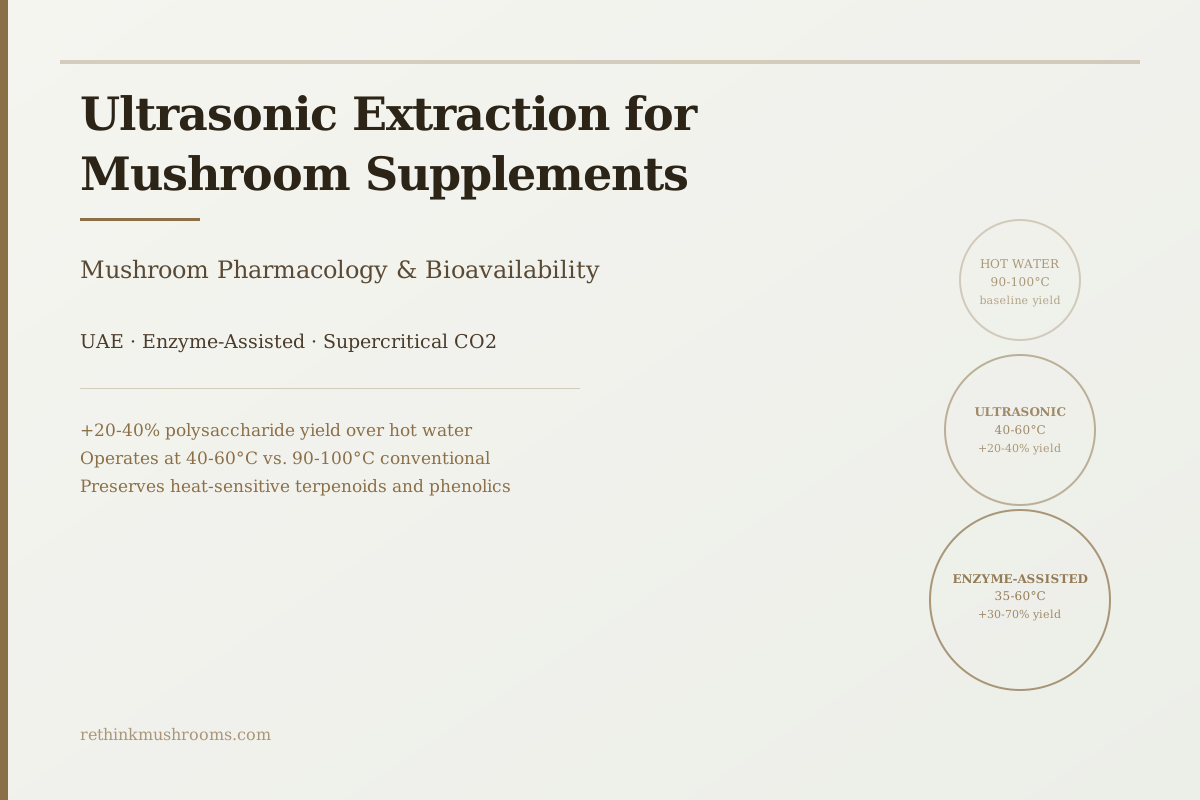
Ultrasonic-assisted extraction achieves 20-40% higher polysaccharide yields than conventional hot water extraction, at temperatures of 40-60°C rather than 90-100°C, preserving heat-sensitive compounds that conventional methods degrade.
Sun et al., Ultrasonics Sonochemistry, 2024
46°C
optimal UAE temperature for Ganoderma polysaccharide extraction vs. 90-100°C for hot water (Zheng et al., 2020)
30-70%
higher polysaccharide yields from UAE and enzyme-assisted methods vs. conventional (Leong et al., 2021)
40-80%
yield improvement from emerging extraction technologies vs. conventional methods (Sirohi et al., 2024)
Sun et al., Ultrasonics Sonochemistry, 2024
 View as image ↗
Hot water and alcohol extraction have been the standard methods for producing mushroom supplements for decades. Both work well enough to capture the major compound classes, and most of the supplements on the market today use one or both. They are not, however, the most efficient methods available. Three newer approaches, documented in peer-reviewed research over the last decade, consistently achieve higher yields, operate at lower temperatures, and in one case capture compound classes that neither hot water nor alcohol can reach at all. This article covers those three methods: ultrasonic-assisted extraction (UAE), enzyme-assisted extraction (EAE), and supercritical fluid extraction (SFE). For the foundational comparison of hot water and alcohol extraction, see mushroom extraction methods explained.
Key Takeaways
- Ultrasonic-assisted extraction (UAE) uses high-frequency sound waves to create and collapse microscopic bubbles that physically rupture mushroom cell walls, achieving 20-40% higher polysaccharide yields than conventional hot water extraction at significantly lower temperatures (Sun et al., Ultrasonics Sonochemistry, 2024)
- Optimized UAE conditions for Ganoderma achieved comparable or superior results to conventional hot water extraction at 46°C and 47 minutes, far below the 90-100°C used in standard hot water extraction (Zheng et al., PLoS ONE, 2020)
- Enzyme-assisted extraction (EAE) uses cellulases and other carbohydrate-degrading enzymes to break down the chitin and cellulose cell wall before solvent extraction; operating at 35-60°C preserves heat-sensitive terpenoids that are partially destroyed by high-temperature hot water methods (Sirohi et al., 2024)
- A 2024 Journal of Fungi study found that green extraction methods (UAE, microwave-assisted, subcritical water) preserved significantly more heat-sensitive phenolics and betulin from Chaga than traditional hot water decoction, while achieving comparable polysaccharide yields (Lazić et al., 2024)
- Supercritical CO2 extraction of Cordyceps sinensis captured a distinct lipophilic metabolite profile including ergosterol, fatty acids, and bioactives that neither hot water nor ethanol extraction reached (Mishra et al., Frontiers in Pharmacology, 2021)
- These extraction technologies are well-established in food science research but are not yet widely used in consumer supplement manufacturing; most commercial products remain hot water or dual extraction
The Problem That Next-Gen Methods Are Solving
Conventional hot water extraction has two limitations that are worth understanding before explaining why ultrasonic methods are an improvement.
The first limitation is the cell wall. Mushrooms build their cell walls from chitin, the same rigid material that forms insect exoskeletons. Chitin is highly resistant to both hot water and most organic solvents. Conventional extraction relies on sustained heat and time to break down the cell wall gradually, which works but inefficiently: much of the bioactive content remains trapped in cell wall fragments that pass through the extraction without releasing their contents.
The second limitation is temperature. Hot water extraction requires 90 to 100 degrees Celsius to be effective. These temperatures break down chitin over time, but they also degrade heat-sensitive compounds. Timm and colleagues' 2023 review in Applied Microbiology and Biotechnology established that high-molecular-weight beta-glucan chains (the molecular form most active in immune modulation) are partially degraded by excessive heat during extraction, even as crude yield increases. Higher-temperature extraction can paradoxically deliver more grams of polysaccharide with lower immunological potency.
Palanisamy and colleagues demonstrated this tradeoff directly in a 2014 Biotechnology Progress study using pressurized hot water extraction of edible mushrooms: beta-glucan yield increased with extraction temperature up to an optimal point, then declined as polysaccharide degradation began.[6] There is a critical temperature window above which hot water extraction becomes self-defeating.
Next-generation extraction methods address both limitations: they break down cell walls more efficiently (solving problem one) at lower temperatures (solving problem two).
How Ultrasonic Extraction Works: Acoustic Cavitation Explained
Ultrasonic-assisted extraction works through a phenomenon called acoustic cavitation. In plain language: high-frequency sound waves create and rapidly collapse millions of microscopic bubbles throughout the extraction liquid.
When these bubbles collapse, they produce localized bursts of extreme pressure and temperature (up to 5,500 degrees Kelvin in the immediate vicinity of the bubble collapse, though the bulk solution stays cool). These bursts physically rupture cell walls, creating pathways for extraction solvent to penetrate directly into the cell interior.
Sun and colleagues published a comprehensive review of ultrasonic applications in mushroom processing in Ultrasonics Sonochemistry in 2024, synthesizing the evidence across multiple mushroom species and bioactive compound classes.[1] Their findings on extraction efficiency were consistent across studies: UAE increases polysaccharide yield by 20 to 40 percent over conventional hot water extraction, reduces extraction time from hours to minutes, and eliminates the need for sustained high temperatures.
The temperature advantage is the key differentiator. Because acoustic cavitation does the mechanical work of cell wall disruption, UAE does not need high heat to drive penetration. Operating at 40 to 60 degrees Celsius rather than 90 to 100 degrees Celsius means heat-sensitive compounds, including certain triterpenoids, phenolics, and volatile terpenes, survive the extraction process intact rather than being partially destroyed by it.
What UAE Yields in Practice: Concrete Parameters From the Research
The yield data for UAE is specific enough to be practically meaningful.
Zheng and colleagues, optimizing UAE conditions for Ganoderma lucidum polysaccharides and triterpenoids in PLoS ONE in 2020, found that a specific combination of parameters (46 degrees Celsius, 47 minutes, 60 percent ultrasonic amplitude) significantly outperformed conventional hot water extraction for polysaccharide yield while simultaneously extracting triterpenoids in a single step.[2] Conventional hot water extraction typically captures polysaccharides but not triterpenoids (which require alcohol); UAE with water-based solvent accessed both compound classes in one extraction.
The implication: UAE with a water-based solvent can approximate the results of conventional dual extraction (hot water plus alcohol) in a single pass, at lower temperatures, with higher yields. It achieves this because cavitation-driven cell wall disruption releases both water-soluble and some lipid-associated compounds that remain inaccessible to passive solvent diffusion at lower temperatures.
Leong and colleagues, in a comprehensive review published in Carbohydrate Polymers in 2021 covering all emerging extraction technologies applied to edible mushrooms, found UAE and enzyme-assisted extraction consistently showed 30 to 70 percent higher polysaccharide yields than conventional hot water extraction across species.[3] The review covered not just polysaccharides but also the interaction between extraction method and compound class recovery across the full literature.
Corrêa and colleagues in 2018 demonstrated one specific application of ultrasonic technology that conventional hot water extraction cannot replicate: ultrasound-assisted ethanol extraction achieved the highest ergosterol yield from Agaricus blazei mushrooms.[7] Ergosterol (the mushroom sterol that converts to Vitamin D2 under UV light) is fully alcohol-soluble and completely absent from hot water extracts. UAE paired with ethanol accessed it more efficiently than conventional alcohol extraction alone.
Here is how the major extraction methods compare based on the available research:
| Method | Operating Temp | Yield vs. Conventional | Preserves Heat-Sensitive Compounds | Commercial Use |
|---|---|---|---|---|
| Hot water extraction | 90-100°C | Baseline | Low | Widespread |
| Ultrasonic (UAE) | 40-60°C | +20-40% | Yes | Growing |
| Enzyme-assisted (EAE) | 35-60°C | +30-70% | Yes | Limited |
| Microwave-assisted (MAE) | Variable | +20-50% | Moderate | Limited |
| Supercritical CO2 (SFE) | 40-60°C | Different classes | Yes | Very limited |
Enzyme-Assisted Extraction: Breaking the Cell Wall Without Heat
Enzyme-assisted extraction (EAE) takes a different approach to the same cell wall problem. Instead of using physical force (ultrasound) to rupture chitin, EAE uses biological catalysts (enzymes) to break down the cell wall chemically at low temperatures.
The enzymes typically used are cellulases, hemicellulases, and pectinases, which degrade different structural components of the fungal cell wall. After enzyme treatment, the cell wall is weakened or dissolved, making the intracellular contents accessible to extraction solvent without requiring high heat.
Sirohi and colleagues' 2024 review in the Journal of Food Science and Technology, covering emerging technologies for bioactive extraction from mushroom waste, found that EAE operating at 35 to 60 degrees Celsius was particularly effective for preserving heat-sensitive terpenoids that are partially destroyed at the 90 to 100 degree temperatures required by hot water extraction.[4] The 40 to 80 percent yield improvement figure reported by Sirohi et al. for emerging methods combined includes EAE as a major contributor.
The temperature advantage for terpenoids matters because triterpenoids (the ganoderic acids in reishi that require alcohol extraction conventionally) are not infinitely heat-stable. Extended high-temperature exposure degrades some of these compounds. EAE paired with ethanol-based solvent at 40 to 60 degrees Celsius can improve triterpene recovery compared to conventional alcohol extraction at higher temperatures.
Leong et al.'s 2021 review also covered an enzyme-ultrasonic sequential approach: enzymes first break down the cell wall, then ultrasound completes the extraction.[3] This combination achieves synergistic gains over either method used alone, because enzyme pre-treatment increases the effective surface area that acoustic cavitation then acts on.
For readers asking whether enzyme-assisted extracts are currently available in mushroom supplements, see how extraction methods determine supplement quality for the market reality.
Chaga as the Test Case: Green Extraction vs. Traditional Decoction
The most concrete head-to-head data comparing green extraction methods against traditional approaches comes from a 2024 study of Chaga mushroom (Inonotus obliquus) specifically.
Lazić and colleagues compared UAE, microwave-assisted extraction, subcritical water extraction, and traditional hot water decoction head-to-head for Chaga in the Journal of Fungi in 2024.[5] The finding: green extraction methods preserved significantly more phenolic compounds and betulin (a key Chaga bioactive) while achieving comparable or superior polysaccharide yields. Traditional hot water decoction degraded heat-sensitive phenolics that are central to Chaga's distinctive biological activity profile.
Betulin is a lipid-soluble compound with documented anti-inflammatory and antiviral properties, and it is concentrated in the outer black layer of Chaga sclerotia. High-temperature decoction (the traditional preparation method) extracts some betulin but simultaneously causes thermal degradation of both betulin itself and the phenolic acids that contribute to Chaga's antioxidant capacity. Green extraction methods achieve access to these compounds without the thermal damage.
The practical implication for Chaga supplements specifically: traditional dual extraction (hot water plus alcohol) may not be the optimal method for this mushroom. Green extraction approaches are demonstrably better at preserving the specific compounds that make Chaga pharmacologically interesting, even though traditional dual extraction remains the industry standard.
Supercritical CO2 Extraction: A Different Tier Entirely
Supercritical fluid extraction (SFE) using carbon dioxide operates on a different principle than any of the methods above. Carbon dioxide under high pressure and temperature above 31 degrees Celsius reaches a "supercritical" state, meaning it simultaneously behaves like a liquid (dissolving compounds) and a gas (penetrating into porous structures). When pressure is released, the CO2 returns to gas phase and leaves behind a clean extract with no solvent residue.
Mishra and colleagues, profiling the metabolite output of supercritical CO2 extraction applied to Cordyceps sinensis in Frontiers in Pharmacology in 2021, found that SFE captured a distinct compound class that neither hot water nor ethanol extraction could reach: ergosterol, fatty acids, and lipophilic bioactives with activity against hypobaric hypoxia.[8] The SFE extract protected against altitude-induced hypoxia in a rat model. This is a compound class and a biological activity that conventional dual extraction simply does not access.
SFE is not a faster or cheaper version of hot water extraction. It is a complementary technology that accesses a different layer of the mushroom's chemistry. A full-spectrum mushroom extract, in principle, would require three separate passes: hot water for polysaccharides, ethanol for triterpenoids and ergosterol, and SFE for the lipophilic class that neither solvent captures. This exists in research settings but not in commercial supplement manufacturing at scale.
For a detailed look at what supercritical extraction captures beyond conventional methods, see comparing extraction technologies: SFE vs. traditional methods.
The Honest Reality: Where These Methods Stand in the Market
The research on UAE, EAE, and SFE is well-established in food science literature. The gap between that research and what is in most supplements on store shelves is significant.
The vast majority of commercial mushroom supplements use hot water extraction, alcohol extraction, or a combination of both. This is because both technologies are mature, the equipment is widely available, the process parameters are well understood, and the regulatory framework for product quality has been built around them.
UAE equipment is available and is used in some premium extract production, but it is not the industry standard. EAE requires enzyme sourcing, additional processing steps, and careful temperature control that adds cost and complexity. SFE equipment costs are prohibitive for all but the largest manufacturers or specialized extract producers.
This creates a practical gap for consumers: the extraction method producing the best yield and compound preservation in research settings is not yet the extraction method most commonly used in supplements. When evaluating a product, checking whether the extraction method is stated on the label, what percentage of beta-glucans or triterpenes is confirmed, and whether a certificate of analysis is available from third-party testing gives more actionable information than the extraction technology claim alone.
For the full framework on evaluating extraction quality from a consumer perspective, see how extraction methods determine supplement quality. For the foundational comparison of hot water and alcohol extraction, see hot water vs. alcohol extraction: which compounds each captures. To understand why the source material matters as much as the extraction method, see dual extraction: why it matters for full-spectrum mushroom products.
The Bottom Line
Ultrasonic-assisted extraction achieves 20-40% higher polysaccharide yields than conventional hot water extraction at operating temperatures of 40-60°C, preserving heat-sensitive terpenoids and phenolics that high-temperature conventional methods partially degrade. Enzyme-assisted extraction reaches similar yield improvements by chemically breaking down the chitin cell wall before solvent contact. Supercritical CO2 extraction accesses a distinct lipophilic compound class missed by both water and alcohol methods. All three technologies are better-performing than conventional extraction in controlled studies; none are yet widely used in commercial supplement manufacturing, where hot water and dual extraction remain standard.
Frequently Asked Questions
Sources & References
- 1RTHM-01998·Sun, Mianli et al. (2024). “A comprehensive review of the application of ultrasonication in the production and processing of edible mushrooms: Drying, extraction of bioactive compounds, and post-harvest preservation..” Ultrasonics sonochemistry.Study breakdown →PubMed →↩
- 2RTHM-00668·Zheng, Shizhong et al. (2020). “Optimization of ultrasonic-assisted extraction of polysaccharides and triterpenoids from the medicinal mushroom Ganoderma lucidum and evaluation of their in vitro antioxidant capacities..” PloS one.Study breakdown →PubMed →↩
- 3RTHM-01383·Leong, Yoong Kit et al. (2021). “Extraction of polysaccharides from edible mushrooms: Emerging technologies and recent advances..” Carbohydrate polymers.Study breakdown →PubMed →↩
- 4RTHM-01993·Sirohi, Ranjna et al. (2024). “Emerging technologies for the extraction of bioactives from mushroom waste..” Journal of food science and technology.Study breakdown →PubMed →↩
- 5RTHM-00888·Lazić, Vesna et al. (2024). “The Effect of Green Extraction Technologies on the Chemical Composition of Medicinal Chaga Mushroom Extracts..” Journal of fungi (Basel.Study breakdown →PubMed →↩
- 6RTHM-00342·Palanisamy, Marimuthu et al. (2014). “Pressurized water extraction of β-glucan enriched fractions with bile acids-binding capacities obtained from edible mushrooms..” Biotechnology progress.Study breakdown →PubMed →↩
- 7RTHM-00506·Corrêa, Rúbia C G et al. (2018). “A natural food ingredient based on ergosterol: optimization of the extraction from Agaricus blazei, evaluation of bioactive properties and incorporation in yogurts..” Food & function.Study breakdown →PubMed →↩
- 8RTHM-00708·Mishra, Jigni et al. (2021). “Supercritical Carbon Dioxide Extracts of Cordyceps sinensis: Chromatography-based Metabolite Profiling and Protective Efficacy Against Hypobaric Hypoxia..” Frontiers in pharmacology.Study breakdown →PubMed →↩