Mushroom Extraction Technology
6 extraction methods compared
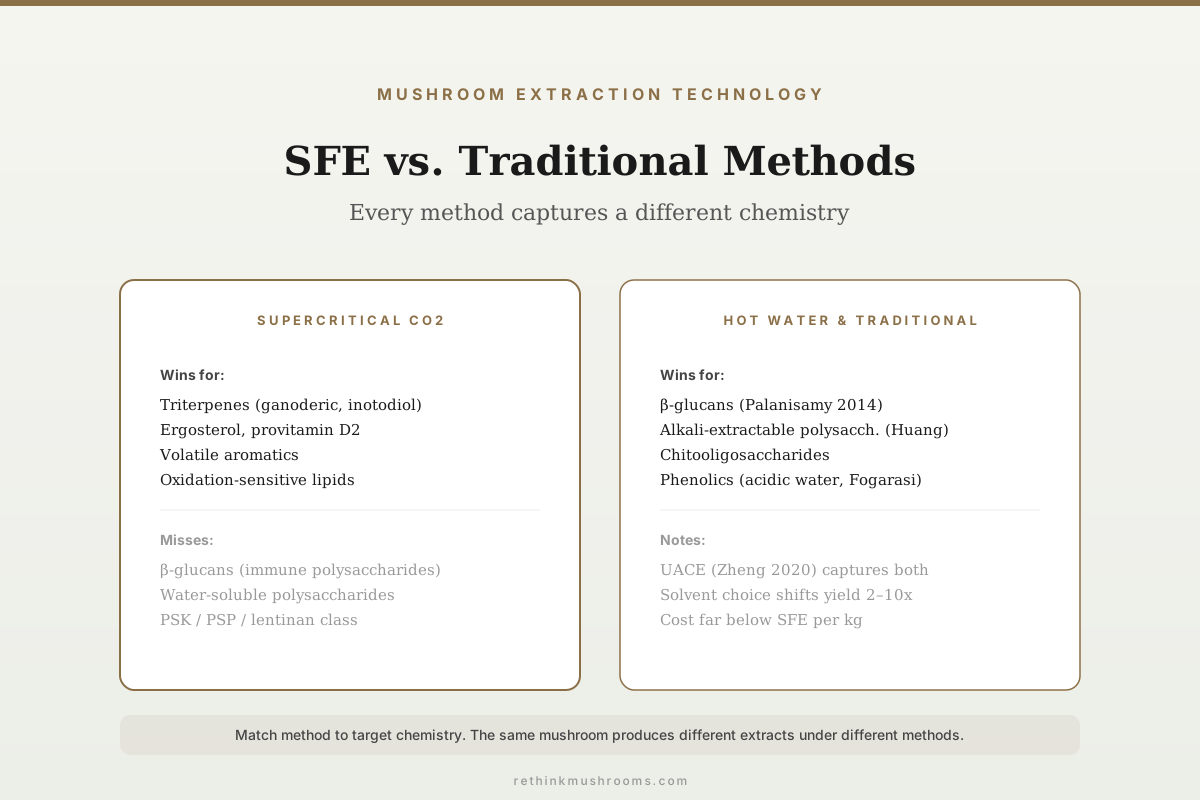
Supercritical fluid extraction (SFE) targets a narrow lipophilic fraction (triterpenes, sterols, volatile aromatics) that water and ethanol struggle to capture, but it cannot extract β-glucans or water-soluble polysaccharides, which are the most clinically validated mushroom immune compounds.
Palanisamy 2014; Huang 2010; Kim 2020; Zheng 2020; Fogarasi 2021; Bian 2020
SFE: Triterpenes & Sterols
wins on lipophilic bioactives
Hot Water: β-Glucans
wins on polysaccharides
Method Determines Identity
the same mushroom produces completely different extracts
Palanisamy 2014; Huang 2010; Kim 2020; Zheng 2020; Fogarasi 2021; Bian 2020
 View as image ↗
Supercritical fluid extraction (SFE) is often marketed as the gold standard for mushroom extracts. In narrow technical terms, SFE is a superior method for isolating a specific fraction of the mushroom chemistry (triterpenes, sterols, volatile aromatics, and some lipid-bound bioactives) that traditional solvents capture poorly or not at all. In broader terms, SFE misses the entire water-soluble polysaccharide fraction, including β-glucans, which is where the strongest clinical immune evidence sits. The comparison between supercritical fluid extraction vs traditional methods for mushrooms is not a ranking but a matrix: each technology captures a different chemistry, and the choice depends on what the extract is for.
For the specific technical details of supercritical CO2 extraction, see the sibling articles supercritical CO2 extraction for mushrooms: how it works and supercritical CO2 extraction for mushroom triterpenes: the gold standard explained. For the marketing-versus-reality framing, see sfe mushroom extracts: premium products or marketing hype? and what supercritical extraction captures that water and alcohol miss.
Key Takeaways
- Palanisamy et al. (2014) demonstrated that pressurized water extraction at 200°C and 10.3 MPa extracted β-glucan-enriched fractions with bile acid-binding capacities from Agaricus, shiitake, and oyster mushrooms, comparable to cereal β-glucan products (Biotechnology Progress)
- Huang et al. (2010) optimized alkaline extraction of Ganoderma lucidum polysaccharides using response surface methodology at 60.1°C, 77.3 min, 5.1% NaOH, 1:21.4 substrate/liquid ratio, with demonstrated immune activity in cyclophosphamide-immunosuppressed mice (Molecules)
- Kim et al. (2020) used methanol extraction to quantify triterpenoids in chaga (Inonotus obliquus), finding inotodiol at 153.9 mg/g (inner) and 194.1 mg/g (outer) and significantly higher anti-proliferative activity in the outer triterpenoid fraction (Molecules)
- Bian et al. (2020) optimized ultrasound-assisted extraction of Auricularia auricula-judae polysaccharides at 74°C, 27 min, 198 W, achieving 14.74 mg/g crude yield with demonstrated anticoagulant activity (Molecules)
- Zheng et al. (2020) developed an ultrasonic-assisted co-extraction method for Ganoderma polysaccharides AND triterpenoids simultaneously, achieving 0.63% polysaccharide and 0.38% triterpenoid yield with higher antioxidant capacity than traditional hot water extraction (PLoS ONE)
- Fogarasi et al. (2021) compared four extraction solvents (acidic water, ethanol/water/acetic acid, hexane, diethyl ether) for Boletus and Cantharellus and found acidic water produced the highest phenolic content and antioxidant capacity, with flavonoid content uncorrelated with antioxidant capacity (Molecules)
The Six Main Mushroom Extraction Technologies
Mushroom extraction methods fall into six broad categories, each with characteristic target fractions, yield profiles, and activity retention. The supercritical fluid extraction vs traditional methods comparison only makes sense once these categories are distinguished.
| Method | Primary target | Typical conditions | Bioactive focus |
|---|---|---|---|
| Hot water extraction | Polysaccharides, β-glucans | 80–100°C, atmospheric pressure | Immune-active cell wall fraction |
| Alcohol (ethanol/methanol) | Triterpenes, phenolics | Room temp–reflux, 50–95% alcohol | Secondary metabolites, sterols |
| Alkaline extraction | Tightly bound polysaccharides | 60°C, 5% NaOH, hours | Alkali-extractable β-glucans |
| Pressurized water | β-glucans + hydrolysis products | 150–200°C, 5–15 MPa | β-glucans with chitooligosaccharides |
| Ultrasound-assisted | Polysaccharides or triterpenes | 60–80°C, ultrasound 200 W, 30–100 min | Depends on solvent paired |
| Supercritical fluid (CO2) | Triterpenes, sterols, lipids | 30–60°C, 10–40 MPa CO2 | Lipophilic bioactives only |
The table reveals the central point: no single method captures the full mushroom bioactive profile. SFE cannot access water-soluble polysaccharides. Hot water cannot extract unmodified triterpenes. Alkaline extraction can damage heat-sensitive compounds. Ultrasound-assisted extraction is solvent-agnostic and only as good as the solvent it pairs with.
Where Hot Water and Pressurized Water Win
Palanisamy et al. (2014), publishing in Biotechnology Progress, developed a pressurized water extraction (PWE) protocol for edible mushrooms (Agaricus bisporus, Lentinula edodes, Pleurotus ostreatus) at 200°C and 10.3 MPa.[1] The process extracted β-glucan-enriched fractions containing α-glucans, hetero-/proteo-glucans, and notably chitooligosaccharides derived from chitin hydrolysis. The bile acid-binding capacity of some PWE extracts was comparable to cereal β-glucan products, providing a mechanism for cholesterol-lowering activity that SFE extracts cannot deliver because they do not contain this fraction.
The pressurized variant of hot water extraction is particularly useful because it hydrolyzes a fraction of the chitin in the cell wall and co-extracts the released chitooligosaccharides with the β-glucans. This is not possible at atmospheric pressure because temperatures above 100°C are required to drive the hydrolysis at reasonable rates. Standard hot water extraction captures the β-glucans but leaves most of the chitin intact in the residue.
For the β-glucan-dependent activities (immune activation, cholesterol binding, cardiovascular protection through fiber mechanisms), hot water and pressurized water are the technically superior extraction methods. No amount of supercritical CO2 optimization will deliver β-glucan extracts, because CO2 does not dissolve large water-soluble polysaccharides.
Where Alkaline Extraction Adds Value
Huang et al. (2010), publishing in Molecules, optimized alkaline extraction of Ganoderma lucidum polysaccharides using response surface methodology.[2] Optimum conditions were 60.1°C, 77.3 minutes, 5.1% NaOH, and 1:21.4 substrate/liquid ratio. The alkaline-soluble polysaccharides restored delayed type hypersensitivity reaction, hemolysis antibody levels, and NK cell activity in cyclophosphamide-immunosuppressed mice.
Alkaline extraction accesses polysaccharides that are covalently or tightly non-covalently associated with the cell wall protein matrix and cannot be released by water alone. The measured immune activities of alkali-extractable fractions are often distinct from those of water-extractable fractions, and both are distinct from SFE-extracted lipid fractions. The three methods extract three different chemistries from the same raw material.
The cost of alkaline extraction is that some heat-sensitive and base-sensitive compounds are degraded in the process. Triterpenes, phenolic esters, and lipid-bound vitamins often do not survive alkaline extraction intact. This is why alkaline extraction is rarely used as a standalone method and more commonly as a second step after water or alcohol extraction.
Where Alcohol and SFE Overlap
Kim et al. (2020), publishing in Molecules, quantified triterpenoids in the inner and outer parts of Inonotus obliquus (chaga) using 80% methanol extraction followed by Diaion HP-20 resin fractionation.[3] Inotodiol content was 153.9 mg/g dry basis in the inner part and 194.1 mg/g in the outer part. Trametenolic acid was 94.5 mg/g and 106.3 mg/g, respectively. Anti-proliferative activity against AGS, MCF-7, and PC3 cancer cell lines was significantly higher in the outer triterpenoid fraction.
Methanol and ethanol extraction are traditional methods for recovering triterpenes, sterols, phenolics, and secondary metabolites from mushrooms. The target chemistry overlaps substantially with the SFE target chemistry because both approaches isolate lipophilic compounds. The practical differences are:
Selectivity. SFE is more selective for purely lipophilic, non-polar compounds. Ethanol and methanol extract a broader fraction that includes moderately polar phenolics and glycosylated compounds.
Solvent residue. SFE leaves essentially no solvent residue because CO2 returns to gas at ambient conditions. Alcohol extraction requires evaporation and typically leaves trace solvent in the final product.
Thermolabile compound preservation. SFE operates at 30–60°C and preserves heat-sensitive compounds better than reflux alcohol extraction at 70–80°C.
Oxidation sensitivity. SFE operates under inert CO2 atmosphere and protects oxidation-sensitive compounds better than ethanol extraction in the presence of air.
Cost and throughput. SFE requires high-pressure equipment and CO2 supply. Ethanol extraction uses standard reflux apparatus and is an order of magnitude cheaper per kilogram of input material.
The honest comparison is that SFE produces a cleaner, more specific, more thermally gentle extract of the same chemistry that ethanol and methanol extract, at substantially higher cost. For most mushroom triterpenes and sterols, the difference in extract quality between optimized ethanol extraction and optimized SFE is real but modest. For specific heat-sensitive or oxidation-sensitive compounds, SFE is a meaningful upgrade.
Where Ultrasound-Assisted Extraction Changes the Picture
Bian et al. (2020), publishing in Molecules, optimized ultrasound-assisted extraction (UAE) of Auricularia auricula-judae polysaccharides with response surface methodology.[4] Optimum parameters were 74°C extraction temperature, 27 minutes, 103:1 liquid-to-solid ratio, and 198 W ultrasound power, producing 14.74 mg/g crude polysaccharide yield. The purified acidic fraction demonstrated anticoagulant activity through both endogenous and exogenous coagulation pathways.
Zheng et al. (2020), publishing in PLoS ONE, developed an ultrasonic-assisted co-extraction (UACE) method that extracted polysaccharides and triterpenoids from Ganoderma lucidum simultaneously.[5] Optimum conditions were 210 W ultrasonic power, 80°C, 50:1 liquid-to-solid ratio, 100 minutes, with 50% aqueous ethanol as the solvent. Yields were 0.63% polysaccharides and 0.38% triterpenoids. The UACE polysaccharides had higher antioxidant capacity than traditional hot water extracts, while the UACE triterpenoid-rich extracts had antioxidant activities similar to ethanol maceration.
Ultrasound-assisted extraction is important in the comparison because it partially addresses the chemistry-isolation problem of every other method. By pairing ultrasound (which disrupts the chitin-glucan cell wall matrix mechanically) with a mixed solvent (ethanol-water), UACE captures both water-soluble polysaccharides and ethanol-soluble triterpenoids in a single step. The resulting extract has a broader chemistry profile than either pure hot water or pure ethanol extraction and closer to a "whole mushroom" chemical signature.
SFE cannot do this co-extraction because CO2 does not dissolve polysaccharides under any conditions attainable in practice. A mushroom producer who wants both polysaccharides and triterpenes in a single extract has to use a mixed-solvent approach like UACE, or perform SFE and aqueous extraction sequentially and combine the results.
Where Solvent Choice Dominates Everything Else
Fogarasi et al. (2021), publishing in Molecules, compared four solvents (acidic water 10% acetic acid, ethanol/water/acetic acid 15:76.5:8.5, hexane, diethyl ether) for Boletus edulis and Cantharellus cibarius.[6] Solvent choice significantly affected total phenolic content and Trolox equivalent antioxidant capacity but did not significantly affect total flavonoid content. Acidic water produced the highest polyphenol yield and the strongest antioxidant activity. A very strong positive correlation was observed between TPC and TEAC across the extracts.
The finding is relevant to the SFE comparison because it shows that within traditional methods, the choice between water-based, ethanol-based, and non-polar solvents swings phenolic yield by several-fold. This range is wider than the range between optimized ethanol and optimized SFE for the same target chemistry. A poorly chosen traditional solvent can deliver less bioactive compound than a well-optimized SFE, and a well-chosen traditional solvent can equal or exceed SFE for the same target chemistry.
What SFE Actually Delivers
Supercritical CO2 extraction is the technically correct method for:
- Triterpenes (ganoderic acids in reishi, inotodiol and trametenolic acid in chaga, ergostane-series in shiitake)
- Ergosterol and provitamin D2 compounds
- Volatile aromatics and flavor compounds
- Oxidation-sensitive lipophilic compounds
- Heat-sensitive lipophilic compounds
- Clean extracts with no residual organic solvent
SFE is the technically wrong method for:
- β-1,3/1,6-glucans (mushroom immune polysaccharides)
- Water-soluble polysaccharides generally
- Protein-bound polysaccharides (PSK, PSP, lentinan)
- Hydrophilic phenolic glycosides
- Any compound clinically validated through β-glucan immune mechanisms
The marketing frame that SFE is "the gold standard for mushroom extraction" is defensible only when the target product is a triterpene or sterol extract. For broad-spectrum mushroom extracts or for β-glucan-dominated immune products, SFE is the wrong tool, and a well-optimized hot water extraction, pressurized water extraction, or ultrasonic co-extraction will produce a more clinically relevant product.
For the cross-cluster fiber chemistry that explains why SFE cannot access the β-glucan fraction, see chitin in mushrooms: is it a benefit or a barrier?. For the clinical validation landscape that favors β-glucan-based products, see combining immune mushrooms: is a blend better than one species?.
The Bottom Line
Supercritical fluid extraction is technically superior for mushroom triterpenes, sterols, and volatile aromatics but cannot capture β-glucans or water-soluble polysaccharides, which dominate the clinical immune evidence. Traditional hot water, alkaline, alcohol, and ultrasound-assisted methods each isolate different bioactive fractions. Product quality depends on matching extraction method to target chemistry rather than picking a universally "best" technology.
Frequently Asked Questions
Sources & References
- 1RTHM-00342·Palanisamy, Marimuthu et al. (2014). “Pressurized water extraction of β-glucan enriched fractions with bile acids-binding capacities obtained from edible mushrooms..” Biotechnology progress.Study breakdown →PubMed →↩
- 2RTHM-00187·Huang, Sheng-Quan et al. (2010). “Optimization of alkaline extraction of polysaccharides from Ganoderma lucidum and their effect on immune function in mice..” Molecules (Basel.Study breakdown →PubMed →↩
- 3RTHM-01218·Kim, Jaecheol et al. (2020). “Composition of Triterpenoids in Inonotus obliquus and Their Anti-Proliferative Activity on Cancer Cell Lines..” Molecules (Basel.Study breakdown →PubMed →↩
- 4RTHM-00609·Bian, Chun et al. (2020). “Extraction Optimization, Structural Characterization, and Anticoagulant Activity of Acidic Polysaccharides from Auricularia auricula-judae..” Molecules (Basel.Study breakdown →PubMed →↩
- 5RTHM-00668·Zheng, Shizhong et al. (2020). “Optimization of ultrasonic-assisted extraction of polysaccharides and triterpenoids from the medicinal mushroom Ganoderma lucidum and evaluation of their in vitro antioxidant capacities..” PloS one.Study breakdown →PubMed →↩
- 6RTHM-00686·Fogarasi, Melinda et al. (2021). “Comparison of Different Extraction Solvents for Characterization of Antioxidant Potential and Polyphenolic Composition in Boletus edulis and Cantharellus cibarius Mushrooms from Romania..” Molecules (Basel.Study breakdown →PubMed →↩