Immune Mushroom Comparisons
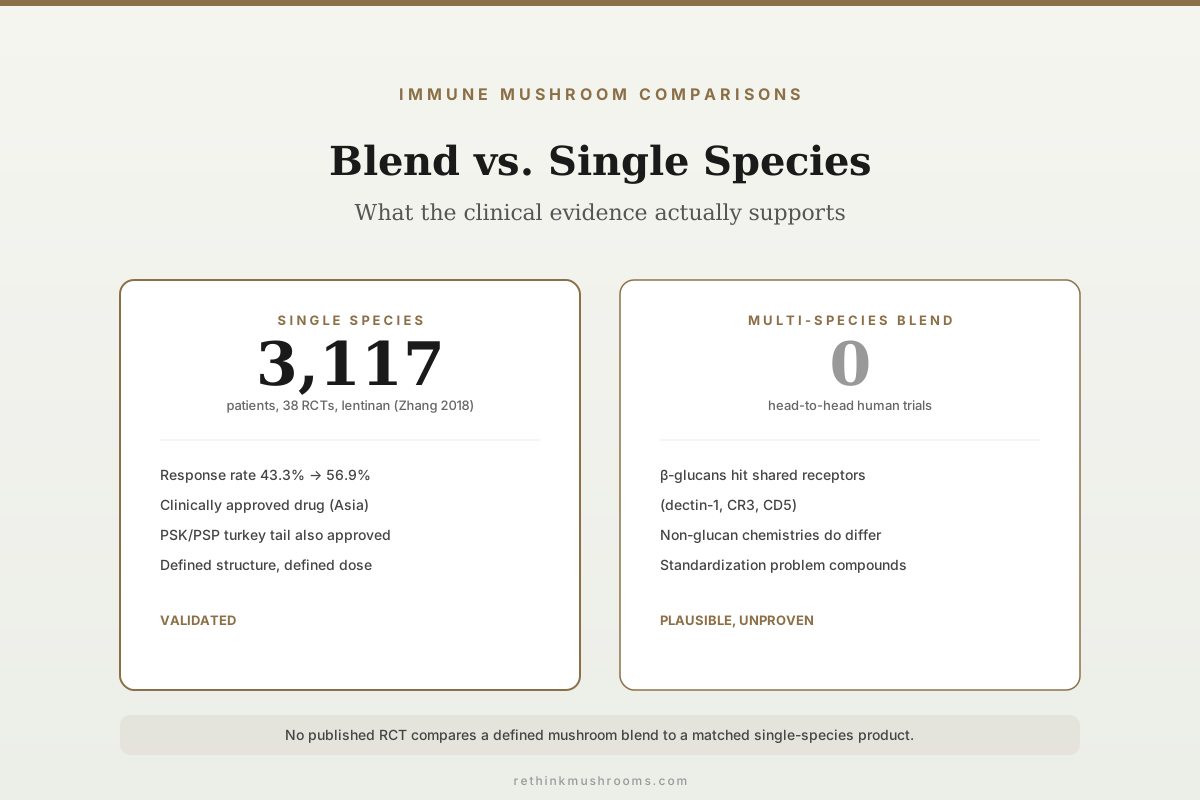
0 head-to-head human trials
Zero published randomized controlled trials compare mushroom blends to matched single-species products for any immune endpoint in human subjects. The strongest single-species clinical evidence (lentinan from shiitake) is 38 RCTs with 3,117 patients. The strongest blend clinical evidence is essentially nothing.
Zhang et al., Journal of Cancer Research and Clinical Oncology, 2018
Receptor Overlap
most mushroom β-glucans hit the same receptors (dectin-1, CR3)
Structural Variation
different species have different β-1,3/1,6 branching and chitin association
Blend Claims Outrun Data
marketing synergy claims exceed published evidence
Zhang et al., Journal of Cancer Research and Clinical Oncology, 2018
 View as image ↗
Combining immune mushrooms into a blend is the default product form for most consumer supplements. Reishi, turkey tail, chaga, lion's mane, cordyceps, maitake, and shiitake appear together in capsules, powders, and tinctures with the implicit claim that combining species produces a stronger or more complete immune effect than any single species alone. The biological premise is plausible. The clinical evidence base is almost entirely absent. This article examines the receptor biology, the structural chemistry, the single-species clinical data that does exist, and the specific gap where the blend-versus-single-species comparison has not been tested.
For the broader species-by-species picture, see the sibling articles ranking medicinal mushrooms by immune-stimulating potency, reishi vs. turkey tail vs. chaga for immunity: which has the best evidence?, turkey tail vs. reishi vs. chaga for immunity: head-to-head research, and which mushroom is best for immune support? a species comparison.
Key Takeaways
- Guggenheim et al. (2014) reviewed immune modulation from five major mushrooms (Agaricus blazei, Cordyceps sinensis, Grifola frondosa, Ganoderma lucidum, Trametes versicolor) in integrative oncology and concluded that each species has a distinct cytokine-modulation profile but overlapping receptor engagement (Global Advances in Health and Medicine)
- Motta et al. (2021) reviewed mushroom immune evidence in Journal of Autoimmunity and identified the lack of standardization across strains, growing conditions, extraction methods, and part of mushroom used as the primary variable confounding between-study comparisons
- Zhang et al. (2018), in a meta-analysis of 38 RCTs with 3,117 patients, showed lentinan (a single-species shiitake β-glucan) plus chemotherapy increased lung cancer response rate from 43.3% to 56.9% compared with chemotherapy alone (Journal of Cancer Research and Clinical Oncology)
- Jin et al. (2018) mapped the receptor biology of mushroom β-glucans to dectin-1, complement receptor 3 (CR3), CD5, and lactosylceramide, with most mushroom species engaging largely overlapping receptor sets (Vaccine)
- Liu et al. (2019) showed that polysaccharide fractions from Agaricus bisporus fruiting body, mycelium, and fermentation broth have different monosaccharide composition (mannose, glucose, galactose dominant, respectively) and different immunomodulatory profiles in mice, demonstrating that even within one species there is substantial structural variation
- Cerletti et al. (2021), reviewing mushroom β-glucans in Nutrients, noted that clinical human evidence remains limited and that structural differences between cereal and mushroom β-glucans drive their distinct immune activities; they did not identify any published trial of a mushroom blend versus single species
Why Blends Exist as the Default Product Form
The rationale most often given for mushroom blends is synergy: different species contain different bioactive compounds that, in combination, cover more immune pathways than any single species. The rationale is plausible at the level of marketing copy but harder to support at the level of molecular biology.
Jin et al. (2018), publishing in Vaccine, reviewed the receptor biology of β-glucans as immunoadjuvants and identified the major receptor set as dectin-1, complement receptor 3 (CR3), CD5, and lactosylceramide.[1] These receptors are engaged by β-1,3/1,6 glucans across mushroom species. A reishi β-glucan activates dectin-1. A turkey tail β-glucan activates dectin-1. A shiitake β-glucan activates dectin-1. The activation is not additive in a simple way because the receptor is shared. Adding a second species does not double the dectin-1 signal if the first species already saturates the receptor.
This is the central tension in blend marketing. The pattern recognition receptors that detect mushroom β-glucans are the same receptors that evolved to detect fungal infections. They are tuned to respond to "fungal" rather than to species-specific signatures. From the immune system's perspective, a reishi + turkey tail + chaga blend looks like "fungi" in the same way a pure reishi extract looks like "fungi." The receptor-level response is not structurally additive.
What can be genuinely additive is the non-β-glucan component: triterpenes in reishi, PSK/PSP in turkey tail, hericenones in lion's mane, cordycepin in cordyceps, polyphenol-melanin complex in chaga. These are distinct chemistries that act through different mechanisms and in principle could combine without overlap. Whether they do in practice has not been tested.
What the Five-Species Evidence Base Actually Shows
Guggenheim et al. (2014), in a review published in Global Advances in Health and Medicine, examined five major medicinal mushrooms (Agaricus blazei, Cordyceps sinensis, Grifola frondosa, Ganoderma lucidum, and Trametes versicolor) in the context of integrative oncology.[2] The review identified distinct cytokine-modulation profiles for each species, specific chemotherapy interactions, and different effects on chemotherapy-induced myelosuppression. Each mushroom produced a specific immunological signature, not a generic "stronger immune response."
This matters for the blend question because it suggests that species selection is meaningful when targeting specific immune endpoints. A cancer patient managing chemotherapy myelosuppression has a different need than a person trying to support general viral immunity. A reishi-cordyceps blend optimized for one endpoint is not automatically optimal for the other.
The review did not claim that blending produces better outcomes than single-species use. The preponderance of the cited clinical evidence was for single-species preparations: PSK (turkey tail), PSP (turkey tail), lentinan (shiitake), schizophyllan (suehirotake), and Agaricus blazei extracts. These are the clinically validated mushroom immune products, and each is validated as a single species.
The Strongest Single-Species Clinical Evidence
Zhang et al. (2018), publishing in the Journal of Cancer Research and Clinical Oncology, meta-analyzed 38 randomized controlled trials of lentinan (a β-1,3-glucan from Lentinula edodes, shiitake mushroom) plus chemotherapy for lung cancer, including 3,117 patients from trials published between 2004 and 2016.[3]
The pooled analysis showed:
- Chemotherapy alone: 43.3% overall response rate
- Chemotherapy + lentinan: 56.9% overall response rate
- Significant improvement in quality-of-life metrics
- Significant enhancement of chemotherapy efficacy
These are large clinical effects for a single-species immune intervention. Lentinan is a clinically approved drug in multiple Asian countries, administered as an injectable. The comparable evidence for any mushroom blend in any oncology or immune context does not exist.
The implication is not that blends are inferior. The implication is that the strongest validated mushroom immune intervention is a single, well-characterized compound from a single species. The conventional marketing argument that a blend is stronger than a single species is making an affirmative claim that has no supporting clinical evidence.
The Structural Variation Within a Single Species
Liu et al. (2019), publishing in the International Journal of Medicinal Mushrooms, demonstrated that the choice within a species matters as much as the choice between species.[4] Polysaccharides from Agaricus bisporus (white button mushroom) fruiting bodies, cultured mycelia, and fermentation broth were shown to have substantially different monosaccharide composition:
- Fruiting body polysaccharide (FPS): mainly mannose
- Mycelium polysaccharide (IPS): mainly glucose
- Broth polysaccharide (EPS): mainly galactose
Each fraction had a distinct immunomodulatory profile in normal mice (thymus/spleen index changes, cytokine profiles, T lymphocyte subset effects) and in cyclophosphamide-immunosuppressed mice. A "white button mushroom" extract is not a single pharmacologically defined thing; it depends on which part of the fungus and which cultivation stage was extracted.
This structural variation within a single species has two implications for the blend question. First, it means that a "reishi + turkey tail + chaga" blend contains potentially six or nine distinct polysaccharide structures depending on which fraction of each species was used. Second, it means that the same blend label can correspond to very different actual products depending on sourcing, extraction, and processing. Motta et al. (2021), in a review published in the Journal of Autoimmunity, identified exactly this standardization problem as the primary confound in the mushroom immunomodulation literature.[5]
What Motta (2021) Actually Concluded About Blends
Motta et al. (2021) reviewed the full mushroom immunity evidence base and was explicit about the gap: "the multitude of variables implicated in the final effect and an inadequate standardization are expected to affect the observed differences, thus making the available evidence insufficient to justify the treatment of human diseases with mushrooms extracts."[5] The review specifically called out strain variation, growing conditions, developmental stage, part of the mushroom used, extraction method, and storage conditions as unaddressed sources of variation.
The review did not identify any rigorous human trial of a defined multi-species mushroom blend. It identified the lentinan shiitake meta-analysis and a placebo-controlled trial of β-glucan from Pleurotus ostreatus in athletes as examples of the better-quality human evidence, both for single species.
A mushroom blend that cannot control for these sources of variation within each component species cannot produce an interpretable clinical effect. The statement "a blend is better than a single species" requires, at minimum, a trial where a defined blend and a defined single-species product are tested against the same immune endpoint in matched populations. No such trial has been published.
Where Blends Might Plausibly Add Value
The evidence does not support the strong claim that blends outperform single species, but it does not rule out specific cases where a rational combination might matter.
Non-β-glucan bioactives are additive in principle. Reishi triterpenes, lion's mane hericenones, cordyceps cordycepin, and chaga polyphenol-melanin each act through mechanisms distinct from β-glucan immune activation. Combining species whose distinct chemistries cover different pathways is structurally a stronger argument than combining species whose β-glucans all hit the same receptors.
Different immune endpoints may respond to different species. The Guggenheim review documented distinct cytokine-modulation profiles. If the goal is to support multiple immune functions (innate, adaptive, regulatory, antiviral, anti-inflammatory) simultaneously, species-level diversity has a plausible rationale even without clinical validation.
Combined PSK/PSP plus lentinan preparations exist. Within oncology supportive care, some Japanese and Chinese clinical protocols use defined combinations of specific purified mushroom polysaccharides. These are not the same as consumer "blend" products but they represent the closest thing to validated multi-compound mushroom immune formulations.
The consumer implication is that not all blends are equally poorly supported. A blend designed around complementary non-β-glucan chemistries (reishi triterpenes + cordyceps cordycepin + lion's mane hericenones for different targeted effects) has a more defensible rationale than a blend of seven species whose β-glucans all converge on the same receptors.
The Specific Evidence Gap
Cerletti et al. (2021), in a comprehensive review published in Nutrients, examined mushroom β-glucans and human health and did not identify a single published randomized controlled trial of a defined multi-species mushroom blend versus a single-species comparator.[6] The review characterized mushroom β-glucans as structurally distinct from cereal β-glucans (β-1,3 + β-1,6 branching vs linear β-1,3 + β-1,4), with distinct receptor recognition profiles, and concluded that clinical validation of the immunomodulatory activity in humans remains an unfinished research program even for single species.
The absent study design would be:
- Randomized controlled trial
- Arm 1: Defined single species at defined dose and extraction method
- Arm 2: Defined blend at matched total polysaccharide dose
- Arm 3: Placebo
- Primary endpoint: A measurable immune function parameter (NK cell activity, cytokine response to vaccine, infection incidence)
- Secondary endpoints: Safety, tolerability, mechanistic biomarkers
This study has not been done. Until it is, the claim that a blend outperforms a comparable single-species preparation is unsupported by published evidence.
For cross-cluster context on the related structural chemistry, see chitin in mushrooms: is it a benefit or a barrier?. For the single-species immune evidence in detail, see ranking medicinal mushrooms by immune-stimulating potency.
The Bottom Line
No published human trial has compared a defined mushroom blend to a matched single-species product for any immune endpoint. The strongest clinical mushroom immune evidence (38 RCTs, 3,117 patients) is for a single compound from a single species. Receptor biology predicts that blend β-glucans largely hit the same pattern recognition receptors, while non-β-glucan chemistries are the more defensible rationale for combining species. The honest claim: blends are plausibly useful, unproven to outperform single species, and product quality varies enormously with sourcing.
Frequently Asked Questions
Sources & References
- 1RTHM-00513·Jin, Yiming et al. (2018). “β-glucans as potential immunoadjuvants: A review on the adjuvanticity, structure-activity relationship and receptor recognition properties..” Vaccine.Study breakdown →PubMed →↩
- 2RTHM-00323·Guggenheim, Alena G et al. (2014). “Immune Modulation From Five Major Mushrooms: Application to Integrative Oncology..” Integrative medicine (Encinitas.Study breakdown →PubMed →↩
- 3RTHM-00538·Zhang, Yiran et al. (2018). “Lentinan as an immunotherapeutic for treating lung cancer: a review of 12 years clinical studies in China..” Journal of cancer research and clinical oncology.Study breakdown →PubMed →↩
- 4RTHM-00576·Liu, Yang et al. (2019). “Immunomodulatory Activities of Polysaccharides from White Button Mushroom, Agaricus bisporus (Agaricomycetes), Fruiting Bodies and Cultured Mycelia in Healthy and Immunosuppressed Mice..” International journal of medicinal mushrooms.Study breakdown →PubMed →↩
- 5RTHM-00709·Motta, Francesca et al. (2021). “Mushrooms and immunity..” Journal of autoimmunity.Study breakdown →PubMed →↩
- 6RTHM-00676·Cerletti, Chiara et al. (2021). “Edible Mushrooms and Beta-Glucans: Impact on Human Health..” Nutrients.Study breakdown →PubMed →↩