Mushrooms & Immune Health
40+ years
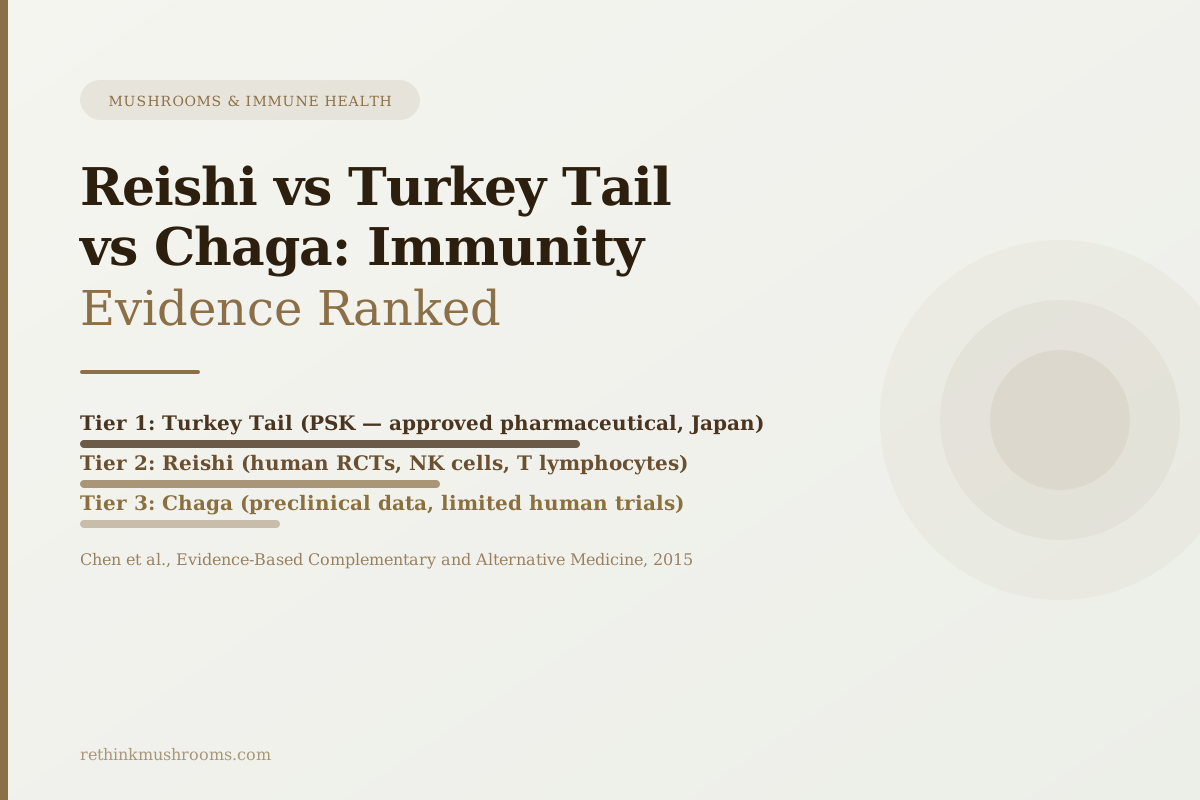
Turkey tail's PSK (polysaccharide-K) has been a licensed cancer immunotherapy in Japan for more than 40 years, making it the most evidence-rich mushroom compound for immunity by a considerable margin. Here's how reishi and chaga compare.
Chen et al., Evidence-Based Complementary and Alternative Medicine, 2015
PSK
Turkey tail compound licensed as cancer immunotherapy in Japan since the 1970s
NK cells
primary immune target of reishi beta-glucans confirmed in human RCTs
0
published human RCTs testing chaga specifically for immune outcomes
Chen et al., Evidence-Based Complementary and Alternative Medicine, 2015
 View as image ↗
The question "which mushroom is best for immunity" has a clear answer when it comes to clinical evidence: turkey tail, and it isn't particularly close. The active compound in turkey tail, polysaccharide-K (PSK), has been a licensed pharmaceutical cancer immunotherapy in Japan since the 1970s. No other mushroom compound has that regulatory history.
But evidence quality is not the only relevant question. Reishi has multiple human randomized controlled trials for immune outcomes in healthy adults, which turkey tail's clinical data does not. And chaga, despite having the weakest clinical evidence of the three, works through a different immune mechanism than either turkey tail or reishi.
This article focuses on evidence quality: how many human trials, how well controlled, and whether any compound has reached regulatory approval. For a mechanistic comparison (which species targets which part of the immune system), see Turkey Tail vs. Reishi vs. Chaga for Immunity: Head-to-Head Research. For the full beta-glucan immune science overview, see Mushroom Beta-Glucans and Immunity: The Complete Research Guide.
Key Takeaways
- Turkey tail's PSK (polysaccharide-K) has been licensed as a supportive cancer immunotherapy in Japan since the 1970s and has the most extensive human clinical evidence of any single mushroom compound, spanning 40+ years of trials and systematic reviews.
- A 2015 systematic review by Chen and colleagues found consistent evidence that PSK improved survival and immune function when added to conventional chemotherapy in lung cancer patients.
- Reishi holds the second-best evidence tier: human RCTs in healthy adults and cancer populations have shown improvements in NK cell cytotoxicity, T-lymphocyte populations, and immunoglobulin A levels.
- Chaga has the weakest clinical evidence of the three: as of 2021, Burmasova and colleagues' review found rich preclinical data but very limited human trial evidence, with the most recent immunological data coming from in vitro cell culture studies.
- Each species targets a different immune compartment. Turkey tail primarily activates macrophages and T cells. Reishi primarily modulates NK cells and dendritic cells. Chaga primarily suppresses inflammation via NF-κB rather than stimulating immune cell proliferation.
- "Best evidence" and "best for your goal" are different questions. For cancer immune support with the strongest evidence, turkey tail. For NK cell enhancement in a healthy adult, reishi. For antioxidant-mediated immune protection, chaga.
Why Evidence Quality, Not "Potency," Is the Right Framework
Mushroom immune supplement content typically presents these three species as roughly equivalent options with different flavor profiles. The evidence does not support that framing.
Clinical evidence exists on a hierarchy. At the top: compounds that have passed through formal regulatory review and been licensed as pharmaceuticals. Below that: compounds with multiple independent human randomized controlled trials showing consistent results. Below that: compounds with human observational data or small trials. Below that: animal studies. At the bottom: in vitro cell culture data alone.
When you apply that hierarchy to reishi, turkey tail, and chaga, a clear ranking emerges. Turkey tail's PSK sits at the top because it is not a supplement: it is a licensed pharmaceutical in Japan. Reishi sits comfortably in the human RCT tier. Chaga is predominantly in the animal and in vitro tiers, with a folk medicine tradition that the clinical literature has not yet validated.
This doesn't mean chaga has no value or that all three mushrooms work through the same immune pathway. But when asking which has the best evidence for immune support, the answer is turkey tail, and the distance between turkey tail and chaga on the evidence hierarchy is substantial.
Turkey Tail: The Only Mushroom Compound That Is an Approved Pharmaceutical
Turkey tail (Trametes versicolor, also called Coriolus versicolor) produces two active immune compounds: PSK (polysaccharide-K) and PSP (polysaccharide peptide). PSK was licensed as a cancer immunotherapy adjuvant in Japan in the early 1970s. It has been prescribed alongside conventional chemotherapy for gastric, colorectal, and lung cancer in Japan for over four decades.
A 2015 systematic review by Chen and colleagues in Evidence-Based Complementary and Alternative Medicine synthesized the PSK evidence for lung cancer specifically.[1] The review found consistent evidence that adding PSK to standard chemotherapy improved survival outcomes and immune function markers across multiple trials. This is the most rigorous systematic synthesis of turkey tail cancer immune data available.
A 2020 comprehensive review by Yang and colleagues in Molecules surveyed 40+ years of Turkey Tail polysaccharide research across cancer types.[2] The breadth of clinical evidence documented in this review is unmatched by any other mushroom species.
In the US, Standish and colleagues published a human immune trial in 2008 in the Journal of the Society for Integrative Oncology, testing turkey tail in breast cancer patients and demonstrating improved immune function parameters.[3] This was followed by a Phase 1 safety and immune response trial by Deng and colleagues, published in ISRN Oncology in 2012, in breast cancer survivors.[4] The Deng trial documented dose-dependent effects on NK cells, CD8+ cytotoxic T cells, and CD19+ B cells, providing the most specific immune cell data for turkey tail in a human clinical trial.
The primary mechanism turkey tail operates through is macrophage and T cell activation: PSK engages toll-like receptors on macrophages (the immune system's first-responder patrol cells), triggering innate immune responses and subsequently activating T cell-mediated adaptive immunity. This is a different target from reishi's primary mechanism.
Reishi: Multiple Human RCTs for NK Cells and T Lymphocytes
Reishi (Ganoderma lucidum) occupies the second evidence tier: it does not have an approved pharmaceutical compound, but it does have multiple human randomized controlled trials specifically measuring immune outcomes.
The strongest single human immune RCT for reishi is Gao and colleagues' 2018 study in Food Science and Nutrition, testing a reishi beta-glucan-enriched yogurt in healthy adults over a defined supplementation period.[5] The results showed significant improvements in multiple immune markers: CD3+, CD4+, and CD8+ T-lymphocyte counts, improved CD4/CD8 ratios, enhanced NK cell cytotoxicity, and elevated immunoglobulin A (IgA, the primary mucosal antibody). This is the most comprehensive set of human immune markers measured in a single reishi RCT.
A more recent clinical evaluation of Ganoderma beta-1,3;1,6 D-glucan immune modulation by Chen and colleagues, published in Frontiers in Immunology in 2023, extended and confirmed the human immune modulation data for reishi's specific glucan fractions.[6] This is the most recent human clinical evidence for reishi's immune effects.
The immune compartment reishi primarily targets is NK cells (natural killer cells, the immune system's surveillance cells for infected and cancerous cells) and dendritic cells (which bridge innate and adaptive immunity by presenting antigens to T cells). This is a different and complementary target from turkey tail's macrophage-and-T-cell focus.
The key distinction from turkey tail: reishi's human clinical data is in healthy adults and mixed cancer populations, not in formal drug-licensed trials with regulatory oversight. The evidence is real and meaningful but sits in a different category from approved pharmaceutical evidence.
Chaga: Strong Preclinical Data, Limited Human Evidence
Chaga (Inonotus obliquus) has the weakest clinical evidence of the three, and the honest consumer article states this directly.
A 2021 review by Burmasova and colleagues in Plants, specifically tracing chaga from folk medicine to clinical use, found an extensive preclinical evidence base (animal studies, cell culture data, ethnobotanical records) but very limited human clinical trial evidence for immune outcomes specifically.[7] The review is the most recent comprehensive assessment of where chaga's clinical evidence stands, and it confirms the gap between the traditional use history and the controlled trial database.
The most recent mechanistic data for chaga comes from Oliinyk and colleagues' 2022 in vitro study in Molecules, which tested chaga extracts on resting macrophage polarization in cell culture.[8] This is meaningful mechanistic evidence that chaga can modulate macrophage polarization, but it is cell culture data, not human data.
Chaga's primary immune mechanism differs from both turkey tail and reishi. Rather than activating immune cells to proliferate, chaga primarily suppresses NF-κB, the cell's inflammatory alarm signal. This anti-inflammatory effect has immune relevance: chronic low-grade inflammation impairs immune function, and compounds that reduce baseline inflammatory load can support immunological homeostasis. But this is a different mechanism from PSK's macrophage activation or reishi's NK cell enhancement. Calling chaga an "immune booster" in the same sense as turkey tail conflates different mechanisms.
This is not a dismissal of chaga. It is an honest placement on the evidence hierarchy: preclinical data and traditional use, with the human clinical evidence not yet available to confirm or refute the mechanistic findings.
The Evidence Scorecard: Reishi, Turkey Tail, and Chaga Compared
When the evidence for each species is placed on the hierarchy, the ranking is clear:
Turkey Tail (Tier 1: Approved pharmaceutical evidence) The only mushroom compound licensed as a pharmaceutical. PSK has been approved in Japan for 40+ years. Multiple systematic reviews and 40+ years of clinical trials. Primary mechanism: macrophage and T cell activation via toll-like receptor engagement. Best supported use: cancer immune support alongside conventional therapy.
Reishi (Tier 2: Human RCT evidence) Multiple independent human RCTs showing immune marker improvements in healthy adults and clinical populations. No pharmaceutical approval but consistent controlled trial data. Primary mechanism: NK cell activation and dendritic cell modulation via beta-glucan and triterpenoid compounds. Best supported use: general immunomodulation, NK cell enhancement.
Chaga (Tier 3: Preclinical evidence, limited human data) Rich traditional use history and extensive animal and cell culture data. Very limited human RCT evidence for immune outcomes specifically. Primary mechanism: anti-inflammatory via NF-κB suppression, antioxidant-mediated immune protection. Best supported use: antioxidant-driven immune protection in principle, but human confirmation needed.
The practical implication: if you are looking for the mushroom with the most extensive human evidence, turkey tail is the clear answer. If you want an extensively studied immunomodulator with human RCT confirmation in healthy adults, reishi is the answer. If you are interested in chaga's antioxidant-immune profile, understand that the human evidence base is thin compared to the other two.
For a look at how combining these species might interact, see Best Mushroom Combinations for Immune Support: Synergy Research. For reishi's broader adaptogenic and stress effects, see Reishi for Stress: The Calming Mushroom Research Review. For the evidence ranking of additional species, see Ranking Medicinal Mushrooms by Immune-Stimulating Potency and Which Mushroom Is Best for Immune Support? A Species Comparison.
The Bottom Line
Turkey tail's PSK has the strongest evidence of any mushroom compound for immune support, having been a licensed cancer immunotherapy in Japan since the 1970s with 40+ years of clinical data and systematic reviews. Reishi occupies the second evidence tier with multiple human RCTs showing NK cell, T-lymphocyte, and IgA improvements in healthy adults and cancer populations. Chaga has the weakest clinical evidence of the three: the 2021 Burmasova review found rich preclinical data but very limited human trial evidence, with the most recent immunological data coming from cell culture studies. Each species targets a different immune compartment, making direct "best" comparisons goal-dependent.
Frequently Asked Questions
Sources & References
- 1. Source details for this reference are not yet available.
- 2. Source details for this reference are not yet available.
- 3. Source details for this reference are not yet available.
- 4. Source details for this reference are not yet available.
- 5. Source details for this reference are not yet available.
- 6. Source details for this reference are not yet available.
- 7. Source details for this reference are not yet available.
- 8. Source details for this reference are not yet available.