Adaptogenic Mushrooms
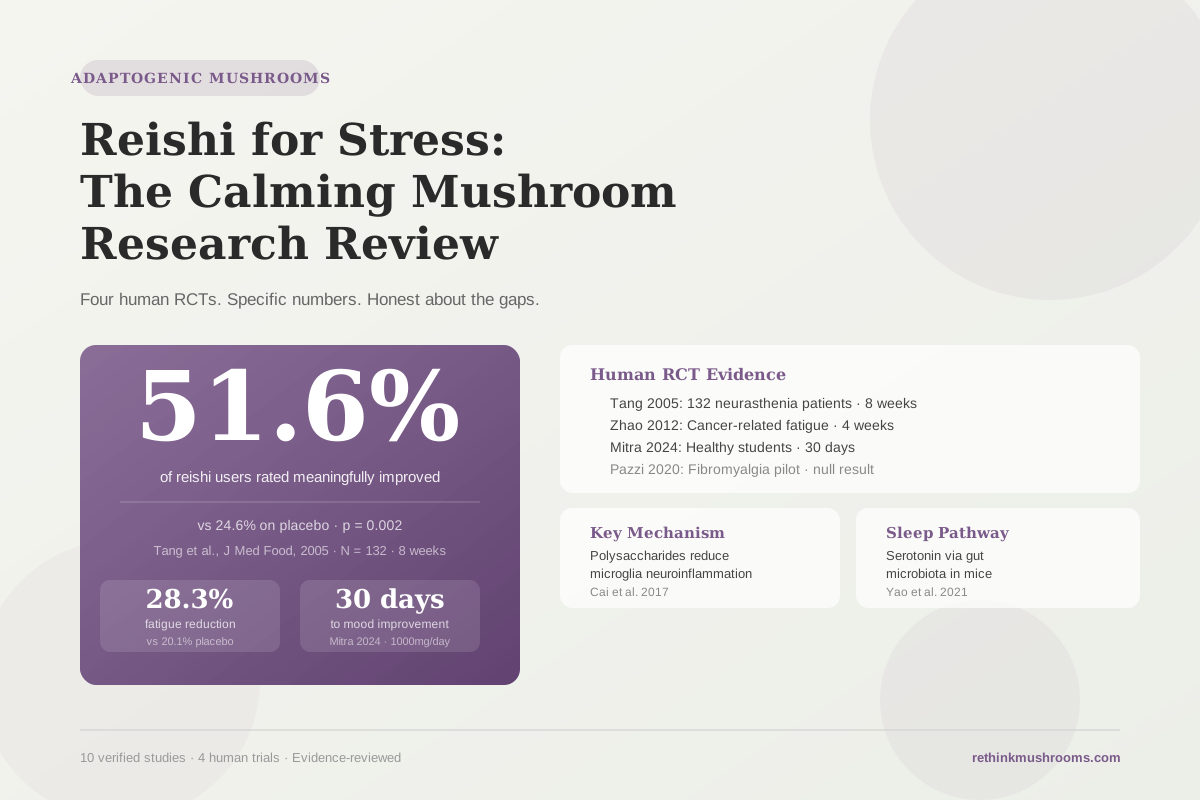
51.6%
In an 8-week RCT of 132 patients with neurasthenia, 51.6% of those taking reishi polysaccharide extract rated as meaningfully improved, compared to 24.6% on placebo.
Tang et al., Journal of Medicinal Food, 2005
28.3%
reduction in fatigue scores in 8 weeks (vs 20.1% placebo)
30 days
to significant mood improvement at 1000mg/day in students (Mitra 2024)
4 RCTs
human clinical trials have tested reishi for stress or fatigue
Tang et al., Journal of Medicinal Food, 2005
 View as image ↗
In an 8-week clinical trial of 132 patients with stress-related exhaustion, those who took a reishi polysaccharide extract scored 28.3% lower on fatigue measures at study's end, compared to a 20.1% reduction in the placebo group.[1] That gap is narrower than supplement marketing suggests, but it is real, statistically significant, and observed in a properly randomized trial. Reishi for stress is one of the better-documented claims in the adaptogenic mushroom category, which is exactly why the specific numbers matter.
The research spans four human clinical trials, multiple animal behavioral studies, and a growing body of mechanistic work on neuroinflammation and neurotransmitter pathways. The broader picture of how adaptogenic mushrooms affect stress physiology provides the wider context for what follows; this article focuses specifically on reishi, what controlled trials show it does and does not accomplish, and where the evidence currently stops.
Key Takeaways
- In an 8-week RCT (Tang et al., 2005), 51.6% of 132 neurasthenia patients showed meaningful clinical improvement on reishi polysaccharide extract vs 24.6% on placebo (p = 0.002)
- Fatigue scores fell 28.3% with reishi vs 20.1% with placebo; well-being scores rose 38.7% vs 29.7% in the same trial (Tang et al., 2005)
- GL1000mg supplementation for 30 days significantly improved anxiety, depression, vitality, and positive well-being scores in 78 healthy female students (Mitra et al., 2024)
- G. lucidum methanol extract at 200 mg/kg showed anxiolytic activity in mice comparable to diazepam at 2 mg/kg; aqueous extracts did not replicate this in the same test (Singh et al., 2016; Socala et al., 2015)
- Reishi polysaccharides suppress microglia-mediated neuroinflammation and promote sleep via a serotonin-linked gut microbiota pathway in animal models (Cai et al., 2017; Yao et al., 2021)
- The Pazzi et al. (2020) pilot RCT found no statistically significant between-group differences in mood or quality of life in fibromyalgia patients after 6 weeks of reishi supplementation
The Evidence Landscape: What the Research Base Looks Like
Before examining individual studies, it helps to map the shape of the evidence. The reishi-stress literature consists primarily of: one well-powered RCT in patients with neurasthenia, a clinical syndrome of persistent fatigue and mental strain; two smaller human trials in specific populations (cancer patients, healthy students); one underpowered pilot RCT with null results; and a set of animal behavioral studies showing anxiolytic and antidepressant-like effects with varying consistency depending on extraction method.
This is a more substantive base than exists for most adaptogenic herbs or fungi.[8] It is not, however, sufficient to draw firm conclusions about mechanisms in humans, optimal dosing, or which preparation types produce reliably replicable effects. The gap between "preclinical support exists" and "clinically validated" is wider than promotional language typically acknowledges.
What the data does support: a polysaccharide-based extract of G. lucidum, taken daily for 4 to 8 weeks, produces measurable improvements in fatigue and mood-related endpoints in populations experiencing psychological or physiological stress. Whether this occurs through direct neurochemical pathways or through downstream effects on immune function, sleep quality, and energy metabolism is an open question the current trial record does not resolve.
Three Mechanisms That May Explain Reishi's Calming Effects
Ganoderic Acids and the GABA Pathway
Reishi triterpenes, particularly the ganoderic acids, are structurally similar to steroid hormones and have been studied as candidate modulators of gamma-aminobutyric acid (GABA) receptors. GABA is the primary inhibitory neurotransmitter in the mammalian central nervous system; drugs that enhance GABAergic signaling produce sedative and anxiolytic effects.
Singh et al. (2016) provided direct behavioral evidence for anxiolytic activity in mice, testing methanol extracts from four wild-collected Ganoderma species using the elevated plus maze (EPM), a standard anxiolytic screening assay.[4] The methanol extract of G. lucidum at 200 mg/kg significantly increased time spent in the open arms of the maze compared to control, with an effect described as "comparable to diazepam at 2 mg/kg by mouth." Bioactivity-guided fractionation traced the effect to the n-butanol fraction, active at 100 mg/kg, containing phenols and flavonoids.
A critical complication: Socala et al. (2015) tested an aqueous extract of G. lucidum mycelium in the same EPM assay and found no anxiolytic activity at 400 to 600 mg/kg.[3] Socala did find antidepressant-like effects in the forced swim test (reduced immobility at 100 to 400 mg/kg), but anxiolytic activity did not replicate using water-based extraction. This inconsistency has practical implications: most commercial reishi supplements use hot water or dual extraction, not methanol, meaning the specific phenol and flavonoid fraction Singh isolated may not be present in typical products at comparable concentrations.
Beta-Glucan Polysaccharides and Neuroinflammation
Reishi's polysaccharides, particularly the beta-1,3-glucans, have neuroprotective properties beyond their established immunomodulatory effects. Cai et al. (2017) demonstrated in BV2 microglia and primary mouse microglia that Ganoderma lucidum polysaccharides (GLP) down-regulate LPS-induced and amyloid-beta-induced pro-inflammatory cytokine expression while promoting anti-inflammatory cytokine production.[5] GLP also attenuated inflammation-related microglial migration and phagocytosis, with confirmatory results in zebrafish brain tissue.
The neuroinflammation connection to stress is relevant because sustained psychological stress activates microglia and elevates central inflammatory signaling, a pathway implicated in anxiety and depressive symptoms. A mushroom extract that reduces microglial inflammatory activation could theoretically attenuate stress-related neuroinflammation, though no human trial has directly tested this mechanism. For a detailed look at how mushrooms regulate the HPA axis and cortisol, the connection between immune pathways and neuroendocrine stress response involves additional complexity beyond what polysaccharide research has resolved for reishi specifically.
Serotonin, Sleep, and the Gut Microbiota
Yao et al. (2021) published a mechanism study in Scientific Reports showing that the acidic fraction of the alcohol extract of G. lucidum mycelia (GLAA) promoted sleep in mice through a gut microbiota-dependent, serotonin-linked pathway.[9] Mice receiving 25 to 100 mg/kg GLAA for 28 days showed shortened sleep latency and prolonged sleeping time. Hypothalamic 5-hydroxytryptamine (serotonin) concentrations increased, alongside elevated Tph2 gene expression in the serotonergic signaling pathway. The sleep-promoting effect and altered gut metabolites disappeared after antibiotic-mediated microbiota depletion, confirming gut dependency.
Specific gut bacteria enriched by GLAA, including Bifidobacterium and Bifidobacterium animalis, and their metabolites, including indole-3-carboxylic acid, correlated negatively with sleep latency and positively with sleeping time. Since sleep disruption both reflects and amplifies stress responses, this pathway could partly explain the fatigue and well-being improvements seen in human trials.
Shevelev et al. (2018) added a neurochemical angle in hypertensive rats: seven weeks of intragastric reishi water extract reduced blood pressure to levels comparable to the antihypertensive drug losartan and significantly increased cerebral blood flow, shifting the balance of inhibitory and excitatory neurotransmitters toward excitation in the cerebral cortex.[6] The authors described this as a potential nootropic effect, though the stress model here is cardiovascular rather than psychological, limiting direct relevance.
Human Clinical Trials: The Strongest Evidence
The Neurasthenia Trial
The most rigorous human evidence remains Tang et al. (2005), a randomized, double-blind, placebo-controlled parallel trial enrolling 132 patients diagnosed with neurasthenia according to ICD-10 criteria.[1] Neurasthenia, rarely diagnosed in Western clinical practice today, describes a syndrome of persistent mental fatigue, difficulty concentrating, and reduced capacity for mental effort following stress, closely aligned with what is now often called burnout or stress-related exhaustion disorder.
Participants received Ganopoly (a polysaccharide extract of G. lucidum) at 1,800 mg three times daily, totaling 5,400 mg/day, or matched placebo for 8 weeks. Efficacy was assessed using the Clinical Global Impression (CGI) severity scale and visual analogue scales for fatigue and well-being. Results at 8 weeks:
- CGI severity score: 15.5% reduction with Ganopoly vs 4.9% with placebo
- Fatigue visual analogue scale: 28.3% reduction vs 20.1% placebo
- Well-being visual analogue scale: 38.7% improvement vs 29.7% placebo
- 51.6% (32 of 62) of Ganopoly patients rated "more than minimally improved" vs 24.6% (15 of 61) of placebo patients (chi-square p = 0.002)
- No significant adverse events reported in either group
Three limitations deserve attention. The Ganopoly extract was provided by a manufacturer with a commercial interest in the outcome. The patient population (neurasthenia) represents a specific form of stress-related exhaustion that does not map directly onto general stress, generalized anxiety disorder, or major depression. The placebo response was substantial: both groups improved meaningfully, and the between-group differences, while statistically significant, were moderate in absolute magnitude. A 28.3% fatigue reduction versus 20.1% is clinically meaningful for a chronically fatigued population, but it is not a transformation.
Cancer-Related Fatigue and Mood
Zhao et al. (2012) ran a pilot randomized trial in 48 breast cancer patients experiencing cancer-related fatigue during endocrine therapy.[2] The active group received Ganoderma lucidum spore powder for 4 weeks. The experimental group showed statistically significant improvements on the physical well-being and fatigue subscales of the FACT-F questionnaire, alongside reduced anxiety and depression on the HADS and improved quality of life on the EORTC QLQ-C30. Immune markers of cancer-related fatigue, specifically TNF-alpha and IL-6, were significantly reduced in the reishi group, and no serious adverse effects occurred.
This study is informative for the mechanistic picture, particularly the immune marker reductions, but has obvious limitations for a general stress audience: cancer patients receiving endocrine therapy have different neuroendocrine physiology than otherwise healthy stressed adults. The 4-week duration is short, and 48 patients is insufficient for subgroup analysis. The study is best interpreted as mechanistic support rather than direct efficacy evidence for stress in healthy populations.
Psychological Stress in Healthy Adults
Mitra et al. (2024) studied 78 sedentary but otherwise healthy female college students divided equally among three groups: 500 mg/day G. lucidum, 1,000 mg/day G. lucidum, or placebo over 30 days.[10] Anxiety, depression, vitality, and positive well-being scores significantly improved in the GL1000mg group compared to placebo at day 30 (p < 0.05). The 500 mg group showed less consistent effects. Physiological fitness markers including heart rate, VO2max, and physical work capacity also improved significantly in the high-dose group.
Key caveats: the study enrolled only young women (mean age 20.64 years) in a single geographic setting (West Bengal, India). Thirty days is a short treatment window. The mechanism connecting G. lucidum supplementation to simultaneously improved aerobic capacity and reduced anxiety scores is not explained by the study design and likely involves overlapping pathways through immune, endocrine, and metabolic systems. Whether the findings extend to older adults, men, or populations with clinically assessed anxiety has not been tested.
Fibromyalgia and Mood: A Null Result
Pazzi et al. (2020) ran a double-blind, randomized placebo pilot trial in women with fibromyalgia, giving one group 6 g/day of micro-milled G. lucidum carpophores (whole fruiting body powder) for 6 weeks.[7] The study found no statistically significant between-group differences on any primary outcome: happiness, depression, satisfaction with life, or health-related quality of life. The authors noted a trend toward improvement in the reishi group but explicitly described the study as underpowered.
This result does not cancel the positive trials. Fibromyalgia patients may respond differently than neurasthenia patients or healthy students, and whole-powder preparations differ from polysaccharide-concentrated extracts. But it is a genuine null result that belongs in any complete account of reishi and mood.
Animal Studies: Anxiolytic Signals, Extraction-Dependent
The adaptogenic effects of reishi and cordyceps on the stress response extend into animal behavioral models, which provide mechanism hypotheses but cannot predict human dose-response relationships with reliability.
Socala et al. (2015) tested aqueous extracts across five behavioral models in mice.[3] Results: significant anticonvulsant activity in the 6-Hz psychomotor seizure test at 100 to 400 mg/kg; significant reduction in immobility in the forced swim test (antidepressant-like signal) at the same doses; no anxiolytic effects in the elevated plus maze; no toxic effects on motor coordination across 50 to 2,400 mg/kg. The antidepressant signal without corresponding anxiolytic activity is consistent with serotonergic rather than GABAergic activity.
Singh et al. (2016) found anxiolytic activity with a methanol extract but not after aqueous extraction.[4] The active phenol and flavonoid fraction is not water-soluble, which means hot-water-extracted reishi supplements likely do not deliver this fraction in meaningful concentrations. Dual-extraction products using both water and alcohol solvents might retain more of this fraction, though no human trial has tested this difference directly.
What the Research Does Not Establish
Several claims circulated widely in the adaptogen supplement market exceed what the current evidence supports for reishi specifically.
Cortisol reduction: No human trial included in this review directly measured serum cortisol as a primary outcome in a reishi-only intervention. Cortisol reductions sometimes attributed to reishi in industry communications typically originate from multi-mushroom blend studies. A 2026 RCT published in Brain and Behavior testing a five-mushroom combination (reishi, lion's mane, cordyceps, shiitake, and maitake) reported serum cortisol reduced by 4.4% at 6 weeks and 5.5% at 12 weeks, with ACTH reduced by 10.5% at 6 weeks, but the combination design makes isolating reishi's individual contribution impossible.
HPA axis modulation: Reishi is frequently described as an HPA axis regulator. No controlled human trial has measured ACTH or CRH responses to reishi supplementation alone. Animal data suggests pathways through which this could occur, but translating this to a human dose-response relationship requires research not yet published.
Dose standardization: The Tang 2005 trial used 5,400 mg/day of a standardized polysaccharide extract; the Mitra 2024 trial found effects at 1,000 mg/day of a different preparation; the Pazzi 2020 trial used 6,000 mg/day of whole fruiting body powder with null results. The extract type, standardization method, and dose all influence outcomes, and no comparative trial has resolved optimal parameters.
For the complete long-term safety evidence accompanying any sustained reishi regimen, the existing case reports of hepatotoxicity and the safety trial data are reviewed in Can You Take Reishi Long-Term? Safety Research.
Reishi Within the Broader Adaptogen Category
Reishi is not the only mushroom with stress-relevant evidence, but it is one of the few with human trial data specifically targeting fatigue and psychological well-being. A full comparison across species is covered in Best Mushrooms for Stress Relief: A Species Guide.
What distinguishes reishi is its high triterpene content relative to most edible fungi, and the fact that its anti-stress evidence dates to a well-powered 2005 RCT that has had time to be independently tested across subsequent populations. The consistency of the fatigue-and-mood improvement signal across trials in neurasthenic patients (Tang 2005), cancer patients (Zhao 2012), and healthy students (Mitra 2024) suggests the effect is not entirely population-specific.
What limits reishi relative to other adaptogens is the reliance on specialized polysaccharide extracts that may not reflect typical consumer products, and the absence of direct cortisol or hormonal measurement from human trials. Ashwagandha, for comparison, has multiple dose-response trials with cortisol as a primary endpoint, giving it more direct neuroendocrine data than reishi currently has.
The Bottom Line
Four human clinical trials have tested reishi for stress-related endpoints. The most robust, Tang et al. (2005), found statistically significant improvements in fatigue and well-being in 132 neurasthenia patients using a high-dose polysaccharide extract over 8 weeks. Two subsequent trials in cancer patients (Zhao 2012) and healthy students (Mitra 2024) found compatible positive results; a pilot fibromyalgia trial found no significant effects. Animal studies show anxiolytic activity that is extraction-method dependent, and mechanistic research points to neuroinflammation suppression and serotonin-linked sleep pathways as plausible explanations. The major unresolved questions are extract standardization, the absence of cortisol or HPA axis measurements from human trials, and the gap between the specialized research extracts and commercially available supplement formulations.
Frequently Asked Questions
Sources & References
- 1RTHM-00088·Tang, Wenbo et al. (2005). “A randomized, double-blind and placebo-controlled study of a Ganoderma lucidum polysaccharide extract in neurasthenia..” Journal of medicinal food.Study breakdown →PubMed →↩
- 2RTHM-00276·Zhao, Hong et al. (2012). “Spore Powder of Ganoderma lucidum Improves Cancer-Related Fatigue in Breast Cancer Patients Undergoing Endocrine Therapy: A Pilot Clinical Trial..” Evidence-based complementary and alternative medicine : eCAM.Study breakdown →PubMed →↩
- 3RTHM-00400·Socala, Katarzyna et al. (2015). “Evaluation of Anticonvulsant, Antidepressant-, and Anxiolytic-like Effects of an Aqueous Extract from Cultured Mycelia of the Lingzhi or Reishi Medicinal Mushroom Ganoderma lucidum (Higher Basidiomycetes) in Mice..” International journal of medicinal mushrooms.Study breakdown →PubMed →↩
- 4RTHM-00826·Singh, Ranjeet et al. (2016). “Evaluation of Antianxiety Potential of Four Ganoderma (Agaricomycetes) Species from India in Mice..” International journal of medicinal mushrooms.Study breakdown →PubMed →↩
- 5RTHM-00462·Cai, Qing et al. (2017). “Polysaccharides from Ganoderma lucidum attenuate microglia-mediated neuroinflammation and modulate microglial phagocytosis and behavioural response..” Journal of neuroinflammation.Study breakdown →PubMed →↩
- 6RTHM-00530·Shevelev, Oleg B et al. (2018). “Hypotensive and neurometabolic effects of intragastric Reishi (Ganoderma lucidum) administration in hypertensive ISIAH rat strain..” Phytomedicine : international journal of phytotherapy and phytopharmacology.Study breakdown →PubMed →↩
- 7RTHM-00648·Pazzi, Francesco et al. (2020). “Ganoderma lucidum Effects on Mood and Health-Related Quality of Life in Women with Fibromyalgia..” Healthcare (Basel.Study breakdown →PubMed →↩
- 8RTHM-01321·Ahmad, Rizwan et al. (2021). “Ganoderma lucidum (Reishi) an edible mushroom; a comprehensive and critical review of its nutritional, cosmeceutical, mycochemical, pharmacological, clinical, and toxicological properties..” Phytotherapy research : PTR.Study breakdown →PubMed →↩
- 9RTHM-00731·Yao, Chunyan et al. (2021). “Ganoderma lucidum promotes sleep through a gut microbiota-dependent and serotonin-involved pathway in mice..” Scientific reports.Study breakdown →PubMed →↩
- 10RTHM-00895·Mitra, Sudeep et al. (2024). “Efficacy of Lingzhi or Reishi Medicinal Mushroom Ganoderma lucidum (Agaricomycetes) Supplementation on Psychological Stress and Selective Fitness Profile Parameters in Female College Students in West Bengal, India..” International journal of medicinal mushrooms.Study breakdown →PubMed →↩