Mushrooms and Stress
Cortisol reduced
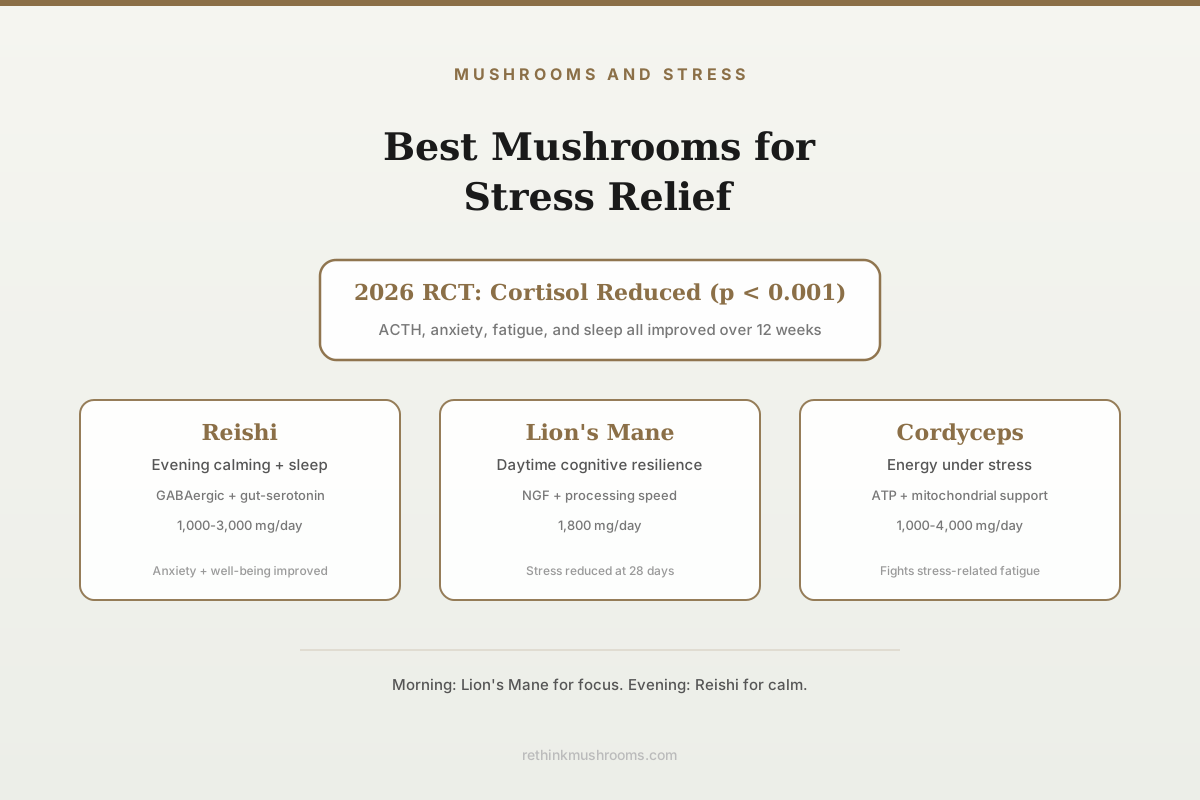
A 2026 double-blind RCT found that 12 weeks of mushroom blend supplementation reduced serum cortisol and ACTH levels, improved sleep quality (PSQI), and decreased anxiety scores compared to placebo.
Hisamuddin et al., Brain and Behavior, 2026
50
participants in the mushroom blend RCT
12 weeks
supplementation duration in the trial
2 Species
single species with human stress or mood trial data
Hisamuddin et al., Brain and Behavior, 2026
 View as image ↗
The relationship between mushroom supplementation and stress relief has moved from traditional claim toward measurable clinical evidence, but not evenly across species. A 2026 randomized, double-blind, placebo-controlled trial found that a multi-species mushroom blend reduced serum cortisol, ACTH, anxiety scores, and fatigue while improving sleep quality over 12 weeks. It is one of the few mushroom trials to pair questionnaire outcomes with serum stress hormones rather than relying on self-report alone. Around that trial sit a small number of single-species human studies — reishi for psychological stress, lion's mane for mood — and a much larger body of animal and mechanistic work. The honest summary is that two single species have direct human stress or mood data, one has none, and the mechanisms are better characterized than the clinical outcomes. For the underlying mechanisms of how mushrooms regulate the HPA axis and cortisol, see the dedicated analysis. For a broader perspective on adaptogenic mushrooms and the HPA axis, see the companion article.
Key Takeaways
- A mushroom blend supplement reduced serum cortisol (p < 0.001) and ACTH (p < 0.001) compared to placebo over 12 weeks in a double-blind RCT of 50 participants, with concurrent reductions in anxiety (STAI-S, HAM-A), depression (BDI), C-reactive protein (p = 0.042), and norepinephrine (p = 0.033) (Hisamuddin et al., 2026)
- Sleep quality scores (PSQI) improved at 6 weeks (p = 0.005) and 12 weeks (p < 0.001), with morning melatonin trending upward after 12 weeks (Hisamuddin et al., 2026)
- Reishi at 1,000 mg/day improved anxiety, depression, vitality, and positive well-being scores over 30 days in sedentary female college students; a 500 mg/day arm in the same three-group trial did not produce the same psychological gains (Mitra et al., 2024)
- Lion's mane at 1,800 mg/day produced a trend toward reduced subjective stress after 28 days that did not reach statistical significance (p = 0.051) in a 41-person pilot; the study's significant cognitive finding was acute, 60 minutes after a single dose (Docherty et al., 2023)
- Reishi's sedative effect is GABAergic and conditional: an aqueous extract did not change sleep architecture in normal rats at all, and only shortened sleep latency in pentobarbital-treated rats — an effect reversed by the benzodiazepine antagonist flumazenil (Chu et al., 2007)
- Cordyceps has no published human trial measuring cortisol or a stress outcome. Its human evidence is exercise-performance data, and it is mixed: positive on metabolic threshold in older adults, null on endurance in trained cyclists (Chen et al., 2010; Parcell et al., 2004)
Evidence by Outcome
What has actually been measured, species by species
Species guides usually compare mushrooms on mechanism. This compares them on endpoints — which stress outcome each mushroom has been tested against, and at what level of evidence.
Reishi
G. lucidum
Lion's Mane
H. erinaceus
Cordyceps
C. sinensis / militaris
Multi-species blend
proprietary
Serum cortisol & ACTH
The only truly objective stress-axis endpoint
Never tested alone against a cortisol endpoint
Never tested against a cortisol endpoint
Never tested against a cortisol endpoint
Both fell, p < 0.001, 12 weeks, n = 50 (Hisamuddin 2026)
Anxiety score
STAI-S, HAM-A, HADS
Improved at 1,000 mg/day over 30 days, n = 78 (Mitra 2024)
Reduced over 8 weeks in 77 people with existing mood complaints (Vigna 2019)
No human anxiety data
STAI-S p = 0.011, HAM-A p = 0.002 at 12 weeks (Hisamuddin 2026)
Depression / mood score
BDI, HADS
Depression and positive well-being improved at 1,000 mg/day (Mitra 2024)
Depression scores fell over 8 weeks alongside a low-calorie diet (Vigna 2019)
No human mood data
BDI p < 0.001 at 6 weeks, p = 0.008 at 12 weeks (Hisamuddin 2026)
Sleep quality
PSQI in humans; sleep latency in rodents
Mice and rats only — microbiota-dependent pathway (Yao 2021), GABAergic (Chu 2007)
Sleep disorder scores fell over 8 weeks in a symptomatic group (Vigna 2019)
No human sleep data
PSQI p = 0.005 at 6 weeks, p < 0.001 at 12 weeks (Hisamuddin 2026)
Fatigue
MFI, FACT-F
3,000 mg/day spore powder improved the fatigue subscale, n = 48, 4 weeks (Zhao 2012)
No human fatigue endpoint
Exercise-capacity trials only, and mixed (Chen 2010; Parcell 2004)
General p = 0.043, physical p = 0.027, mental p = 0.043 (Hisamuddin 2026)
Subjective stress
Self-reported perceived stress
No dedicated perceived-stress endpoint reported
p = 0.051 at 28 days — did not reach significance, n = 41 (Docherty 2023)
No perceived-stress data
The Perceived Stress Scale was administered but no result was published
Sources: Hisamuddin 2026 (ref 1); Mitra 2024 (ref 2); Zhao 2012 (ref 3); Yao 2021 (ref 4); Docherty 2023 (ref 5); Chu 2007 (ref 7); Vigna 2019 (ref 9); Chen 2010 (ref 11); Parcell 2004 (ref 12).
The 2026 Mushroom Blend Trial: Cortisol and Sleep
Hisamuddin et al. (2026) published the strongest clinical evidence to date for mushroom supplementation and stress relief. This randomized, double-blind, placebo-controlled trial assigned 50 participants to receive either a commercial multi-species mushroom blend (marketed as Restake) or placebo for 12 weeks, with assessments at baseline, 6 weeks, and 12 weeks.[1]
The study measured both subjective (questionnaire-based) and objective (serum biomarker) outcomes. On the subjective side, anxiety scores decreased on both the State-Trait Anxiety Inventory (STAI-S: p = 0.025 at 6 weeks, p = 0.011 at 12 weeks) and the Hamilton Anxiety Scale (HAM-A: p = 0.002 at both timepoints). Beck Depression Inventory scores decreased at 6 weeks (p < 0.001) and 12 weeks (p = 0.008). Fatigue measures on the Multidimensional Fatigue Inventory showed reductions in general (p = 0.043), physical (p = 0.027), and mental fatigue (p = 0.043).
The biomarker data is what elevates this study above prior questionnaire-only research. Serum cortisol decreased with high statistical confidence (p < 0.001). ACTH, the pituitary hormone that drives cortisol production, also decreased (p < 0.001). C-reactive protein fell (p = 0.042) and norepinephrine fell (p = 0.033), indicating the effect reached both the inflammatory and sympathetic arms of the stress response, not the HPA axis alone.
Sleep quality improved on the Pittsburgh Sleep Quality Index at both 6 weeks (p = 0.005) and 12 weeks (p < 0.001). Morning melatonin showed an upward trend after 12 weeks. The supplement was well tolerated with no reported adverse effects.[1]
Hisamuddin et al. (2026) · Brain and Behavior
- Population
- 50 adults, randomized, double-blind, placebo-controlled, 12 weeks
- Intervention
- A commercial multi-species mushroom blend (Restake), daily
- Comparator
- Matched placebo
- Finding
- Serum cortisol and ACTH both fell significantly (p < 0.001), alongside CRP (p = 0.042) and norepinephrine (p = 0.033). Anxiety (STAI-S, HAM-A), depression (BDI), fatigue (MFI) and sleep quality (PSQI) all improved versus placebo. Morning melatonin trended upward at 12 weeks.
positive The trial's strength is the serum panel. Its limitation is attribution: it tested one proprietary multi-species blend, so no individual species can be credited with any of the effects, and no dose is recoverable for any single mushroom. Fifty participants is small for a supplement trial, and no replication exists yet.
Hisamuddin et al., Brain and Behavior, 2026; 16(1):e71193
This trial demonstrates that a mushroom blend can produce measurable changes in stress hormones over a clinically meaningful timeframe. The unavoidable limitation is that a blend cannot tell you which mushroom did the work — a point that matters as soon as you try to convert the finding into a single-species purchase.
Objective vs. Self-Report
One of five human trials measured a stress hormone
1 of 5 human trials in this article measured serum cortisol or ACTH. The other four established their stress and mood results with questionnaires.
That single trial tested a proprietary blend, so its hormonal result cannot be assigned to any individual species.
- Hisamuddin 2026Multi-species blendn = 50ref 1
Stress-axis biomarker
✓ Serum cortisol, ACTH, norepinephrine, melatonin, CRP (ELISA)
Self-report instruments
STAI-S, HAM-A, PSS, BDI, PSQI, MFI, VAS-F
- Mitra 2024Reishi, 1,000 mg/dayn = 78ref 2
Stress-axis biomarker
✕ None — objective measures were fitness (HR, VO₂max, PWC170, grip strength)
Self-report instruments
Anxiety, depression, vitality, positive well-being scales
- Zhao 2012Reishi spore powder, 3,000 mg/dayn = 48ref 3
Stress-axis biomarker
✕ TNF-α, IL-6, liver and kidney function — inflammatory, not stress-axis
Self-report instruments
FACT-F, HADS, EORTC QLQ-C30
- Docherty 2023Lion's mane, 1.8 g/dayn = 41ref 5
Stress-axis biomarker
✕ None reported — objective measures were cognitive tasks
Self-report instruments
Perceived stress and mood scales (stress p = 0.051)
- Vigna 2019Lion's mane, 8 weeksn = 77ref 9
Stress-axis biomarker
✕ Circulating pro-BDNF and BDNF — neurotrophins, not stress hormones
Self-report instruments
Self-assessment questionnaires for mood, sleep, binge eating
Sources: Hisamuddin 2026 (ref 1); Mitra 2024 (ref 2); Zhao 2012 (ref 3); Docherty 2023 (ref 5); Vigna 2019 (ref 9). Instrument lists as reported in each publication.
Reishi: The Most Studied Stress Mushroom
Reishi (Ganoderma lucidum) has the longest traditional history as a calming mushroom and the most human data on stress-related outcomes of any single species.
Mitra et al. (2024) ran a double-blind, randomized, placebo-controlled trial in 78 sedentary female college students, assigned equally to placebo, 500 mg/day, or 1,000 mg/day of G. lucidum for 30 days. Anxiety, depression, vitality, and positive well-being scores improved significantly in the 1,000 mg/day group; the 500 mg/day arm did not produce the same psychological gains. Physical measures — heart rate, VO2max, physical work capacity, and grip strength — also improved in the 1,000 mg group versus placebo (P < 0.05).[2] This is a young, healthy, single-sex, single-site sample, which limits how far the result generalizes.
Zhao et al. (2012) tested reishi in a clinical population: 48 breast cancer patients undergoing endocrine therapy were randomized to spore powder at 1,000 mg three times daily (3,000 mg/day) or placebo for four weeks. The treatment group showed significant improvement in the fatigue subscale and physical well-being, reported less anxiety and depression, and had lower inflammatory markers, with no serious adverse effects.[3] The authors describe it as a pilot trial. Cancer-related fatigue is not everyday stress fatigue, but the study shows reishi modifying fatigue and mood at the organism level in a population with a genuine, measurable burden.
The sleep connection was elucidated by Yao et al. (2021) in mice. The acidic fraction of an alcohol extract of G. lucidum mycelia (GLAA), given at 25–100 mg/kg for 28 days, shortened sleep latency and prolonged sleeping time in pentobarbital-treated mice, raised hypothalamic 5-hydroxytryptamine (serotonin) and serotonergic-pathway transcripts, and enriched gut bacteria including Bifidobacterium.[4] The decisive detail is the control experiment: when the gut microbiota was depleted with antibiotics, the sleep effect disappeared. That converts "reishi is associated with gut changes" into "the gut is required for the effect" — in mice.
That flumazenil result is the best available evidence that reishi's triterpenoid fraction acts through GABAergic signaling, the brain's primary inhibitory system.[7] It should be read alongside a counterweight: Socała et al. (2015) tested an aqueous extract of cultured G. lucidum mycelium in mice and found significant antidepressant-like activity in the forced swim test at 100–400 mg/kg, but reported no anxiolytic-like or sedative effects in the elevated plus maze at 400–600 mg/kg.[8] Different preparations of the same mushroom do not behave the same way, and "reishi is anxiolytic" is not a settled statement even in rodents. For the full evidence review on reishi for stress, see the dedicated article.
Research vs. Retail
Reishi (Ganoderma lucidum), stress and mood outcomes: Research vs. commercial doses
What research used
1,000 mg/day (fruiting body preparation) or 3,000 mg/day (spore powder)
Oral capsule or powder
Once daily (Mitra 2024); 1,000 mg three times daily (Zhao 2012) · 30 days (Mitra 2024); 4 weeks (Zhao 2012)
Sedentary female college students; breast cancer patients on endocrine therapy
What supplements sell
500 to 2,000 mg per day
Oral capsule, most commonly a hot-water or dual extract
Once to twice daily
8:1 and 10:1 hot-water extracts, dual extracts, spore powder, and blends where the reishi share is undisclosed
The retail range brackets the trial doses, but the 500 mg arm of the only dose-ranging psychological trial did not reproduce the 1,000 mg result — so the low end of the shelf is below the dose that worked. Preparation is the bigger gap: spore powder, fruiting body extract, and cultured mycelium extract are three different products, and the mechanistic studies show they do not behave identically.
- *No human trial has tested reishi alone against a cortisol endpoint. The cortisol evidence comes from a multi-species blend.
- *Matching a milligram figure with a different extract type does not reproduce the exposure that was studied.
- *The GABAergic and gut-serotonin mechanisms were established in rodents, at mg/kg doses that do not convert directly to human capsules.
- *This is informational only and is not a dosing recommendation.
Mitra et al., 2024; Zhao et al., 2012; Chu et al., 2007; Yao et al., 2021
Lion's Mane: A Weaker Signal Than Usually Reported
Lion's mane (Hericium erinaceus) is routinely described as a stress-reducing mushroom. The primary citation for that claim in healthy adults is weaker than the claim.
Docherty et al. (2023) randomized 41 healthy adults aged 18–45 to 1.8 g/day of H. erinaceus or placebo in a double-blind, parallel-groups pilot. Two separate things were measured. Acutely, 60 minutes after a single dose, participants performed faster on the Stroop task (p = 0.005). Chronically, after 28 days, the authors observed a trend toward reduced subjective stress that did not reach significance (p = 0.051). The authors also report null and limited negative findings elsewhere in the battery and explicitly caution that the small sample requires the results be interpreted with care.[5]
Two corrections follow. First, p = 0.051 is a non-significant trend, not a demonstrated stress reduction. Second, the cognitive result and the stress result are not the same finding: the Stroop improvement was acute and the stress trend was chronic, so the common claim that "stress fell because cognition improved" is not something this trial tested.
Docherty et al. (2023) · Nutrients
- Population
- 41 healthy adults aged 18–45, randomized, double-blind, parallel groups
- Intervention
- 1.8 g/day Hericium erinaceus, assessed acutely (60 min) and chronically (28 days)
- Comparator
- Matched placebo
- Finding
- Acute: faster Stroop task performance 60 minutes after a single dose (p = 0.005). Chronic: a trend toward reduced subjective stress at 28 days that did not reach significance (p = 0.051). Null and limited negative findings were also reported across the wider battery.
preliminary This is a pilot study, described as such by its authors, and the stress finding is a non-significant trend. It is frequently cited as evidence that lion's mane reduces stress; on its own numbers, it is evidence that the question is worth a larger trial.
Docherty et al., Nutrients, 2023; 15(22):4842
Stronger human evidence for lion's mane and mood exists, but in a different population. Vigna et al. (2019) supplemented 77 volunteers with overweight or obesity — recruited specifically because they had a mood, sleep, or binge-eating disorder — for eight weeks alongside a low-calorie diet. Depression, anxiety, and sleep disorder scores all decreased, and circulating pro-BDNF rose without a significant change in BDNF itself.[9] The result is more clinically meaningful than the Docherty trend, but it comes from a symptomatic population on a concurrent dietary intervention, which makes attribution to the mushroom alone harder.
At the animal level, Rodriguez et al. (2022) fed H. erinaceus to tau-pathology mice for 4.5 months and found genuine anxiolytic behavior — shorter latency to enter the open field center and significantly more time in the open arms of the elevated zero maze (p < 0.001) — with no improvement in spatial memory.[10] That supports a direct anxiety-relevant action rather than a purely cognitive route, but in a disease model, not in healthy animals.
The practical read: lion's mane is the better-supported choice for daytime use because it does not sedate, and it has a plausible mood signal. It does not have a demonstrated stress-reduction effect in healthy adults. For combination guidance, see how to build a mushroom brain stack.
Cordyceps: A Popular Stress Recommendation With No Stress Data
Cordyceps appears in nearly every "mushrooms for stress" list, usually framed as the option for stress-related fatigue. No published human trial has given people cordyceps and measured cortisol, perceived stress, or an anxiety score. Its human evidence is exercise physiology, and that evidence is mixed.
Chen et al. (2010) gave 20 healthy adults aged 50–75 Cs-4 at 333 mg three times daily (~1 g/day) for 12 weeks in a double-blind, placebo-controlled trial. Metabolic threshold rose 10.5% (p < 0.02) and ventilatory threshold rose 8.5%, with no change in either measure in the placebo group — but VO2max did not change in either group, and the authors call it a pilot study.[11]
Parcell et al. (2004) ran the counter-case: 22 endurance-trained male cyclists took CordyMax Cs-4 at 3 g/day for five weeks. VO2peak, ventilatory threshold, and time-trial performance were all unchanged.[12] Hirsch et al. (2017) found that a mushroom blend containing Cordyceps militaris at 4 g/day produced no significant effects after one week, with VO2max improving only after three weeks (p = 0.042) in a subgroup of ten who continued.[13]
The 1,000–4,000 mg/day range commonly quoted for cordyceps is real — it is the span of these three trials — but it is a range for aerobic performance endpoints in trained and older adults, not for stress. Extending it to "stress-related fatigue" is an inference, not a finding.
- Cell and mechanistic workcompleted
Reviews describe mushroom-derived serotonin precursors, anti-neuroinflammatory and antioxidant activity, and gut-brain effects as candidate antidepressant mechanisms. Ref 6.
- Animal studiescompleted
Reishi extract shortened sleep latency via a flumazenil-reversible GABAergic mechanism in rats, and a mycelial fraction promoted sleep in mice through a microbiota-dependent, serotonin-involved pathway abolished by antibiotics. Lion's mane produced anxiolytic behavior in tau mice. Refs 4, 7, 10.
- Small human trialscurrent
A 50-person blend RCT moved cortisol, ACTH, CRP and norepinephrine over 12 weeks; a 78-person reishi trial improved anxiety and well-being at 1,000 mg/day; a 41-person lion's mane pilot produced only a non-significant stress trend (p = 0.051). Refs 1, 2, 5.
- Large single-species RCT with a hormonal endpointmissing
No trial has given a single, identified mushroom species to a large sample and measured cortisol or ACTH. The one hormonal dataset comes from a proprietary blend, so no species can be credited with it.
- Meta-analysismissing
Not possible. The existing human trials use different species, preparations, doses, durations, populations and outcome measures, with no replicated pairing to pool.
The mechanistic and animal layers are unusually well developed for this field, and one small blend RCT reached hormonal endpoints. What is missing is the step that would let a shopper act on any of it: a single-species trial, at a stated dose, against a stress biomarker.
Refs 1, 2, 4, 5, 6, 7, 10
The Mechanistic Framework
Lazur et al. (2023) reviewed candidate mechanisms behind medicinal mushroom antidepressant activity, noting first that population studies of mushroom consumption patterns associate mushroom intake with lower odds of depression — an epidemiological correlation, not a causal test.[6] The review groups the plausible mechanisms into four families.
Serotonin precursors. Edible mushrooms are a dietary source of serotonin precursors. The proposed route is that increasing precursor availability supports serotonin synthesis; the review presents this as a mechanism to explain observed associations, not as a demonstrated pharmacological effect at culinary or supplemental intakes.
Anti-inflammatory compounds. Chronic stress elevates neuroinflammation, which impairs serotonergic and dopaminergic neurotransmission. Mushroom polysaccharides and triterpenoids that suppress inflammatory signaling may therefore improve mood indirectly. The 2026 blend trial is consistent with this: CRP fell alongside cortisol (p = 0.042).[1] For how mushrooms target chronic inflammation, see the companion article.
Antioxidant compounds. Ergothioneine, a diet-derived antioxidant compound for which mushrooms are the principal food source, was assessed in a 2025 systematic review of its effects on cognition and age-related neurodegenerative disease, which describes it as beneficial for cognitive function and a candidate "longevity vitamin."[14] That review covers cognition and neurodegeneration, not stress or cortisol, so this remains an adjacent mechanism rather than a stress finding.
Gut-brain axis modulators. Multiple species alter gut microbiota composition in ways that favor tryptophan-to-serotonin conversion. The Yao et al. antibiotic-depletion experiment is the strongest causal evidence in this category, and it is a mouse experiment.[4]
Species Comparison for Stress Relief
Reishi. The best-supported single species. Human data at 1,000 mg/day for psychological well-being over 30 days and 3,000 mg/day of spore powder for fatigue and mood over four weeks. Mechanistically the most developed case — GABAergic, flumazenil-reversible sedation and a microbiota-dependent sleep pathway — with the caveat that both mechanisms are rodent findings and different preparations diverge. Generally used in the evening because the demonstrated action is sedative-amplifying rather than stimulating.
Lion's mane. Suited to daytime use because it does not sedate. Mood evidence exists in a symptomatic population over eight weeks; stress evidence in healthy adults is a non-significant trend in a 41-person pilot. Research doses: 1.8 g/day.
Cordyceps. No human stress or cortisol data. Human trials cover aerobic performance at roughly 1–4 g/day with inconsistent results across populations. Choosing it for stress is an extrapolation from energy-metabolism findings, and should be described that way.
Mushroom blends. The only preparation with human hormonal stress data, and the 2026 RCT moved cortisol, ACTH, CRP, norepinephrine, anxiety, fatigue, and sleep together. The trade-off is total loss of attribution: you cannot tell which species did what, or replicate the result with a single-species product. For how adaptogenic mushrooms help the body cope with stress, see the comprehensive overview.
Safety
ModerateStress, anxiety, and insomnia are clinical conditions, not supplement categories
Concern
The trials described here enrolled screened volunteers for 4 to 12 weeks and measured group averages. None establishes that a mushroom supplement can treat an anxiety disorder, a depressive disorder, or chronic insomnia, and none ran long enough to characterize extended use. Reishi's best-characterized mechanism is at the benzodiazepine site of the GABA-A receptor, which is also where sedatives, sleep medications, and alcohol act — a plausible route for additive sedation. Reishi has also been studied in oncology and immune-modulation contexts, which is relevant for anyone on immunosuppressants or anticoagulants.
What the research says
Treat these findings as evidence about a research compound, not as a care plan. Where a stress symptom is persistent, disabling, or accompanied by low mood, the appropriate step is assessment, not a supplement trial — and any supplement taken alongside prescribed treatment should be disclosed to the prescriber rather than substituted for it.
Particularly relevant for: Anyone taking sedatives, benzodiazepines, sleep medication, antidepressants, anticoagulants, or immunosuppressants; anyone pregnant or breastfeeding; anyone with a diagnosed mood, anxiety, or sleep disorder
What to do
This article is not medical advice. Do not use mushroom supplements to self-treat anxiety, depression, or insomnia, and do not stop or adjust prescribed medication on your own. Discuss any supplement with a qualified clinician first.
Based on the trial protocols and mechanisms in Hisamuddin 2026, Mitra 2024, Zhao 2012, Chu 2007, and Docherty 2023.
The Bottom Line
A 2026 double-blind RCT of 50 participants provides the strongest evidence to date that mushroom supplementation can move measurable stress biomarkers: serum cortisol, ACTH, CRP, and norepinephrine all fell over 12 weeks alongside improvements in anxiety, fatigue, depression, and sleep quality. That result came from a proprietary multi-species blend, so no individual species can claim it. Among single species, reishi has the most human data — improved anxiety and well-being at 1,000 mg/day over 30 days, and reduced fatigue and mood symptoms at 3,000 mg/day of spore powder in a cancer pilot — plus the most developed mechanistic case, though its GABAergic and gut-serotonin pathways are rodent findings and its sedative effect required an existing sedative to appear. Lion's mane is the reasonable daytime option but its most-cited stress result is a non-significant trend (p = 0.051) in a 41-person pilot, and cordyceps has no human stress data at all. The evidence supports species-specific selection by mechanism and by what has actually been measured — and it does not yet support a single-species product marketed against a cortisol claim.
Frequently Asked Questions
Sources & References
- 1RTHM-00959·Hisamuddin, Ahmad Safiyyu'd-Din et al. (2026). “Adaptogenic Effects of Mushroom Blend Supplementation on Stress, Fatigue, and Sleep: A Randomised, Double-Blind, and Placebo-Controlled Trial..” Brain and behavior.Study breakdown →PubMed →↩
- 2RTHM-00895·Mitra, Sudeep et al. (2024). “Efficacy of Lingzhi or Reishi Medicinal Mushroom Ganoderma lucidum (Agaricomycetes) Supplementation on Psychological Stress and Selective Fitness Profile Parameters in Female College Students in West Bengal, India..” International journal of medicinal mushrooms.Study breakdown →PubMed →↩
- 3RTHM-00276·Zhao, Hong et al. (2012). “Spore Powder of Ganoderma lucidum Improves Cancer-Related Fatigue in Breast Cancer Patients Undergoing Endocrine Therapy: A Pilot Clinical Trial..” Evidence-based complementary and alternative medicine : eCAM.Study breakdown →PubMed →↩
- 4RTHM-00731·Yao, Chunyan et al. (2021). “Ganoderma lucidum promotes sleep through a gut microbiota-dependent and serotonin-involved pathway in mice..” Scientific reports.Study breakdown →PubMed →↩
- 5RTHM-00821·Docherty, Sarah et al. (2023). “The Acute and Chronic Effects of Lion's Mane Mushroom Supplementation on Cognitive Function, Stress and Mood in Young Adults: A Double-Blind, Parallel Groups, Pilot Study..” Nutrients.Study breakdown →PubMed →↩
- 6RTHM-00837·Lazur, Jan et al. (2023). “Discovering the Potential Mechanisms of Medicinal Mushrooms Antidepressant Activity: A Review..” Antioxidants (Basel.Study breakdown →PubMed →↩
- 7RTHM-00210·Chu, Qing-Ping et al. (2007). “Extract of Ganoderma lucidum potentiates pentobarbital-induced sleep via a GABAergic mechanism..” Pharmacology.Study breakdown →PubMed →↩
- 8RTHM-00400·Socala, Katarzyna et al. (2015). “Evaluation of Anticonvulsant, Antidepressant-, and Anxiolytic-like Effects of an Aqueous Extract from Cultured Mycelia of the Lingzhi or Reishi Medicinal Mushroom Ganoderma lucidum (Higher Basidiomycetes) in Mice..” International journal of medicinal mushrooms.Study breakdown →PubMed →↩
- 9RTHM-00590·Vigna, Luisella et al. (2019). “Hericium erinaceus Improves Mood and Sleep Disorders in Patients Affected by Overweight or Obesity: Could Circulating Pro-BDNF and BDNF Be Potential Biomarkers?.” Evidence-based complementary and alternative medicine : eCAM.Study breakdown →PubMed →↩
- 10RTHM-01610·Rodriguez, Mya N et al. (2022). “Lion's Mane (Hericium erinaceus) Exerts Anxiolytic Effects in the rTg4510 Tau Mouse Model..” Behavioral sciences (Basel.Study breakdown →PubMed →↩
- 11RTHM-00176·Chen, Steve et al. (2010). “Effect of Cs-4 (Cordyceps sinensis) on exercise performance in healthy older subjects: a double-blind, placebo-controlled trial..” Journal of alternative and complementary medicine (New York.Study breakdown →PubMed →↩
- 12RTHM-00075·Parcell, Allen C et al. (2004). “Cordyceps Sinensis (CordyMax Cs-4) supplementation does not improve endurance exercise performance..” International journal of sport nutrition and exercise metabolism.Study breakdown →PubMed →↩
- 13RTHM-00473·Hirsch, Katie R et al. (2017). “Cordyceps militaris Improves Tolerance to High-Intensity Exercise After Acute and Chronic Supplementation..” Journal of dietary supplements.Study breakdown →PubMed →↩
- 14RTHM-02193·Takhor, Nurfarah Hazwani et al. (2025). “The role of Ergothioneine in cognition and age-related neurodegenerative disease: a systematic review..” Inflammopharmacology.Study breakdown →PubMed →↩