Mushroom Nootropic Stacks
3g/day lion's mane
In the most-cited human trial, 3,000 mg/day of lion's mane dry powder for 16 weeks improved cognitive scores in adults with mild cognitive impairment compared to placebo.
Mori et al., Phytother Res, 2009
4 Species
with human cognitive or energy data
8-16 wk
minimum trial durations observed
0 Trials
testing multi-species combinations
Mori et al., Phytother Res, 2009
 View as image ↗
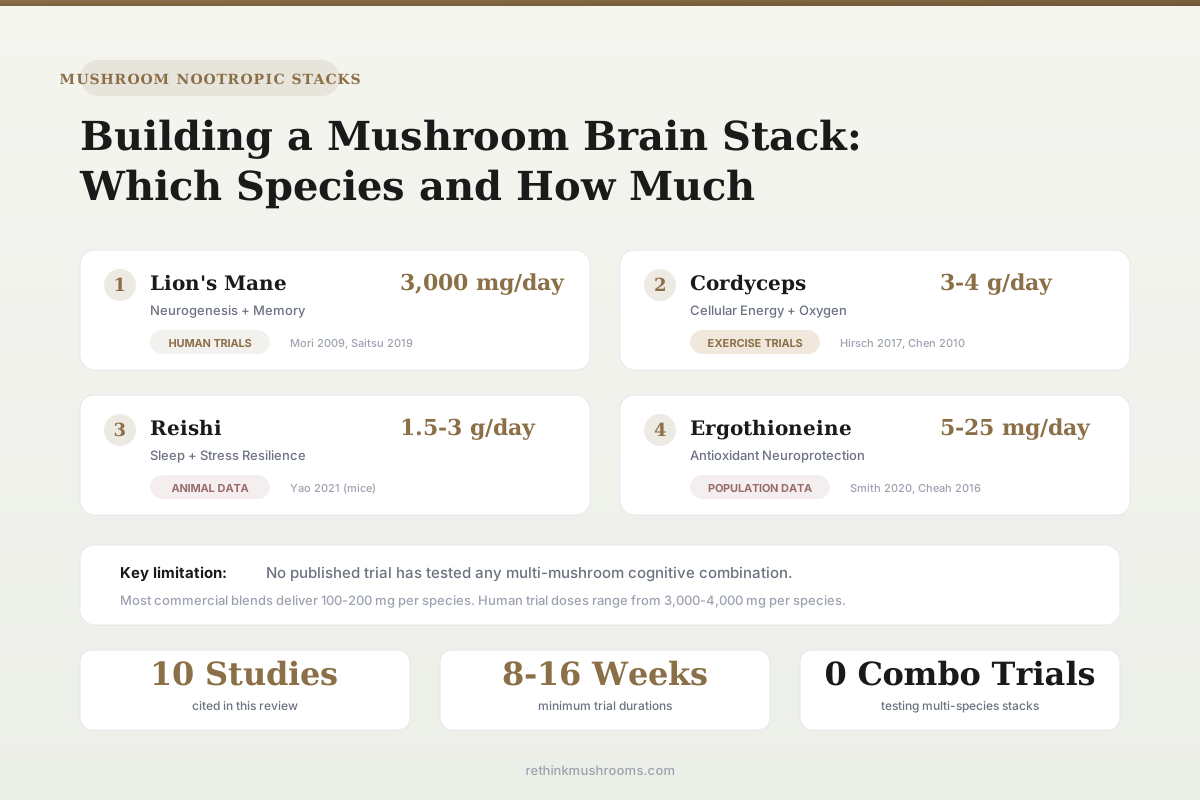
The concept of a "mushroom brain stack" combines multiple species targeting different aspects of cognitive function: lion's mane for neurogenesis and memory, cordyceps for cellular energy and oxygen utilization, reishi for sleep quality and stress resilience, and ergothioneine-rich species for antioxidant neuroprotection. Each of these species has at least some human or mechanistic data supporting its inclusion. None of them have been tested in combination with each other in a clinical trial. For evidence-based combinations targeting other goals beyond cognition, see best mushroom nootropic stacks: evidence-based combinations.
That last point matters more than any dosage recommendation. Every "mushroom brain stack" product and protocol extrapolates from single-species studies to multi-species combinations without direct evidence that the combination works better than any individual species alone, or that the species interact at all. This article reviews what each component has demonstrated individually, the dosages used in human trials, and the substantial gaps in evidence for combining them.
Key Takeaways
- Lion's mane at 3,000 mg/day dry powder for 16 weeks improved cognitive function scores in 30 adults with mild cognitive impairment; benefits disappeared 4 weeks after stopping (Mori et al., 2009)
- A second lion's mane trial found improved cognitive test scores at 12 weeks with fruiting body supplements in older adults (Saitsu et al., 2019)
- Cordyceps militaris at 4 g/day for 3 weeks improved time to exhaustion by 69.8 seconds and VO2max by 4.8 mL/kg/min in 28 young adults (Hirsch et al., 2017)
- Cordyceps Cs-4 at 3 g/day for 12 weeks improved VO2max and ventilatory threshold in 20 healthy adults aged 50-75 (Chen et al., 2010)
- Reishi extract promoted sleep in mice through a gut microbiota-dependent serotonin pathway, shortening sleep latency at 25-100 mg/kg for 28 days (Yao et al., 2021)
- No published trial has tested any multi-mushroom cognitive combination against placebo
Lion's Mane: The Neurogenesis Component
Lion's mane (Hericium erinaceus) has the strongest human evidence for direct cognitive effects among all medicinal mushrooms. Its bioactive compounds, hericenones from the fruiting body and erinacines from the mycelium, stimulate nerve growth factor (NGF) synthesis in cell models. Two compounds in particular, erinacine A and hericenone C, have been studied for their ability to cross the blood-brain barrier and promote neurogenesis.
Human Trial Data
Mori et al. (2009) conducted a double-blind, placebo-controlled trial in 30 Japanese adults aged 50-80 with diagnosed mild cognitive impairment. The treatment group took four 250 mg tablets containing 96% lion's mane dry powder three times daily (3,000 mg/day total) for 16 weeks.[1]
Cognitive function scores on the Revised Hasegawa Dementia Scale improved at weeks 8, 12, and 16 in the lion's mane group compared to placebo, with scores increasing progressively throughout the treatment period. The critical finding: at week 4 after stopping supplementation, scores decreased back toward baseline. This suggests lion's mane may need to be taken continuously to maintain cognitive benefits, which has implications for any brain stack protocol.
Saitsu et al. (2019) conducted a separate randomized, double-blind, placebo-controlled trial in older Japanese adults, finding improvement in cognitive test scores after 12 weeks of lion's mane fruiting body supplementation.[2] The results were consistent with Mori et al. in direction and time course.
Li et al. (2020) tested erinacine A-enriched Hericium erinaceus mycelia in a pilot double-blind, placebo-controlled study for early Alzheimer's prevention, reporting improvements in cognitive assessments and brain biomarkers.[3]
Dosage Implications
The Mori et al. dosage (3,000 mg/day whole fruiting body powder) is the most commonly cited reference point. Many commercial products use concentrated extracts (10:1 or higher), making direct dosage comparison difficult. A 500 mg capsule of 10:1 extract is not equivalent to 5,000 mg of powder; extraction concentrates certain compounds while eliminating others, and the bioactive fraction responsible for cognitive effects has not been definitively identified.
For a brain stack, the evidence-supported starting point is 3,000 mg/day of whole fruiting body powder, or the extract equivalent based on the specific extraction ratio and verified hericenone/erinacine content. Lower doses have not been tested in human cognitive trials.
Cordyceps: The Energy and Oxygen Component
Cordyceps appears in brain stacks not for direct neurogenesis effects but for its proposed role in cellular energy production and oxygen utilization. The rationale is that the brain consumes approximately 20% of the body's oxygen and relies heavily on aerobic metabolism; improving cellular energy efficiency could support cognitive stamina. For a detailed review of the focus and energy evidence, see lion's mane + cordyceps for focus and energy: research review.
Human Trial Data
Hirsch et al. (2017) tested Cordyceps militaris supplementation at 4 g/day in a randomized, double-blind, placebo-controlled study with 28 subjects performing high-intensity exercise. After 3 weeks of supplementation, the cordyceps group showed a 69.8-second improvement in time to exhaustion and a 4.8 mL/kg/min increase in VO2max, with an improved ventilatory threshold of 0.7 L/min. No improvements were seen in the placebo group.[4]
Chen et al. (2010) tested Cs-4 (Cordyceps sinensis) at 3 g/day for 12 weeks in 20 healthy adults aged 50-75. The supplementation group showed improved metabolic threshold (10.5% increase), ventilatory threshold (8.5% increase), and VO2max improvement compared to placebo.[5]
Choi et al. (2020) investigated the mechanism in a mouse model, finding that Cordyceps militaris improved exercise performance through enhanced cellular energy production and increased ATP levels rather than through reduced muscle fatigue markers.[6]
The Cognitive Extrapolation Problem
These studies measured physical endurance, not cognitive performance. The leap from "improved oxygen utilization during exercise" to "improved brain function" is a hypothesis, not a demonstrated effect. No published trial has measured cordyceps effects on memory, attention, processing speed, or any other cognitive endpoint in humans. Including cordyceps in a brain stack is a reasonable theoretical choice, but the direct cognitive evidence does not exist.
Dosage Implications
Human exercise trials used 3-4 g/day of cordyceps powder or extract for 3-12 weeks. Most brain stack products contain 500-1,000 mg of cordyceps, well below the doses tested in exercise trials. Whether sub-exercise doses produce any cognitive benefit is unknown.
Reishi: The Sleep and Stress Component
Reishi (Ganoderma lucidum) enters brain stacks through its proposed effects on sleep quality and stress resilience. The logic is indirect but defensible: poor sleep and chronic stress are established contributors to cognitive decline, so a compound that improves both could support cognition without directly affecting neurons. For a broader look at how adaptogenic mushrooms interact with stress pathways, see adaptogenic mushrooms for stress: reishi, cordyceps, and the HPA axis.
Preclinical Evidence
Yao et al. (2021) demonstrated that Ganoderma lucidum extract promoted sleep in mice through a gut microbiota-dependent, serotonin-involved pathway. Administration of 25-100 mg/kg for 28 days shortened sleep latency and prolonged sleeping time. The mechanism involved increased 5-hydroxytryptamine (serotonin) levels in the hypothalamus, with upregulation of Tph2, Itpr3, and Gng13 transcripts in the serotonergic synapse pathway. The sleep-promoting effects were abolished when gut microbiota were depleted with antibiotics, confirming the gut-brain axis as the required signaling route.[7]
The Human Evidence Gap
The reishi-sleep connection has less human trial support than lion's mane for cognition or cordyceps for energy. The Yao et al. mouse study is mechanistically compelling but has not been replicated in a human sleep trial with objective polysomnography endpoints. Historical use in traditional Chinese medicine for "calming the spirit" (an shen) is consistent with the serotonergic mechanism but does not substitute for clinical evidence.
Dosage Implications
Mouse study doses (25-100 mg/kg) are not directly translatable to human doses. Traditional preparations typically use 1.5-9 g/day of dried fruiting body or 1-1.5 g/day of concentrated extract. Without human sleep trial data for reishi specifically, dosage guidance relies on traditional use ranges rather than clinical evidence.
Ergothioneine: The Neuroprotective Antioxidant
The fourth component in a comprehensive brain stack targets oxidative damage to neurons. Ergothioneine, a sulfur-containing amino acid found at highest concentrations in mushrooms, is actively transported into the brain via the OCTN1 transporter and accumulates in tissues with high oxidative demand.
Cheah et al. (2016) documented that blood ergothioneine levels decline after age 60 and that lower levels correlate with incidence and rate of cognitive decline in elderly populations.[8] Smith et al. (2020) found that higher plasma ergothioneine was associated with reduced cardiovascular mortality and all-cause mortality over a 21.4-year follow-up in 3,236 Swedish adults.[10]
Kalaras et al. (2017) quantified ergothioneine content across mushroom species. Porcini (Boletus edulis) had the highest concentrations, followed by oyster, shiitake, maitake, and king oyster. Common white button mushrooms (Agaricus bisporus) had lower but meaningful levels.[9]
Adding ergothioneine-rich mushrooms (or a pure ergothioneine supplement) to a brain stack addresses a different mechanism than lion's mane, cordyceps, or reishi: long-term neuroprotection against oxidative damage rather than acute cognitive enhancement. The evidence is observational (population studies showing correlation between levels and cognitive outcomes) rather than interventional (randomized trials showing supplementation prevents decline).
Putting a Stack Together: What the Evidence Actually Supports
Based on available human data, an evidence-informed mushroom brain stack would include:
Lion's mane: 3,000 mg/day whole fruiting body powder (or extract equivalent). The only mushroom species with direct human cognitive trial data showing benefit. Start here if choosing a single species.
Cordyceps: 3,000-4,000 mg/day powder. Demonstrated exercise performance and oxygen utilization benefits; cognitive benefit is theoretical. Most products significantly underdose this component.
Reishi: 1,500-3,000 mg/day dried fruiting body (or 1,000-1,500 mg extract). Sleep and stress modulation support is mechanistically plausible but lacks rigorous human sleep trial data.
Ergothioneine source: Regular dietary intake of porcini, oyster, or shiitake mushrooms, or 5-25 mg/day ergothioneine supplement. Long-term neuroprotective rationale based on population data, not intervention trials.
The total daily mushroom powder in this protocol (7,500-10,000 mg) exceeds what most "10-in-1" mushroom blend products provide in a single serving. Products advertising 1,000-2,000 mg total of a 10-species blend deliver approximately 100-200 mg per species, far below any dose tested in human trials. For comparison of mushroom and synthetic cognitive enhancers, see mushroom nootropics vs. synthetic nootropics: how they compare.
Why Combination Evidence Does Not Exist
The absence of multi-mushroom combination trials is not an oversight. Combination trials are expensive, require larger sample sizes to detect interaction effects, and face regulatory complexity. Each additional species doubles the number of possible drug-drug interactions that safety monitoring must track. Funding bodies and pharmaceutical companies prioritize single-compound studies because they produce cleaner, more publishable results.
This means that claims about "synergistic" mushroom stacks are marketing language, not scientific conclusions. Two compounds that independently produce small effects do not necessarily produce a combined effect. They might, but they also might compete for absorption, cancel each other's signaling pathways, or simply add linearly without any synergy. The default assumption without combination data should be additive effects at best, not synergistic effects.
The Mori et al. (2009) finding that lion's mane cognitive benefits disappeared within 4 weeks of stopping is also relevant for stack design. If each component requires continuous dosing to maintain its effect, the cost and compliance burden of a 4-species daily protocol becomes a practical constraint. For discussion of how to combine lion's mane and cordyceps specifically, see building a mushroom nootropic stack: lion's mane, cordyceps, and ergothioneine.
The Bottom Line
A mushroom brain stack combining lion's mane, cordyceps, reishi, and ergothioneine-rich species targets four different cognitive mechanisms: neurogenesis, cellular energy, sleep/stress resilience, and antioxidant neuroprotection. Only lion's mane has direct human trial evidence for cognitive improvement (3,000 mg/day, 16 weeks). Cordyceps has exercise performance data at 3-4 g/day but no cognitive endpoint trials. Reishi has mouse sleep data through a gut-serotonin pathway but no human sleep trials. Ergothioneine shows population-level correlations with cognitive preservation. No combination trial exists, and most commercial multi-mushroom products deliver doses far below those tested in individual species trials.
Frequently Asked Questions
Sources & References
- 1RTHM-00165·Mori, Koichiro et al. (2009). “Improving effects of the mushroom Yamabushitake (Hericium erinaceus) on mild cognitive impairment: a double-blind placebo-controlled clinical trial..” Phytotherapy research : PTR.Study breakdown →PubMed →↩
- 2RTHM-00585·Saitsu, Yuusuke et al. (2019). “Improvement of cognitive functions by oral intake of Hericium erinaceus..” Biomedical research (Tokyo.Study breakdown →PubMed →↩
- 3RTHM-00631·Li, I-Chen et al. (2020). “Prevention of Early Alzheimer's Disease by Erinacine A-Enriched Hericium erinaceus Mycelia Pilot Double-Blind Placebo-Controlled Study..” Frontiers in aging neuroscience.Study breakdown →PubMed →↩
- 4RTHM-00473·Hirsch, Katie R et al. (2017). “Cordyceps militaris Improves Tolerance to High-Intensity Exercise After Acute and Chronic Supplementation..” Journal of dietary supplements.Study breakdown →PubMed →↩
- 5RTHM-00176·Chen, Steve et al. (2010). “Effect of Cs-4 (Cordyceps sinensis) on exercise performance in healthy older subjects: a double-blind, placebo-controlled trial..” Journal of alternative and complementary medicine (New York.Study breakdown →PubMed →↩
- 6RTHM-00613·Choi, Eunhyun et al. (2020). “Beneficial Effect of Cordyceps militaris on Exercise Performance via Promoting Cellular Energy Production..” Mycobiology.Study breakdown →PubMed →↩
- 7RTHM-00731·Yao, Chunyan et al. (2021). “Ganoderma lucidum promotes sleep through a gut microbiota-dependent and serotonin-involved pathway in mice..” Scientific reports.Study breakdown →PubMed →↩
- 8RTHM-00420·Cheah, Irwin K et al. (2016). “Ergothioneine levels in an elderly population decrease with age and incidence of cognitive decline; a risk factor for neurodegeneration?.” Biochemical and biophysical research communications.Study breakdown →PubMed →↩
- 9RTHM-00476·Kalaras, Michael D et al. (2017). “Mushrooms: A rich source of the antioxidants ergothioneine and glutathione..” Food chemistry.Study breakdown →PubMed →↩
- 10RTHM-00655·Smith, Einar et al. (2020). “Ergothioneine is associated with reduced mortality and decreased risk of cardiovascular disease..” Heart (British Cardiac Society).Study breakdown →PubMed →↩