Mushrooms & Brain Health
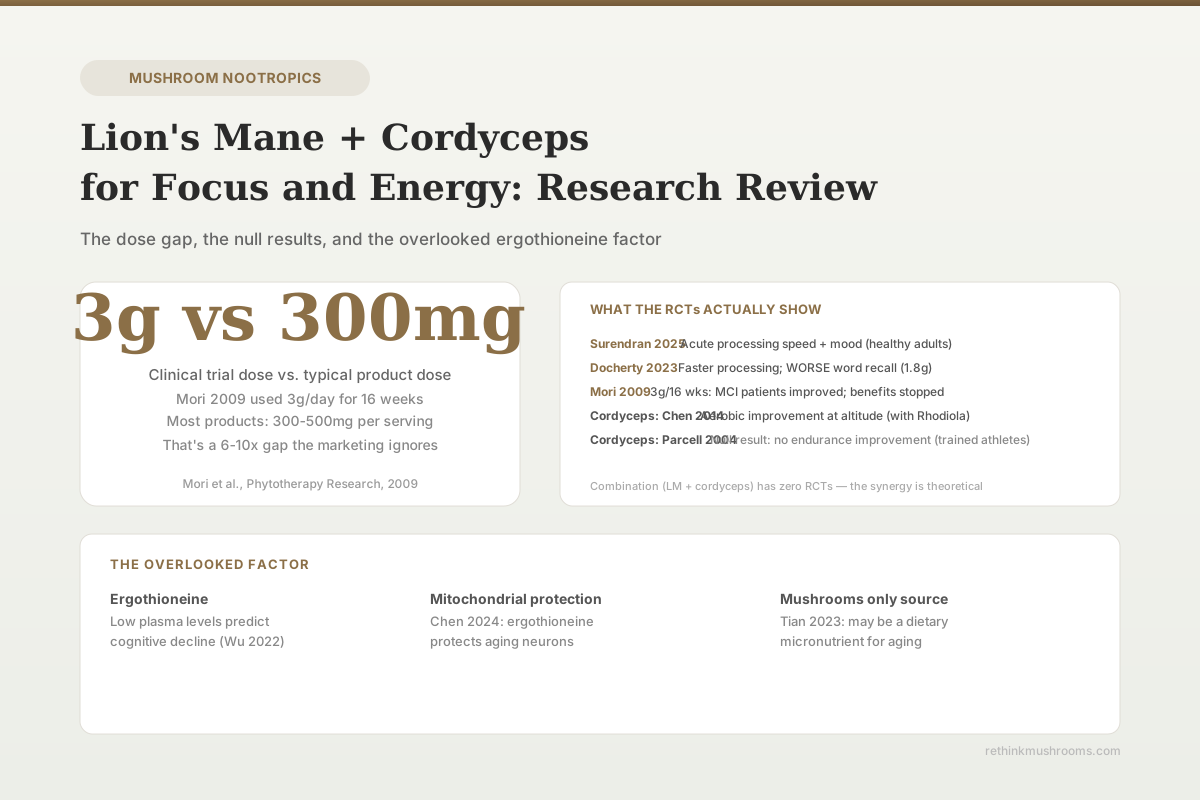
3g vs 300mg: the dose gap no one mentions
Mori 2009 used 3g/day of lion's mane for 16 weeks to achieve cognitive benefits in MCI patients. Most commercial products deliver 300-500mg per serving. That 6-10x gap matters for interpreting every focus stack claim.
Mori et al., Phytotherapy Research, 2009
Mixed results
Docherty 2023: lion's mane (1.8g/day, 28 days) improved processing speed but worsened word recall accuracy vs placebo; effects are selective, not uniform
Acute effect confirmed
Surendran 2025: standardized lion's mane extract acutely improved processing speed and mood in healthy young adults (Frontiers in Nutrition, 2025)
Cordyceps null result
Parcell 2004: Cordyceps CS-4 did not improve endurance exercise performance in 22 trained cyclists; an honest counterpoint to the energy marketing
Mori et al., Phytotherapy Research, 2009
 View as image ↗
Lion's mane and cordyceps are the two mushrooms most commonly marketed together for focus and energy. They appear together in dozens of products, with claims ranging from "sharper mental clarity" to "sustained energy without the crash." What do the actual clinical trials show? The evidence is more interesting and more nuanced than the marketing suggests.
This article reviews the published human research on both mushrooms as they relate to cognitive performance and energy, including two results that most consumer content ignores: the honest null result from Docherty 2023 (lion's mane worsened word recall in one measure), and the dose gap between clinical trials and commercial products. For context on where this fits within the broader mushroom brain health research, see mushrooms and cognitive aging: can they protect your brain?.
Key Takeaways
- Surendran et al. (2025) found acute improvement in processing speed and mood from a standardized lion's mane extract in healthy young adults, the most recent human RCT
- Docherty et al. (2023) found lion's mane (1.8g/day, 28 days) improved speed of task performance but worsened word recall accuracy versus placebo; effects are real but selective
- Mori et al. (2009) found 3g/day for 16 weeks significantly improved cognitive function in MCI patients, but benefits disappeared after stopping; the highest effect size was in those with impaired cognition
- Most commercial products deliver 300-500mg per serving; clinical trials used 1.8-3g/day, a 3-10x gap that makes product claims difficult to evaluate against trial data
- Cordyceps improved aerobic energy output in combination with Rhodiola (Chen 2014), but in a separate trial Parcell et al. (2004) found Cordyceps CS-4 alone did not improve endurance in trained cyclists
- No randomized controlled trial has directly tested the lion's mane + cordyceps combination; the synergy claim is theoretically plausible but empirically untested
The Lion's Mane Evidence: Three RCTs, Different Populations, Mixed Results
The most recent clinical trial on lion's mane for focus came from Surendran and colleagues in 2025, published in Frontiers in Nutrition.[1] Using a standardized Hericium erinaceus extract, their double-blind, randomized, placebo-controlled study found acute improvements in processing speed and mood in healthy younger adults. This is the strongest recent signal that lion's mane has cognitive effects in healthy people, not only in those with cognitive impairment.
Two years earlier, Docherty and colleagues conducted a 28-day parallel-group study in 41 healthy adults aged 18-45, using 1.8g of lion's mane daily.[2] Their results were mixed in an instructive way. Participants in the lion's mane group showed faster performance on cognitive tasks and a reduction in stress levels (though the stress reduction did not reach statistical significance). However, word recall accuracy was significantly worse in the lion's mane group than in the placebo group.
This is a result that almost no lion's mane content acknowledges. It does not mean lion's mane impairs memory; the pattern across both studies suggests that lion's mane may improve processing speed at the expense of careful, accurate recall, which reflects a well-known cognitive speed-accuracy tradeoff. But it does mean that lion's mane effects are not uniformly positive across all aspects of cognition. Honest reporting of this result is what distinguishes research-based content from advocacy.
The foundational clinical trial remains Mori and colleagues' 2009 RCT, which enrolled 30 adults with mild cognitive impairment (MCI) and tested 3g of lion's mane powder daily for 16 weeks.[3] Cognitive function scores improved significantly in the lion's mane group compared to placebo. The effect was substantial enough to be clearly meaningful for an MCI population. However, when participants stopped taking lion's mane after the trial, the cognitive improvements disappeared within four weeks, suggesting the effects require continuous use.
Three important patterns emerge from comparing these trials:
- Effect size tends to be larger in those with existing cognitive impairment (Mori 2009 with MCI patients) than in healthy young adults (Docherty 2023)
- Effects are specific to speed-related domains rather than uniformly positive across all cognitive tasks
- The therapeutic dose in the most successful trial (3g) is substantially higher than doses in recent trials with healthy adults (1.8g)
The Dose Problem: Why Trial Data and Commercial Products Don't Match
The dose gap between clinical evidence and commercial products is the most underreported issue in mushroom nootropic content.
Mori 2009 used 3g per day of lion's mane powder, the equivalent of about 3,000mg. Docherty 2023 used 1.8g (1,800mg). The typical commercial lion's mane product delivers 300-500mg per serving. Some "high potency" products deliver 1,000mg per serving.
Most products on the market are delivering less than one-sixth of the clinical therapeutic dose, and some are delivering less than one-tenth. When a brand claims their product "supports cognitive function" based on the Mori 2009 trial, the claim may be scientifically accurate in the abstract but practically misleading if the product dose is 10x lower than the trial dose.
This does not mean lower doses have no effect. Surendran 2025 and Docherty 2023 used lower doses and still found some cognitive signals. But the effect at 300mg is almost certainly smaller than at 1.8g, and the meaningful MCI improvements from Mori 2009 occurred at a dose almost never available in commercial products. Consumers comparing product claims to clinical evidence need this context.
Why Lion's Mane Takes Weeks: The NGF Mechanism
The mechanism behind lion's mane's cognitive effects helps explain why it takes weeks to produce noticeable benefits and why it is fundamentally different from stimulant-based nootropics.
Hericenones and erinacines are the primary active compounds in lion's mane associated with cognitive effects. Martínez-Mármol and colleagues (2023) found that hericerin derivatives (hericenone derivatives) activate ERK1/2 signaling in central hippocampal neurons, the same signaling pathway activated by nerve growth factor (NGF) and brain-derived neurotrophic factor (BDNF).[4] This activation enhanced spatial memory in mouse models.
The ERK1/2/NGF pathway is relevant because it stimulates neurogenesis (the formation of new neurons and neural connections) rather than modulating existing neurotransmitters. Neurogenesis is a slow biological process. The hippocampus, the brain region most associated with memory formation, takes weeks to reorganize under new growth factor stimulation. This is why lion's mane is not a quick-fix cognitive enhancer in the way caffeine or modafinil are; it may be building neural infrastructure rather than temporarily enhancing what's already there.
The implication is also why benefits disappear when lion's mane is stopped: if the benefit comes from ongoing neurogenesis supported by continuous compound exposure, stopping the compound presumably slows that support. This aligns with the Mori 2009 observation that benefits reversed within weeks of stopping.
Cordyceps for Mental Energy: What the Trials Show
Cordyceps' energy claim is based primarily on its effects on aerobic metabolism. The proposed mechanism involves adenosine regulation and ATP synthesis enhancement, which in theory could support both physical energy and mental clarity.
Chen and colleagues (2014) tested a Rhodiola crenulata and Cordyceps sinensis combination supplement in athletes training at altitude, finding improved aerobic exercise performance compared to controls.[5] The altitude context is relevant because altitude impairs oxygen delivery, and cordyceps is hypothesized to improve oxygen utilization efficiency. This study is often cited in support of cordyceps energy claims.
But the critical counterpoint comes from Parcell and colleagues (2004), who conducted a rigorous RCT testing Cordyceps Cs-4 supplementation in 22 trained cyclists over 5 weeks.[6] The result: cordyceps supplementation did not improve endurance exercise performance, VO2 max, or any other measured parameter compared to placebo.
This null result in trained athletes is important because it appears in very few consumer nootropic comparisons. The reconciliation of these two studies is that cordyceps may improve aerobic performance in untrained individuals or in physiologically stressed conditions (like altitude), but may not provide additional benefit to people who are already highly aerobically fit. For mental energy specifically, which depends on cerebral oxygen delivery and ATP availability rather than muscular aerobic capacity; the evidence is even less direct.
The Ergothioneine Factor: The Most Underrated Component
Every mushroom in the lion's mane and cordyceps focus stack also contains ergothioneine, a compound that may be more important for long-term cognitive health than either hericenones or cordyceps energy mechanisms, though through a completely different timeline and pathway.
Wu and colleagues (2022) followed elderly patients attending memory clinics and measured plasma ergothioneine levels alongside cognitive outcomes.[8] Low plasma ergothioneine predicted both cognitive and functional decline over time. This is a prospective human cohort study, a stronger evidence design than most mechanistic work in the mushroom cognition space.
Chen and colleagues (2024) found that ergothioneine improved cognitive function in a D-galactose-induced aging model by protecting mitochondria and reducing neuroinflammation.[7] The mitochondrial protection mechanism is particularly relevant because mitochondrial dysfunction is a central feature of age-related cognitive decline. Most nootropic mechanisms target neurotransmitters; ergothioneine targets the energy production infrastructure of neurons themselves.
Tian and colleagues (2023) made a more provocative argument in the British Journal of Nutrition: ergothioneine should be considered a dietary micronutrient essential for healthy aging.[9] Their review noted that plasma ergothioneine levels decline with age and that this decline is associated with multiple age-related conditions including cognitive impairment. Critically, mushrooms are essentially the only significant dietary source of ergothioneine, which means mushroom consumption may have broad cognitive health benefits that operate independently of any hericenone or cordyceps mechanism.
For more detail on ergothioneine's brain health research specifically, see ergothioneine and brain health: neuroprotective research. For population-level evidence connecting ergothioneine to dementia prevention, see ergothioneine and dementia prevention: population studies.
The Stack Combination: What's Tested and What's Theory
No randomized controlled trial has specifically tested the lion's mane plus cordyceps combination for focus and energy outcomes. The combination's popularity is driven by product marketing rather than direct evidence.
The theoretical case for the combination rests on complementary mechanisms: lion's mane provides neurogenesis support through NGF/ERK1/2 pathway activation, while cordyceps provides energy metabolism support through adenosine and ATP pathway enhancement. If both mechanisms work as claimed, combining them would address two different aspects of cognitive performance: the neural infrastructure side (lion's mane) and the energy substrate side (cordyceps).
This mechanistic rationale is plausible but untested as a combination in humans. The fact that individual components show some evidence does not establish that their combination produces greater than individual effects. Synergy must be tested, not assumed. Adding ergothioneine-rich mushrooms to the equation adds a third mechanism (mitochondrial protection) that may be more relevant to long-term outcomes than either of the first two.
The stack discussion continues in best mushroom nootropic stacks: evidence-based combinations.
The Honest Picture
Lion's mane has genuine cognitive evidence in humans, specifically for processing speed in healthy adults (Surendran 2025, Docherty 2023) and more substantial cognitive improvement in MCI patients at therapeutic doses (Mori 2009). The mechanism is well-characterized. The limitations are: the dose gap between trials and commercial products, the selective nature of effects (speed over accuracy), and the need for continuous use.
Cordyceps has plausible energy mechanisms and some aerobic performance data, but a meaningful null result from a well-designed trial in trained athletes, and limited direct evidence for mental focus specifically.
Ergothioneine has population-level cognitive protection evidence that may be the most clinically important effect of regular mushroom consumption, not dramatic acute focus, but protection against age-related cognitive decline over years.
The combination is theoretically synergistic, practically popular, and clinically untested as a stack.
The Bottom Line
Three human RCTs show lion's mane (1.8-3g/day) has cognitive effects: Surendran 2025 found acute processing speed and mood improvement; Docherty 2023 found speed improvement but worse word recall at 1.8g/day; Mori 2009 found meaningful cognitive improvement in MCI patients at 3g/day for 16 weeks. Commercial products typically deliver 300-500mg per serving. Cordyceps shows aerobic energy effects in combination (Chen 2014) but failed to improve endurance in trained athletes alone (Parcell 2004). No RCT has tested the combination. Ergothioneine in mushrooms predicts cognitive protection at population level (Wu 2022) and may be the most important long-term cognitive benefit of mushroom consumption.
Frequently Asked Questions
Sources & References
- 1RTHM-00952·Surendran, Geyan et al. (2025). “Acute effects of a standardised extract of Hericium erinaceus (Lion's Mane mushroom) on cognition and mood in healthy younger adults: a double-blind randomised placebo-controlled study..” Frontiers in nutrition.Study breakdown →PubMed →↩
- 2RTHM-00821·Docherty, Sarah et al. (2023). “The Acute and Chronic Effects of Lion's Mane Mushroom Supplementation on Cognitive Function, Stress and Mood in Young Adults: A Double-Blind, Parallel Groups, Pilot Study..” Nutrients.Study breakdown →PubMed →↩
- 3RTHM-00165·Mori, Koichiro et al. (2009). “Improving effects of the mushroom Yamabushitake (Hericium erinaceus) on mild cognitive impairment: a double-blind placebo-controlled clinical trial..” Phytotherapy research : PTR.Study breakdown →PubMed →↩
- 4RTHM-01746·Martínez-Mármol, Ramón et al. (2023). “Hericerin derivatives activates a pan-neurotrophic pathway in central hippocampal neurons converging to ERK1/2 signaling enhancing spatial memory..” Journal of neurochemistry.Study breakdown →PubMed →↩
- 5RTHM-00313·Chen, Chung-Yu et al. (2014). “Rhodiola crenulata- and Cordyceps sinensis-based supplement boosts aerobic exercise performance after short-term high altitude training..” High altitude medicine & biology.Study breakdown →PubMed →↩
- 6RTHM-00075·Parcell, Allen C et al. (2004). “Cordyceps Sinensis (CordyMax Cs-4) supplementation does not improve endurance exercise performance..” International journal of sport nutrition and exercise metabolism.Study breakdown →PubMed →↩
- 7RTHM-01866·Chen, Fangyang et al. (2024). “Ergothioneine improves cognitive function by ameliorating mitochondrial damage and decreasing neuroinflammation in a D-galactose-induced aging model..” Food & function.Study breakdown →PubMed →↩
- 8RTHM-01634·Wu, Liu-Yun et al. (2022). “Low Plasma Ergothioneine Predicts Cognitive and Functional Decline in an Elderly Cohort Attending Memory Clinics..” Antioxidants (Basel.Study breakdown →PubMed →↩
- 9RTHM-01805·Tian, Xiaoying et al. (2023). “Ergothioneine: an underrecognised dietary micronutrient required for healthy ageing?.” The British journal of nutrition.Study breakdown →PubMed →↩