Mushroom Nootropics
1,800 mg/day
Lion's mane at 1,800 mg/day improved cognitive speed and accuracy in healthy young adults within 60 minutes of a single dose and after 28 days of supplementation.
Docherty et al., Nutrients, 2023
3 RCTs
on lion's mane for cognition in humans
VO2max +11%
cordyceps improved exercise tolerance
5 Species
with nootropic-relevant human data
Docherty et al., Nutrients, 2023
 View as image ↗
A nootropic stack combines multiple compounds targeting different cognitive mechanisms for effects that no single compound achieves alone. Mushroom-based nootropics have a narrower but more credible evidence base than most synthetic nootropics: lion's mane has three published randomized controlled trials in humans showing cognitive improvements, cordyceps has human exercise performance data relevant to mental energy, and reishi has emerging stress-modulation evidence. The challenge is that most mushroom supplement products and online stack recommendations ignore dosing, evidence strength, and the distinction between preclinical promise and human proof. This article examines what each species actually contributes to a cognitive stack based on published human data, what doses those studies used, and which combinations have pharmacological rationale versus marketing rationale. For the comparison between mushroom nootropics and synthetic nootropics, see the companion article.
Key Takeaways
- Lion's mane (1,800 mg/day) improved Stroop task speed within 60 minutes of a single dose and reduced stress after 28 days of supplementation in a double-blind placebo-controlled study of 41 healthy adults aged 18-45 (Docherty et al., 2023)
- A single 1,800 mg dose of standardized lion's mane extract improved reaction time at 60 minutes post-dose in a separate double-blind RCT in healthy younger adults (Surendran et al., 2025)
- Older Japanese adults with mild cognitive impairment who took 3,000 mg/day lion's mane for 16 weeks showed improved cognitive function scores that declined after stopping supplementation (Mori et al., 2009)
- Cordyceps militaris (4 g/day mushroom blend) improved VO2max by 11% and time to exhaustion after 3 weeks of supplementation in a double-blind RCT of 28 participants (Hirsch et al., 2017)
- Reishi spore powder (3,000 mg/day) improved cancer-related fatigue scores and physical well-being in breast cancer patients after 4 weeks in a clinical study (Zhao et al., 2012)
- Ergothioneine from mushrooms (Agaricus bisporus) is bioavailable in humans, with plasma levels increasing dose-dependently after a single mushroom serving (Weigand-Heller et al., 2012)
Lion's Mane: The Strongest Cognitive Evidence
Lion's mane (Hericium erinaceus) has more published human cognitive data than any other medicinal mushroom. Three randomized controlled trials provide the evidence base.
Mori et al. (2009) conducted the foundational study: a double-blind, placebo-controlled trial in 30 Japanese men and women aged 50-80 diagnosed with mild cognitive impairment.[1] Participants received 3,000 mg/day of lion's mane powder (four 250 mg tablets, three times daily) or placebo for 16 weeks. The lion's mane group showed improved cognitive function scores on the Revised Hasegawa Dementia Scale at weeks 8, 12, and 16 compared to placebo. Scores increased progressively with treatment duration.
The most informative finding came after cessation: when participants stopped taking lion's mane, their cognitive scores declined back toward baseline over the following four weeks. This washout effect suggests that lion's mane's cognitive benefits require ongoing supplementation rather than producing permanent changes, and it argues against a pure placebo explanation (which would not be expected to reverse upon stopping).[1]
Saitsu et al. (2019) extended the evidence to a different population. In a randomized, double-blind, placebo-controlled study, oral intake of Hericium erinaceus improved cognitive function scores compared to placebo.[2] This replication in a separate research group strengthened the case that lion's mane's cognitive effects are reproducible rather than a single-group finding.
Docherty et al. (2023) brought the evidence to healthy young adults (18-45 years) for the first time. In a double-blind, parallel-group pilot study, 41 participants received 1,800 mg/day of lion's mane or placebo.[3] Two findings stood out: acute effects were measurable within 60 minutes of a single dose (faster Stroop task performance), and chronic effects appeared at 28 days (reduced subjective stress). The Stroop task measures executive function and cognitive inhibition, making this a more relevant cognitive endpoint for nootropic applications than the dementia screening scales used in earlier studies.
Surendran et al. (2025) confirmed the acute cognitive effect in a separate double-blind RCT. A single 1,800 mg dose of standardized lion's mane extract improved reaction time 60 minutes post-dose in healthy younger adults.[4] The replication of acute effects across two independent research groups at the same dose provides strong evidence that lion's mane produces rapid, measurable cognitive changes.
The mechanism involves hericenones (from fruiting body) and erinacines (from mycelium), which stimulate nerve growth factor (NGF) synthesis. NGF is essential for neuronal survival, growth, and synaptic plasticity. Whether the acute cognitive effects (within 60 minutes) operate through NGF or a faster-acting mechanism is unknown. For more on how lion's mane and cordyceps combine for focus and energy, see the dedicated analysis.
Cordyceps: The Energy Component
Cordyceps (Cordyceps militaris) contributes to a nootropic stack not through direct cognitive enhancement but through cellular energy production and oxygen utilization, both relevant to sustained mental performance.
Hirsch et al. (2017) tested a mushroom blend containing C. militaris in a double-blind RCT of 28 participants. After three weeks of supplementation at 4 g/day, the treatment group showed an 11% improvement in VO2max (maximal oxygen consumption) and increased time to exhaustion during high-intensity exercise.[5] The acute (one-week) assessment showed no benefit, suggesting cordyceps requires chronic supplementation for exercise performance effects.
Choi et al. (2020) provided the mechanistic basis: C. militaris supplementation promoted cellular energy production through enhanced ATP synthesis and improved mitochondrial function in a mouse model.[6] The brain is the most metabolically demanding organ, consuming roughly 20% of total body oxygen despite representing 2% of body mass. Compounds that enhance cellular energy production and oxygen utilization have theoretical relevance to cognitive performance, particularly under conditions of fatigue or sustained mental effort.
The active compounds in cordyceps include cordycepin (3'-deoxyadenosine), an adenosine analog that affects purinergic signaling, and beta-glucan polysaccharides. Cordycepin's structural similarity to adenosine gives it potential neuroactive properties, though human cognitive trials specific to cordyceps are not yet published.
For a nootropic stack, cordyceps addresses the "mental energy" dimension. Lion's mane targets neuroplasticity and processing speed; cordyceps targets the metabolic substrate that sustained cognitive effort requires. For how adaptogenic mushrooms modulate the HPA stress axis, which affects cognitive performance under stress, see the companion article.
Reishi: The Stress-Modulation Layer
Reishi (Ganoderma lucidum) contributes to nootropic stacks through stress reduction and fatigue management rather than direct cognitive enhancement. Chronic psychological stress impairs working memory, attention, and executive function through elevated cortisol and HPA axis dysregulation. A compound that normalizes stress responses indirectly supports cognitive performance.
Zhao et al. (2012) tested reishi spore powder at 3,000 mg/day in breast cancer patients experiencing treatment-related fatigue. After four weeks, the reishi group showed improved cancer-related fatigue scores and physical well-being compared to baseline.[7] While this population is far from the typical nootropic user, the study demonstrates that reishi can modify fatigue at the organism level, not just in vitro.
Mitra et al. (2024) tested reishi supplementation on psychological stress and cardiovascular fitness in sedentary female college students. The results showed that reishi supplementation reduced psychological stress markers and improved physical performance parameters.[8] This population is more relevant to the nootropic context, and the dual effect on stress and physical fitness aligns with reishi's traditional adaptogenic classification.
Reishi contains triterpenoids (ganoderic acids) that modulate the HPA axis and GABAergic signaling, and polysaccharides that affect immune-brain communication. The sleep-promoting effects documented in animal studies (through gut microbiota-dependent serotonin pathways) add another dimension: adequate sleep is the single most important factor for cognitive performance, and a mushroom that improves sleep quality indirectly supports daytime cognition.
In a nootropic stack, reishi's role is protective rather than stimulatory. It does not sharpen cognition directly but reduces the stress, fatigue, and sleep disruption that degrade cognitive performance. The dose range from human studies is 1,500-3,000 mg/day of spore powder or extract. For how adaptogenic mushrooms help the body cope with stress, see the dedicated article.
Ergothioneine: The Antioxidant Foundation
Ergothioneine is a sulfur-containing amino acid found in nearly all edible mushrooms that functions as a cellular antioxidant with unusual pharmacological properties. Humans have a dedicated transporter for ergothioneine (OCTN1/SLC22A4), suggesting evolutionary importance.
Weigand-Heller et al. (2012) demonstrated that ergothioneine from common mushrooms (Agaricus bisporus) is bioavailable in humans. After consuming a single serving of mushrooms, plasma ergothioneine levels increased dose-dependently, and markers of oxidative stress (8-isoprostane, 8-OHdG) showed favorable trends.[9]
Ergothioneine crosses the blood-brain barrier via its dedicated transporter and accumulates in brain tissue. Low plasma ergothioneine has been associated with cognitive decline in epidemiological studies. While no interventional trial has tested ergothioneine supplementation for cognitive outcomes, its unique brain accumulation and antioxidant properties make it a mechanistically plausible component of a neuroprotective stack.
Any mushroom-containing stack automatically includes ergothioneine. Concentrations vary: king oyster, oyster, shiitake, and maitake contain the highest levels (0.4-2.0 mg/g dry weight). Lion's mane and cordyceps contain moderate levels. Reishi contains lower levels.
Building an Evidence-Based Stack
Based on the human data reviewed above, an evidence-based mushroom nootropic stack would include:
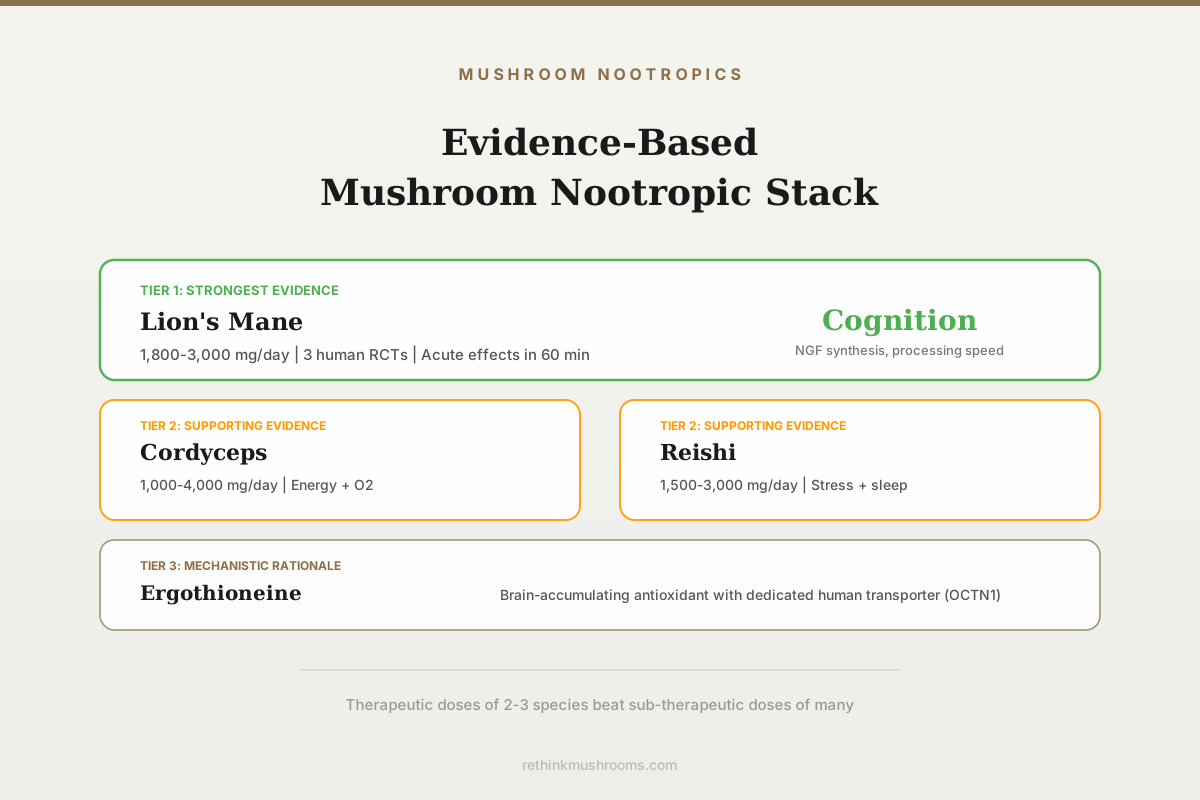
Tier 1 (strongest evidence for cognition):
- Lion's mane: 1,800-3,000 mg/day of fruiting body extract or powder. This is the only mushroom species with replicated human RCT evidence for cognitive improvement in both healthy young adults and older adults with mild cognitive impairment.
Tier 2 (supporting evidence for energy and stress):
- Cordyceps militaris: 1,000-4,000 mg/day. Human exercise performance data supports the "mental energy" claim through improved oxygen utilization and cellular energy production. Direct cognitive evidence in humans is absent.
- Reishi: 1,500-3,000 mg/day. Stress modulation and fatigue reduction evidence in humans supports an indirect cognitive benefit through improved stress resilience and sleep quality.
Tier 3 (mechanistic rationale, limited direct evidence):
- Ergothioneine-rich mushroom sources or dedicated supplements. Brain-accumulating antioxidant with a dedicated human transporter and epidemiological associations with cognitive health. No interventional cognitive trial yet.
Timing considerations: Lion's mane shows acute effects within 60 minutes, making it suitable for morning or pre-task dosing. Cordyceps effects require chronic supplementation (3+ weeks). Reishi's calming and sleep-promoting properties make evening dosing logical.
What to avoid: Stacks that spread small doses across 6-8 species rather than providing therapeutic doses of 2-3. A stack containing 200 mg each of six mushrooms (1,200 mg total) is less evidence-based than 1,800 mg of lion's mane alone. Effective dosing of fewer species beats underdosing of many. For a more detailed guide on building a mushroom brain stack with specific dosing, see the companion article. For the specific lion's mane, cordyceps, and ergothioneine combination, see the dedicated breakdown.
The Bottom Line
Lion's mane is the only mushroom with replicated human RCT evidence for direct cognitive improvement, effective at 1,800-3,000 mg/day with measurable effects within 60 minutes and cumulative benefits over weeks. Cordyceps supports mental energy through improved cellular energy production and oxygen utilization at 1,000-4,000 mg/day, though direct cognitive trials are lacking. Reishi contributes stress modulation and fatigue reduction at 1,500-3,000 mg/day, indirectly supporting cognitive performance. An evidence-based mushroom nootropic stack prioritizes therapeutic doses of 2-3 well-studied species over sub-therapeutic sprinklings of many.
Frequently Asked Questions
Sources & References
- 1RTHM-00165·Mori, Koichiro et al. (2009). “Improving effects of the mushroom Yamabushitake (Hericium erinaceus) on mild cognitive impairment: a double-blind placebo-controlled clinical trial..” Phytotherapy research : PTR.Study breakdown →PubMed →↩
- 2RTHM-00585·Saitsu, Yuusuke et al. (2019). “Improvement of cognitive functions by oral intake of Hericium erinaceus..” Biomedical research (Tokyo.Study breakdown →PubMed →↩
- 3RTHM-00821·Docherty, Sarah et al. (2023). “The Acute and Chronic Effects of Lion's Mane Mushroom Supplementation on Cognitive Function, Stress and Mood in Young Adults: A Double-Blind, Parallel Groups, Pilot Study..” Nutrients.Study breakdown →PubMed →↩
- 4RTHM-00952·Surendran, Geyan et al. (2025). “Acute effects of a standardised extract of Hericium erinaceus (Lion's Mane mushroom) on cognition and mood in healthy younger adults: a double-blind randomised placebo-controlled study..” Frontiers in nutrition.Study breakdown →PubMed →↩
- 5RTHM-00473·Hirsch, Katie R et al. (2017). “Cordyceps militaris Improves Tolerance to High-Intensity Exercise After Acute and Chronic Supplementation..” Journal of dietary supplements.Study breakdown →PubMed →↩
- 6RTHM-00613·Choi, Eunhyun et al. (2020). “Beneficial Effect of Cordyceps militaris on Exercise Performance via Promoting Cellular Energy Production..” Mycobiology.Study breakdown →PubMed →↩
- 7RTHM-00276·Zhao, Hong et al. (2012). “Spore Powder of Ganoderma lucidum Improves Cancer-Related Fatigue in Breast Cancer Patients Undergoing Endocrine Therapy: A Pilot Clinical Trial..” Evidence-based complementary and alternative medicine : eCAM.Study breakdown →PubMed →↩
- 8RTHM-00895·Mitra, Sudeep et al. (2024). “Efficacy of Lingzhi or Reishi Medicinal Mushroom Ganoderma lucidum (Agaricomycetes) Supplementation on Psychological Stress and Selective Fitness Profile Parameters in Female College Students in West Bengal, India..” International journal of medicinal mushrooms.Study breakdown →PubMed →↩
- 9RTHM-00270·Weigand-Heller, AuBrei J et al. (2012). “The bioavailability of ergothioneine from mushrooms (Agaricus bisporus) and the acute effects on antioxidant capacity and biomarkers of inflammation..” Preventive medicine.Study breakdown →PubMed →↩